


An investment backed by invoices or valuable watches sounds easier to understand than a mysterious trading system. There appears to be something concrete behind the promised return.
But those supporting documents and objects need their own scrutiny. The Tradepay and Luxestreet case shows how convincing-looking collateral can become part of the deception.
Overview
Two business stories concealed fabricated investments
The Tradepay Luxestreet investment scam involved Pushpesh Kumar Baid, also known as PK Jain. Tradepay purported to finance invoices, while Luxestreet presented luxury goods as investment backing.
According to the DOJ’s sentencing announcement, fraudulent invoices, forged contracts, fake supporting identities, and counterfeit watches helped sustain the schemes.
Baid received a twenty-year federal prison sentence on January 23, 2026, after pleading guilty in the Tradepay case and admitting his participation in Luxestreet.
Familiar financial concepts didn’t authenticate the underlying assets
Factoring normally involves buying an invoice at a discount and receiving its full payment later. That explanation doesn’t establish that a particular invoice is genuine.
Likewise, an object resembling a luxury watch doesn’t establish its authenticity or value. The prosecution described knockoffs alongside forged Luxestreet paperwork and false valuation reports.
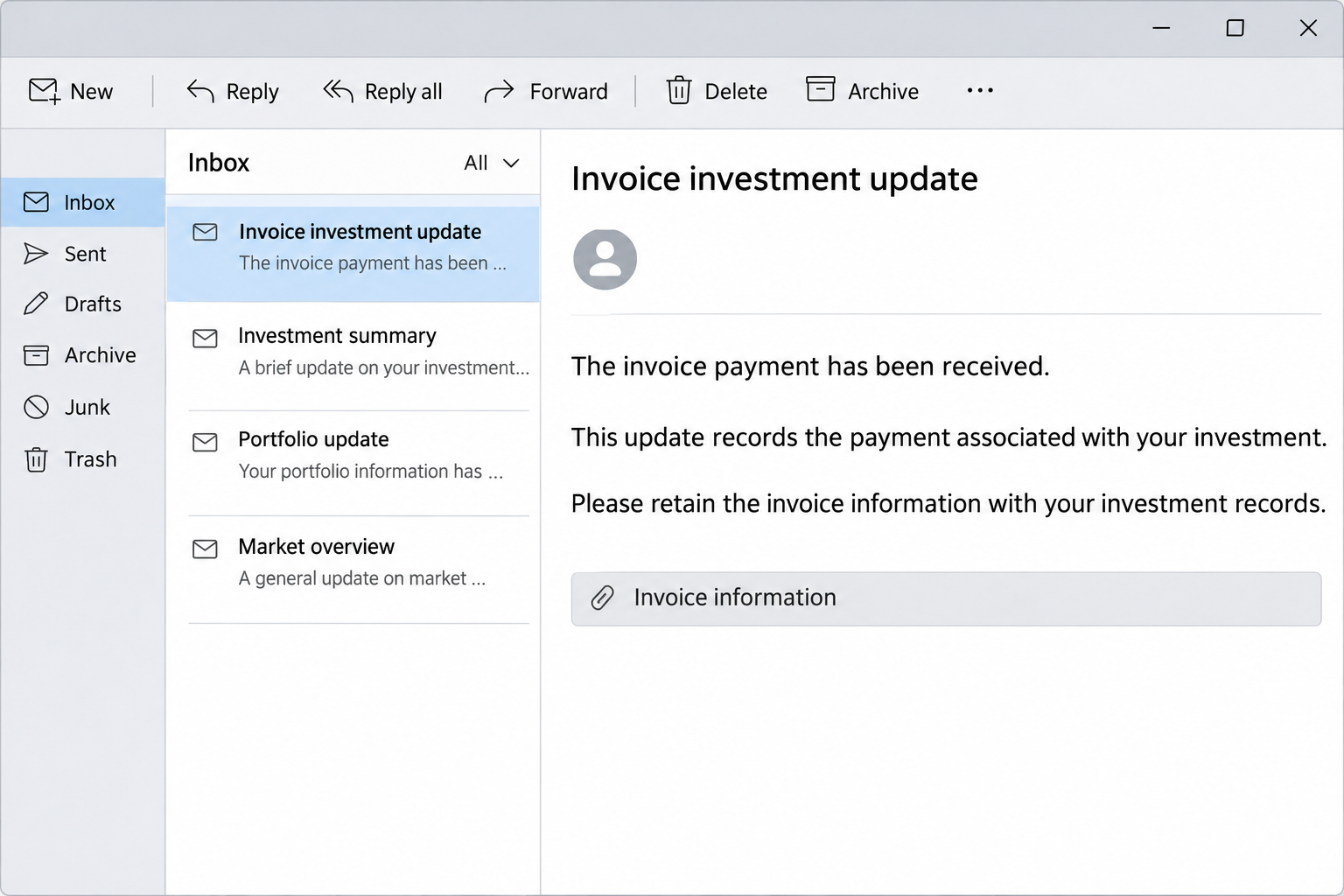
The lead illustration reconstructs a payment-update email. It isn’t original Tradepay correspondence or proof that an actual customer paid an invoice.
Verify the supposed backing separately from the promoter
- An invoice can be fabricated even when its format looks professional.
- A payment received early doesn’t authenticate every later investment.
- A contract and valuation can repeat the same false information.
- Restitution and forfeiture figures aren’t money automatically returned to investors.
The deception depended on assets investors couldn’t independently confirm: commercial transactions behind the invoices and genuine valuable goods behind the Luxestreet promises.
Why Concrete-Sounding Collateral Can Be Misleading
A specific asset can make a financial offer feel more transparent. You may believe that an invoice or valuable item gives you something independent to rely on.
That confidence is justified only when the backing can actually be verified. Otherwise, you’re still relying on the promoter’s description, now expressed through another document or object.
The risk increases when one person selects the asset, supplies its valuation, controls the paperwork, and explains why outside confirmation isn’t available.
Several apparently supporting records can therefore share the same weakness. An invoice, agreement, valuation, and website may all originate from the same dishonest operation.
Count independent sources, rather than the number of files in the presentation. A second document isn’t independent merely because it uses different stationery.
Tradepay supplied a commercial explanation for returns, while Luxestreet supplied objects that appeared valuable. Both required investors to trust backing represented through the operator’s own material.
The documents worked together to make the investment look supported. Their shared weakness was the missing independent confirmation of what investors were actually financing.
For someone considering a new offer, the useful pause comes before payment. Ask what evidence remains if you set aside everything supplied by the promoter.
How the Tradepay and Luxestreet Scam Worked
Step 1: A plausible business model explained the promised income
Tradepay presented itself as an international factoring business with experienced executives. That familiar commercial activity gave investors an explanation for why money might generate a return.
The model depended on genuine invoices and real counterparties paying them. Without those underlying transactions, the explanation was only a story about how financing could work.
Don’t confuse understanding a model with verifying a business. You can understand invoice financing perfectly while still being shown fabricated invoices.
Ask who owes the payment, what goods or services created the obligation, and which independent records establish it. A promoter should not choose every verification contact.
If material details remain inaccessible, decline to fund the transaction. An impressive presentation doesn’t require you to accept an unverified receivable.
Step 2: Fraudulent invoices created apparent transaction evidence
The prosecution described hundreds of fraudulent invoices, including fake signatures on both sides of supposed transactions. The paperwork made nonexistent commercial activity look real.
An invoice number or signature image can therefore identify a document without authenticating the underlying obligation. Examine the business relationship, rather than just the document’s completeness.
Independent confirmation should reach the genuine counterparty through contact information obtained separately. A telephone number printed only on the suspicious invoice isn’t another source.
Keep the version you were shown before investing. Later changes in counterparties, dates, or invoice explanations may matter when reconstructing the payment decision.
You don’t need to accuse a genuine business merely because its name appears on false paperwork. It may have been impersonated without participating.
Step 3: Early payments encouraged larger commitments
Tradepay investors initially received payments on invoices, which encouraged further contributions. By approximately July 2019, payments stopped and losses reached approximately $35 million.
An early payment establishes that money arrived on that occasion. It doesn’t establish that the stated invoice generated it or that later investments share the same backing.
That distinction is important when someone uses past withdrawals as their strongest sales argument. Ask for the underlying transaction evidence as well as the payment receipt.
For an affected investor, record genuine repayments separately from expected returns. Their existence matters to the loss calculation without authenticating the entire operation.
Don’t reinvest automatically because an earlier payment made you feel reassured. Each additional contribution exposes more money to the same unresolved questions.
Step 4: Investor money moved through concealed accounts
The DOJ describes funds routed through shell entities and straw signatories into accounts Baid controlled. Money represented as going to business partners instead funded personal spending.
That payment trail undermined the appearance created by the invoices. Formal business names didn’t prevent the person controlling the operation from using investor funds differently.
Before contributing to another offer, compare the beneficiary with the agreement and represented purpose. An unexplained recipient deserves attention even when the investment presentation is polished.
After paying, preserve the actual destination and transfer reference. You don’t need to identify every shell account before asking your financial institution for help.
Keep any explanation for a changed beneficiary alongside the original instructions. Don’t overwrite the earlier account details when assembling your records.
Step 5: Luxestreet supplied another story built on false backing
Baid founded Asset Capital Partners in 2018, and it began doing business as Luxestreet. The venture was presented as a pawn-style business for high-end goods.
The supposed backing included luxury watches, but the prosecution described forged contracts and knockoff watches. Fake websites, telephone numbers, and valuation reports further supported the deception.
The presence of a physical item didn’t fix the problem. Its authenticity, value, ownership, and connection with the investment all required verification.
A valuation supplied by the same operation shouldn’t settle those questions. Independent expertise matters because an expensive-looking object can be worth far less than its claimed collateral value.
Don’t assume a photographed watch is the item available to secure your money. A picture can illustrate a claim without establishing possession, title, or enforceable rights.
Tradepay, Asset Capital Partners and Luxestreet
Tradepay’s executive identity needed independent scrutiny
Baid served as Tradepay’s Business Head while using PK Jain as another identity. The prosecution says he concealed his real name from investors.
For an investor, the legal person behind an agreement matters more than the name used during a sales conversation. Preserve both identities when they differ.
Don’t assume a new name is an administrative detail. It changes which records you can check and whom you understand to be responsible for the money.
Asset Capital Partners and Luxestreet described the same second venture
The DOJ links the company Baid founded with the Luxestreet trading name. That connection helps distinguish the legal entity from the brand investors encountered.
Use exact names when reviewing an agreement or reporting a payment. A similarly named business elsewhere isn’t automatically connected with this case.
Record where each name appeared, including contracts, account instructions, correspondence, and receipts. Those differences may help explain the transaction trail.
Supposed independent evidence came from inside the scheme
The false websites, telephone contacts, contracts, and valuations supplied apparent corroboration. Their existence didn’t make them independent confirmation of the assets.
When checking another offer, identify who created each supporting record. Ask whether the person supplying the evidence also controls the investment and receives your funds.
For valuable objects, use genuinely independent verification appropriate to the item. Don’t send more money merely to obtain the promoter’s preferred certificate or inspection.
The sentence and financial orders have different meanings
The court preliminarily ordered $35,056,852.83 in restitution for victims of both schemes and ordered forfeiture of $2,607,689 in proceeds.
Those are distinct legal orders, rather than amounts to add together as an automatic investor refund. The announcement doesn’t establish your personal recovery entitlement.
Keep your actual contributions and repayments available for any legitimate victim process. A case-wide figure can’t replace the records establishing your own loss.
A Practical Test for Invoice and Asset-Backed Offers
First identify the actual obligation or asset. A broad claim that the company handles valuable transactions isn’t enough to connect your contribution with a particular investment.
Next establish which person or entity owns the asset or owes the invoice. If you can’t identify that party, you can’t meaningfully verify the backing.
Obtain counterparty contact details independently of the promoter’s documents. Otherwise, the same operator can control the investment claim and the apparent confirmation.
For physical collateral, distinguish a photograph, an appraisal, ownership records, and the legal agreement. Each answers a different question and may need separate professional review.
Ask what happens if the underlying customer doesn’t pay or the asset is worth less than stated. A promise of safety shouldn’t erase ordinary commercial risk.
Keep all written terms before making the payment. If the agreement differs materially from the sales explanation, don’t resolve that discrepancy by assuming the reassuring version applies.
Walk away when the proposal depends on skipping those checks. Pressure to act quickly isn’t evidence that an invoice or watch is genuine.
What to Do if You Have Fallen Victim to This Scam
-
Stop additional contributions and preserve the investment material. Keep invoices, agreements, valuations, photographs, correspondence, payment instructions, and any statements showing supposed returns.
Record what each document was supposed to establish. Separate what you independently confirmed from what Baid or another representative told you.
If your records use different company names or aliases, retain each version. Don’t replace the original wording with the identity you discovered later.
-
Contact your financial institution through its established business or personal banking channel, as appropriate. Explain that your transfer was induced through fraudulent investment representations.
Provide the amount, date, recipient, account details, and transaction reference for each payment. Ask about receiving-bank notification, recall options, and relevant reporting requirements.
Obtain a case number and follow-up instructions. A request to trace or recall funds doesn’t guarantee the receiving account still holds the money.
-
Prepare a loss summary showing actual contributions and genuine repayments. List projected profits or reported balances separately from funds you really received.
Connect each payment with the invoice, agreement, or investment explanation that prompted it. Preserve the dates when payments stopped or repayment requests were made.
If another person made payments on your behalf, document that accurately. Don’t combine separate investors into one total without identifying whose funds were involved.
-
Start your report at IC3.gov using File A Complaint. Review the terms before selecting Accept, then describe the investment, correspondence, and destination accounts.
Include Tradepay, Luxestreet, Asset Capital Partners, Baid, or PK Jain only where your records connect those names with the transaction.
Save the resulting confirmation and relevant bank case numbers. An online complaint doesn’t automatically enroll someone in a court restitution process.
-
For case-related assistance, locate the Eastern District of New York through the official DOJ sentencing announcement. Ask the appropriate victim-assistance unit about current documentation instructions.
Use independently published agency contact information rather than an address supplied by an unsolicited recovery message. Keep official replies with your original financial records.
If your investment rights or collateral claims require interpretation, obtain qualified legal advice. Don’t assume a copied contract gives enforceable rights over a particular watch or invoice.
-
Reject anyone requesting an advance fee to unlock restitution, release collateral, or guarantee recovery. Public knowledge of Baid’s sentence doesn’t authenticate a caller.
Verify supposed claims deadlines through the actual agency or court process. Don’t rush another transfer because a stranger says your recovery will otherwise disappear.
Maintain your records after any partial repayment. Confirm actual credits and keep the unresolved balance clear for institutions or authorities requesting further information.
Frequently Asked Questions
Is invoice factoring itself a scam?
Factoring is a genuine financing activity involving the purchase of invoices. The Tradepay fraud involved fabricated underlying transactions and misuse of investor funds.
Understanding the business model doesn’t authenticate an individual invoice or the person asking you to finance it.
Were Luxestreet’s watches genuine collateral?
The prosecution described knockoff watches and forged contracts, supported by false valuations and other fabricated material. The represented backing wasn’t what investors were told.
That finding concerns the documented operation, rather than every watch dealer or luxury-goods financing business.
Did early Tradepay payments prove the business was legitimate?
Investors initially received payments, which encouraged additional contributions. Those payments didn’t establish that the supposed invoices and counterparties were genuine.
Keep actual repayments in your records while independently checking the activity claimed to have generated them.
Who was PK Jain in this case?
PK Jain was an alias used by Pushpesh Kumar Baid. The DOJ describes him concealing his real identity from investors.
Use both names where relevant to your own documents, but don’t treat them as separate independent endorsements of the investment.
Do the financial orders guarantee a refund for every investor?
The announced restitution and forfeiture orders don’t establish automatic payment to each person or a completed recovery of their funds. Each individual claim needs its own supporting records.
Verify any legitimate victim process through official channels and don’t pay someone who guarantees acceptance.
What should I do if I still have the investment paperwork?
Preserve it with payment records and correspondence rather than discarding documents because you now believe they were false. They can explain what induced your contribution.
Contact the payment provider and use verified reporting routes. Don’t test the old contact details by sending additional information or money.
The Bottom Line
Do not invest through the documented Tradepay or Luxestreet schemes. Their invoices, contracts, and watch valuations created the appearance of backing that wasn’t genuine.
If you paid, stop further transfers, preserve the original documents, and contact your financial institution promptly. Verify any restitution instructions independently before disclosing more information or paying another fee.

Join the discussion
0 commentsShare your experience or ask a question about this article.
Community experiences
Did this happen to you?
Your experience could help someone recognize the same scam. Submit a private report for our team to review.
I experienced this tooReports are reviewed before publication. Sharing publicly is always your choice.
Discussion
Start the conversation
Have a question or something useful to share? Add the first comment.