


The caller knows your name, your address, and perhaps your age. Before explaining why they contacted you, they already seem to know enough to sound convincing.
That familiarity can have a very ordinary price tag. A confirmed fraud case shows how personal details became stock for people running lottery scams.
Overview
Personal information became a product for fraudsters
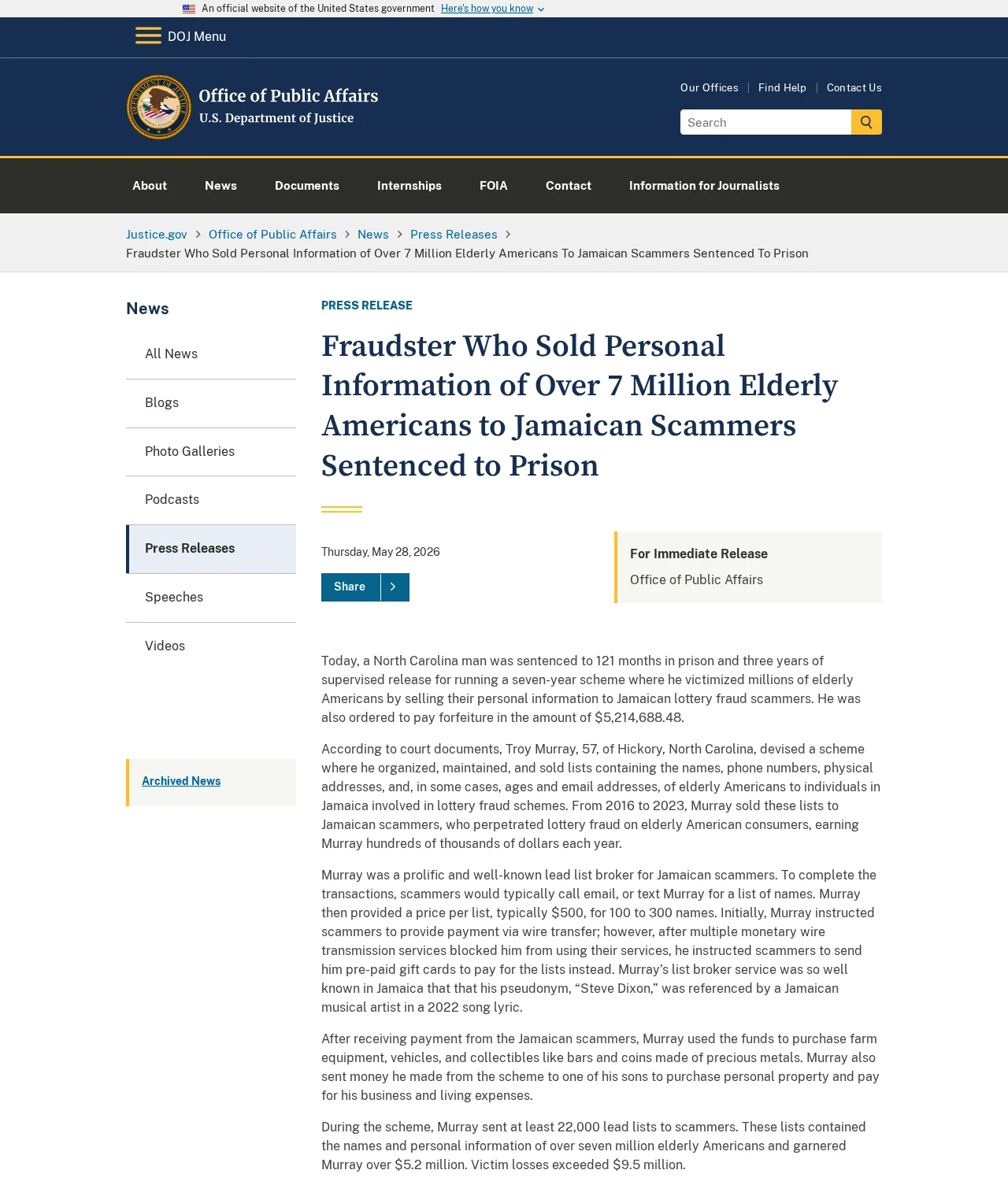
Troy Murray sold lists containing older Americans’ names, telephone numbers, physical addresses, and sometimes ages and email addresses to Jamaican lottery scammers.
The DOJ sentencing announcement says he supplied at least 22,000 lists containing information about more than seven million older Americans. The operation ran from 2016 through 2023.
These were targeting records sold to people committing fraud. The case does not establish that every recipient of an unwanted call appeared in Murray’s database.
A guilty plea and sentence confirm the scheme
Murray pleaded guilty to conspiracy to commit wire fraud in January 2026. In May, he received a 121-month prison sentence and a forfeiture order exceeding $5.2 million.
Prosecutors described more than $9.5 million in victim losses. That figure is different from Murray’s proceeds and should not be treated as money already recovered for victims.
The wrongdoing was his knowing role in supplying scammers, rather than the mere existence of a list of names or an ordinary customer database.
What the case means when a caller knows your details
A caller’s knowledge can come from a record somebody bought. It does not independently establish a relationship with your bank, a prize organization, or a government agency.
- Do not confirm missing identity information to make an unexpected caller’s record complete.
- Judge the requested action separately from the personal details the caller already knows.
- Do not pay a prize fee or a supposed charge to remove your name from a criminal list.
- Respond to actual financial or identity exposure, rather than assume every unwanted call means your accounts were hacked.
Why Knowing Your Name Is Such a Useful Opening
A call that begins with personal information feels different from a random sales pitch. You may spend less time asking how the caller obtained your number.
But a name and address can travel independently of any legitimate prize or account. The caller may know the identity details while inventing the reason for contact.
That is the practical lesson of the Murray case. Information that feels personal to the recipient can be a purchased input for the person conducting the scam.
It does not mean you should argue about where the information originated. An unfamiliar caller can provide another false explanation as easily as the first one.
Instead, focus on what they want you to do. A request for money, a verification code, or additional identity details deserves independent scrutiny regardless of the greeting.
You can end the conversation without deciding whether every detail they recited was accurate. Protecting your information does not require winning an argument with the caller.
The same reasoning applies to a text or email containing your real name. Personalization is a message feature, rather than proof that the sender has authority.
How the Scam Target List Business Worked
Step 1: A broker assembled records useful for targeting older people
Murray organized and maintained personal-information lists. The records gave scammers details they could use to select and contact potential victims.
The case identifies the kinds of information sold, but does not provide a public way to check every person’s inclusion. An unwanted call alone cannot establish that connection.
Step 2: Scammers ordered batches of potential contacts
Buyers contacted Murray by phone, email, or text to request lists. A typical price was about $500 for a batch of 100–300 names.
That commercial arrangement helps explain the scale. The broker did not need to make every fraudulent call himself to help many calls become possible.
For the person receiving one call, the approach can feel individual and exceptional. Behind it, the operation may be working through a purchased batch of contact records.
Step 3: The broker adjusted how he accepted payment
Murray initially requested wire payments for lists. When money-transfer services blocked him, he switched to asking scammers to pay with prepaid gift cards.
That detail concerns how the scammers paid their supplier. It should not be confused with a claim that every consumer victim in this case paid using gift cards.
The distinction matters when reconstructing a loss. Record the payment method you actually used rather than copying a method mentioned elsewhere in the case.
Step 4: Buyers used the information in lottery fraud
The lists went to people running lottery scams against older consumers. Personal details helped those callers reach the people they intended to deceive.
The information can also make a claim seem tailored to you. A supposed prize notice sounds more plausible when the person announcing it already knows whom they are calling.
A prize story can make an advance payment seem like a final administrative step. The recipient believes they are claiming money, while the caller is collecting it.
If someone says you must pay to receive an unexpected prize, stop before sending anything. The personal information used to address you does not validate the award.
Step 5: One person’s information becomes useful beyond a single conversation
Once a scammer has a contact record, ending one call does not erase the record they possess. That is why protecting your response matters alongside reducing unwanted contact.
The case does not show where every copy of every list ended up. Nor does a prison sentence mean all personal information has disappeared from the people who received it.
Do not interpret another approach as a personal failure to stop the first one. Focus on refusing the requested payment and keeping verified contacts outside the caller’s control.
Four Conclusions the Numbers Do Not Support
Seven million records do not identify your own exposure
The reported scale concerns the information in Murray’s operation. It is not a reliable explanation for every scam message received by an older person.
To report an approach, you can describe the information the caller knew without claiming a database connection you cannot establish. That preserves useful facts without creating a false certainty.
If the caller recites a wrong detail, do not supply the correction. Their mistake is not an invitation to improve the information available to them.
A sold contact record does not automatically mean a bank account was accessed
A name, phone number, and address are different from a bank password or one-time authentication code. Respond according to what was actually disclosed or done.
If you only received a call and gave nothing away, record the attempt and end contact. Do not assume you need to move your savings because of the call.
If you approved a transaction or shared account access, tell the financial institution exactly what happened. Its response needs to fit the specific exposure.
Forfeiture is different from a personal refund
The forfeiture order concerns criminal proceeds. It does not establish that a particular person on a list has an approved claim or an immediately available payment.
Someone offering a refund merely because your details supposedly appeared in the database should therefore be independently checked. Do not pay a processing fee based on that claim.
Use the authorities’ published channels to ask about relevant information. Do not use a telephone number supplied only by the person offering the refund.
A data-removal promise needs a clear explanation
Be careful with anyone offering a paid search of this supposed victim database. Their claim would need independent authentication before you supplied more personal information.
A service can describe the websites it covers without proving that it can erase copies held by criminals. Ask precisely what information and locations a removal offer addresses.
Do not give identity documents to an unexpected caller promising to delete a scam targeting record. The request could add more valuable information to what they already possess.
The immediate protection remains practical: do not act on the fraudulent request, and verify any financial or official claim independently.
Handling an Unexpected Caller Who Knows Your Details
Let the caller explain the purpose without confirming additional information. You can listen long enough to identify the request without answering questions about accounts or identity documents.
If a prize, refund, or official warning appears, end the call before taking the requested action. Contact the genuine organization through details you obtain separately.
Do not call back through the recent-call entry merely because the displayed number looks familiar. Use the institution’s established website, statement, or existing contact record.
Tell the organization what the caller claimed and what payment or information was requested. Ask whether it actually issued the communication or needs to secure an account.
If the organization cannot confirm immediately, keep the original request on hold. Lack of an immediate answer does not make the stranger’s claim valid.
If unwanted calls are becoming frequent, ask your phone provider about the blocking or screening options available for your service. Avoid giving another unsolicited caller access to configure them.
Tell trusted household members what happened so that the next call can be handled consistently. A shared decision to verify independently is more useful than memorizing one scammer’s name.
Keep any warning to relatives focused on the behavior. Knowing personal details does not justify payments, banking access, or instructions to move savings into supposed protection.
What to Do if You Have Fallen Victim to This Scam
- Stop the conversation and do not send another payment. Separate money already lost from any remaining request that you can still refuse.
- Contact the actual payment provider promptly if you paid. Explain the lottery or advance-fee deception, provide the transaction reference, and ask whether cancellation, recall, or recovery is possible.
- Obtain the provider’s case number and record its answer. A request being reviewed is not confirmation that money has been returned; ask how and when to follow up.
- Preserve the caller’s messages, displayed number, claimed organization, payment instructions, and receipt. Distinguish information the caller already knew from information you supplied during the conversation.
- If a gift card was used, keep the card and purchase receipt. Contact the issuer through its published route and report the fraud without sharing the code again publicly.
- Contact the U.S. Postal Inspection Service at 1-877-876-2455 about relevant lottery fraud. State the actual delivery and payment circumstances and ask for the appropriate reporting route.
- If you have information about Murray’s operation, explain your connection. Ask which secure channel accepts your records, and keep the resulting case reference.
- Tell your bank immediately if you disclosed account credentials or approved a code. A caller knowing your address and a caller accessing your banking account require different responses.
- Report threats to local police, using emergency services for immediate danger. Do not confront a caller or intermediary to try to obtain a refund yourself.
- Reject a follow-up charge for database removal, victim registration, or priority recovery. Verify any claimed official process through an independently obtained contact before sending information or money.
If you never paid or disclosed information, describe the incident as an attempt rather than a completed theft. It can still be useful to report what was requested.
If a relative received the call, ask whether another payment is planned. That question can identify an immediate opportunity to protect money without forcing a debate about every earlier decision.
Keep the response proportionate and calm. Unexpected contact can be upsetting, but urgency should come from an actual pending transaction or threat rather than the caller’s claims alone.
For repeated approaches, retain a simple record of dates, names used, and requests made. It helps distinguish new attempts from genuine follow-up by an organization you independently contacted.
Do not send bank statements to somebody merely to prove you were targeted. Begin with a concise description and use the secure evidence route the verified organization provides.
Frequently Asked Questions
Is selling the lists in this case established criminal conduct?
Murray pleaded guilty to conspiracy to commit wire fraud and was sentenced. The case concerns his role supplying scammers, rather than an unsupported allegation about an ordinary marketing business.
Does a scammer knowing my address prove I was on Murray’s list?
That fact alone cannot establish the source of their information. Record what they knew without assuming a connection that the available evidence cannot confirm.
Did seven million people lose money in the case?
The figure describes people whose details appeared in the lists. It should not be presented as a count of people who completed payments to scammers.
Does blocking one number erase my information?
Blocking a number does not remove information already held by the caller. Continue checking unexpected requests independently instead of treating one blocked contact as complete protection.
Should I pay someone to remove me from a criminal database?
Do not pay an unexpected caller making that promise. A claim to erase criminals’ copies needs independent evidence and should not justify giving the caller more sensitive information.
Does the forfeiture order create an automatic refund for everyone listed?
It does not establish an individual payment entitlement merely because someone was targeted. Ask verified authorities about any actual process and reject advance-fee recovery offers.
The Bottom Line
Do not treat knowledge of your name or address as authority over your money. Murray’s case shows how personal familiarity can be purchased and reused in fraudulent approaches.
If a caller requests payment, pause and verify independently. If you already paid, contact the provider promptly, keep the evidence, and use verified authorities for reporting and follow-up.

Join the discussion
0 commentsShare your experience or ask a question about this article.
Community experiences
Did this happen to you?
Your experience could help someone recognize the same scam. Submit a private report for our team to review.
I experienced this tooReports are reviewed before publication. Sharing publicly is always your choice.
Discussion
Start the conversation
Have a question or something useful to share? Add the first comment.