

Smart HDD is a malicious software that will display fake alerts, claiming that several hard drive errors were detected on your computer.The alerts are professional looking pop-ups and when you click on them, you’re advised to buy Smart HDD in order to fix this errors.
In reality, none of the reported issues are real, and are only used to scare you into buying Smart HDD and stealing your personal financial information.
If you’ve got a Smart HDD infection , you’ll be seeing this screens :
![[Image: Smart-HDD.png]](http://malwaretips.com/images/fakeav/Smart-HDD.png "Smart HDD")
Registration codes for Smart HDD
As an optional step,you can use the following license key to register Smart HDD and stop the fake alerts.
15801587234612645205224631045976
Please keep in mind that entering the above registration code will NOT remove Smart HDD from your computer , instead it will just stop the fake alerts so that you’ll be able to complete our removal guide more easily.
We strongly advise you to follow our Smart HDD removal guide and ignore any alerts that this malicious software might generate.Under no circumstance should you buy this rogue security software as this could lead to identity theft.
Removal guide for Smart HDD
STEP 1 : Start your computer in Safe Mode with Networking
- Remove all floppy disks, CDs, and DVDs from your computer, and then restart your computer.
- Press and hold the F8 key as your computer restarts.Please keep in mind that you need to press the F8 key before the Windows start-up logo appears.
- On the Advanced Boot Options screen, use the arrow keys to highlight Safe Mode with Networking , and then press ENTER.
![[Image: Safemode.jpg]](//malwaretips.com/images/removalguide/safemode.jpg "Safe Mode with Networking screen")
- Log on to your computer with a user account that has administrator rights
![[Image: Safemode.jpg]](http://malwaretips.com/images/removalguide/safemode.jpg "Safe Mode with Networking screen")
STEP 2: Remove Smart HDD malicious proxy server
Smart HDD may add a proxy server which prevents the user from accessing the internet,follow the below instructions to remove the proxy.
- Start Internet Explorer
![[Image: Smart HDD- IE]](//malwaretips.com/images/removalguide/Ieicon.png "IE 9") and if you are using Internet Explorer 9 ,click on the gear icon
and if you are using Internet Explorer 9 ,click on the gear icon ![[Image: IE gear icon]](//malwaretips.com/images/removalguide/icongear.jpg "Gear Icon") (Tools for Internet Explorer 8 users) ,then select Internet Options.
(Tools for Internet Explorer 8 users) ,then select Internet Options.
![[Image: Internet-options-IE.png]](//malwaretips.com/images/removalguide/ie1.png "Internet Options in IE")
- Go to the tab Connections.At the bottom, click on LAN settings.
![[Image: Remove-proxy-server2.png]](//malwaretips.com/images/removalguide/ie2.png "Connections tab in Internet Explorer")
- Uncheck the option Use a proxy server for your LAN. This should remove the malicious proxy server and allow you to use the internet again.
![[Image: Remove-proxy-server3.png]](//malwaretips.com/images/removalguide/ie3.png "Uncheck the option Use a proxy server for your LAN")
![[Image: Smart HDD- IE]](http://malwaretips.com/images/removalguide/Ieicon.png "IE 9") and if you are using Internet Explorer 9 ,click on the gear icon
and if you are using Internet Explorer 9 ,click on the gear icon ![[Image: IE gear icon]](http://malwaretips.com/images/removalguide/icongear.jpg "Gear Icon") (Tools for Internet Explorer 8 users) ,then select Internet Options.
(Tools for Internet Explorer 8 users) ,then select Internet Options.![[Image: Internet-options-IE.png]](http://malwaretips.com/images/removalguide/ie1.png "Internet Options in IE")
![[Image: Remove-proxy-server2.png]](http://malwaretips.com/images/removalguide/ie2.png "Connections tab in Internet Explorer")
![[Image: Remove-proxy-server3.png]](http://malwaretips.com/images/removalguide/ie3.png "Uncheck the option Use a proxy server for your LAN")
If you are a Firefox users, go to Firefox(upper left corner) → Options → Advanced tab → Network → Settings → Select No Proxy
STEP 3: Run RKill to terminate known malware processes associated with Smart HDD.
RKill is a program that attempts to terminate any malicious processes associated with Smart HDD ,so that your normal security software can then run and clean your computer of infections.
As RKill only terminates a program’s running process, and does not delete any files, after running it you should not reboot your computer as any malware processes that are configured to start automatically will just be started again.
- While your computer is in Safe Mode with Networking ,please download the latest official version of RKill.

- Double-click on the RKill iconin order to automatically attempt to stop any processes associated with Smart HDD.
![[Image: run-rkill-1.png]](//malwaretips.com/images/removalguide/rkill1.png "RKILL ICON")
- RKill will now start working in the background, please be patient while the program looks for various malware programs and tries to terminate them.
![[Image: run-rkill-2.png]](//malwaretips.com/images/removalguide/rkill2.png "RKILL Command prompt")
IF you receive a message that RKill is an infection, that is a fake warning given by the rogue. As a possible solution we advise you to leave the warning on the screen and then try to run RKill again.Run RKill until the fake program is not visible but not more than ten times.
IF you continue having problems running RKill, you can download the other renamed versions of RKill from here. - When Rkill has completed its task, it will generate a log. You can then proceed with the rest of the guide.
![[Image: Smart HDD rkill3.jpg]](//malwaretips.com/images/removalguide/rkill3.png "RKILL LOG")
![[Image: run-rkill-1.png]](http://malwaretips.com/images/removalguide/rkill1.png "RKILL ICON")
![[Image: run-rkill-2.png]](http://malwaretips.com/images/removalguide/rkill2.png "RKILL Command prompt")
![[Image: Smart HDD rkill3.jpg]](http://malwaretips.com/images/removalguide/rkill3.png "RKILL LOG")
WARNING: Do not reboot your computer after running RKill as the malware process will start again , preventing you from properly performing the next step.
STEP 4: Remove Smart HDD malicious files with Malwarebytes Anti-Malware FREE
- Please download the latest official version of Malwarebytes Anti-Malware FREE.
- Install Malwarebytes’ Anti-Malware by double clicking on mbam-setup.
![[Image: malwarebytes-installer.png]](//malwaretips.com/images/removalguide/mbam1.png "Malwarebytes Anti-Malware Installer")
- When the installation begins, keep following the prompts in order to continue with the installation process. Do not make any changes to default settings and when the program has finished installing, make sure you leave both the Update Malwarebytes’ Anti-Malware and Launch Malwarebytes’ Anti-Malware checked. Then click on the Finishbutton. If Malwarebytes’ prompts you to reboot, please do not do so.
![[Image: install-malwarebytes.png]](//malwaretips.com/images/removalguide/mbam2.png "Install Malwarebytes Anti-Malware")
- Malwarebytes Anti-Malware will now start and you’ll be prompted to start a trial period , please select ‘Decline‘ as we just want to use the on-demand scanner.
![[Image: decline-trial-malwarebytes.png]](//malwaretips.com/images/removalguide/mbam3.PNG "Decline trial period in Malwarebytes Anti-Malware")
- On the Scanner tab,please select Perform full scan and then click on the Scan button to start scanning your computer for any possible infections.
![[Image: malwarebytes-full-system-scan.png]](//malwaretips.com/images/removalguide/mbam4.png "Perform a Full System Scan")
- Malwarebytes’ Anti-Malware will now start scanning your computer for Smart HDD malicious files as shown below.
![[Image: malwarebytes-scanning.png]](//malwaretips.com/images/removalguide/mbam5.png "Malwarebytes Anti-Malware scanning for Smart HDD")
- When the scan is finished a message box will appear, click OK to continue.
![[Image: malwarebytes-scan-finish.png]](//malwaretips.com/images/removalguide/mbam9.png "Malwarebytes when the scan is finished")
- You will now be presented with a screen showing you the malware infections that Malwarebytes’ Anti-Malware has detected.Please note that the infections found may be different than what is shown in the image.Make sure that everything is Checked (ticked) and click on the Remove Selected button.
![[Image: malwarebytes-scan-results.png]](//malwaretips.com/images/removalguide/mbam6.png "Smart HDD infection scan results")
- Malwarebytes’ Anti-Malware will now start removing the malicious files.If during the removal process Malwarebytes will display a message stating that it needs to reboot, please allow this request.
![[Image: malwarebytes-reboot-prompt.png]](//malwaretips.com/images/removalguide/mbam10.png "Reboot prompt from Malwarebytes")
![[Image: malwarebytes-installer.png]](http://malwaretips.com/images/removalguide/mbam1.png "Malwarebytes Anti-Malware Installer")
![[Image: install-malwarebytes.png]](http://malwaretips.com/images/removalguide/mbam2.png "Install Malwarebytes Anti-Malware")
![[Image: decline-trial-malwarebytes.png]](http://malwaretips.com/images/removalguide/mbam3.PNG "Decline trial period in Malwarebytes Anti-Malware")
![[Image: malwarebytes-full-system-scan.png]](http://malwaretips.com/images/removalguide/mbam4.png "Perform a Full System Scan")
![[Image: malwarebytes-scanning.png]](http://malwaretips.com/images/removalguide/mbam5.png "Malwarebytes Anti-Malware scanning for Smart HDD")
![[Image: malwarebytes-scan-finish.png]](http://malwaretips.com/images/removalguide/mbam9.png "Malwarebytes when the scan is finished")
![[Image: malwarebytes-scan-results.png]](http://malwaretips.com/images/removalguide/mbam6.png "Smart HDD infection scan results")
![[Image: malwarebytes-reboot-prompt.png]](http://malwaretips.com/images/removalguide/mbam10.png "Reboot prompt from Malwarebytes")
STEP 5: Double check your system for any left over infections with HitmanPro
- This step can be performed in Normal Mode ,so please download the latest official version of HitmanPro.
- Double click on the previously downloaded file to start the HitmanPro installation.
![[Image: hitmanpro-icon.png]](//malwaretips.com/images/removalguide/hpro1.png "HitmanPro Installer")
NOTE : If you have problems starting HitmanPro, use the “Force Breach” mode. Hold down the left CTRL-key when you start HitmanPro and all non-essential processes are terminated, including the malware process. (How to start HitmanPro in Force Breach mode – Video) - Click on Next to install HitmanPro on your system.
![[Image: installing-hitmanpro.png]](//malwaretips.com/images/removalguide/hpro2.png "HitmanPro installation process")
- The setup screen is displayed, from which you can decide whether you wish to install HitmanPro on your machine or just perform a one-time scan, select a option then click on Next to start a system scan.
![[Image: hitmanpro-setup-options.png]](//malwaretips.com/images/removalguide/hpro3.png "HitmanPro setup options")
- HitmanPro will start scanning your system for malicious files. Depending on the size of your hard drive, and the performance of your computer, this step will take several minutes.
![[Image: hitmanpro-scanning.png]](//malwaretips.com/images/removalguide/hpro4.png "HitmanPro scanning for Smart HDD")
- Once the scan is complete,a screen displaying all the malicious files that the program found will be shown as seen in the image below.After reviewing each malicious object click Next.
![[Image: hitmanpro-scan-results.png]](//malwaretips.com/blogs/wp-content/uploads/2012/02/rsz_hpro5.png "HitmanPro Smart HDD scan results")
- Click Activate free license to start the free 30 days trial and remove the malicious files.
![[Image: hitmanpro-activation.png]](//malwaretips.com/images/removalguide/hpro6.png "Activate HitmanPro free license to remove detected infections")
- HitmanPro will now start removing the infected objects, and in some instances, may suggest a reboot in order to completely remove the malware from your system. In this scenario, always confirm the reboot action to be on the safe side.
![[Image: hitmanpro-icon.png]](http://malwaretips.com/images/removalguide/hpro1.png "HitmanPro Installer")
![[Image: installing-hitmanpro.png]](http://malwaretips.com/images/removalguide/hpro2.png "HitmanPro installation process")
![[Image: hitmanpro-setup-options.png]](http://malwaretips.com/images/removalguide/hpro3.png "HitmanPro setup options")
![[Image: hitmanpro-scanning.png]](http://malwaretips.com/images/removalguide/hpro4.png "HitmanPro scanning for Smart HDD")
![[Image: hitmanpro-scan-results.png]](http://malwaretips.com/blogs/wp-content/uploads/2012/02/rsz_hpro5.png "HitmanPro Smart HDD scan results")
![[Image: hitmanpro-activation.png]](http://malwaretips.com/images/removalguide/hpro6.png "Activate HitmanPro free license to remove detected infections")
STEP 6: Unhide your files and folders
Smart HDD modifies your file system in such a way that all files and folders become hidden, to restore the default settings , you’ll need to run the below program.
- Download Unhide.exe, to unhide your files and folders.
- Double-click on the Unhide.exe icon on your desktop and allow the program to run.The whole process should not take more than 5 minutes to complete,and at the end this utility will generate a report.
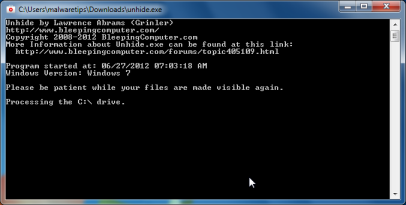
STEP 7 : Restore your shortcuts and remove any left over malicious registry keys
Smart HDD has moved your shortcuts files in the Temporary Internet folder and added some malicious registry keys to your Windows installation , to restore your files we will need to perform a scan with RogueKiller.
- Please download the latest official version of RogueKiller.
- Double click on RogueKiller.exe to start this utility and then wait for the Prescan to complete.This should take only a few seconds and then you can click the Start button to perform a system scan.
![[Image: roguekiller-1.png]](//malwaretips.com/blogs/wp-content/uploads/2012/04/roguek-1.png "Click on the Start button to perform a system scan")
- After the scan has completed, press the Delete button to remove any malicious registry keys.
![[Image: roguekiller-2.png]](//malwaretips.com/blogs/wp-content/uploads/2012/04/roguek-2.png "Press Delete to remove the malicious registry keys")
- Next we will need to restore your shortcuts, so click on the ShortcutsFix button and allow the program to run.
![[Image: roguekiller-1.png]](//malwaretips.com/blogs/wp-content/uploads/2012/04/roguek-3.png "Click on the Start button to perform a system scan")
![[Image: roguekiller-1.png]](http://malwaretips.com/blogs/wp-content/uploads/2012/04/roguek-1.png "Click on the Start button to perform a system scan")
![[Image: roguekiller-2.png]](http://malwaretips.com/blogs/wp-content/uploads/2012/04/roguek-2.png "Press Delete to remove the malicious registry keys")
![[Image: roguekiller-1.png]](http://malwaretips.com/blogs/wp-content/uploads/2012/04/roguek-3.png "Click on the Start button to perform a system scan")
STEP 8: Get your desktop look back!
Smart HDD changes your desktop background to a solid black color,to change it back to default one follow the below instruction.
- Windows XP : Click on the Start button and then select Control Panel. When the Control Panel opens, please click on the Display icon. From this screen you can now change your Theme and desktop background.
- Windows 7 and Vista : Click on the Start button and then select Control Panel. When the Control Panel opens, please click on the Appearance and Personalization category. Then select Change the Theme or Change Desktop Background to revert back to your original Theme and colors.
If you are still experiencing problems while trying to remove Smart HDD from your machine, please start a new thread in our Malware Removal Assistance forum.
What’s next? Join our amazing community and build up your malware defenses !









How long is each scan suppose to take?? I am scanning using the Malwarebytes Anti-Malware and it has already been 6 hours with 18 detected. Is this normal??
P.S. Whoever does these hacks needs to get a life :(
All it depends on the sizes of your hard drive and your PC speed but usually around 1 hour,however because this is an infected PC it can take longer………. Let the scan complete and then move on with the next steps, which will be a lot faster.
Thanks, all good now. Can I uninstall/ delete the downloaded programs from above after I am done?
Yes, you can uninstall all of them if that’s what you want.. :)
Stay safe!
Thank you! Worked!
Wow thanks!! All done and then like a dummy went into history and trued to delete site and clicked in Firefox “forget it” but somehow it launched :( Reran and back in business. THANKS!! I guess I will just leave it in history. Do you all have any recommendations as to what is good software to run so these stupid things get caught before they infect? My Free Malware version does not and my Mcaffee (paid) is worthless (grrrr).
McAfee is the worst!! :)
As a quick answer :
Free – Avast 7 Free version or COMODO Internet Security
Paid : Norton Internet Security 2012 or Avast Internet Security 7
Anyway ,you should really start a thread in our Security Configuration forum as you need to build a layerd security config: http://malwaretips.com/Forum-Security-Configuration-Wizard
One stupid act spoiled my week and you saved me! Mucho gracious. Very nice step by step instruction.
Internet Explorer is no where to be found on my computer. No icon. Did a search for it and nothing came up. Any ideas?
Try to launch Internet Explorer from Task Manager > by clicking File, New Task, and type iexplore in the Open box.
Wow, thanks for the quick response! Really appreciate the help!
Did it work?:)
If yes, then follow the guide…and you should be ok!… If you need any help just aks!
Good luck!
When i try to open internet explorer it says “internet explorer has encountered a problem and needs to close”. Any suggestions?
Do your have any other web browser installed on your PC?
Lets try to restore Internet Explore to it’s default factory settings:
If you are using Internet Explorer 9 follow this instructions> http://windows.microsoft.com/en-us/windows7/Reset-Internet-Explorer-settings-in-Internet-Explorer-9
If your are a Internet Explorer 9 user follow this instructions > http://windows.microsoft.com/en-us/windows-vista/Reset-Internet-Explorer-8-settings
Thank you so much for the help, my computer is alive again!
Works good!!! Thks…
Awesome instructions, fixed everything for me. Great job!
I got a wicked virus and for the most part have cleaned it off. but now internet explorer 9 starts to open then closes, it won’t run and neither would google chrome. Games like league of legends and skype wont work either. I tried to re-install skype and it opens but you cant see anything other then the background. any suggestions???
Did you scan with Malwarebytes and HitmanPro and remove the detected threats??
If yes,please try to scan again….
Next , perform a system scan with Emsisoft Emergency Kit:
Make sure that everything is Checked (ticked) and click on the ‘Quarantine selected objects’ button.
If during the removal process Emsisoft will display a message stating that it needs to reboot, please allow this request.
If you are still experiencing problems , start a thread in our Malware Removal Support forum : http://malwaretips.com/Forum-Help-my-PC-is-infected
Your instructions have been wonderful and helped me re-gain control of my computer after the smart virus. The main problem I’m having now is, each time my computer gets turned off (ie: storm) all my icons are missing and I have to re-run Rogue Killer. Is there a fix for this? Also, one other thing … I am no longer able to see a preview in my pictures folder. Thanks a bunch!!
Lets try to run Unhide.exe and run it.
Thanks a bunch for the answer but when I run unhide.exe the black screen comes up and gets to the Processing the c drive but doesn’t go any further.
Lets check with Emsisoft Emergency Kit to see if there are any active infection :
Make sure that everything is Checked (ticked) and click on the ‘Quarantine selected objects’ button.
If during the removal process Emsisoft will display a message stating that it needs to reboot, please allow this request.
Thanks very much for the help … I ran the program and it found 11 malicious files, which I deleted. Still, when I restart the computer, all the icons are missing.
OK….Please run again > Unhide.exe
THANKS, you save my day!!
Thanks so much! Very easy to follow instructions… got rid of that horrible program very quickly :-)
I followed these directions and everything seems to be working correctly except for on thing. We cannot get the desktop items to show on the desktop. Folder #4 was not in the smtmp folder and when I checked the desktop folders, both in all users and the user folder for the current user, the shortcuts were still there. However, they will not show on the desktop. I am unable to copy and paste anything onto the desktop either. Any ideas?
Great directions, BTW!! Thanks so much!
Nevermind…a restart fixed that issue. All the desktop shortcuts are not visible. Thanks again!!
Stay safe!:D
this stinkin’ piece of crap malware is like Frankenstein, it rises from the dead over and over and the nerds best software can’t stop it, the Turds that created this “SMART” Monster must be better Nerds!!! Anyone ever wonder if this whole “Malware” problem is just like the Mafia, they create a problem and offer you the solution for a Price $$$ !?! The so-called law is sleeping when it comes to on-line extortion from all these Malwares…. the people that make Malwares should be lined up and shot on Pay-Per-View and millions would pay to see their Slaughter! Muhahahahaaa…
NICE JOB!
I’m having trouble with step 9. I’m in the temporary files, but I can’t find the smtmp files. could they be named something else? I’m using windows 7. Everything else has worked like a champ. Thank you so much.
Did you get back all your files and folders?
If yes, then you don’t need to worry about that step :)
Stay safe!
Not only did it work, it removed another virus I had & fixed a program that kept crashing. The steps laid out here were perfect & I consider myself a beginner when it comes to this kind of stuff. The SMART virus was the 1st virus I’ve ever had. Thank you for posting this page. It’s the only one I found that clearly laid out all the steps & it was easy to follow.
Thank you!
Stay safe!
I got my MalwareBytes back after I ran every anti-malware program I could find, I’ll give it to em’, the Turds that made the SMART malware made one heck of a rabid nightmare, Malwarebytes had kept me safe for 8 months and I picked that SMART fawker up in a boxing message board, I’d like to KTFO the Turd that hid it in his postings but it dis-abled my Malwarebytes and started hiding everything on my computer which has 1 GB of pics and videos saved, I had back-ups but I hate to re-install my computer due to one idiots malware, so I tried it all and it took a cocktail of various programs to finally work… guess I need to keep all these anti-malware programs on my computer at all times… thanks alot Malware-Turds, I know you Fawkers browse here to admire your work!!!
It also worked fine here! Thanks a lot!
Thanks guys! You saved my life today.
Thanks so much for the excellent step by step guide.
YAY!! It worked!!Thank you so much! I wish I had found this 7 hours sooner. Worth every minute and I can’t thank you enough!!!
Hi Jack, I’m stuck on Step 3 (Run RKill). I downloaded RKill from the “Download Now” button in this guide, but the RKill icon doesn’t appear. I tried downloading the other renamed versions of RKill from the “here” button in this guide:
•RKill.com Download Link
•RKill.exe Download Link
•RKill.scr Download Link
•eXplorer.exe Download Link
•iExplore.exe Download Link
•uSeRiNiT.exe Download Link
•WiNlOgOn.exe Download Link
but still no icon appears, therefore I haven’t been able to run RKill, and therefore no log has been generated.
What should I do next?
Hello Lindsey,
STEP 1 : Download HitmanPro and then start this program in ForceBreach Mode
1.Here are the direct download links for HitmanPro,
– http://dl.surfright.nl/HitmanPro36.exe (For 32bit)
– http://dl.surfright.nl/HitmanPro36_x64.exe (For 64bit)
2.Hold down the left CTRL-key when you start HitmanPro and all non-essential processes are terminated, including the Smart HDD malicious process
Here is a video that explains with graphic details how to do this : http://www.youtube.com/watch?v=m6eRWTv2STk
3. Let it scan and remove all the detected threats , after that run the RKILL scan and then try to scan with Malwarebytes!
STEP 2: Run RKILL and then run a scan with Malawrebytes
STEP 3: Next , perform a system scan with Emsisoft Emergency Kit:
Make sure that everything is Checked (ticked) and click on the ‘Quarantine selected objects’ button.
If during the removal process Emsisoft will display a message stating that it needs to reboot, please allow this request.
If you are still experiencing problems , start a thread in our Malware Removal Support forum : http://malwaretips.com/Forum-Help-my-PC-is-infected