

Snoring can exhaust an entire household. When someone also wakes gasping or unrefreshed, a small wearable device may look like a welcome escape.
Z3 Pro promises quiet sleep from the first night and lasting improvement after several months. Its own pages reveal important limits behind that confidence.
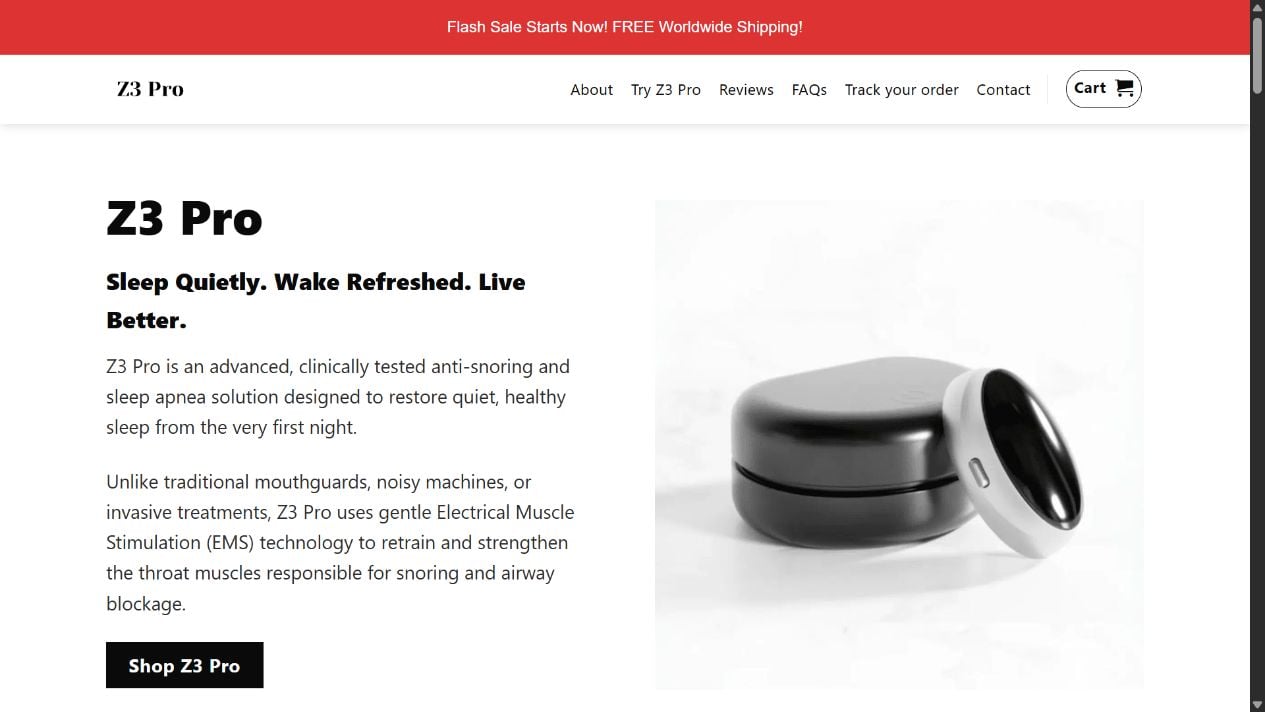
Overview
Z3 Pro is a real type of under-chin stimulation device
The product is presented as a rechargeable unit worn under the chin with adhesive patches or a strap.
It supposedly detects snoring vibrations and sends electrical muscle stimulation, commonly shortened to EMS, through the skin.
Comparable devices are sold under different names. A physical unit can arrive, but that does not validate every medical claim made for Z3 Pro.
The marketing repeatedly crosses into sleep-apnea treatment
The homepage says Z3 Pro treats sleep apnea at its source, keeps airways open, improves oxygenation, and produces immediate and lasting results.
It also describes the product as clinically proven, doctor approved, and based on medically certified technology.
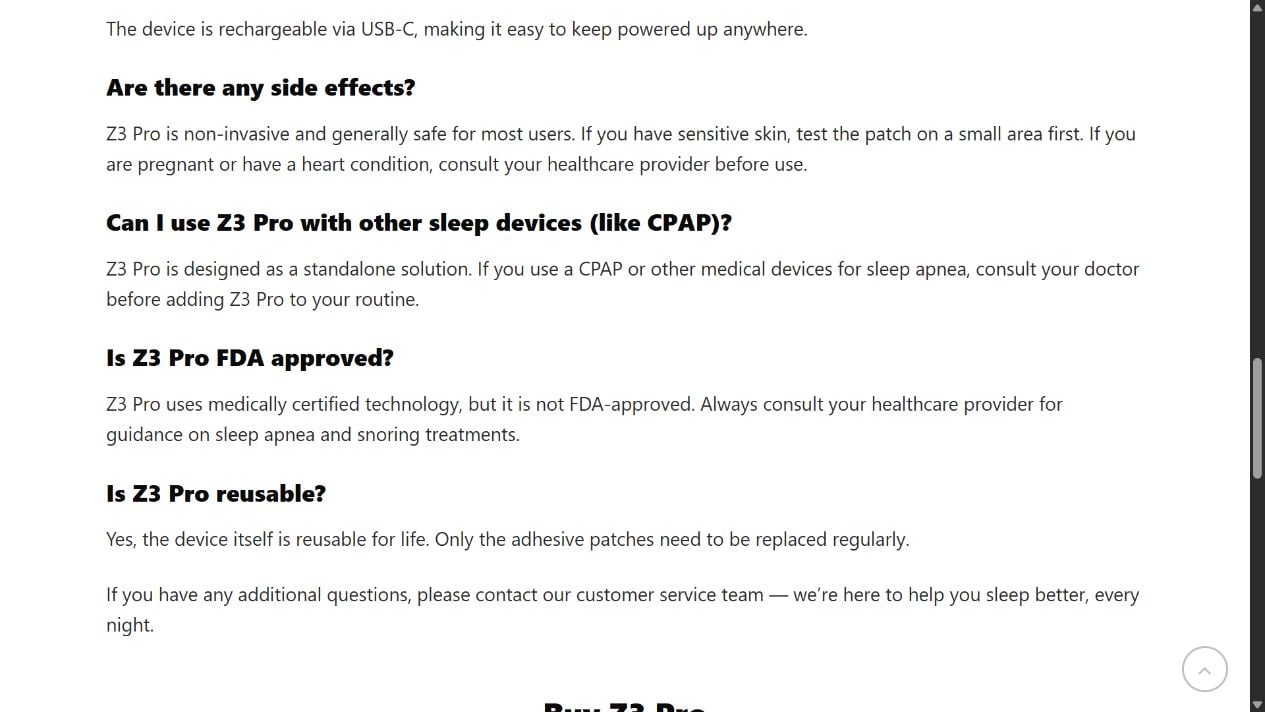
The site’s FAQ later says Z3 Pro is not FDA approved. That admission is crucial because sleep apnea can be dangerous when untreated.
The seller’s identity and address remain incomplete
The site publishes support@z3pro.net and 400 Lydia Street, Carnegie, Pennsylvania. It does not prominently identify a legal company beside those details.
The address is a multi-tenant office and virtual-office location used by unrelated organizations. It is not evidence of a factory or sleep-device laboratory.
A contact address can be legitimate while revealing little about manufacturing, clinical responsibility, or who accepts legal claims.
- Z3 Pro appears to be a physical EMS-style device.
- The site makes explicit sleep-apnea treatment claims.
- The FAQ states that the product is not FDA approved.
- No product-specific clinical study is prominently identified.
- The public address is a shared commercial location.
- Sleep-apnea symptoms require professional assessment.
Is Z3 Pro a Scam?
The available evidence does not justify saying that Z3 Pro is imaginary or that every order produces an unauthorized charge.
The central concern is more serious than an ordinary gadget disappointment. The website markets a non-FDA-approved product as a treatment for sleep apnea.
A device can deliver mild electrical pulses and still fail to detect airway obstruction, reduce apnea events, or improve oxygen levels.
The page does not identify a Z3 Pro clinical trial, FDA clearance number, named medical-device manufacturer, or published performance data.
Its testimonials describe people abandoning CPAP or improving apnea symptoms. Such stories can encourage unsafe substitution for prescribed treatment.
The same hardware appears through other sellers using similar copy, clinician images, discount percentages, and review claims.
Our conclusion is that Z3 Pro is a real consumer device sold with unverified and potentially hazardous medical claims.
Why Sleep Apnea Is Not Just Loud Snoring
Snoring is sound created by vibrating tissues in a narrowed airway. Obstructive sleep apnea involves repeated reductions or pauses in breathing during sleep.
Those events can lower oxygen, fragment sleep, and strain the cardiovascular system. A person may not remember waking even when sleep is repeatedly disrupted.
Possible signs include gasping, witnessed pauses, morning headaches, daytime sleepiness, poor concentration, and high blood pressure.
Diagnosis generally relies on clinical evaluation and sleep testing. A social-media advertisement cannot determine severity or rule out other causes.
Treatment depends on the person and may include positive airway pressure, oral appliances, weight management, positional therapy, surgery, or other medical care.
An approved neuromuscular tongue stimulator exists as a regulated device category, but its design and clinical pathway cannot be transferred automatically to an under-chin gadget.
Stopping CPAP because a testimonial praises Z3 Pro could leave serious apnea untreated. Any change should be discussed with the prescribing clinician.
How the Z3 Pro Offer Works
Step 1: The page combines snoring and sleep apnea
The funnel begins with relationship strain, fatigue, embarrassment, and fear about interrupted breathing.
It then presents one device as an answer for both ordinary snoring and medically significant sleep apnea.
Combining these conditions broadens the audience while making the product appear more capable than a basic anti-snoring accessory.
Step 2: A plausible mechanism is presented as proven treatment
Electrical stimulation can contract muscles. That general fact makes the Z3 Pro explanation sound reasonable.
The site says sensors detect snoring and stimulation retrains throat muscles, eventually removing the need for the device.
To prove this, researchers would need validated sensing, dose control, sham comparison, sleep-study outcomes, adverse-event monitoring, and durable follow-up.
Step 3: Medical authority is suggested without verifiable detail
The homepage uses phrases such as clinically proven, doctor approved, and medically certified. It does not prominently name the trial or certification.
Other sellers of similar hardware display generic doctor quotations and clinician-sharing badges. These visuals are not equivalent to regulatory review.
A genuine study should identify authors, journal, participants, protocol, device model, outcome measures, and funding.
Step 4: Testimonials normalize abandoning proven treatment
One testimonial says the user could not tolerate CPAP. Another says apnea symptoms improved drastically after using Z3 Pro.
Testimonials are especially risky when they imply that a consumer gadget can replace prescribed therapy.
The site does not show before-and-after sleep studies, apnea-hypopnea indexes, oxygen data, or independent clinical verification for those stories.
Step 5: A large discount makes the decision feel temporary
The product page lists an original price of $249 and a sale price of $75.75.
A top banner announces a flash sale and free worldwide shipping. Similar devices appear through other stores at different prices.
A crossed-out price does not establish ordinary value. Compare hardware, patches, certifications, warranty, and seller identity before treating the discount as savings.
Step 6: The guarantee carries the remaining risk
Z3 Pro advertises a 60-day money-back guarantee. The short headline does not explain every return condition beside the health claims.
Buyers should inspect whether opened, worn, or hygiene-sensitive devices qualify and whether used adhesive patches affect eligibility.
International return postage can materially reduce a refund. Obtain the exact destination and approval before ordering.
The Site Contradicts Itself About Regulatory Status
The homepage calls Z3 Pro clinically tested, clinically proven, and doctor approved. These expressions imply substantial external validation.
The FAQ asks whether Z3 Pro is FDA approved and answers no. It says the technology is medically certified instead.
Certification of a component or general technology does not authorize this finished product to treat sleep apnea.
The FDA classifies several anti-snoring and sleep-apnea devices as Class II devices requiring appropriate controls and review.
A regulated neuromuscular tongue stimulator is an intraoral device used with a defined protocol. Z3 Pro is marketed as an external under-chin unit.
The seller should provide the exact manufacturer, regulatory jurisdiction, device listing, clearance, intended use, and contraindications.
Without those details, consumers should not treat the homepage’s medical language as proof.
Safety Questions Missing From the Sales Story
Electrical stimulation products can require precautions for pacemakers, implanted devices, heart conditions, epilepsy, pregnancy, skin disease, or reduced sensation.
The Z3 FAQ advises some users to consult a clinician, but prominent sales copy says the device is safe and effective from the first night.
Adhesive patches can irritate skin. Reusable electrodes may perform differently as adhesion and conductivity change.
A vibration sensor may react to movement or sound without measuring airway collapse. Detection accuracy needs published validation.
Most importantly, perceived quiet does not prove that apnea events stopped. Reduced sound and normalized oxygen are different outcomes.
Anyone waking with chest pain, severe shortness of breath, fainting, or confusion should seek urgent care rather than test an online gadget.
What Evidence Would Make the Claims More Credible
A serious evaluation would enroll people with diagnosed snoring or sleep apnea and confirm severity using an accepted sleep study.
Participants would receive either the active device or a convincing sham, while researchers and outcome assessors remained blinded where possible.
The study would report apnea-hypopnea index, oxygen saturation, arousals, snoring measures, daytime sleepiness, adherence, skin reactions, and dropouts.
Results should separate simple snoring from mild, moderate, and severe apnea. Combining those groups can conceal who benefited and who did not.
Researchers should also disclose stimulation settings, sensor accuracy, patch placement, treatment duration, and whether users continued CPAP.
Long-term follow-up would test the claim that throat muscles remain trained after the device is stopped.
Z3 Pro’s public pages do not provide this level of product-specific evidence. General references to EMS cannot fill those gaps.
Until such data appear, medical claims should remain narrow and should never encourage users to abandon established treatment.
Company, Address, and Fulfillment Checks
The site does not prominently name a legal operator
The public pages consistently use the Z3 Pro product name. We did not find a clearly displayed corporation or limited company in the reviewed footer.
A brand is not the same as a legal seller. The receipt should identify who accepted payment and who owes the warranty.
The Pennsylvania address is a shared business location
Z3 Pro lists 400 Lydia Street, Carnegie, Pennsylvania 15106. Public records show offices, coworking, and multiple unrelated organizations at that address.
That does not make the address false. It means the location alone does not establish a dedicated Z3 Pro headquarters, laboratory, factory, or warehouse.
Customer support appears email-centered
The site publishes support@z3pro.net and a contact page. We did not see a customer-service telephone number beside the footer details.
Before buying a health-related device, send a specific technical question and evaluate whether the response identifies the manufacturer and regulatory status.
The manufacturing and return locations are not obvious
The pages do not clearly state where Z3 Pro is manufactured. The public contact address should not be assumed to accept returns.
Request a written return address, authorization process, shipping responsibility, and warranty provider before the 60-day period begins.
What to Check Before Ordering Z3 Pro
Ask for the manufacturer’s legal name, model number, production country, electrical specifications, contraindications, and complete instructions.
Request the exact clinical study for Z3 Pro, not general research about EMS, tongue stimulation, snoring, or sleep apnea.
Ask for the FDA clearance or approval number if the device is marketed for U.S. sleep-apnea treatment.
Confirm whether the seller is claiming to diagnose, monitor, reduce, or treat apnea. Each claim has different evidence requirements.
Read the return policy for opened devices, used patches, skin irritation, dissatisfaction, and international shipping.
Calculate replacement-patch costs. A reusable device can still create recurring accessory expenses.
Never stop CPAP or another prescribed therapy without medical guidance. Quiet sleep is not proof that breathing events are controlled.
Ask whether the device records any objective breathing data. A morning impression cannot measure oxygen drops, apnea events, or treatment effectiveness.
Request the electrical output range and contraindications in writing. That information matters when a product sends stimulation through skin near the jaw.
Seek written guidance for facial hair, sensitive skin, pacemakers, pregnancy, epilepsy, and other conditions before applying an electrical device overnight.
What to Do if You Have Fallen Victim to This Scam
- Keep using prescribed treatment. Do not replace CPAP, an oral appliance, oxygen, or another therapy based on advertising or perceived quiet.
- Preserve the marketing. Save the sleep-apnea claims, FDA FAQ, discount, guarantee, order summary, receipt, instructions, packaging, and model labels.
- Stop if adverse effects occur. Remove the device for pain, skin burns, persistent irritation, palpitations, dizziness, or worsening sleep symptoms.
- Discuss results with a clinician. A professional may recommend formal testing rather than relying on snoring volume or a partner’s observation.
- Contact support promptly. State the order number, delivery date, concern, requested remedy, and date the 60-day guarantee expires.
- Request return authorization. Ask whether opened devices qualify, where the parcel goes, who pays postage, and what refund amount is expected.
- Use tracked shipping. Photograph the device and accessories, retain the parcel receipt, and preserve delivery confirmation.
- Escalate accurately. Contact the card issuer for non-delivery, unauthorized quantity, or a refund refused contrary to written terms.
- Review online safety. Run Malwarebytes after suspicious redirects or downloads. AdGuard can filter risky advertisements, tracking scripts, and intrusive pop-ups.
Frequently Asked Questions
Is Z3 Pro a real device?
Yes. It appears to be a physical under-chin electrical stimulation device. That does not validate its sleep-apnea treatment claims.
Is Z3 Pro FDA approved?
No. The seller’s own FAQ explicitly says Z3 Pro is not FDA approved, despite stronger medical language elsewhere.
Can Z3 Pro replace CPAP?
No evidence presented by the seller establishes equivalence to CPAP. Never change prescribed apnea treatment without guidance from a qualified clinician.
Does Z3 Pro permanently retrain throat muscles?
The site claims lasting results after several months, but it does not identify a product-specific controlled trial proving permanent benefit.
Is the Pennsylvania address a factory?
No evidence shows that. The address is a multi-tenant commercial location offering offices and virtual-office services.
Is Z3 Pro sold by other companies?
Similar devices and near-identical claims appear through other storefronts. Buyers should compare the exact model, merchant, policies, and regulatory evidence.
The Bottom Line
Z3 Pro appears to be a real EMS-style anti-snoring device, but its sales page makes unverified treatment claims for a serious medical condition.
The site’s own admission that Z3 Pro is not FDA approved conflicts sharply with its clinically proven and doctor-approved language.
Do not use it as a substitute for diagnosis or prescribed therapy. Demand verifiable regulatory evidence and clear return terms before paying.

Join the discussion
0 commentsShare your experience or ask a question about this article.
Discussion
Start the conversation
Have a question or something useful to share? Add the first comment.