What do you mean? I'm unsure, but I think the "File Age" rule should work in all scenarios; you can either add the file age criteria to the rules in the Internet Security config, or you can keep the "All Applications—Unrecognized—3 days" rule and disable the below rules.Yes, however, I do not recall if we noticed at that time that other rules can remove the file age dependence from some delivery scenarios, such as files downloaded from the Internet, Intranet, etc. In the end only some scenarios can depend on the file age.


The MalwareTips app
Your community, one tap away.
Open MalwareTips from your Home Screen or desktop. Follow discussions, find answers and pick up where you left off.
- Home Screen access
- Optional push alerts
- Your community
You're ready to explore.Explore what's new
Installation instructions
iPhone & iPad
- Open MalwareTips in Safari and tap Share. You may need to open the Page Menu first.
- Choose Add to Home Screen. If it is not listed, use Edit Actions to add it.
- Keep Open as Web App enabled if shown, then tap Add.
Android
- Open MalwareTips in Chrome or another browser that supports app installation.
- Open the browser menu and look for Install app, Install and create shortcut, or Add to Home screen.
- Choose Install and confirm. Wording varies by browser.
Desktop
- Chrome: use the install icon in the address bar, or the menu under Cast, save and share.
- Edge: open the menu, then More tools, Apps and Install this site as an app.
- Safari on Mac: choose Share or File, then Add to Dock. Firefox on Windows: look for the web apps button in the address bar.
If you cannot find an install option, update your browser or use its bookmark option to keep MalwareTips close.
Keep up with your conversations
After installation, open the app and sign in. Enable push notifications in Preferences if you want alerts. On iPhone and iPad, push requires a Home Screen web app and iOS or iPadOS 16.4 or later.
Sign in to manage notificationsInstallation is optional. Your notification settings stay under your control.
You are using an out of date browser. It may not display this or other websites correctly.
You should upgrade or use an alternative browser.
You should upgrade or use an alternative browser.
Software Review COMODO Internet Security Pro 2027
- Thread starter Shadowra
- Start date
Video Reviews - Security and Privacy
130 Replies
17,445 Views
Reviews reflect the reviewer's setup and methods. Check the evidence and limitations.
Thread details
- Content created by
- Shadowra

Andy Ful
From Hard_Configurator Tools
Verified
Honorary Member
Top Poster
Developer
Well-known
Forum Veteran
What do you mean? I'm unsure, but I think the "File Age" rule should work in all scenarios;
This is a general rule for all files. The next rules modify it because they are more specific (valid for some groups of files).
As you can see in the test for BAT files from my previous post, the BAT file on the flash drive was still contained even 3 days after creation.
I meant Comodo should allow the file in all scenarios if you add the file age criteria to the containment rule/s. For example, Comodo should allow the BAT file on the flash drive after 3 days. Does editing the rule/s work, i.e., allow the BAT file on the flash drive?This is a general rule for all files. The next rules modify it because they are more specific (valid for some groups of files).
As you can see in the test for BAT files from my previous post, the BAT file on the flash drive was still contained even 3 days after creation.
Andy Ful
From Hard_Configurator Tools
Verified
Honorary Member
Top Poster
Developer
Well-known
Forum Veteran
I meant Comodo should allow the file in all scenarios if you add the file age criteria to the containment rule/s.
This works if there are no other more specific rules
For example, Comodo should allow the BAT file on the flash drive after 3 days. Does editing the rule/s work, i.e., allow the BAT file on the flash drive?
You can remove the "Removable Media" group from the rule below:
As you can see, the file age for this rule is unlimited.
The File Age rule in the CIS default configuration works for all supported file types, not only for BAT files. In my test, I used BAT files because they can be easily created.
@Andy Ful, I tested the BAT file scenarios (#Post97) using the default Internet Security config and kept the "All Applications—Unrecognized—1 hour(s)" rule while disabling the rules listed below.
With the default Internet Security config, after 1 hour, the test1 file runs outside the container, but both the test2 files run inside, as per KillSwitch.
With the edited config, after 1 hour, all files run outside the container, as per KillSwitch.
With the default Internet Security config, after 1 hour, the test1 file runs outside the container, but both the test2 files run inside, as per KillSwitch.
With the edited config, after 1 hour, all files run outside the container, as per KillSwitch.
Last edited:
Andy Ful
From Hard_Configurator Tools
Verified
Honorary Member
Top Poster
Developer
Well-known
Forum Veteran
@Andy Ful, I tested the BAT file scenarios (#Post97) using the default Internet Security config and kept the "All Applications—Unrecognized—1 hour(s)" rule while disabling the rules listed below.
With the default Internet Security config, after 1 hour, the test1 file runs outside the container, but both the test2 files run inside, as per KillSwitch.
With the edited config, after 1 hour, all files run outside the container, as per KillSwitch.
So the File Age works, with one difference.

It is interesting because I repeated this test several times with consistent results.
My test was conducted in VirtualBox.
Edit.
Damn, I got a strange result. It seems that CIS works differently in VirtualBox and on a real machine.
I repeated the test on a real machine, and the test file downloaded from the same flash drive was still contained, even after the isolation time limit.
In the same test in VirtualBox, the file is not contained.
So one can be cautious when testing CIS in a virtual machine. It looks like in some nonstandard environments CIS may have trouble determining the origin of a downloaded file.
The good news is that such problems can hardly affect most users.
Last edited:
Andy Ful
From Hard_Configurator Tools
Verified
Honorary Member
Top Poster
Developer
Well-known
Forum Veteran
If we skip the exotic issue related to VirtualBox or similar nonstandard environments, we are left with files created directly on the hard disk. Even if some malware could use this to bypass CIS, it would first have to bypass CIS in another way, for example, by exploiting a Trusted process/application. In my opinion, this could be possible only in highly targeted attacks.
Anyway, one should be cautious when testing CIS in a virtual machine.
Anyway, one should be cautious when testing CIS in a virtual machine.
Yes, I've mentioned this several times in this forum, including in test threads. Comodo has had problems on virtual machines. I believe a virtual machine test isn't a perfect copy of a real system test; that's why I always test or confirm on a real system. Over the years, I've also seen products fail to install on light virtualization software like Shadow Defender and RollBack Rx; these same products installed fine on real systems.Damn, I got a strange result. It seems that CIS works differently in VirtualBox and on a real machine.
Andy Ful
From Hard_Configurator Tools
Verified
Honorary Member
Top Poster
Developer
Well-known
Forum Veteran
Here we have an example that could bypass CIS:
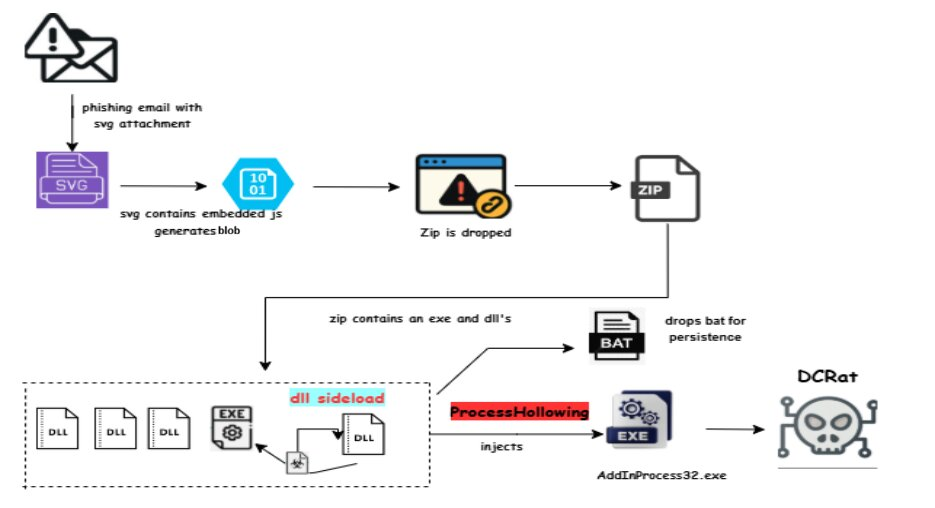
The attack uses DLL hijacking and process hollowing (both not auto-contained). There is also a BAT file created on the hard disk for persistence, and it is auto-contained for at least 3 days (in the CIS default configuration). The question is: Will that BAT file be allowed after three days, like the BAT file created in my test? Can such an attack be dangerous to home users after three days?
The attack uses DLL hijacking and process hollowing (both not auto-contained). There is also a BAT file created on the hard disk for persistence, and it is auto-contained for at least 3 days (in the CIS default configuration). The question is: Will that BAT file be allowed after three days, like the BAT file created in my test? Can such an attack be dangerous to home users after three days?
Last edited:

I can help u answer that question by providing u with the initial payload! Also interestingly the final malware sample is classified by most AVs as AsyncRat.Here we have an example that could bypass CIS:
View attachment 299456
The attack uses DLL hijacking and process hollowing (both not auto-contained). There is also a BAT file created on the hard disk for persistence, and it is auto-contained for at least 3 days (in the CIS default configuration). The question is: Will that BAT file be allowed after three days, like the BAT file created in my test?
Andy Ful
From Hard_Configurator Tools
Verified
Honorary Member
Top Poster
Developer
Well-known
Forum Veteran
I can help u answer that question by providing u with the initial payload! Also interestingly the final malware sample is classified by most AVs as AsyncRat.
You're welcome.

sample sent w8ing for comodo vs this malware strain analysis.You're welcome.
Andy Ful
From Hard_Configurator Tools
Verified
Honorary Member
Top Poster
Developer
Well-known
Forum Veteran
I used the SVG file provided by @Khushal. After opening it in the web browser and clicking, it dropped the ZIP file via HTML smuggling. It was password-protected, but the password was noted in the article.
I unpacked the ZIP archive and executed the benign EXE file. However, the attack was contained to my surprise. I checked the benign file in Comodo Valkyrie, and it was unknown there. So this particular attack in the wild would fail.
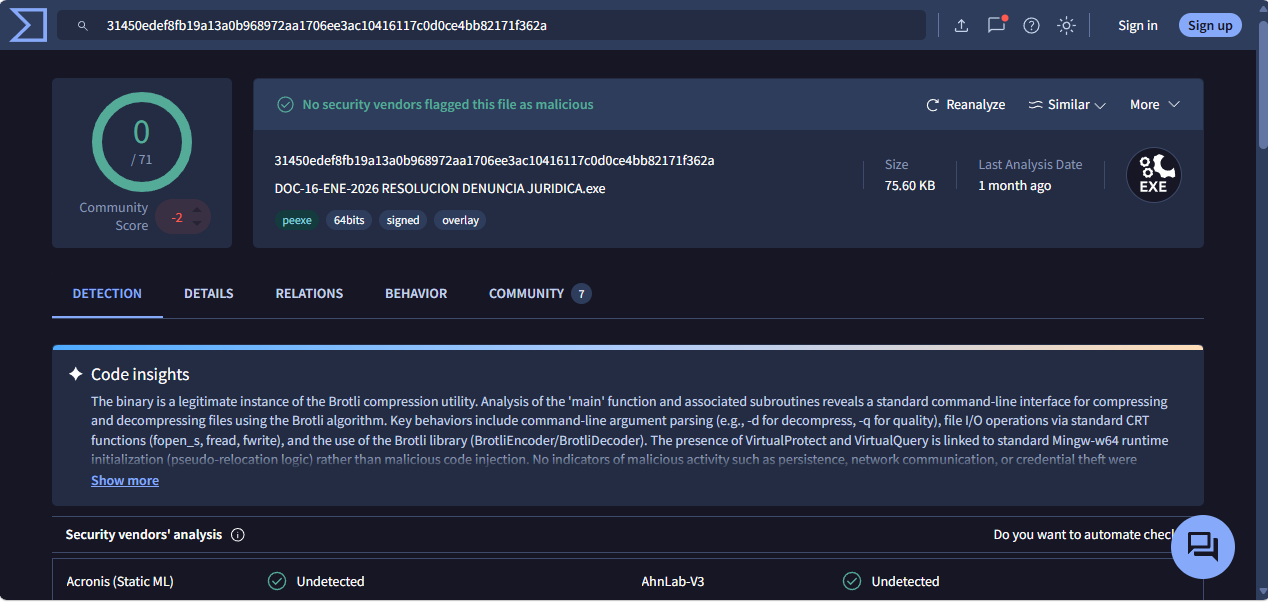
Anyway, it would not fail if the file was known to Valkyrie (it is a legitimate and signed tool). Here is the screenshot from VT (hash 31450edef8fb19a13a0b968972aa1706ee3ac10416117c0d0ce4bb82171f362a):
To continue the test and see what can happen with the BAT file, I manually changed the rating to Trusted.
Now the DLL hijacking worked:
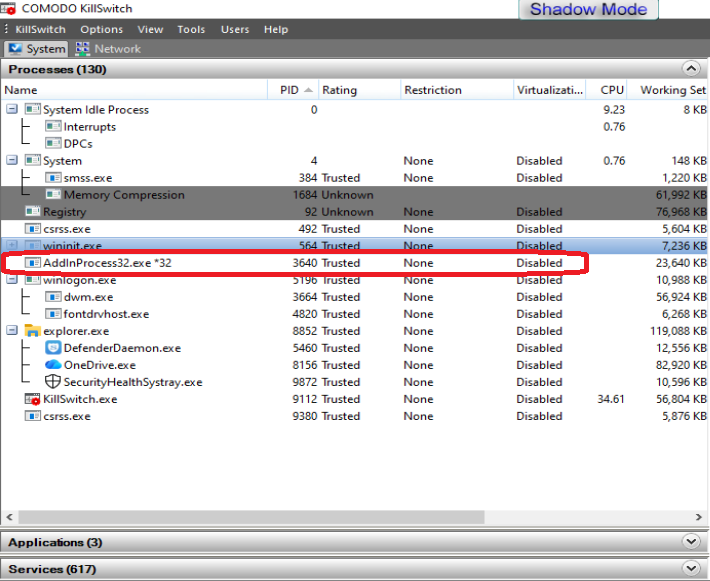
The malware created a special folder and copied there the needed files + the newly created BAT file. The Registry key was added for persistence to run this BAT.
After signing off/on, the BAT file was executed and auto-contained by CIS (as expected). I increased the date by 3 days and signed off/on again.
This time, the malware was not auto-contained. So, the persistence mechanism is delayed, but only by the CIS time isolation limit.
I unpacked the ZIP archive and executed the benign EXE file. However, the attack was contained to my surprise. I checked the benign file in Comodo Valkyrie, and it was unknown there. So this particular attack in the wild would fail.
Anyway, it would not fail if the file was known to Valkyrie (it is a legitimate and signed tool). Here is the screenshot from VT (hash 31450edef8fb19a13a0b968972aa1706ee3ac10416117c0d0ce4bb82171f362a):
To continue the test and see what can happen with the BAT file, I manually changed the rating to Trusted.
Now the DLL hijacking worked:
The malware created a special folder and copied there the needed files + the newly created BAT file. The Registry key was added for persistence to run this BAT.
After signing off/on, the BAT file was executed and auto-contained by CIS (as expected). I increased the date by 3 days and signed off/on again.
This time, the malware was not auto-contained. So, the persistence mechanism is delayed, but only by the CIS time isolation limit.
Andy Ful
From Hard_Configurator Tools
Verified
Honorary Member
Top Poster
Developer
Well-known
Forum Veteran
The question is: Will that BAT file be allowed after three days, like the BAT file created in my test? Can such an attack be dangerous to home users after three days?
Yes, the newly created BAT will not be auto-contained after three days.
The average lifespan of malicious C2 servers often exceeds 7 days, so after 3 days, the attack can still be dangerous.
The incompleteness of Comodo Valkyrie ratings can be additional protection at home against attempts to abuse the Trusted binaries.
Last edited:

A blessing in disguise.The incompleteness of Comodo Valkyrie ratings can be additional protection at home against attempts to abuse the Trusted binaries.
We already confirmed this with your BAT file tests; after 3 days, the newly created "local" file will run outside the container, and the newly created file from the "internet/intranet/removable drive" will run inside.Yes, the newly created BAT will not be auto-contained after three days.
Andy Ful
From Hard_Configurator Tools
Verified
Honorary Member
Top Poster
Developer
Well-known
Forum Veteran
We already confirmed this with your BAT file tests; after 3 days, the newly created "local" file will run outside the container, and the newly created file from the "internet/intranet/removable drive" will run inside.
Not exactly. The creation was done in our tests by hand in Explorer. In the malware example, the creation was done by malware.
Such details can matter in the CIS case.

I tried CIS 2027 and I am pretty sure that if you have protonVPN installed and active (system wide), the firewall doesn't filter anything. I got no prompts. As soon as I disabled the VPN, I got prompts. Reminds me of Sygate firewall that had the so called "proxy hole", if I remember correctly. Shame, because I am trying to implement "defense in depth", but "HIPS" are no more in fashion (and now they are called EDR it seems). Ah, the good old days of Process guard, SSM, Online armor, etc. As a matter of fact, D+ with proactive security had once saved me from an infected USB stick of a neighbour. I got a prompt for new autostart registry entry when she inserted the USB key. I thought "why would a USB key trigger an autostart entry?". Antivirus didn't see anything... That was many years ago. Now it seems everyone is in love with AI and defense in depth consists of OS hardening.
Comodo has the ability to prevent infection from trusted binaries (see the video I linked to above). Regarding msi detection inability, that is totally untrue (nonsense) and was discussed earlier. As for the EDR, I personally don't recommend the use as some can't understand it, and others add ill conceived Rules that have unintended consequences, and it really doesn't add to overall protection.
As to free AV's- one must break the shackles of trusting these. A relic of the past, either it has a definition for the malware or it does not. If one feels lucky, then use it- but to be better protected choose another path.
Hello, Cruel Sister. If I may ask, aside from Comodo, what other programs (pardon me, I am old fashioned...I mean apps), would you recommend for someone who doesn't want to just rely on antivirus? As a matter of fact, now that most run Defender, I wonder how wise this is, since, I imagine that every bad guy out there must test his ware against Defender... So, no surprise that lately some exploits used Defender to gain root access.

It is the current firewall of Symantec endpoint protection.Reminds me of Sygate firewall that had the so called "proxy hole"
Recently browsing
Members who viewed this thread in the last 5 minutes
You may also like...
-

-
Software Review AVG Free Antivirus
-
Software Review ZOHO Endpoint Managed Antivirus 2026
-
Software Review Panda Dome Advanced Antivirus 2026
-