Battle F-Secure SAFE vs. Dr.Web Security Space

Like a Western!

Level 9
Thread author
Verified
Well-known
Apr 6, 2016
430
2,651
771
Iran
Hi guys.

i want to choose only between F-Seure and Dr.Web so please do not suggest any security software else :D
most important for me?
Customer support.
behavior blocker ( their power against zero days.. )

thats it. nothing else :)

and to add a plus here:
+ something i don't like at F-Secure comapny, is that they have not 24/7 support, but DrWeb have, also 24/7 phone support so we can call in urgents..

well i hope you help me to have a right choice :D

Regards,Parham
 
Last edited by a moderator:
Dr Web has always been a Russian AV first and for-most. It's great at detecting RU malware. But lacks in detecting non-ru malware.

F-secure has better detection for global malware campaigns. It's better at all round protection than Dr Web.

I would probably choose F-secure if I had to choose.
 
Hi guys.

i want to choose only between F-Seure and Dr.Web so please do not suggest any security software else :D
most important for me?
Customer support.
behavior blocker ( their power against zero days.. )

thats it. nothing else :)

and to add a plus here:
+ something i don't like at F-Secure comapny, is that they have not 24/7 support, but DrWeb have, also 24/7 phone support so we can call in urgents..

well i hope you help me to have a right choice :D

Regards,Parham
F-Secure according to my opinion
 
I know it's not the real-time protection, but I tried Dr. Web CureIt recently, and the scan was riddled with false positives. I couldn't believe how many legitimate files it marked as malicious. So with that alone I would go with F-Secure. But on it's own merits, it offers good security.
 
how many legitimate files it marked as malicious
Hmm... Could you please remember _exact_ Dr.Web's verdict? There are a lot of programs which Dr.Web detects as 'Tool', or potentially unwanted. It's not real and dangerous virus/trojan, but under certain circumstances the program marked as Unwanted or Tool may cause damage, especially in the hands of an inexperienced user.
 
Hmm... Could you please remember _exact_ Dr.Web's verdict? There are a lot of programs which Dr.Web detects as 'Tool', or potentially unwanted. It's not real and dangerous virus/trojan, but under certain circumstances the program marked as Unwanted or Tool may cause damage, especially in the hands of an inexperienced user.
Just ran another scan in response to your message, and it marked 96 files as PUPs, many of which belonging to a legitimate paid signed program. If the average user just went ahead and did what it recommended, it would render all these programs useless. That is completely unacceptable and reckless if you ask me. The files associated with the paid invoice program has a limited time frame to download the initial installation file. So if you didn't have the original install file, and let Dr. Web delete those files, you would have to re-purchase the software. This isn't so much a problem for me, but for many people that wouldn't know any better, would be in pretty bad shape. Ran a scan with Malwarebytes which is still very good with PUPs, and it didn't flag any files.
 
many of which belonging to a legitimate paid signed program.
Thanks for your reply!
Unfortunately, a lot of 'legitimate paid signed programs' still PUPs. As a fact, numerous boosters/optimizers mainly written to pay for them. This is the main goal of their creators. IMO, most of such software are "fake" and useless software, which simulates rough activity (no doubt, it impresses newbies), but real useful results are about 0 (except wasting your disk). Independent experts and computer scientists have investigated the effectiveness of the software. They concluded that the software practically does NOT improve your PC, compared with the standard system maintenance programs. Defrag procedures are "built-in" in Win 7+, including boot-time defrag (BTW, defrag in Win 7+ IS smart, so SmartDefrag from IObit (as an example) goes to Trash...). Registry fragmentation has almost no effect on performance, so defragmenting the registry every time - meaningless waste of time. DriverBooster can't boost your drivers... Should I continue? :)
 
Last edited:
I used F-Secure and it appears to be quite functional product, effective with a very intuitive UI.
It doesn't consume a lot of memory, and Deepguard behavioral module seems very responsive.

Honestly there is a lot of competition between the various antivirus, I always suggest to test them in order to have a concrete personal opinion
 
I used F-Secure and it appears to be quite functional product, effective with a very intuitive UI.
It doesn't consume a lot of memory, and Deepguard behavioral module seems very responsive.

Honestly there is a lot of competition between the various antivirus, I always suggest to test them in order to have a concrete personal opinion
People absolutely need to test the products they're curious about to see how they work for them.
And that's why I tested F-Secure SAFE when the 6-month promo came up. Liked the performance and simplicity, but nothing else.

The DeepGuard is terrible to keep, with its many false alerts on simple s/w. It doesn't even provide 'allow/ignore' option (exclusions are a different thing, but no Allow option on so many FPs just becomes irritating). Its options are like that of Bitdefender with no allowing, but a little less silent.

If you just see AV test results, it boasts of the max number of FPs. And that's an enough reason for many I've seen, to keep away from such a product.
 
People absolutely need to test the products they're curious about to see how they work for them.
And that's why I tested F-Secure SAFE when the 6-month promo came up. Liked the performance and simplicity, but nothing else.

The DeepGuard is terrible to keep, with its many false alerts on simple s/w. It doesn't even provide 'allow/ignore' option (exclusions are a different thing, but no Allow option on so many FPs just becomes irritating). Its options are like that of Bitdefender with no allowing, but a little less silent.

If you just see AV test results, it boasts of the max number of FPs. And that's an enough reason for many I've seen, to keep away from such a product.
Your experience confirms that different personal tests generate subjective opinions, but they are always constructive to share useful information :)
 
  • Like
Reactions: Parsh
Your experience confirms that different personal tests generate subjective opinions, but they are always constructive to share useful information :)
Yes, these experiences are subjective, what's said out there might not be true for everyone.

But in case of Fsecure, I've seen many users agree on the FPs caused by DeepGuard.
Even the CRO of Fsecure says that their behavioral guard (the five scan engines aside) has been made aggressive to cope with the best of latest threats. It does great, but it comes with some negatives.
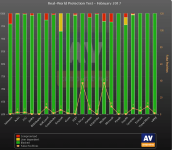
Some Realtime and FPs stats from AV comparatives:
Screenshot_2017-03-29-00-30-39-643_com.adobe.reader.png
Having said that, I've nothing against Fsecure. I think of it like Zemana - excellent protection with a good amount of FPs.

As the comparison here is against Dr.Web (that is another nice tool, I consider it to be a great AV complementary), I've voted for the former.
 
Last edited: