The malware was small, had a limited command set and disguised itself as legitimate Realtek software. Its most unusual feature was its configuration: the address of its command-and-control server was not stored as readable text or encrypted data, but encoded in the number of spaces on each line of a Windows `desktop.ini` file. To a user, and to many automated inspection systems, the file would appear almost empty. To the malware, those spaces spelled out its server address. We found no evidence connecting the backdoor to a known threat actor, and the original infection happened before our protection was installed. However, the implant's custom design, its deployment on only one observed machine and the absence of related samples suggest that this may have been a deliberately targeted operation rather than a failed mass campaign.
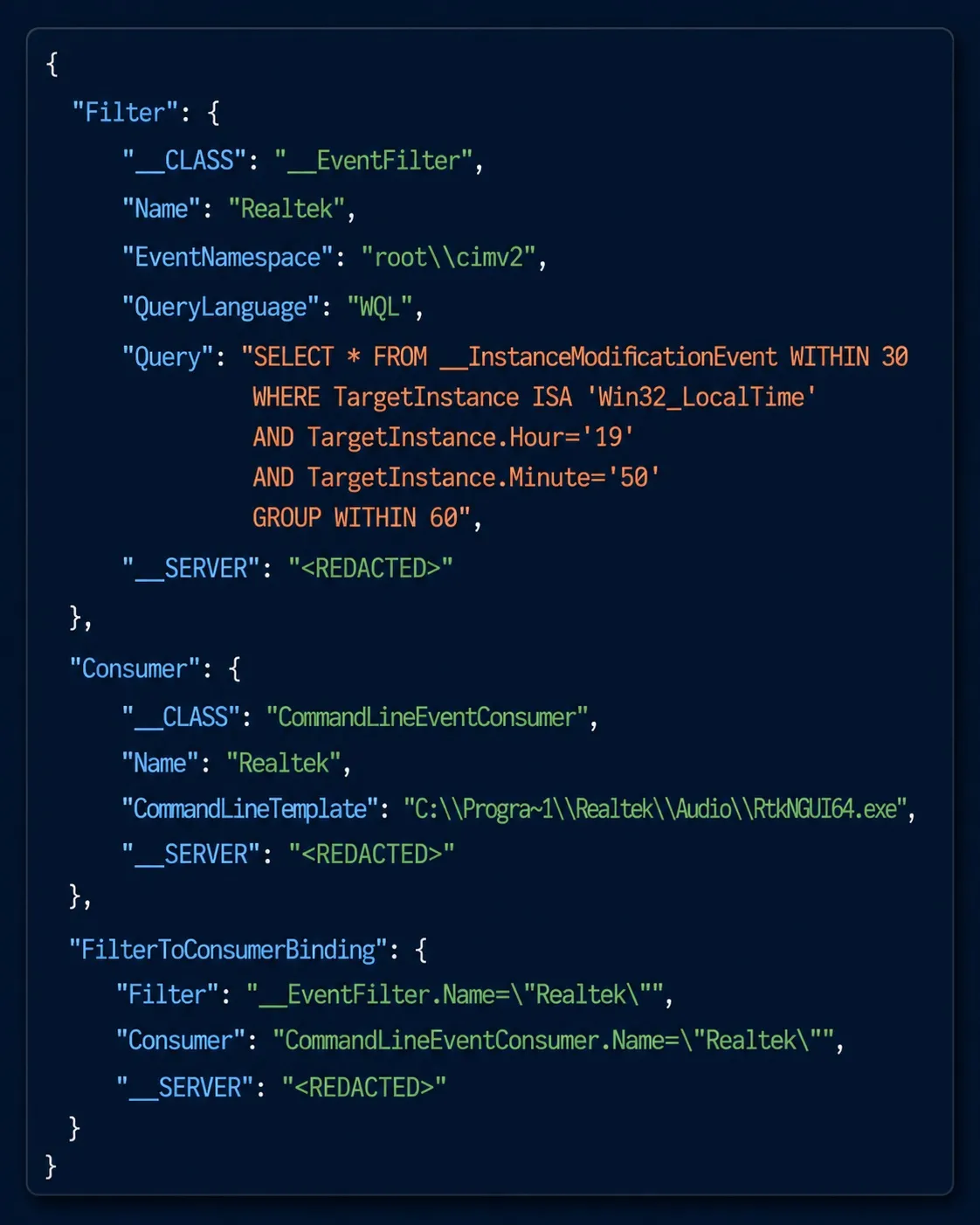
An event subscription named "Realtek"
Most malicious WMI subscriptions are easy to spot because the query asks for something no administrator would. This one asked for something an administrator plausibly might, at a very specific time.
Our behavioural engine dumped the subscription it objected to. This is our own export of the WMI objects rather than a file the attacker left on disk, with the host name redacted:
A hand-written Windows backdoor stored its command-and-control domain as the number of trailing spaces in a fake desktop.ini, and we found it on exactly one machine.

www.gendigital.com