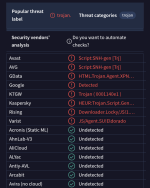
Hot Take Missed script malware by signature analysis

Status
Not open for further replies.
Absolutely agree and it's why I posted my favorite AV above. The writting on the AV box says it all. It is quite simple really.

View attachment 292833
People here are not interested in highly capable and effective security - which is a process, and not software. They are only interested in the software part - AV that keeps them safe while they do what they want. Meanwhile, AV cannot protect them from themselves.

I remember one of the owners of MRG Effitas making a comment to all AV teams... "Try harder."

What a joke that statement was. AV teams can certainly make their products highly effective - at the "cost" of annoying users.

I watch users everyday on government systems that run Windows and Linux 100% in SUA/non-root, with all LOLBins disabled, many OS features disabled, nothing can be installed other than authorized and approved software, blah, blah, blah... and they lose no productivity and are able to fulfill their various missions.

If there is a breakage, and it takes a day or two to fix it - perhaps even longer - well then those users are OK with it. They don't get emotional over it and they don't say stuff like "Default Deny makes your system unusable."

People (users) are always the problem - ALWAYS.
 
You really shouldn’t run unknown scripts that ask for admin access, Microsoft's Administrator Protection feature helps mitigate this threat.
You're making the assumption that Microsoft's new Administrator Protection feature works as intended and, by design, it is intended to cover all elevation scenarios.

I would not make that assumption.

It is just a matter of time before people out there discover ways to circumvent it because the feature was NOT designed to cover all elevation scenarios. And why is that?

Do you think that Microsoft has a security research team that makes exhaustive investigation of possible ways to elevate, including all the arcane corner cases, and ensures that its security solutions protect against them all before it releases a security feature? Of course Microsoft does none of this.
 
What a joke that statement was. AV teams can certainly make their products highly effective - at the "cost" of annoying users.
UAC made it pretty clear, I know UAC is not a security feature, but MS made UAC lighter to appease users, making it useless.
People (users) are always the problem - ALWAYS.
AV is like: I will block this potentially harmful file at all cost.
User is like: I will run this potentially harmful file at all cost!
 
User is like: I will run this potentially harmful file at all cost!
And then be butthurt and angry because their system got smashed because AV did not protect.

I purposefully did not use the wording "failed to protect" because most users' expectations of AV are too high and/or they just don't know (ignorant).

UAC made it pretty clear, I know UAC is not a security feature, but MS made UAC lighter to appease users, making it useless.
When it comes to "forcing functions" they are only effective if the user cannot circumvent the forcing function. In other words... lock user out from being able to change, interfere, or tamper with the system.

The entire "Users want to use stuff" paradigm is dinosaur thinking. It is absurd, but hey... AVs, Microsoft, and cybersec pros don't care. They're available to take a user's (or enterprise's or govt's) money when they screw up and they don't know what to do and have to request help.

The daily click-bait security news is the most effective marketing tool of all because fear, uncertainty, doubt (FUD) is the most effective method to manipulate people. It sells all the solutions that are the worst for the average user.
 
UAC made it pretty clear, I know UAC is not a security feature, but MS made UAC lighter to appease users, making it useless.

AV is like: I will block this potentially harmful file at all cost.
User is like: I will run this potentially harmful file at all cost!
G5QTEmuWIAAVJ6V.jpg
 
Last edited by a moderator:
UAC is not security (anti-malware, anti-phishing, anti-spyware), it is authorisation.

When authorising suspicious code from youtubers with 2 subscribers, the user declares that they authorise the said youtuber to perform whatever actions they wish on the user’ system.

UAC is the equivalent of the phone passcode.

Programatic attacks (Mercenary and so on) are the OS developer’s problem.

If the device owner unlocks the device, gives the device to their jealous partner who then goes through all messages and pictures, this is not a programatic attack and is in no way the phone manufacturer’s responsibility.
 
UAC is not security (anti-malware, anti-phishing, anti-spyware), it is authorisation.
Well it prevents a remote execution to a certain level, because even if PIN is 0000, a remote hacker can not enter it, even if he knows it, because it is a local authorization.
If someone uses a local account, a hacker can easily use it for a remote access, if he knows the password, but MSA/PIN basically renders it useless. One thing, MS got right.
 
Programmatic attacks (Mercenary and so on) are the OS developer’s problem.
If one thinks about it, this is inherently true because the OS developer (any developer of any software in fact) is the one that has access to the code base and can fix the problem. It is even true for FOSS to which anyone has access to the code.

However, ideologically and legally within the global legal system, software publishers have no obligation to do much of anything unless there is a contract that states in-detail the security requirements, shared responsibility, etc. Comprehensively written contracts that favor the buyer/client are very, very rare because no software publisher in their right mind would sign and commit to such a contract.

In all other instances, as in the case of the average home user that has a system with any OS on it, software publishers universally utilize EULAs and Terms of Service that absolve them of virtually all responsibility and accountability for most anything. For security solutions publishers, their liability is minimal when it comes to protection failures. For any software publisher their liability can be absolutely zero within specific jurisdictions.

Now when it comes to software that can cause physical harm and death, then there are established cases where courts across the globe have determined that the software publisher was liable and issued judgements against the defendant (the software publisher). A famous case is an early medical radiographic (x-ray) system that used a software that over-exposed ("dosed") patients with lethal amounts of radiation, and they all died as a result.

The software industry is this way because requiring publishers to meet secure coding, audits - both self and external independent audits of both code and the overall development system, pentesting their products, attestations of comprehensive secure coding and oversight, and so on is considered unreasonable and economically unviable.

The sole exception is regulations that impose requirements onto software publishers - but none of the regulations are effective for various reasons. Most are weak and accomplish nothing.

The EU is the only one that I know of that requires software publishers to patch vulnerabilities for five (5) years after its release - and there is a huge effort by the industry against it. Some publishers have or plan on exiting the EU because of it. Most will continue but raise prices to cover the regulatory overhead expense. So, in the end, the buyer always assumes the cost.

But the world thinks "Security is software" and there's not much that can be done at this point. Things will never be as good as they are at this moment. It will only become progressively worse. And before someone brings up AI - no, this will not definitively solve the problems because the "Users want to use stuff" model + people will still be a part of the equation. AI might have a chance if people are completely removed from the equation.
 
You're making the assumption that Microsoft's new Administrator Protection feature works as intended and, by design, it is intended to cover all elevation scenarios.

I would not make that assumption.

It is just a matter of time before people out there discover ways to circumvent it because the feature was NOT designed to cover all elevation scenarios. And why is that?

Do you think that Microsoft has a security research team that makes exhaustive investigation of possible ways to elevate, including all the arcane corner cases, and ensures that its security solutions protect against them all before it releases a security feature? Of course Microsoft does none of this.
No security feature is foolproof, it’s always a back-and-forth battle. But for now, this one still does the job.
 
  • Like
Reactions: Khushal
I love how something so simple can be turned into a software war. This is 101 security right here. Do not download items you can not verify. Stop playing with scripts especially for gaming when you absolutely know gaming is highly targeted. If you must game then by all means, buy legit games, play them in counsel separate from your PC.

I do think it's great seeing participation in threads, it would just be nice to see some serious discussions on anything but who is the best AV. This just enforces people to make bad decisions while relying on something that will at some point let them down. If you are to discuss it, discuss habits and routines so others can learn to avoid crap like this. Some kid watching this right now is going to think if I put AV "A" on my system I can download this dumb crap and be ok. 🤦‍♂️
 
Last edited:
I love how something so simple can be turned into a software war. This is 101 security right here. Do not download items you can not verify. Stop playing with scripts especially for gaming when you absolutely know gaming is highly targeted. If you must game then by all means, buy legit games, play them in counsel separate from your PC.

I do think it's great seeing participation in threads, it would just be nice to see some serious discussions on anything but who is the best AV. This just enforces people to make bad decisions while relying on something that will at some point let them down. If you are to discuss it, discuss habits and routines so others can learn to avoid crap like this. Some kid watching this right now is going to think if I put AV "A" on my system I can download this dumb crap and be ok. 🤦‍♂️
Oh, absolutely, because teaching people to pick the right antivirus is soooo useless. Let’s just skip the real talk about which tools actually catch the nasties and focus only on habits—like, ‘Don’t download files from sketchy sites,’ which, surprise, some folks ignore anyway. Meanwhile, AV brands fight tooth and nail on features, detection rates, and usability—because those things matter. So yeah, let’s just pretend AV debates don’t matter while people keep downloading suspicious files thinking their antivirus is a magic bullet. Brilliant plan!
 
Oh, absolutely, because teaching people to pick the right antivirus is soooo useless. Let’s just skip the real talk about which tools actually catch the nasties and focus only on habits—like, ‘Don’t download files from sketchy sites,’ which, surprise, some folks ignore anyway. Meanwhile, AV brands fight tooth and nail on features, detection rates, and usability—because those things matter. So yeah, let’s just pretend AV debates don’t matter while people keep downloading suspicious files thinking their antivirus is a magic bullet. Brilliant plan!
Ok genius just how many AV vs AV threads do we need to discuss this topic then if habits are so unimportant?
 
Ok genius just how many AV vs AV threads do we need to discuss this topic then if habits are so unimportant?
Oh, just enough to keep the keyboard warriors busy while the rest of us try to survive the wild internet jungle. Because sure, habits are important, but when your AV decides to nap right as you click that ‘definitely safe’ download, suddenly who’s the MVP? Let’s keep debating AVs—it’s cheaper than therapy for all those ‘my AV didn’t catch it’ moments. Meanwhile, some of us will actually use both good habits and a solid AV, but hey, debating is way more fun, right?
 
I am not sure how this thread which is packed with malware analysis information, as well as general information on programatic vs non-programatic attack is related to “which one is the best antivirus” or habits.

Should we then close every forum and blog related to malware analysis and replace it with one large banner
DO NOT DOWNLOAD SOFTWARE FROM SHADY SITES…
 
My post #86 already discussed that users should not authorise code from suspicious locations.

If anyone should worry about “the reader” and “the kid executing this code”, this is Google/YouTube which generates billions and with AI can easily detect the intention of the video which is:
-Lure users with promises for “cracked” and “hacked” expensive services and software
-There is then no free launch, users are tricked into running a hybrid of fileless and file-based malware.

YouTube should NEVER under any circumstances allow videos that promote cracking and they should not allow descriptions that ask users to turn off their AVs. With the antivirus software on, the malware is easy to detect.

If YouTube/Google don’t bother investing 0.001% of their revenue in proper moderations, not sure why we here, on MalwareTips should be bothered about “the kid that will see this malware”.

Are we the police of the internet?

Cracked software bringing malware, this is not from today, as early as 2006-2007, the zlob trojan and the fake avs were known to be distributed as driver-by and through software cracks.

Are we gonna re-discover the hot water on every thread?
 
Status
Not open for further replies.