Malware News Seqrite reported a multi-stage .NET malware campaign abusing GST-themed phishing to deliver Remcos RAT, using in-memory loaders targeting Indian users

Khushal

Level 16
Thread author
Verified
Top Poster
Well-known
Apr 4, 2024
754
4,968
1,469

Introduction

Seqrite Labs recently identified a malware distribution campaign that abused the credibility of government institutions to increase infection success rates. The threat actors impersonated legitimate government departments and distributed malicious emails disguised as official notifications related to taxation, refunds, compliance requirements, and regulatory matters. By leveraging recognizable government branding, urgency, and financial incentives, the campaign was designed to persuade recipients to open malicious attachments or interact with embedded content. This activity highlights the continued effectiveness of government-themed social engineering techniques in facilitating malware delivery and compromising targeted users.

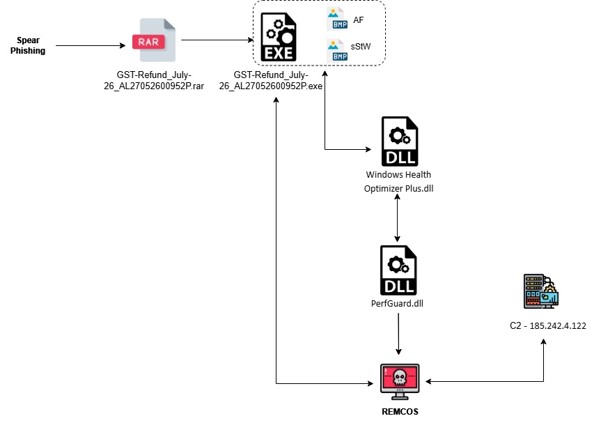
Infection Chain:

Picture1.jpg
 
Key Takeaways

This is a good example of how attackers combine trusted government branding with urgency and financial incentives to bypass normal caution. Tax refunds, compliance notices, and regulatory deadlines are especially effective themes because recipients may fear penalties or want to recover money.

According to the linked report, the campaign ultimately delivers Remcos RAT through a multi-stage infection chain. Opening an attachment or following a link is therefore not necessarily the final malicious action; it may initiate additional downloads, scripts, or payload delivery.

Recommended precautions include:

  • Verify tax and regulatory notices through the relevant official website or portal, rather than using links or contact details contained in the message.
  • Treat unexpected attachments, refund notifications, and requests to enable macros or run scripts as suspicious.
  • Check the sender domain and the actual destination of embedded links; convincing branding does not prove authenticity.
  • Keep operating systems, browsers, document software, and security products updated.
  • Submit suspicious files or URLs to reputable analysis services such as VirusTotal, while avoiding the upload of confidential documents.
  • If an attachment was opened or an unknown program executed, disconnect the affected system from the network and perform a scan with reputable security software.

The exact safety of any individual message or attachment cannot be determined from branding or appearance alone. Independent verification through official channels is the safest approach.