
Question Which AV are you using and why did you choose this one ??

Help answer the author's question with clear explanations and useful steps.
Forgive me, but why would you want to replace Kaspersky...possibly with Bitdefender? Granted, BD does have good protection, but IMO, they are a jack of all trades, and a master of one, device/online security. Otherwise, there are better VPN's (and PM's) than BD. BD does have some glitch issues, and it's not as stable as Kaspersky. Again, just my opinion and observation from my past use.

Maybe also consider ESET? I'm not sure about their VPN, though, as I've tended towards independent VPN providers.
Kaspersky spins up the cpu (9800X3D) after boot like there is no tomorrow, the fans go crazy for a good few seconds. ESET did not do that.
Because of Yandex bombing the 3 days no vpn screwed me.
The other thing I won't mention I don't want to start off-topic flame here.
 
Kaspersky spins up the cpu (9800X3D) after boot like there is no tomorrow, the fans go crazy for a good few seconds. ESET did not do that.
Because of Yandex bombing the 3 days no vpn screwed me.
The other thing I won't mention I don't want to start off-topic flame here.

Yep, I understand :) Again, I don't want to lay into BD, but it will use a lot of processes (~14-16 with the VPN), and some RAM, anywhere from ~285 to 385 MB, and I've seen it climb up higher to ~450+

ESET would be more stable, less processes, BD Total does have more bells and whistles (modules) while ESET is more about the finer grain settings app.

You could give BD Total a trial run though.
 
What about a replacement for Kaspersky Standard? Same options?

Yep!
It's just that ESET doesn't include a VPN in the Essentials plan—only in the Ultimate plan (which is a rebrand of Windscribe...).
Bitdefender has everything, but as far as I remember, it's limited to 200 MB per day, except for the most expensive plans... (It works the same way with ESET and Ultimate, and ESET offers unlimited data on the Ultimate plan...)
 
Yep!
It's just that ESET doesn't include a VPN in the Essentials plan—only in the Ultimate plan (which is a rebrand of Windscribe...).
Bitdefender has everything, but as far as I remember, it's limited to 200 MB per day, except for the most expensive plans... (It works the same way with ESET and Ultimate, and ESET offers unlimited data on the Ultimate plan...)

Yep, you're right, BD VPN is 200 MB unless you buy the VPN Premium version (for Total or AV Plus), or buy the Premium Security version with the unlimited VPN.
 
Yep, I understand :) Again, I don't want to lay into BD, but it will use a lot of processes (~14-16 with the VPN), and some RAM, anywhere from ~285 to 385 MB, and I've seen it climb up higher to ~450+

ESET would be more stable, less processes, BD Total does have more bells and whistles (modules) while ESET is more about the finer grain settings app.

You could give BD Total a trial run though.
Uses a lot of processes means that it has a relatively 'high' cpu usage every time?
RAM is not an issue I have plenty (64 GB).
 
Uses a lot of processes means that it has a relatively 'high' cpu usage every time?
RAM is not an issue I have plenty (64 GB).

And that's just it, if you have the RAM, it's not an issue, maybe if you only had 8 GB of RAM like on my Surface 5 laptop, it was.

As far as CPU, it's not so much high CPU, but RAM, the processes used aren't an issue for most users, as some of them are for backup, redundancy sake, and to help share the process load. But, it can randomly spike to a higher Ram use every now and then. I used to keep track of it occasionally with Task Manager.

The BD VPN does have some nice settings and features, a nice UI. It uses Hotspot Shield's (AnchorFree) Catapult Hydra infrastructure.

edited for better clarification.
 
Last edited:
Kaspersky spins up the cpu (9800X3D) after boot like there is no tomorrow, the fans go crazy for a good few seconds. ESET did not do that.
Because of Yandex bombing the 3 days no vpn screwed me.
The other thing I won't mention I don't want to start off-topic flame here.
My first choice is always Kaspersky. But if you want something else, second paid choice is BitDefender. Nothing else comes nearby in terms of protection. These two play in their own league.

Now, if none of these are an option for you, I wouldn't consider paying for any other antivirus. Else, I'd go for Microsott Defender + VoodooShield CyberLock, and harden Defender with DefenderUI (free software). As for VPN, I'd go for a separate, decent option, like Windscribe/NordVPN/AirVPN if you want a decent, no-log VPN.
 
Thanks!
Without going into any political stuff.

I know Kaspersky has some kind of 'EU' division, but the Yandex incident showed that VPN goes through their RU data centers.
How safe is Kaspersky for an average EU citizen who doesn't do any political stuff and has nothing to hide?

I also know many international AV testing sites show that Kaspersky is very good.

By the way, why is Kaspersky your first choice always?
 
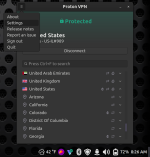
I use Proton VPN Free. It's very very beautiful.

In Kubuntu, are you getting the full GUI like on Windows? For Mint Cinnamon, it's the compact version, with the expandable Settings window.

2026-10-15_08-27.png
 
My first choice is always Kaspersky. But if you want something else, second paid choice is BitDefender. Nothing else comes nearby in terms of protection. These two play in their own league.

Now, if none of these are an option for you, I wouldn't consider paying for any other antivirus. Else, I'd go for Microsott Defender + VoodooShield CyberLock, and harden Defender with DefenderUI (free software). As for VPN, I'd go for a separate, decent option, like Windscribe/NordVPN/AirVPN if you want a decent, no-log VPN.
Avast comes close to both of them, and in some scenarios, even outperforms them. Keep in mind that Avast is an antivirus conglomerate.
 
Honestly, my favorite antivirus products right now are Bitdefender, Malwarebytes, and AVG. I used to really like Trend Micro, but its product development seems to have slowed down, and the application hasn’t changed much in quite a while. They did introduce some type of AI-powered URL checker, but it feels poorly designed and implemented.
 
I believe Malwarebytes offers some of the best web protection available, especially with its Scam Guard checker, which provides useful information about a website’s age and WHOIS registration details. It’s also effective at detecting new and emerging phishing threats, including potential zero-day attacks. Another great feature is the ability to submit suspicious URLs that haven’t yet been detected, helping Malwarebytes identify and address new threats. What makes it even better is that both Browser Guard and Scam Guard are available for free, which is a fantastic move by Malwarebytes.
 

Recently browsing

Members who viewed this thread in the last 5 minutes

Back
Top