


A caller discussing suspicious bank activity can sound reassuring when they already know customer information and offer to organize the next steps.
The Albert Guerra bank scam shows why the next instruction matters far more than how convincingly a caller introduces an account investigation.
Overview
The caller used a bank investigation as the explanation
Albert Guerra and his associates obtained bank customer information, then called people while falsely claiming to be investigating fraud affecting their banks.
They persuaded victims to withdraw cash and hand it to people described as bank employees, according to the account in Guerra’s plea agreement.
The collection was therefore presented as part of resolving a banking problem, rather than an ordinary payment the victims had independently decided to make.
Rideshare drivers carried the packages under a different story
The collectors were rideshare drivers sent by Guerra to retrieve cash from victims and deliver it back to him, according to federal prosecutors.
Guerra frequently told the drivers they were collecting documents from his grandparents, giving them an explanation different from the one supplied to victims.
That detail matters because a genuine driver arriving at the correct address does not establish that a bank authorized the collection of cash.
The fraud was admitted in federal court
The Justice Department’s March 26, 2026 announcement reports Guerra’s guilty plea to bank fraud and money laundering after the nationwide impersonation scheme.
It identifies victims in the San Diego area and Portland, showing that the conduct involved more than one isolated complaint about an unfamiliar caller.
- A caller knowing banking information does not establish permission to tell you where cash should go or who should collect your savings.
- A legitimate transportation booking proves that someone arranged a trip, rather than proving the driver’s passenger or package represents an authorized bank operation.
- Withdrawing your own money and handing it over creates a different recovery problem from an unauthorized card purchase you discover on a statement.
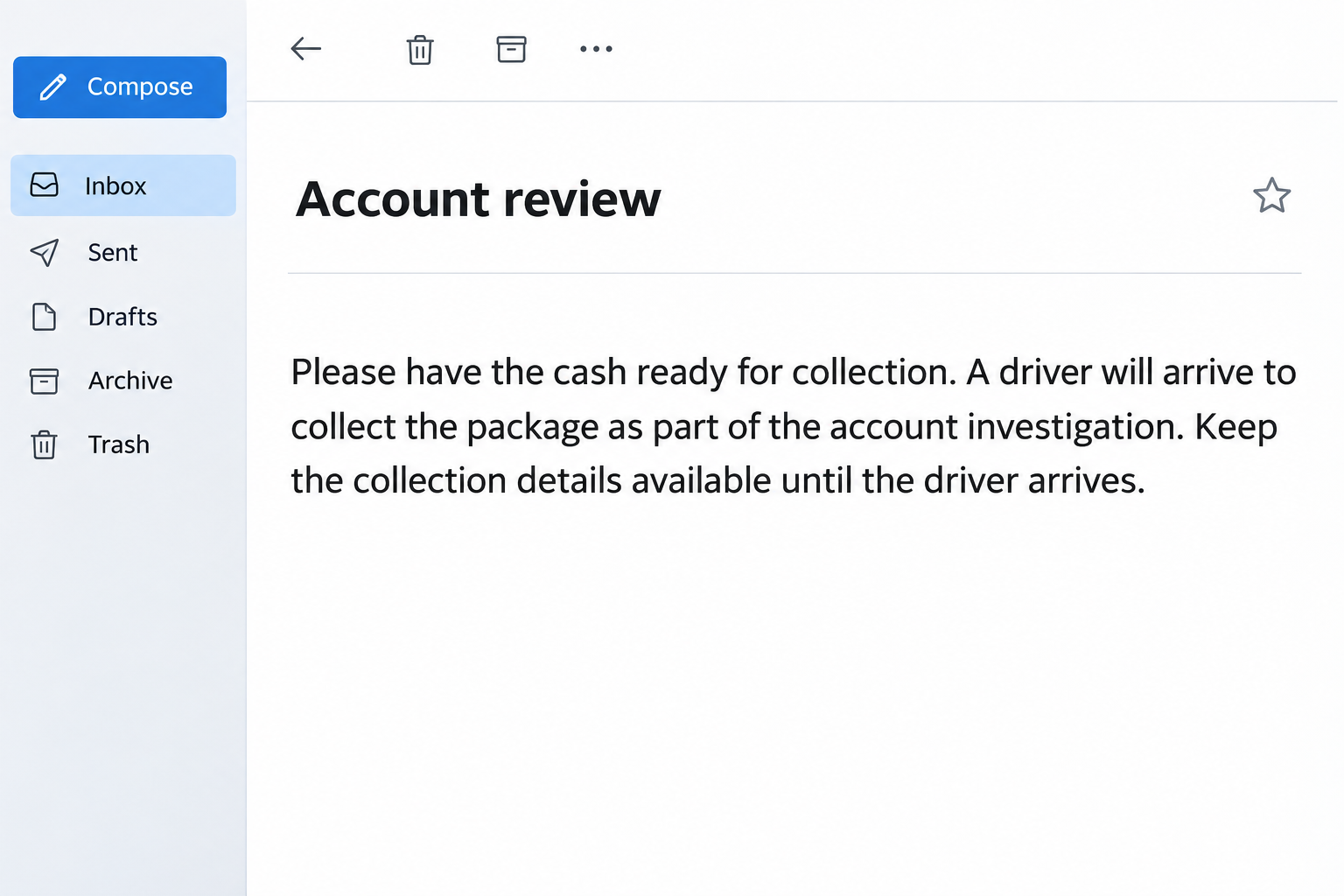
The image reconstructs the collection request in ordinary message form; it is not an original text recovered from Guerra or a victim.
Two Explanations Met at the Same Doorstep
Victims expected a bank employee, while drivers believed they were carrying out a family errand, leaving both sides accepting different explanations for the collection.
For the victim, the arrival could seem like confirmation that the caller had access to a real organization capable of arranging a collection.
For the driver, collecting documents from a relative could resemble an ordinary delivery, without revealing that the package actually contained savings obtained through deception.
The public account does not establish that every driver knew about the fraud, so their involvement should not automatically be described as criminal participation.
The same limit applies to the rideshare platform, whose service being used does not prove that the company endorsed or knew about the scheme.
What connects the two stories is Guerra’s direction of the collection and his admitted use of the process to obtain money from victims.
This is why asking whether the car or driver looks genuine misses the banking question that should be answered before any cash changes hands.
The independent check belongs with the actual bank, reached through an established contact route that the caller did not supply or control.
What the Confirmed Case Says About the Losses
Three San Diego victims lost $13,000, $37,000 and $86,300 after Guerra arrived in October 2025, according to the Justice Department’s account.
The announcement also describes a Portland victim losing $40,000 in January 2026, after Guerra traveled there as part of the same scheme.
These amounts identify reported incidents, rather than establishing a complete nationwide total or a loss suffered by every person approached by the callers.
The account also describes Guerra making a substantial cash purchase after collecting victims’ money, illustrating how quickly the scheme could turn withdrawals into spending.
The key detail for someone facing this demand is that the transaction can begin with a withdrawal they personally authorize at their own bank.
That withdrawal does not become safe merely because the bank dispenses the cash, since the fraudulent instruction concerns what happens to the money afterward.
When reporting, describe both stages accurately instead of saying only that money disappeared from the account or that a driver accepted an ordinary package.
The bank and investigators need to understand the false banking explanation, the withdrawal and the collection together to assess what happened to the funds.
How the Albert Guerra Bank Scam Works
Step 1: Customer information makes the caller sound relevant
Guerra and his associates obtained bank customer information before making calls that falsely claimed to concern fraud investigations affecting the victims’ banks.
The plea announcement does not identify every source of that information, so a particular data breach or method of theft should not be assumed.
For the person answering, accurate details can make the caller sound like someone with legitimate account access, even before any instruction is given.
Treat that knowledge as information the caller possesses, rather than proof of their employment, authority or right to direct a transaction involving your savings.
End the conversation and contact your bank independently, without answering more security questions or telling the caller how you plan to verify the claim.
Step 2: A supposed investigation produces a cash withdrawal
The callers persuaded victims to withdraw money from their accounts, presenting that action as part of an investigation instead of a payment to strangers.
Victims were acting on financial instructions, moving beyond listening to a warning and following directions from someone whose identity they had never independently verified.
The risk remains even when a caller sounds polite and knowledgeable, or offers to stay on the line throughout your visit to the bank.
If an unexpected caller wants savings withdrawn for collection, stop and tell your bank exactly what that person has asked you to do next.
Refuse the caller’s suggested cover story, because accurate information helps bank staff recognize the deception behind what otherwise looks like an ordinary cash withdrawal.
Step 3: Guerra arranges a driver using another explanation
Guerra arranged rideshare collections and frequently told drivers that they would retrieve documents from his grandmother or grandfather, according to the Justice Department’s announcement.
The driver could therefore arrive with apparently ordinary booking instructions while the victim expected someone connected to the false investigation described over the phone.
Arriving at the promised address shows that someone arranged transportation there, without establishing any connection between the package collector and the bank being impersonated.
A driver’s name or booking notification cannot validate banking instructions, especially when the request began with an unexpected caller claiming authority over your account.
If collection is imminent, keep the package and yourself safe while contacting police as appropriate, rather than trying to investigate the driver through confrontation.
Step 4: The cash leaves the victim’s control
Victims handed over the withdrawn money because they believed the collectors were bank employees, while the drivers delivered the packages back to Guerra.
That physical handover is the point where cash still held by the victim becomes property controlled by someone operating the fraudulent arrangement.
Before that happens, stopping the collection can preserve money already withdrawn, even if the person feels embarrassed about having followed the earlier instructions.
Afterward, the response needs details about the collection as well as the withdrawal, including timing, communications and any booking information already available.
Once another person takes the cash and transports it away, do not assume the handover can be reversed through a routine bank transfer recall.
Step 5: The victim must report the whole sequence
Guerra admitted bank fraud and laundering, confirming that the investigation story deceived victims instead of reflecting confusion about a genuine service from their bank.
For another affected person, recognizing that pattern should lead to immediate reporting without waiting for the caller to admit wrongdoing or provide another explanation.
Tell the bank which actions you authorized because of the deception, and retain messages explaining why you believed the withdrawal and collection were required.
Accurate reporting helps the institution assess the withdrawal, account exposure and available recovery options, without having to untangle an incomplete description of the transaction.
If another pickup is requested, keep the demand as evidence and seek verified police guidance rather than agreeing to meet the collector again.
What a Driver’s Arrival Does and Does Not Confirm
The following comparison helps someone evaluate a collection request without confusing a real transportation service with the banking authority claimed by the caller.
| Detail that seems reassuring | What it actually shows | Safer response |
|---|---|---|
| Caller knows account-related information | The caller has information about a customer | Verify the request directly with the bank |
| Driver arrives at the expected address | Someone arranged a collection there | Keep the cash and check the claimed authority |
| Recognizable rideshare booking | A real transport service may be involved | Separate the booking from the reason for pickup |
| Package described as documents | The driver may have received a different story | Preserve both explanations for investigators |
| Bank completed a cash withdrawal | The customer obtained their own funds | Do not assume the later handover is authorized |
A Practical Pause Before Any Collection
If the cash is still with you, do not let the caller’s deadline decide whether a package leaves your home or another meeting place.
End contact and call the bank using the number on your card or statement, then describe the proposed collection and the investigation claim.
Ask whether the bank authorized that specific request, and explain any information or security codes you already shared during the earlier telephone conversation.
The FTC’s recovery guidance recommends contacting the relevant financial institution promptly, while recognizing that money already paid to scammers may be difficult to retrieve.
If a collection has been scheduled, involve a trusted person who can stay with you and help organize the information needed for reporting.
Avoid traveling to meet the driver or following the vehicle after a handover, because retrieving cash is not worth creating a dangerous encounter.
Someone who was deceived needs practical help and a calm conversation, particularly when shame might otherwise keep them answering the original caller’s next demand.
What to Do if You Have Fallen Victim to This Scam
-
Stop the pickup while you still have the cash, and refuse any handover to a driver while the supposed investigator continues directing your actions.
If someone arrives or threatens you, stay physically safe and contact emergency services when necessary rather than confronting or attempting to detain the person.
Let a trusted family member or friend help you make independent calls, especially if the original caller is repeatedly demanding that the collection proceed.
-
Contact the bank through an established number and explain that a caller impersonating its staff instructed you to withdraw cash for an investigation.
Give the withdrawal dates and amounts, describe any account information you disclosed, and ask what protection or recovery steps fit those exact circumstances.
Be clear whether the cash remains with you or was already collected, because those situations require different decisions and offer different practical options.
-
Save call logs, messages, withdrawal receipts and collection instructions, including any driver or booking information that is already available from the incident.
Write down the time and place of the handover, who arranged it and what each person claimed the package or investigation was for.
Keep these records privately for your bank and investigators, and do not publish a driver’s personal information as a substitute for reporting the fraud.
-
Report the collection to local police and describe the false bank investigation alongside the cash handover, rather than presenting only a missing delivery complaint.
If you know the transportation service involved, contact its official support and supply the trip details or collection information you hold about the incident.
Ask how to record the incident and retain its reference, without assuming the driver or platform knew the package contained money obtained through deception.
-
Open IC3 to file your online report, review the complaint terms and enter the caller’s claims, withdrawal amounts and collection details.
Include the caller’s claims, payment amounts, collection route and any financial or contact information used, then keep the confirmation provided after the submission.
The report helps document cyber-enabled fraud, but it does not replace an urgent safety call or automatically require your bank to reimburse the withdrawal.
-
Use bank and police reference numbers when following up, and record any calls claiming another pickup will resolve the loss from the first collection.
Refuse advance recovery fees or account-access requests from anyone promising guaranteed compensation, even when they know details about the incident you reported to police.
Help older relatives with verified contacts and paperwork, so embarrassment does not leave them isolated when another caller tries to exploit financial worries.
Frequently Asked Questions
Was Albert Guerra’s scheme confirmed or merely alleged?
Guerra pleaded guilty to bank fraud and money laundering on March 26, 2026, admitting conduct described in the Justice Department’s announcement of the case.
That is the basis for calling this a confirmed scheme, rather than treating one customer’s concern about a legitimate bank as proof of fraud.
Did the rideshare drivers knowingly participate in the scam?
The announcement says Guerra frequently told drivers they were collecting documents from his grandparents, which differs from the banking explanation given to victims.
A collection booking cannot establish every driver’s knowledge, so report the facts accurately without turning the incident into unsupported accusations against drivers or platforms.
Why does withdrawing the cash myself matter when reporting?
The bank needs to distinguish a withdrawal you made under a false explanation from a transaction someone carried out without your authorization or knowledge.
Describe the deception honestly and ask about the available response, rather than changing the account of events to fit an assumed reimbursement category.
What if the driver is already on the way?
Keep the cash secure, end the caller’s instructions and contact verified police or your bank about the attempted collection before surrendering any package.
An immediate threat at the property requires personal safety and emergency assistance, rather than challenging the collector or trying to keep the arranged appointment.
Does knowing my customer information prove the caller works for my bank?
No, knowing account information does not establish employment or authority, and prosecutors say Guerra’s associates obtained customer details before beginning their deceptive bank calls.
Use your own established banking contact to check the request, and tell that institution what information the caller knew or asked you to provide.
Is this the same as a bank card collection scam?
The related warning signs overlap, but Guerra’s admitted scheme persuaded victims to withdraw cash that rideshare drivers then transported back to him.
Your response must address cash and the collection itself, since replacing a bank card cannot retrieve the money you handed over inside a package.
The Bottom Line
Refuse an incoming caller’s request to withdraw cash for a bank investigation, regardless of their information or arrangements for someone to collect the money.
Guerra’s admitted scheme used different explanations for victims and drivers, making an ordinary-looking collection part of a fraudulent route for taking savings.
If cash was collected, contact your bank and police promptly, preserve withdrawal and pickup records, and refuse requests to arrange another handover of money.

Join the discussion
0 commentsShare your experience or ask a question about this article.
Community experiences
Did this happen to you?
Your experience could help someone recognize the same scam. Submit a private report for our team to review.
I experienced this tooReports are reviewed before publication. Sharing publicly is always your choice.
Discussion
Start the conversation
Have a question or something useful to share? Add the first comment.