


An unexpected refund email can seem easy to resolve when it offers a representative who will explain everything over the phone.
In the Jiandong Chen scam case, that apparently helpful conversation was one entrance to a much larger operation targeting older Americans.
Overview
Different opening stories fed the same collection network
The network used technical support, bank impersonation, government impersonation and refund stories, rather than relying on one message every victim received.
Unsolicited calls, emails and pop-up ads directed people toward phone numbers operated by scam call centers in India, according to prosecutors.
Those conversations eventually produced payments to participants in the United States, including cash packages, wire transfers and some collections made in person.
A guilty plea and prison sentence confirmed Chen’s role
Jiandong Chen, also known as Little Tiger, admitted participating in the conspiracy and received a 78-month federal prison sentence in November 2026.
The specific sentencing announcement describes an operation that caused more than $27 million in losses to over 2,000 older victims during 2021–2023.
Chen admitted that losses during his involvement exceeded $9.5 million, which forms part of the broader case rather than an additional total.
A parcel changes the recovery problem
When the requested payment becomes physical cash, the immediate question is whether the shipment can still be stopped before someone receives it.
- A domestic delivery address does not establish that a caller represents your bank, a technology company or a legitimate government agency.
- A parcel tracking receipt confirms a shipment’s movement, but it cannot confirm that the person collecting it has authority over your account.
- A supposed refund should not require withdrawing savings and sending cash, even when the caller describes that action as correcting an error.
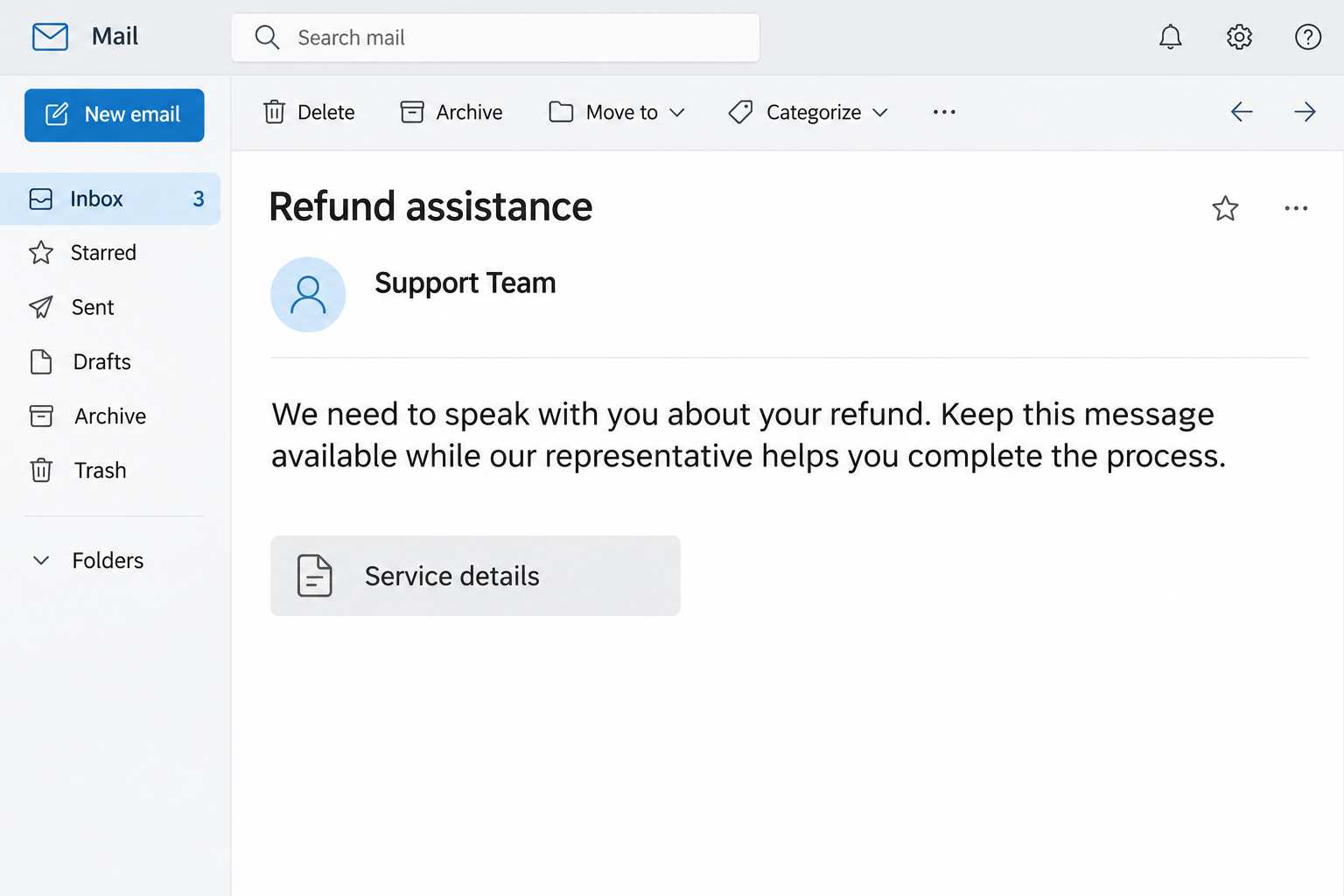
The email image is a reconstruction of a refund callback approach, not original correspondence recovered from Chen’s case or a victim’s inbox.
Why a Helpful Phone Conversation Can Become Dangerous
The opening message does not need to explain the full payment request, because its first purpose is simply to get a conversation started.
Once that happens, the caller can answer questions, adjust the explanation and keep the person focused on a problem the caller has introduced.
The Justice Department describes trust-building through social engineering, which means manipulating someone’s decisions rather than gaining authority through a genuine institutional role.
An older person might therefore be following what sounds like a protective instruction while the caller works toward an entirely different outcome.
Blaming the person who answered misses that distinction and can make it harder for someone to ask for help before another payment leaves.
If a relative is still talking to the caller, start with the requested action and the money at risk rather than arguing about intelligence.
Ask whether any cash has been withdrawn, packaged or shipped, and whether a bank transfer or personal collection has already been arranged.
Those practical questions help identify the next useful call, even before the family understands every identity or explanation used during the conversation.
The goal is to interrupt the transfer route while preserving enough information for the bank, carrier and investigators to understand what happened.
How the Jiandong Chen Scam Network Worked
Step 1: An unsolicited message creates a reason to call
Victims received calls, emails or pop-up ads that directed them toward telephone numbers belonging to the network’s overseas scam call centers.
The public announcement identifies several impersonation stories, so a refund message should be understood as one route rather than the only opening.
For the recipient, the first decision is whether to accept the contact details provided by a message they did not independently verify.
Do not use an unexpected email or pop-up as your source for a company’s support number, especially when money or account access becomes involved.
Open the service through a route you already trust and check whether the claimed issue appears there before entering a new conversation.
Step 2: The caller builds confidence around a false role
The conspirators used social engineering to gain trust before persuading victims to send money, according to the account provided in the sentencing announcement.
A conversation can sound organized because multiple people coordinate it, rather than because the organization they claim to represent approved the request.
Being transferred between supposed departments therefore cannot substitute for starting a separate conversation with the real institution through its established contact route.
The same applies when a caller knows personal details, because knowledge about a customer does not authorize that person to direct financial transactions.
Keep the institutional claim separate from the proposed action, and ask why that action would require money to leave your control.
Step 3: The conversation turns into a payment instruction
The network induced victims to send money to participants in the United States, most often as bulk cash through express mail packages.
Other payments traveled by wire transfer, while some members collected money directly, so an affected person needs to identify the route actually used.
This is the stage where a supposed support problem becomes a financial loss, even if the caller continues describing it as assistance.
Do not withdraw money or prepare a parcel to fix an account problem introduced by an unsolicited contact, regardless of the claimed department.
If a payment is already being arranged, pause it and bring a trusted person into a separate conversation before following any further instructions.
Step 4: Local collectors make the remote operation work
Chen admitted using false identification to retrieve victims’ packages and moving between jurisdictions to evade law enforcement during his participation in the scheme.
This explains why sending money to a nearby address does not establish that the request came from a legitimate local office or employee.
The person receiving the package may be another part of a larger network, while the caller giving instructions remains somewhere else entirely.
Do not travel to the delivery address or try to confront a collector yourself, even if tracking information shows where a package went.
Give those details to the carrier and law enforcement, who can assess the available options without asking you to create another unsafe encounter.
Step 5: Funds move onward after collection
Chen also admitted laundering proceeds through cryptocurrency to foreign-based counterparts and using funds to pay others and support trips to retrieve cash packages.
That later movement does not mean victims necessarily paid in cryptocurrency, because the original handover could involve cash or a bank transfer.
For reporting, record the payment you actually made and its destination, rather than guessing how another participant later moved the stolen proceeds.
Keeping the stages separate helps investigators follow the available evidence and prevents a victim’s report from mixing confirmed transactions with assumptions.
It also explains why the relevant bank or carrier should hear about the payment immediately, while a reachable transaction may still be identifiable.
Match the Response to the Money’s Location
A refund story, a bank warning and a government impersonation can lead to similar pressure, but the recovery options depend on the payment route.
Use the receipt, statement or tracking information to establish what has happened so far, without relying on the caller’s description of completion.
The comparison below organizes that first decision, especially when a family member is trying to help while several transactions remain unclear.
| Current situation | Who needs to hear first | Details to have ready |
|---|---|---|
| Cash withdrawn but still with you | Your bank and a trusted helper | Withdrawal record and caller’s instructions |
| Cash parcel still traveling | The actual shipping carrier | Tracking number, sender and delivery status |
| Bank transfer already sent | The sending bank’s fraud team | Amount, recipient and transaction reference |
| Pickup arranged or underway | Local police if safety is at risk | Location, timing and collection instructions |
| Payment delivered or collected | Bank or carrier, then investigators | Complete timeline and proof of delivery |
The FTC’s payment recovery guidance advises contacting the provider used to send money, even though a refund or interception cannot be guaranteed.
For cash sent through the postal service, preserve the tracking number and contact the U.S. Postal Inspection Service promptly about the suspected fraud.
For a private carrier, use the contact route on your shipping receipt or its official website and explain that the parcel contains scam proceeds.
Ask whether the shipment can be held, intercepted or returned under that carrier’s process, and note any identification requirements, charges or delivery limitations.
Do not pay a separate caller claiming that an advance recovery charge will unlock the package, because that request needs its own verification.
Helping Someone Who Still Believes the Caller
People can feel committed after spending hours with someone who appears to understand their account, their savings and the problem they are facing.
Try a practical pause: ask them to stop moving money while you call the real bank together using a contact you both trust.
Keep your questions specific enough to answer, such as whether a parcel has a tracking number or whether another collection has been scheduled.
Avoid insisting that every detail must be explained before help begins, because the fastest useful action may be contacting the carrier about one shipment.
If the caller interrupts with new instructions, keep that communication separate from the independent bank conversation and do not relay security information back.
Offer to sit with the person while they organize receipts, making clear that stopping another payment matters more than defending an earlier decision.
Where there is an immediate threat or someone arrives demanding money, prioritize physical safety and contact emergency services rather than attempting a confrontation.
What to Do if You Have Fallen Victim to This Scam
-
End the conversation with the supposed representative and stop any further withdrawals, wires or package handovers while you identify which payments already left.
Keep money still in your possession secure, and do not move it again because the caller introduces a different account or emergency explanation.
Write a short list of pending and completed actions so your next calls address the transfers that may still be interrupted.
-
If cash is inside a shipment, contact the actual carrier immediately using your receipt or independently opened official website rather than the caller’s number.
Provide the tracking reference, destination and current status, explain the fraud, and ask what steps are available to stop or redirect delivery.
For U.S. mail, the FTC lists the Postal Inspection Service at 1-877-876-2455; keep the receipt and ask about available interception options.
-
For a wire payment, call your bank’s fraud department and request urgent recovery assistance, including contact with the institution that received the funds.
Give the representative accurate dates, amounts and beneficiary information, and distinguish a transfer you made under deception from an unexplained unauthorized transaction.
Record the bank’s reference number and follow-up instructions, without assuming a fraud report automatically cancels a payment or guarantees reimbursement afterward.
-
Preserve the original messages, call history, shipment records, payment confirmations and any instructions about packaging or collection, keeping them together in a secure folder.
Photograph receipts you already hold, but do not arrange another meeting or reopen suspicious content merely to create additional evidence for a report.
Include a timeline showing which claimed institution appeared at each stage, because the story may have changed before the final request for money.
-
Open the FBI’s IC3 website, choose File A Complaint, read the terms and enter the contact and transaction details you have preserved.
Explain whether the contact began by email, a pop-up or telephone, then describe the cash parcel, wire or collection route actually used.
Save the report confirmation and provide it when following up with your bank, carrier or local police about the same incident.
-
If you disclosed passwords or allowed computer access, tell your trusted support provider and bank separately before using that device for further financial activity.
Explain exactly what was shared or installed, rather than assuming the email alone proves an infection or that ending the call resolved every exposure.
Reject unsolicited recovery specialists who promise guaranteed repayment for an advance fee, including anyone claiming a special relationship with the FBI or IC3.
Frequently Asked Questions
Was Jiandong Chen’s involvement confirmed in court?
Yes, Chen pleaded guilty in April 2026 and later received a 78-month sentence for his role in the fraud and laundering conspiracy.
The warning concerns admitted criminal conduct, rather than a consumer complaint about an ordinary refund policy or a legitimate company’s customer support.
Did every victim receive the same refund email?
No, prosecutors describe several entry points and impersonation stories, including unsolicited calls, emails and pop-up ads that directed victims toward call centers.
The reconstructed email represents one type of callback approach and should not be treated as an original message sent to a particular victim.
Does a U.S. delivery address make a payment safe?
A local address identifies a destination, but it does not establish that the person receiving the package represents the company named by the caller.
In this case, domestic collectors formed part of a wider operation, and Chen admitted using false identification when retrieving victims’ cash packages.
Can a cash parcel still be recovered after shipping?
The available options depend on the carrier, service and delivery status, so contact the actual shipping provider immediately with your tracking details.
A request to hold or intercept a package is worth making, but it should never be described as a guaranteed recovery method.
Should I add Chen’s $9.5 million to the network’s $27 million?
Those figures describe overlapping parts of the case, with Chen’s admitted period of involvement sitting within the broader network discussed by prosecutors.
Adding them would create an unsupported loss total and obscure the distinction between an individual’s participation and the operation’s overall reported harm.
Is a conviction the same as getting my money back?
A criminal outcome establishes responsibility and punishment, while recovery depends on what money or property can actually be located, returned or distributed.
Keep pursuing the appropriate bank, carrier and reporting steps rather than waiting for an unsolicited person who promises to collect compensation for you.
The Bottom Line
Do not mail cash, arrange a courier or wire savings because an unexpected support or refund contact says this will resolve a problem.
Chen’s case shows how a remote conversation can connect to domestic collectors, leaving a person dealing with an entirely different payment than they expected.
If money already left, act on its actual location now: contact the bank or carrier, preserve the transaction evidence and report the deception.

Join the discussion
0 commentsShare your experience or ask a question about this article.
Community experiences
Did this happen to you?
Your experience could help someone recognize the same scam. Submit a private report for our team to review.
I experienced this tooReports are reviewed before publication. Sharing publicly is always your choice.
Discussion
Start the conversation
Have a question or something useful to share? Add the first comment.