


A startup deck can tell you a lot about the company in minutes, especially when its customer list looks familiar.
The questions get harder when you try to find out which names belong to paying customers and what they bought.
Overview
Kalder was a real startup with a false fundraising story
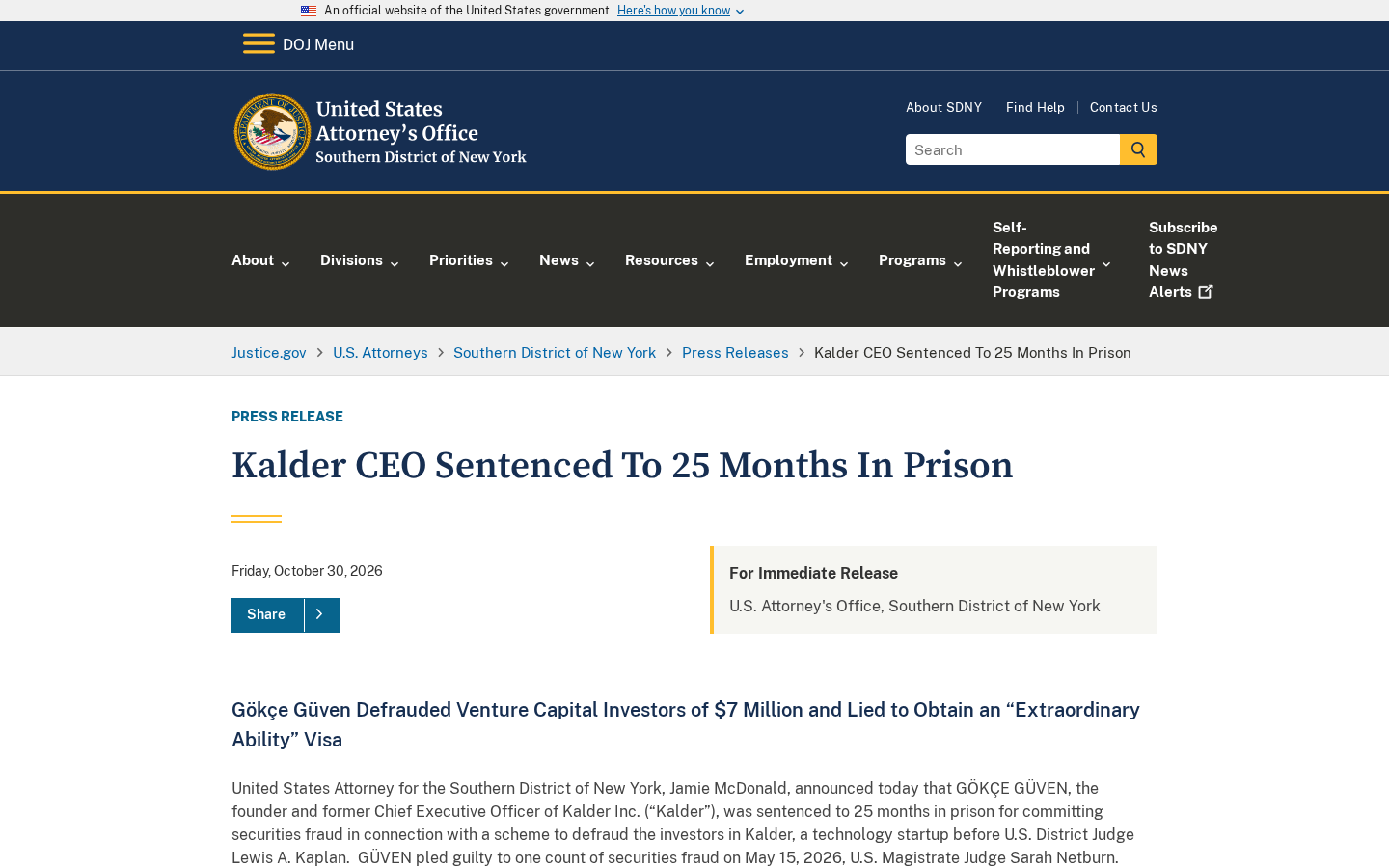
Kalder Inc. was a New York startup developing loyalty and rewards services for businesses, not just a name placed on a slide.
Gökçe Güven, its founder and former chief executive, solicited venture capital investors for a seed round beginning in April 2024.
The Justice Department’s October 30 sentencing announcement says Güven supplied false claims and fabricated records concerning revenue and relationships with brands.
She pleaded guilty to securities fraud in May 2026 and received a 25-month prison sentence in the federal case that October.
Federal prosecutors say the fundraising brought in about $7 million from more than a dozen investors through those false representations.
The court ordered restitution and forfeiture, each for $6,717,997, which are separate obligations rather than two payments to add together.
A company can have a product without having the customers it claims
A brand might run a short trial, sign a paid contract, or decide against using the service after the first meeting.
Each of those relationships sounds different when you tell the story plainly, although a slide full of logos can make them look identical.
Prosecutors say Kalder counted some brands with limited, typically discounted pilots and others that had no agreement with the company.
That matters because an investor can pay for expected recurring business without realizing the company is still trying to convert trials into customers.
A pilot is not automatically a problem, and there is nothing wrong with counting it separately as part of a sales pipeline.
The concern is presenting that early interest as a lasting commercial relationship that a reviewer cannot verify with the purported customer.
Check what each number measures before comparing it
Annual recurring revenue estimates the yearly value of recurring business under a company’s counting method, not the balance in its bank account.
A signed recurring contract, an invoice and a bank deposit are useful together because each answers a different question about that claim.
| Claim in a pitch | Independent record to request |
|---|---|
| Brand uses the product | Authorized customer contact and scope of deployment |
| Customer is paying | Executed agreement, dated invoice and evidence of payment |
| Trial converted to paid service | Start date, renewal terms and customer confirmation |
| Revenue is recurring | Revenue schedule with one-time fees and credits separated |
| Accountant checked the totals | Original report, period and scope of the accountant’s work |
- Ask what the company counts as a customer, including trials, free users, unpaid invoices and signed deals that have not launched.
- Pick a few names from different categories rather than letting one strong reference stand in for the entire list.
- Compare revenue from those names against the report period so a new deal does not become evidence of older performance.
These checks can change the questions you ask even if they do not immediately identify why a number is wrong.
How the Kalder Fundraising Fraud Worked
Step 1: Investors saw familiar brands presented as customers
In the seed round pitch, prosecutors say Güven claimed 26 brands used Kalder and 53 brands used an active free tier.
Some of the companies had only trial arrangements, while others had never reached an agreement with Kalder at all.
A table showing dozens of companies can be useful when each category is consistently defined and an investor can check the relationships.
Without those definitions, a brand counted after one brief trial can look like a buyer with a multi-year commitment.
Ask which period the figures cover and whether customers who dropped out remained in the totals shared with investors.
A real brand name on a slide does not imply that brand helped write the pitch or approved its descriptions.
Step 2: Reported recurring revenue gave the customer list more weight
The deck claimed that Kalder’s annual recurring revenue grew over time to $1.2 million, a figure the Justice Department describes as false.
Prospective investors could read that figure as a sign customers kept paying, a stronger signal than interest in a free trial.
When reviewing a similar figure, ask how discounts, unpaid invoices, ending contracts and one-time work affect what goes into the calculation.
Request the monthly schedule with a stated definition, then compare it with independent records for a sample of recurring fees.
If a pilot has an end date and no renewal agreement, do not treat a year’s projected value as contracted income.
For a private company, the necessary records may require permission and confidentiality, but that does not turn missing evidence into verified revenue.
Step 3: A contract and a different set of numbers backed the pitch
Prosecutors say Güven sent investors a forged agreement with a purported brand partner while also providing inflated financial information.
The company had internal records prepared by its outside accounting firm and a second, inaccurate set that investors received.
That distinction matters because invoking an accounting firm is not the same as the firm issuing the specific report being reviewed.
Ask which report the accountant produced and whether it included an audit, a review or financial statements prepared without providing assurance.
If the accountant can only speak with permission, use an approved channel to request confirmation rather than relying on a forwarded email.
For the contract, verify the relationship through someone at the claimed customer who is authorized to discuss the actual arrangement.
Step 4: Money reached the company before the false claims were exposed
The Justice Department says roughly $7 million came from investors who made decisions based on false revenue and customer information.
Güven separately reused similar misrepresentations in a visa application, and prosecutors say the visa was later revoked after it was issued.
The sentencing release concerns established securities fraud, not a rule that a startup with a failed product automatically committed a crime.
The investment question is whether the figures and relationships were true when money was sought, rather than whether the business later struggled.
Investors who suspect a false pitch should keep the original deck and share the exact versions with their advisers or regulators.
A corrected deck can be useful to compare, but it should never replace the original file you relied on before paying.
What Counts as Independent Confirmation?
Ask the customer who can verify the relationship
One customer call may support a specific claim, but whether that person can confirm contract terms depends on the authority they have.
A product manager might know the software ran during a trial without knowing whether the purchasing team ever signed a renewal deal.
Tell the company which relationships you want to verify and ask for permission to contact named organizations using independently sourced details.
Where a customer agrees to confirm information, ask about the product, launch date and whether the agreement is a trial or ongoing.
If parts of the contract remain confidential, record what was verified and make a conservative decision about risks you cannot resolve.
Keep each version of the deck
The SEC explains in its private placement bulletin that private investments can have limited disclosure, which makes independent checks particularly important before funds move.
Ask for a reconciliation showing how older figures relate to the new ones instead of letting each revised deck answer a different question.
When a person sends a second report that contradicts the first, keep both and ask which transaction or period explains the difference.
If there is no support for the revenue the price assumes, you can walk away without ever proving why the unsupported claim appeared.
Match contract terms to the actual payments
Check how the company presents amendments, because a small change to a cancellation clause can affect whether future payments are actually committed.
An invoice that was later credited does not represent the same revenue as a paid recurring invoice that remained in good standing.
Where a customer pays through a reseller, get permission to verify the arrangement without assuming the reseller and end customer paid separately.
Once the company gives you a list, pick a sample that includes new accounts, older renewals and customers contributing unusually large amounts.
Ask whether unpaid balances are excluded from the metric or kept in it, and whether that definition stayed consistent between deck versions.
If the founder sends a spreadsheet with no source records, ask which contracts or invoices you can match to the largest entries.
Identify who actually issues the investment
An investor should also be able to tell who receives the investment and which legal entity issues the shares or other rights.
Keep the final signed subscription paperwork with the original offer, because marketing claims and enforceable terms may appear in different places.
Before paying, note the claims that still matter to your decision and list which records would change your mind about each one.
If the fundraising deadline arrives before those answers, let it pass rather than replacing independent checks with a promise to verify them later.
What to Do if You Have Fallen Victim to This Scam
-
Preserve the original fundraising materials
Keep the deck, financial reports, contract copies, communications and any notes showing which claimed customers or numbers mattered to your decision.
Save the date you received each version and the names or addresses of people who represented or distributed the investment.
Mark separately which facts you independently verified and which facts appeared only in the documents the company provided.
-
Keep the actual payment history with the investment documents
Record your transfer date, the legal recipient, the amount and what ownership or rights the agreement said you would get.
If someone asks for follow-up funding or a payment to unlock a refund, stop and get advice before sending anything else.
If a payment is recent, contact the sending bank through your known route and ask what options remain for that transaction.
-
Ask independent counsel to review any preservation issues quickly
Give a qualified securities adviser or lawyer the dated materials and identify the original statements you believe were false when made.
Ask what deadlines matter and whether you should preserve evidence before approaching the company or any named business partner.
Do not disclose confidential documents publicly just to pressure a reply, especially when they contain unrelated company or customer information.
-
Send a focused report through the regulator’s official channel
Use the SEC’s tip and complaint page if the conduct involves a securities offering, and attach evidence that identifies the investment directly.
Note what was promised, what changed on later records and why you believe the figures or contract were unsupported.
Include the case name only when your own documents connect it to the operation, and keep a copy of your report.
-
Verify any claim about repayment before agreeing to it
Contact the prosecutor’s office or your counsel independently if someone says they can arrange payment from this particular restitution order.
Do not send an upfront fee or bank login details to a person who found your name on a public discussion board.
A judgment can create an obligation without telling you whether every investor will recover the original amount they paid.
Frequently Asked Questions
Was Kalder itself a made-up company?
No, prosecutors describe Kalder as a real loyalty and rewards startup whose founder sent false claims while raising money from investors.
The distinction matters because an actual product can exist alongside a customer or revenue story that is not supported by records.
Does every pilot customer count as recurring revenue?
A pilot can generate revenue under its own terms, but it does not necessarily establish a continuing contract or future renewal.
Ask what the reported figure includes and compare a few entries with the actual end dates and terms the customer signed.
Can I trust a revenue report because an accountant is mentioned?
The name of an accountant does not show who produced the report on your desk or what level of work was done.
Verify the source of the report and what it covers before using it as evidence for the amount you are investing.
Is a forged partner agreement the same as a disputed renewal?
No, a false agreement represents something that was never authorized, while a disputed renewal may concern the terms of a real contract.
Ask for the original execution record and authorized confirmation before deciding what the document actually proves about the relationship.
Did the court already compensate investors in the entire round?
The sentencing announcement reports the amount ordered as restitution, not a completed distribution or a schedule for payments to each person.
Verify any notice about a payment through the official case contacts rather than relying on someone who quotes the order back to you.
How can early-stage investors check a company with limited data?
Start by identifying what is known independently, then make any remaining risk explicit rather than filling gaps with the company’s projections.
If the offer depends on revenue that no one can verify, pause until the evidence improves or decline to fund it.
The Bottom Line
Do not fund a startup based on logos and reported recurring revenue when the underlying customers, contracts and payments cannot be checked independently.
If you already invested, save the exact materials you relied on, stop further transfers and seek advice about the records and deadlines.

Join the discussion
0 commentsShare your experience or ask a question about this article.
Community experiences
Did this happen to you?
Your experience could help someone recognize the same scam. Submit a private report for our team to review.
I experienced this tooReports are reviewed before publication. Sharing publicly is always your choice.
Discussion
Start the conversation
Have a question or something useful to share? Add the first comment.