


A payment-processing job can sound like ordinary administrative work, especially when a recruiter describes simple assignments and regular contact with overseas partners.
The Your Mule Cashout case reveals what those assignments can conceal when an employer wants business payments routed through your personal bank account.
Overview
The job description hid the source of the money
Your Mule Cashout, known as YMCO, recruited U.S. residents who believed they were working for legitimate companies and handling genuine business transfers.
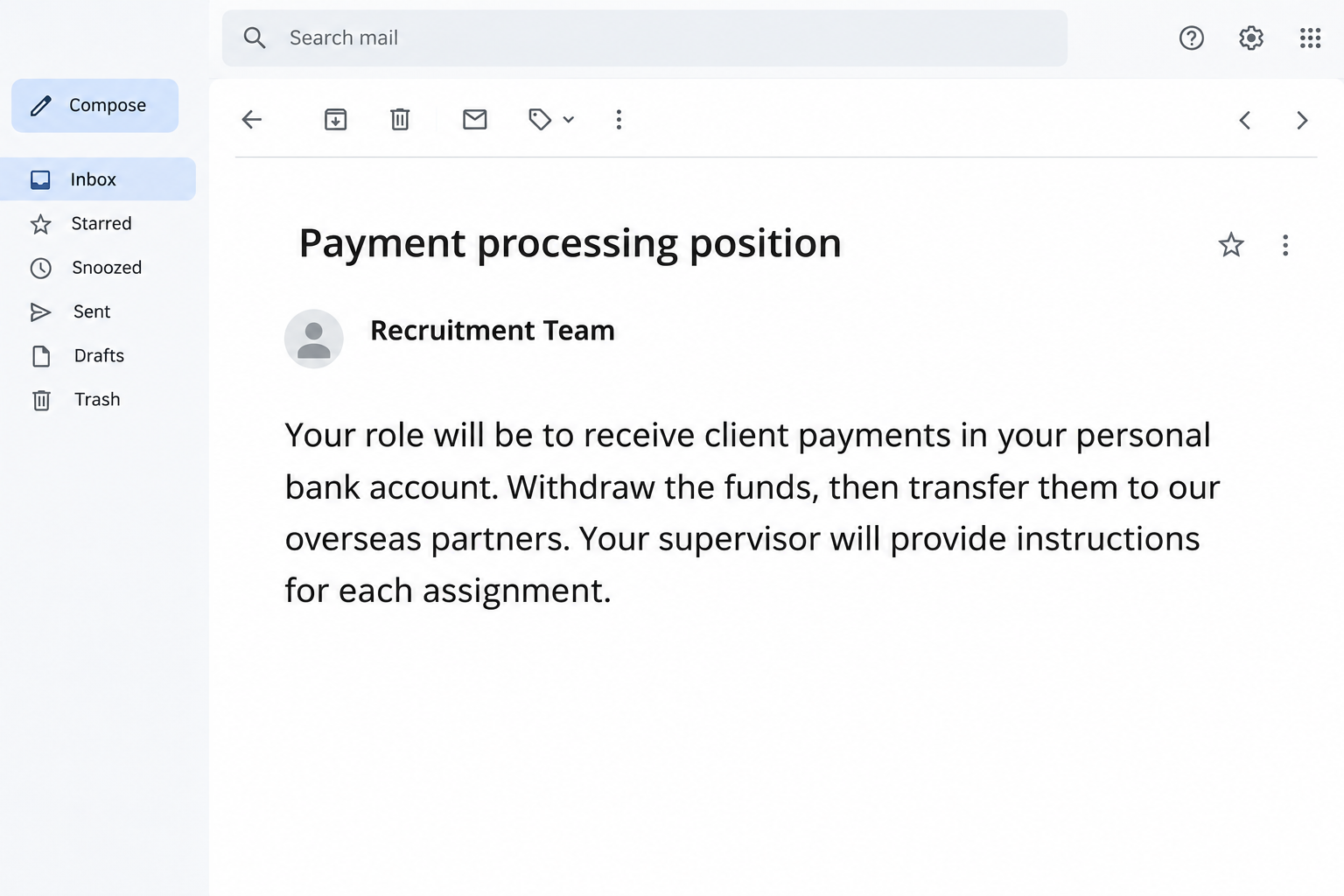
Their supposed duties involved receiving payments in personal accounts, withdrawing the money and wiring it onward to partners described by the fake employer.
The funds actually came from hacked bank accounts, making the recruits part of a route that moved stolen money out of the country.
Korniev admitted helping run the operation
Oleg Korniev pleaded guilty on October 8, 2026, to offenses including money laundering, computer fraud conspiracy, access device theft conspiracy and aggravated identity theft.
The Justice Department’s plea announcement describes more than 15,000 U.S.-based recruits and at least $10 million stolen from over 750 bank accounts.
Those figures describe the wider organization, while Korniev admitted personally laundering at least $7 million as part of his involvement in the operation.
A real deposit does not make the employment real
The balance appearing in a recruit’s account could look like proof that the company had genuine customers, while concealing who actually owned the money.
- Receiving a bank transfer does not establish that the sender authorized it or that the person directing you has any right to it.
- A stranger’s business payments should not pass through your personal account simply because a recruiter calls the arrangement a remote processing job.
- Forwarding money creates a separate financial exposure, even when the supposed employer promises to explain the paperwork or pay wages afterward.
The image reconstructs the payment-processing pitch; it does not reproduce an original YMCO advertisement, recruitment email or message from a named employer.
The Difference Between Getting Paid and Moving Other People’s Money
An employer paying wages into your account is different from asking you to receive other people’s business payments and forward them somewhere else.
In the second arrangement, your account becomes part of the employer’s claimed payment system, placing your identity between the original sender and the destination.
That difference can disappear inside a routine-sounding description of processing, administration or assisting overseas partners, particularly when someone urgently needs paid work.
The important question is what happens to the money after it arrives, rather than how professional the recruiter sounds during the hiring conversation.
If the central task is withdrawing and forwarding incoming funds, pause before supplying banking details or accepting another payment into an existing account.
The FBI’s money mule guidance specifically warns against job offers that require using your own bank account to transfer money for someone else.
It also distinguishes unwitting recruits from people who ignore warning signs or knowingly participate, so an individual’s legal position requires individual assessment.
Do not assume a stranger can promise immunity, and do not conclude that everyone approached through a fake job knowingly joined a criminal operation.
If you already handled funds, stop transferring money, preserve the instructions and tell your bank exactly what the recruiter asked you to do.
How the Your Mule Cashout Job Scam Works
Step 1: A fake employer offers a payment role
YMCO told recruits they would work for legitimate companies, receiving business payments and transferring money to those companies’ overseas partners as their assigned duties.
The announcement does not identify every employer or recruitment message, so the warning concerns the assigned task without supplying an invented company list.
Someone searching for flexible work may reasonably ask about wages, hours and responsibilities, but the account arrangement deserves its own separate examination.
A recruiter who describes everything as simple administration still needs a legitimate reason for using an employee’s personal account to process customer money.
When the proposed role depends on that arrangement, decline it rather than trying a small assignment to see whether the promised wages arrive.
Step 2: Stolen funds arrive in the recruit’s account
Hackers had taken money from U.S. business bank accounts, and YMCO supplied the people and infrastructure used to move those proceeds onward.
For the recruit, an incoming payment could look like the first real assignment, even though it did not belong to the supposed employer.
The presence of funds therefore answers only whether money reached an account, rather than whether its owner authorized the payment for this purpose.
Do not spend the money, deduct a commission or send it back using new instructions supplied by the recruiter after doubts arise.
Contact the bank about the unexpected funds and let its fraud team determine the appropriate handling of the payment and any requested return.
Step 3: Instructions turn the deposit into a withdrawal
The recruits were told to withdraw received funds and then wire them to the fake company’s partners overseas, according to the plea announcement.
Withdrawing the money changes the practical recovery problem because the incoming bank payment and the outgoing movement may require different handling afterward.
Your participation can also connect the transfer to an identified local account holder, adding distance from the person who actually directs the scheme.
Keep records of those instructions instead of accepting a supervisor’s explanation that the arrangement is ordinary business practice or a temporary payroll requirement.
The task itself is the warning sign, even if the recruiter has already supplied paperwork, answered interview questions or arranged regular check-ins.
Step 4: The network moves the money overseas
YMCO served cybercriminals for a share of stolen money, using its online infrastructure to move proceeds primarily toward countries located in Eastern Europe.
The recruits’ transfers added another layer between the businesses whose accounts were hacked and the people receiving the proceeds outside the United States.
That is the laundering function hidden by the job description, rather than a genuine administrative need that an applicant can resolve with better paperwork.
Do not treat a foreign destination alone as proof of fraud, because legitimate employers and businesses make international payments for many ordinary reasons.
The decisive combination here was stolen money, deceptive recruitment and instructions to route payments through personal accounts under the cover of employment.
Step 5: The promised work leaves the recruit exposed
The Justice Department says these recruits never received payment for their services, despite believing they were carrying out genuine assignments for legitimate companies.
The missed wages were therefore only one part of the harm, because the account activity also connected them to transfers of stolen funds.
A recruiter may answer questions with another explanation, but your bank still needs a direct account of the transactions you have already processed.
Ending contact prevents further instructions from shaping your decisions, while preserving the messages allows the actual circumstances of your involvement to be assessed.
If there is concern about legal exposure, seek independent legal advice from a qualified professional rather than relying on assurances from the recruiter.
Check the Duties Before Accepting the Offer
Searching a company name can be useful, but a real business with the same name does not establish that the recruiter works there.
Likewise, a registration entry cannot authorize someone to use your personal banking arrangements as a channel for money that belongs to other people.
Ask what service you would provide independently of moving the funds, and whether the job would still exist without access to your account.
If the answer remains receiving, withdrawing and forwarding payments, the basic risk is already clear without experimenting with a transfer or opening another account.
The following distinctions help applicants recognize the difference between ordinary employment payments and the routing duties described in the YMCO criminal case.
| Arrangement | What the money is for | What to consider |
|---|---|---|
| Wages deposited for completed work | Paying the employee | Verify the employer and ordinary hiring details |
| Client funds deposited into your personal account | Using your account to process other people’s money | Decline the arrangement and do not forward funds |
| Withdrawal followed by an overseas wire | Moving incoming money beyond the first account | Stop and contact the bank’s fraud team |
| Recruiter directs a return to a different recipient | Another outgoing payment | Let the bank determine legitimate return handling |
If the Recruiter Says the Deposit Proves Everything
A deposit can be persuasive because it appears inside an account you genuinely control, rather than on a fake dashboard supplied by the recruiter.
That makes it different from a task scam that merely shows imaginary earnings, but it does not make the payment safe to handle.
The money can be real while the employer’s explanation of ownership and purpose is false, which is exactly the distinction this case exposes.
Checking an available balance cannot establish permission from the business whose funds were stolen, and waiting briefly does not supply that missing authorization.
The bank needs the original transaction information and the recruiter’s instructions, so keep both rather than relying on a screenshot of the balance alone.
If someone claims a payment must be returned immediately, resist the pressure to create another outgoing transfer before the bank reviews the situation.
The same caution applies if the recruiter offers to cover charges later or says a supervisor has already approved the destination on your behalf.
Someone directing the suspicious arrangement cannot independently certify the safety of the next payment they want you to make from your personal account.
What to Do if You Have Fallen Victim to This Scam
-
Stop accepting new assignments and do not withdraw, spend or forward money received through the supposed job while you contact your bank for guidance.
If a transfer is already scheduled, tell the institution immediately and ask which outgoing instructions can still be stopped before they are completed.
Do not send funds to a replacement recipient supplied by the recruiter, even when the instruction is described as correcting the earlier mistake.
-
Call the bank through the number on your statement or established banking app, and explain that a fake employer directed personal-account payment processing.
Identify every incoming and outgoing transaction connected with the job, including transfers you authorized because you believed the recruiter’s explanation of the work.
Ask how the funds should be handled, what recovery steps are possible and which records the fraud team needs before you take further action.
-
Save recruitment messages, job descriptions, contracts, supervisor details and transfer receipts, keeping the original records rather than replacing them with a rewritten summary.
Make a timeline of when you supplied banking details, received payments, withdrew funds or followed instructions to send money to another person.
Preserve messages that show what you believed the job involved, because the explanation you received is relevant alongside the transaction record itself.
-
Report the recruitment and transfers to IC3 by opening File A Complaint, reading the terms and entering the facts you can accurately document.
Include the employer names used, communication methods, payment destinations and a clear explanation that your own account received or forwarded the funds.
Save the complaint confirmation and keep the bank’s separate case reference, because filing a report does not itself stop or reverse a transfer.
-
If you supplied identification documents or account credentials, tell the relevant provider what was exposed and request assistance appropriate to that specific information.
Use a trusted device to contact providers, and refuse further document requests from a recruiter promising to close the job or clear your name.
Where money handling creates legal concerns, obtain independent advice from a qualified attorney who can assess your circumstances without relying on the recruiter’s assurances.
-
Respond to verified banks or investigators through independently checked contact routes, retaining their instructions about any funds that remain or transfers that are disputed.
Be alert to anyone offering a paid clearance certificate, guaranteed immunity or a special recovery service connected with the fake employer’s accounts.
Neither a recruiter nor an unsolicited recovery contact should receive more money or banking access to solve the problem created by the original scheme.
Frequently Asked Questions
Was Your Mule Cashout an ordinary payroll service?
No, the Justice Department describes a criminal laundering organization that deceived residents into handling stolen business funds under the cover of legitimate employment.
Korniev’s guilty plea confirms the operation’s criminal nature, while the accounts of individual recruits still require attention to their own actions and knowledge.
Why did the money appear in a genuine bank account?
The network moved stolen funds, so recruits could see real deposits even though the supposed employer had no legitimate claim to the incoming money.
A genuine banking interface therefore did not validate the job, the sender’s authorization or the instructions to withdraw and forward the incoming payment.
Were the recruits paid for processing the transfers?
The plea announcement says the deceived money mules never received payment for their services, despite being told they were working for legitimate companies.
That finding should not be turned into an invented wage rate or a claim that every unrelated payment-processing offer uses identical recruitment terms.
Can I return an unexpected deposit to the recruiter myself?
Contact your bank before moving it, because an instruction to send funds somewhere else can create another transaction rather than undoing the original payment.
Tell the fraud team who contacted you and how the deposit arrived, then follow its verified instructions about handling or returning the funds.
Does being tricked automatically remove every legal risk?
An individual’s position depends on the facts, including what they knew and did, so no recruiter can guarantee immunity from investigation or financial consequences.
Stop handling funds, preserve the instructions and seek independent legal advice if you are concerned about transactions already completed through your account.
Was Korniev sentenced when the October announcement appeared?
That announcement reported a guilty plea and said sentencing would be set later, so it should not be presented as an imposed prison term.
The reported loss and laundering figures describe different measures and overlapping conduct, rather than amounts readers should combine into a new case total.
The Bottom Line
Reject any supposed job that requires receiving client money in your personal account, withdrawing it and forwarding it to the employer’s chosen recipients.
The YMCO case shows why a real deposit can conceal a fake job, with stolen funds passing through people who expected legitimate work.
If you already followed those instructions, stop moving the money, contact your bank’s fraud team and preserve the recruitment and transaction records immediately.

Join the discussion
0 commentsShare your experience or ask a question about this article.
Community experiences
Did this happen to you?
Your experience could help someone recognize the same scam. Submit a private report for our team to review.
I experienced this tooReports are reviewed before publication. Sharing publicly is always your choice.
Discussion
Start the conversation
Have a question or something useful to share? Add the first comment.