


A computer warning can become much harder to dismiss when the person answering the phone starts discussing your bank account and savings.
The Carlsbad gold scam shows how that conversation developed into a plan involving precious metals, a courier and a supposedly protected locker.
Overview
A computer pop-up introduced a financial emergency
A Carlsbad resident called for help after a pop-up claimed her computer had been hacked, according to the Justice Department’s account of the case.
The people speaking with her posed as technology support, bank and government employees, bringing several claimed authorities into the same deceptive story.
They convinced her to buy precious metals for supposed safekeeping by the U.S. Treasury, which would supposedly create a locker in her name.
Real purchases led to a fraudulent collection
Over two months, the victim sent approximately $1,335,000 through three wire transfers to a precious metals business in San Marcos, California.
She collected the purchased metals, mostly gold, then handed over packages because the impostors claimed they were being secured to protect her savings.
The problem was not imaginary gold on an investment screen; it was losing control of purchased property after accepting a false explanation for collection.
Guilty pleas confirmed the participants’ involvement
Xilin Sun and Alexander Charles James admitted knowing participation in the organization, as described in the original guilty-plea announcement published in December 2025.
A later Justice Department summary reports that both received 27-month sentences on May 21, 2026, following their participation in the fraud and laundering scheme.
- A genuine gold purchase does not authenticate the caller who tells you to make it or the person sent to collect it.
- A courier repeating an agreed word establishes coordination with the caller, rather than proving a government agency authorized the collection of your property.
- A claim that savings need protection should never be accepted as a reason to surrender gold to someone introduced through an unsolicited warning.
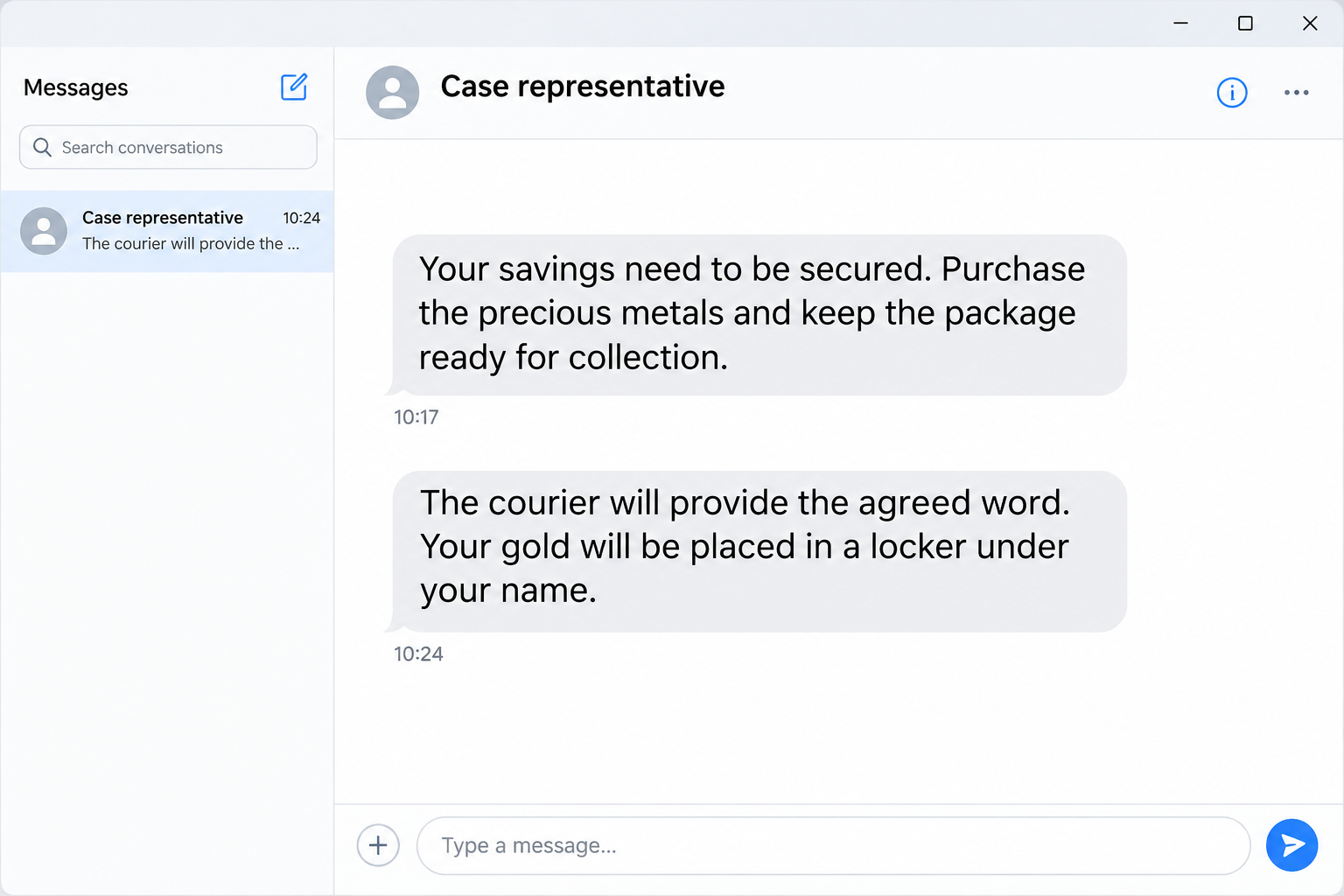
The message image is a reconstruction of the collection pretext, rather than an original conversation, government instruction or recovered exhibit from this case.
The False Promise Behind the Treasury Locker
The proposed locker gave the victim a reason to believe ownership would continue after the physical gold left her possession with a collector.
The callers made surrendering control sound protective, while the actual handover removed the victim’s ability to keep the purchased gold in her possession.
Putting your name on a supposed locker does not establish that an institution holds your property or that the collector actually works for it.
The metals dealer and the Treasury should not be blamed simply because the scammers placed them inside the explanation given to the victim.
The prosecution describes the dealer as the business receiving purchase transfers, while the fraudulent organization directed what the victim did after obtaining the metals.
For someone considering a similar instruction, the decisive question is why an unexpected caller wants savings converted into property that another person will collect.
That question is more useful than debating gold prices, the quality of a bar or whether precious metals can be legitimate investments generally.
Even genuine, valuable gold can be stolen through deception when the person handing it over has been misled about the collector’s authority.
How the Carlsbad Gold Scam Works
Step 1: A pop-up persuades the victim to seek help
The victim reported that a warning appeared while she was using her computer and told her to call because the device had been hacked.
The warning supplied the opening for contact, but the existence of that pop-up did not independently establish that the computer had actually been compromised.
An alarming message can prompt someone to call before checking whether the displayed number belongs to the service that supposedly issued the warning.
Do not call a number supplied through an unsolicited warning, and do not let that warning become your source for financial or technical advice.
If help is needed, reach a support provider you already trust through an independently established route and describe the message without following its instructions.
Step 2: Impostors bring banking and government roles into the story
The victim encountered people posing as government, bank and technology support employees over the course of the deception described in the court-related announcement.
Those different roles can make a problem feel independently confirmed, although several voices may simply be cooperating within the same fraudulent operation.
A transfer to another supposed department does not create independent verification if the original unsolicited contact controls how the next conversation is reached.
Separate the claimed bank issue from the caller by ending contact and opening your own conversation with the real bank through its established number.
Tell the bank what action was requested, because buying and surrendering gold reveals more about the arrangement than the title the caller has used.
Step 3: Savings become a real precious metals purchase
The victim wired funds to the metals business and then picked up the purchased property, which consisted mostly of gold according to prosecutors.
This stage can make the overall story feel credible because the buyer receives something tangible from a real transaction they can recognize.
However, completing a purchase does not confirm the separate claim that a government representative needs that property or will hold it safely afterward.
If you are arranging a purchase because of an unexpected security call, pause before sending funds and tell the dealer the circumstances honestly.
Ask what can still be canceled or held under the transaction’s status and terms, without assuming that a completed sale automatically includes a refund.
Step 4: A collector takes the package under a safekeeping pretext
The callers instructed the victim to package the metals and give them to someone who would supposedly secure the property under their protective arrangement.
The financial instruction now becomes a physical handover, placing the victim’s savings in the hands of someone whose authority has never been independently established.
In a later controlled operation, James supplied a secret word before accepting the package and then met Sun, who took possession of it.
That word demonstrated communication between participants, not a genuine Treasury connection, which is why a shared password cannot validate this type of collection.
Do not complete a handover to test whether the collector knows the right phrase, and never arrange a confrontation to investigate the person yourself.
Step 5: The collection route becomes part of the criminal evidence
In February 2024, the FBI arranged a controlled delivery with the victim’s help, using a package that supposedly contained $100,000 in gold bars.
The fake bars belonged to that operation, so their value should not be described as another completed loss suffered by the victim.
Investigators observed the handover and subsequent movement of the package, while the guilty pleas later established Sun’s and James’s knowing participation in the organization.
A reader should not copy the controlled operation by arranging another meeting, because law enforcement decisions and protections differ from an unassisted victim’s situation.
If collection details are already available, preserve them and give them to police while keeping yourself and any remaining property away from the collector.
Where the Money Is Determines the Next Call
The earliest useful intervention may concern a bank transfer, a pending gold order or a package that the targeted person still holds at home.
Each stage needs a different request, so establish what has actually happened before asking someone to reverse a transaction they do not control.
The following table separates those stages without promising that a bank, dealer or investigator can recover property after a completed fraudulent handover.
| Stage reached | Contact to use | Specific request |
|---|---|---|
| Wire not yet released | Sending bank through its established number | Stop the payment and review the fraud concern |
| Wire sent, purchase pending | Bank and actual metals dealer | Discuss recovery, cancellation or a collection hold |
| Gold remains with you | Local police and a trusted helper | Report the attempted pickup and keep the property secure |
| Gold already handed over | Police and the bank’s fraud team | Document purchase, collection and payment history |
| Caller requests another package | Independently verified investigators | Preserve the demand without arranging another handover |
The Warning Extends Beyond One Gold Dealer or City
An FBI courier fraud alert describes scammers telling victims to convert savings into cash or precious metals before arranging collection for supposed protection.
It also identifies passcodes as part of some collection arrangements, which helps explain why an apparently organized handover can still be fraudulent.
The warning concerns the request to surrender assets under a false protective story, rather than every purchase of gold or every legitimate delivery service.
For a family member helping someone, ask about the planned handover and the caller’s authority before discussing whether the purchased metal is genuine.
If the metal is still with the buyer, preventing collection preserves an option that disappears once a stranger takes possession of the package.
You do not need the caller’s permission to stop, even when they insist that the protective process has started and must now be completed.
Keep urgent demands for another delivery as evidence and discuss them with verified police, without treating the caller’s pressure as permission to continue.
What to Do if You Have Fallen Victim to This Scam
-
Stop any proposed collection and keep precious metals still in your possession secure, without traveling to meet a person introduced by the callers.
If someone is at your home demanding the package or making threats, avoid confrontation and contact emergency services when immediate safety is at risk.
Do not attempt to recreate a sting operation or lure the collector back, because that adds physical risk to an already deceptive situation.
-
Call your bank through its normal verified contact route and explain that a false security story led to a wire for precious metals.
Provide the payment reference, amount, date and dealer details, then ask which pending transfers can be stopped and whether recovery assistance is available.
Be precise about where the funds went, since a payment to the real dealer differs from the later collection by the fraudulent organization.
-
Contact the metals dealer through your receipt or independently verified business details, explaining that scammers directed the purchase under a false promise of protection.
Ask about the order’s current status and any available cancellation, collection hold or other options under the real transaction, keeping its response in writing.
The dealer may be unable to retrieve gold already collected by a stranger, and the original caller must not supply your replacement contact number.
-
Save wire confirmations, invoices, purchase receipts, collection instructions and call records, including details of any agreed word or location used for the handover.
Write down what property actually left your control and when, keeping purchase amounts separate from later demands or attempted payments that never occurred.
Share collection information with verified police, but avoid posting private addresses, account details or a proposed meeting publicly in an attempt to identify someone.
-
Report the deception at IC3, starting with File A Complaint and reading the terms before entering the relevant contact, payment and collection information.
Include the metals dealer’s name and location, recipient banking details and the sequence from the computer warning to the request to surrender gold.
Keep a copy or confirmation of the submission, and tell local police about any upcoming collection that requires a separate, immediate safety response.
-
If you shared credentials or allowed computer access, explain what happened to the affected provider and trusted technical support before resuming banking activity.
A pop-up alone does not establish infection, while actual remote access or a disclosed password creates additional issues beyond the physical gold collection.
Decline anyone requesting another payment for a government locker release or guaranteed recovery, even if they know the amount of your original purchase.
Frequently Asked Questions
Was the Carlsbad case based only on a victim’s complaint?
No, Sun and James admitted knowing participation in the fraudulent organization, and a later DOJ summary reports 27-month sentences for both participants.
The victim’s account, the controlled delivery and the guilty pleas provide a different foundation from an unresolved allegation about an ordinary metals purchase.
Was the gold itself fake before the collection?
The reported scheme involved the victim buying precious metals and surrendering them for supposed safekeeping; the deception concerned the reason for that handover.
The fake gold bars mentioned in the announcement were used in the FBI’s controlled operation, not proof that the dealer sold counterfeit metal.
Does a courier’s secret word prove a government connection?
It proves only that the courier knows a word supplied through the arrangement, which cooperating scammers can share just as easily as legitimate participants.
Verify an institution independently rather than treating a passphrase, appointment or organized arrival as permission to give a stranger control of valuable property.
Did the U.S. Treasury ask the victim to buy gold?
The Treasury locker was the false protective explanation used by the impostors, rather than an authentic instruction issued by the government to this victim.
The relevant decision is to refuse that collection request and contact the real bank or police through a route separate from the unsolicited caller.
Should I include an attempted pickup in my report?
Yes, describe it accurately as planned or attempted, and preserve the timing, instructions and communication details without arranging another meeting to gather more evidence.
Keep attempted payments separate from completed losses so investigators can follow what happened without confusing a demand with property already handed over.
Can the dealer cancel the purchase after I report the scam?
That depends on the transaction’s status and actual terms, so contact the dealer promptly while also asking your bank about the payment itself.
Explain whether the metal is still awaiting collection, remains with you or has already been surrendered, because those situations call for different responses.
The Bottom Line
Do not buy or hand over gold because an unexpected computer warning leads to callers promising to protect your savings in a government locker.
The Carlsbad case involved real purchases followed by a fraudulent collection, so genuine gold and an agreed word did not make the arrangement legitimate.
If you already acted, stop the next handover, contact your bank and dealer, and give police collection details before more property leaves your control.

Join the discussion
0 commentsShare your experience or ask a question about this article.
Community experiences
Did this happen to you?
Your experience could help someone recognize the same scam. Submit a private report for our team to review.
I experienced this tooReports are reviewed before publication. Sharing publicly is always your choice.
Discussion
Start the conversation
Have a question or something useful to share? Add the first comment.