


A familiar nonprofit sends what looks like a routine banking update, just as your accounts team prepares another invoice payment.
The Fresno County invoice scam shows why an ordinary administrative request deserves attention before anyone changes where the next payment goes.
Overview
A genuine working relationship became the opening
Fresno County already had reason to pay the nonprofit, so the deception centered on changing payment instructions within an existing relationship.
The attackers secretly controlled an email account used by its finance director, giving their request a connection to someone the county recognized.
That distinction matters because checking whether an organization exists would not have answered whether its latest banking instruction was authorized.
The criminal case established a false account change
Jafaar September Nyangoro received a 46-month prison sentence on November 9, 2026, after pleading guilty to conspiracy to commit wire fraud.
The Justice Department’s sentencing announcement describes fraudulent invoices and a false claim that the nonprofit had moved its banking to another institution.
County employees changed the payment record, and subsequent ACH transfers went toward an account Nyangoro had opened instead of the nonprofit’s account.
The practical warning concerns the destination
The important question is whether a trusted person authorized the account change, rather than whether the invoice has a familiar logo.
- A known sender’s mailbox can be compromised, so its usual address cannot independently confirm new instructions for sending money elsewhere.
- An established vendor relationship should provide a separate contact route, allowing staff to verify changes without using the disputed email.
- A payment being scheduled does not remove the need for verification, even when delaying it would create an awkward conversation.
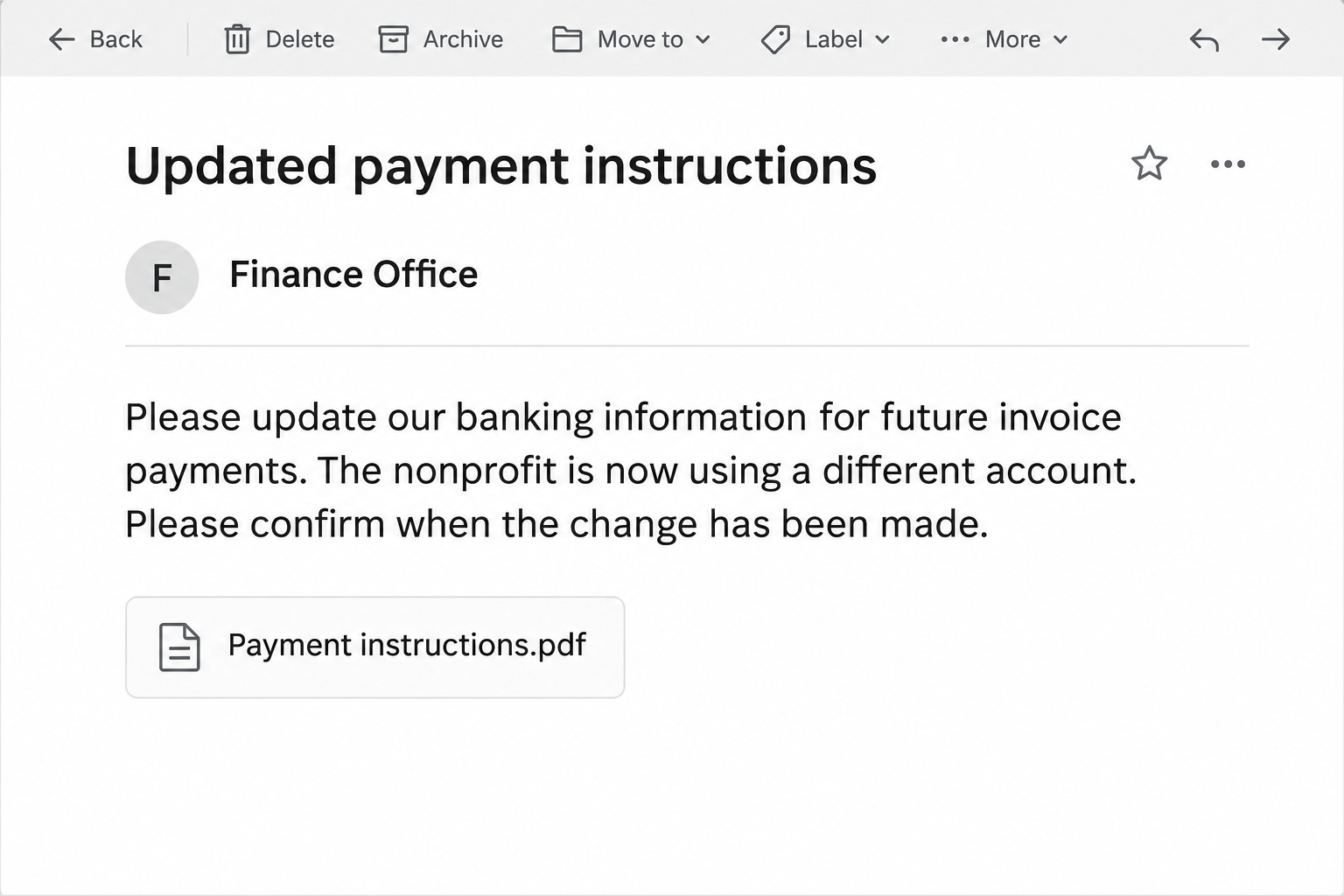
The lead image reconstructs this type of banking request; it is not a recovered email or an exhibit from the prosecution.
What Happened to the Fresno County Payments
Between September 24 and October 13, 2020, the county initiated several ACH transfers totaling more than $1.5 million toward Nyangoro’s account.
Those dates describe the underlying conduct, while the guilty plea and sentence came later as the criminal case moved through court.
Regions Bank reversed some transfers because of suspected fraud, a development discussed in communications between participants cited by the Justice Department.
The court also ordered $1,178,000 in restitution, which should not be added to the initiated transfers as another category of stolen money.
Restitution is an obligation imposed by the court; that figure does not tell an individual reader that every payment was returned.
The announcement identifies Peter Bah Acha as a co-defendant, but Nyangoro’s sentence does not establish a separate conviction or sentence for Acha.
For a finance team, the revealing detail is the point at which a requested change became an approved entry in payment records.
Once that record changed, later payments could follow the wrong destination without requiring a fresh argument about each invoice being processed.
That is why reviewing a single suspicious transfer may miss the larger problem if future payments still use the altered vendor record.
How the Fresno County Invoice Scam Works
Step 1: An attacker gains a trusted email position
In this case, conspirators secretly gained control of the nonprofit finance director’s email account before submitting the fraudulent requests to county employees.
The public announcement does not identify the exact intrusion method, so a password lure, malicious attachment or software exploit should not be assumed.
What matters to the recipient is that access to a real account can place an attacker inside an otherwise legitimate business conversation.
A familiar display name, recognized address and accurate references to the organization can therefore coexist with an unauthorized instruction to redirect money.
Looking for spelling mistakes alone is a weak defense when the underlying problem is control of a mailbox people already trust.
Step 2: The request changes banking rather than the relationship
The conspirators represented that the nonprofit’s account information had changed and that county payments should now go to a different bank.
This makes the requested action resemble maintenance work, rather than asking staff to approve an unfamiliar supplier or an obviously unusual purchase.
The request can feel less consequential because the vendor name stays familiar, even though the destination now determines who receives the funds.
Treat the account change as a new authorization decision, requiring confirmation from someone whose identity was established outside the incoming request.
Do not assume a reasonable explanation for changing banks answers the separate question of who actually supplied the replacement banking details.
Step 3: Staff update the payment record
County employees believed they were communicating with the legitimate nonprofit and updated its bank information, according to the account in court documents.
At that point, the deception entered the process used to release payments, moving beyond the inbox into the organization’s financial records.
An invoice review may then appear satisfactory because the payee’s name and expected relationship remain consistent with work the organization recognizes.
The missing check is whether the bank destination belongs to the intended recipient and whether an authorized contact approved that change.
A second employee repeating the same email check offers little protection if both people rely on information supplied through the compromised account.
Step 4: Payments follow the substituted destination
The county initiated ACH transfers to the newly supplied account rather than directing those payments to the nonprofit’s established bank account.
ACH is the payment network used in this case; the deception was the false instruction, rather than something inherently fraudulent about ACH.
For an accounts team, that means the response needs both a transaction review and a check of the instructions retained for future payments.
Ask which invoices were affected, when the banking record changed, and whether additional transfers have been scheduled using those same altered details.
Keep the original record and its change history available so investigators can distinguish the genuine vendor information from the substituted destination.
Step 5: A bank reversal interrupts part of the route
The reported reversals show that a bank intervention can affect transfers already initiated, although they do not guarantee recovery in another case.
This is why a suspected diversion needs an immediate call to the sending institution, rather than waiting for an internal investigation to finish.
Give the bank the transaction references and explain that the intended nonprofit did not authorize the destination used for the affected payments.
Let the institution handle contact with the receiving bank, and retain the response details so your organization’s next decisions reflect the actual outcome.
Continue checking scheduled payments while that process runs, because attempting recovery does not automatically correct a compromised invoice or vendor record.
Checks That Actually Test the Banking Request
The FBI’s business email compromise guidance recommends verifying changes in account numbers or payment procedures with the person making the request.
The independence of that conversation matters: a phone number inserted into the suspicious email gives the same sender another chance to answer.
Use an established contact from records that predate the request, and ask whether that person authorized the exact change your team received.
Confirm the recipient name and relevant account details under your organization’s process, without sending full banking information through unnecessary email chains.
Record who confirmed the instruction, the route used and which details were checked, so another approver can understand the basis for releasing payment.
If the contact cannot be reached independently, hold the change and escalate it through the existing approval process rather than improvising permission.
The following comparison helps separate information that looks reassuring from checks that address whether the payment instruction is actually authorized.
| What you see | What it establishes | Useful next check |
|---|---|---|
| Recognized nonprofit name | An existing relationship may be real | Confirm the specific banking change |
| Usual finance email address | The message uses a familiar account | Call a previously recorded contact |
| Matching invoice amount | The payment may resemble expected work | Compare the destination against approved records |
| Bank receipt | A transaction was initiated or processed | Ask whether it reached the intended recipient |
A Safer Routine for the Next Vendor Update
Accounts teams need a repeatable way to handle account changes, particularly when the person requesting one already has a trusted working relationship.
First, separate the request from approval by placing the proposed details into a pending change record without immediately replacing the existing destination.
Second, verify the change through a known contact and document the answer before another authorized employee approves the updated vendor record.
Third, check scheduled payments against that approved record, so an unverified instruction cannot quietly carry forward into the next payment run.
These are process recommendations, rather than claims that the public record identifies every control Fresno County had or lacked during the fraud.
An organization can adapt the approval roles to its size while preserving the essential separation between receiving instructions and independently confirming them.
For a nonprofit awaiting payment, a missing transfer also deserves prompt attention, especially if the payer reports sending it to unfamiliar banking details.
Compare the payment reference and destination through a secure conversation, rather than simply asking the payer to send the same invoice payment again.
Your aim is to establish where the money went before either side creates another transaction that could deepen the loss or obscure the record.
If account compromise is suspected, involve the organization’s authorized email administrator so access can be investigated while original messages and logs remain available.
What to Do if You Have Fallen Victim to This Scam
-
Contact the sending bank’s fraud team immediately using its established business banking number, and explain that a fraudulent banking change redirected payments.
Supply transaction dates, amounts, recipient details and references, then request recovery assistance and contact with the receiving institution about the affected transfers.
Ask which payments remain pending and what can still be stopped, and write down the case number and instructions the bank provides.
-
Alert the authorized finance lead and pause unverified payment instructions for that vendor while checking every scheduled transfer linked to the altered record.
Do not erase the substituted details before preserving them, because the timing and exact destination can help explain how the diversion occurred.
Confirm the correct destination with the real nonprofit through a previously established contact before anyone resumes payments or replaces the banking record.
-
Preserve original emails, attachments, invoice versions, approval records and bank confirmations, keeping the material in a restricted location your organization can access.
Ask authorized technical staff to retain relevant mailbox access and change logs, rather than forwarding only screenshots that omit useful message details.
Keep a dated timeline showing when the instruction arrived, who approved it and when each transfer was initiated or flagged as suspicious.
-
Report the incident through IC3, selecting File A Complaint and reading the terms before entering accurate contact, transaction and narrative information.
Describe the real nonprofit relationship, the false account-change request and the destination used, then save the confirmation or copy offered after submission.
If the form cannot be completed, retain your prepared details and seek help through an independently verified law enforcement or institutional contact.
-
Have the organization’s authorized support team investigate the affected mailbox and connected payment workflow, especially if genuine credentials or account access were compromised.
Tell them what happened and which accounts were involved, allowing them to preserve evidence and handle access changes under the organization’s recovery process.
A bank recall and an email investigation address different problems, so neither should be treated as completing the other part of the response.
-
Track the bank’s recovery decision and any replacement payment separately, making clear which funds were returned and which amounts remain under review.
Keep the nonprofit informed through the verified contact, and avoid promising a reimbursement or settlement before the responsible parties establish the actual outcome.
Reject unsolicited recovery offers that request advance fees or banking access, even when the caller knows public details about the criminal case.
Frequently Asked Questions
Was this an ordinary dispute over a nonprofit invoice?
The criminal case concerned deliberate account redirection through a controlled email account, and Nyangoro pleaded guilty before receiving his prison sentence.
That established conduct is different from a billing disagreement, late payment or a customer’s dissatisfaction with services a legitimate organization actually provided.
Could a real finance email address still carry the fraudulent request?
Yes, the sentencing announcement says the conspirators gained control of an account used by the nonprofit’s finance director before the payment diversion.
The appropriate check therefore goes beyond recognizing the address and asks an independently reached contact to confirm the requested banking change.
Did the county send more than $1.5 million in one transfer?
The Justice Department describes several ACH transfers initiated over a period between September and October 2020, rather than a single transaction.
Some transfers were reversed, so the initiated total should not be presented as proof that the same amount remained permanently lost.
Does the restitution order mean all the money came back?
The court ordered $1,178,000 in restitution, but that obligation alone does not establish that every affected payment was recovered or repaid.
An organization should rely on its bank’s confirmed transaction outcome and verified case information when deciding which losses still require further action.
Is checking a phone number inside the email enough?
No, a number supplied by the person requesting the change can lead back to someone participating in the same attempted payment diversion.
Use a contact already held in trusted records, and confirm the specific account change before approving or releasing money toward the new destination.
Should the nonprofit simply send another invoice for the missing payment?
Both sides should establish the destination and status of the original transfer first, because another invoice does not resolve a compromised banking record.
Preserve the genuine invoice and disputed instructions, then coordinate the bank response and any replacement payment through independently verified finance contacts.
The Bottom Line
Do not change a vendor’s banking details solely because a familiar email account requests it; verify the exact instruction through an independent contact.
The Fresno County case shows how a real relationship can carry a false payment destination into the records used for subsequent transfers.
If payments already followed that destination, call the sending bank immediately, preserve the change history and stop additional releases using the disputed instructions.

Join the discussion
0 commentsShare your experience or ask a question about this article.
Community experiences
Did this happen to you?
Your experience could help someone recognize the same scam. Submit a private report for our team to review.
I experienced this tooReports are reviewed before publication. Sharing publicly is always your choice.
Discussion
Start the conversation
Have a question or something useful to share? Add the first comment.