


Allhealed Expert invites people who lost cryptocurrency to start a recovery case. Its website repeats program descriptions and leadership listings from the Crypto Recovery Alliance.
The two sites use different contact routes. Allhealed Expert’s form contains a confirmation message that says it cannot serve clients, even though the blank form asks for personal details.
Overview
The same design leads to two different destinations
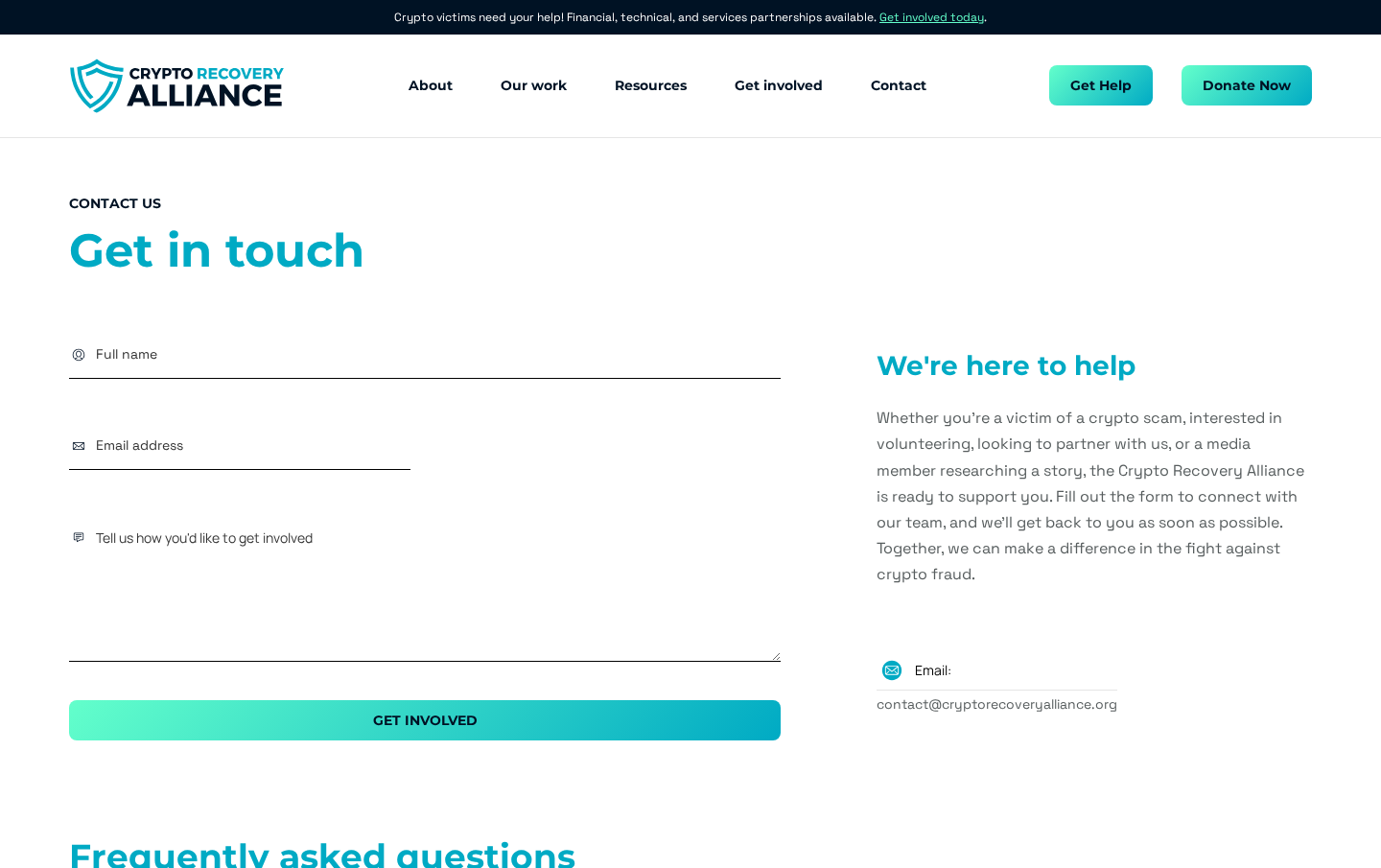
The Crypto Recovery Alliance identifies itself at cryptorecoveryalliance.org. Allhealedexpert.com copies parts of its website, but lists a different contact address on its own domain.
We compared the public pages independently and found identical site and page identifiers in the homepage markup. The overlap goes beyond a similar name or stock logo.
Starting a case does not mean a case can be opened
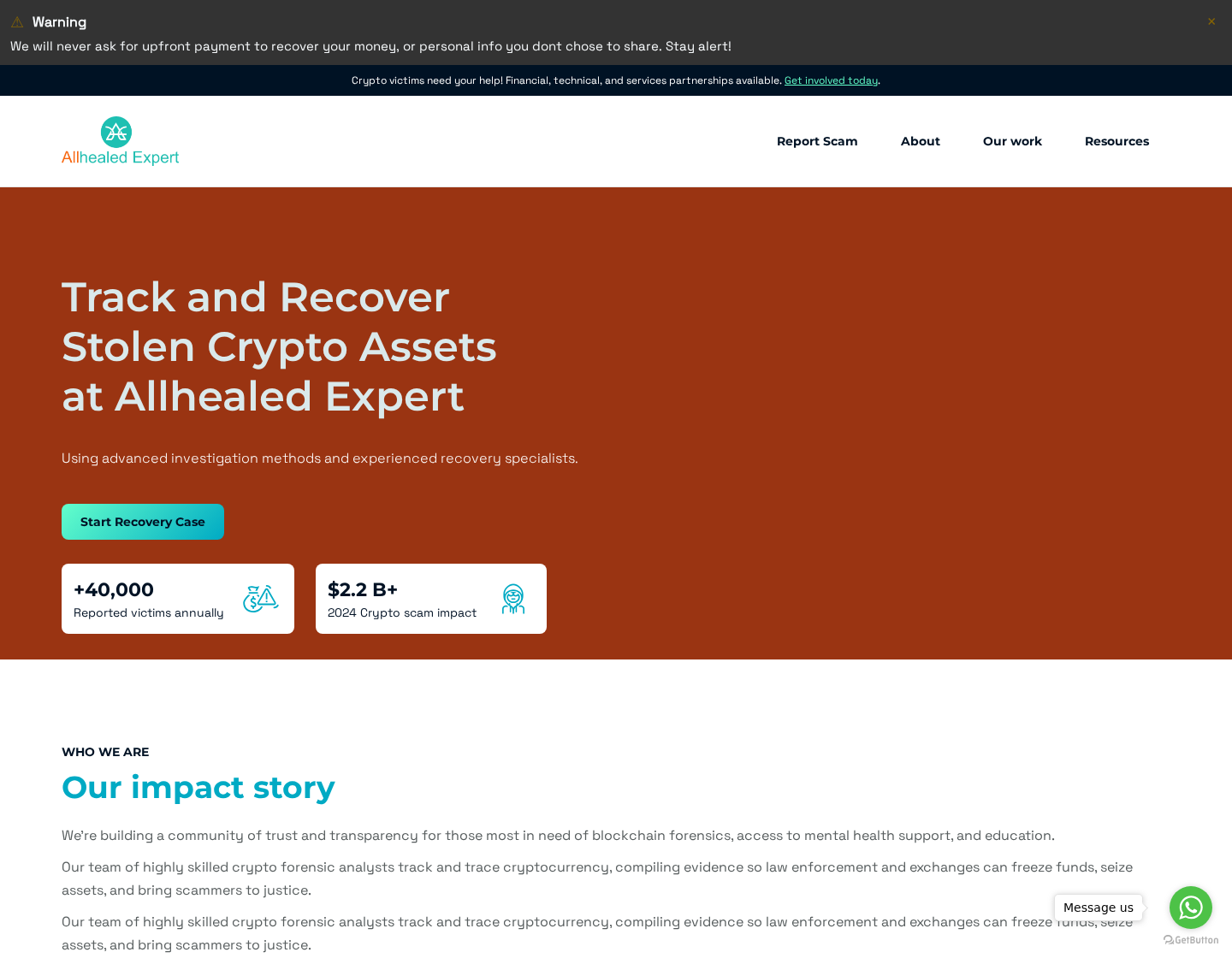
The Allhealed Expert homepage shows a Start Recovery Case button. The contact form’s confirmation text says the organization is still obtaining tax-exempt status and cannot provide services.
It also says inquiries can be logged. A submission could disclose your identity and loss history without establishing who would receive it or what they could do.
Verify the destination before you send anything
- Check the exact website and contact address against the organization you intended to reach.
- Verify a charity claim separately instead of relying on a familiar logo, staff listing or tax reference.
- For a suspected theft, contact the original exchange and report the incident through official channels before discussing any private recovery offer.
Do not submit a case through Allhealed Expert. The copied site elements do not show that its inquiry route belongs to the organization it resembles.
How Allhealed Expert Borrows the Alliance’s Identity
Step 1: The homepage presents the same recovery mission
Both sites describe blockchain forensics, mental health support and fraud prevention education. They use the same program categories and much of the same wording under different logos.
That resemblance can be convincing if you land directly on a page after reading a comment or receiving a message. Start the comparison with the address, not the design.
The Crypto Recovery Alliance’s website uses its own domain for its publicly listed contact. Allhealed Expert instead directs inquiries to an address on allhealedexpert.com.
Step 2: Shared page identifiers show where the design came from
The two homepages carry the same Webflow site and page identifiers in their markup. Their domain fields differ, even though the underlying identifiers match.
The copied identifiers do not give the alternate domain authority to act for the charity. What they show is that these are not two independently designed pages with similar names.
The Allhealed Expert copy names people listed on the Alliance’s website. Their public names are not evidence they operate the copy or take inquiries from it.
Step 3: The case invitation and the contact disclaimer conflict
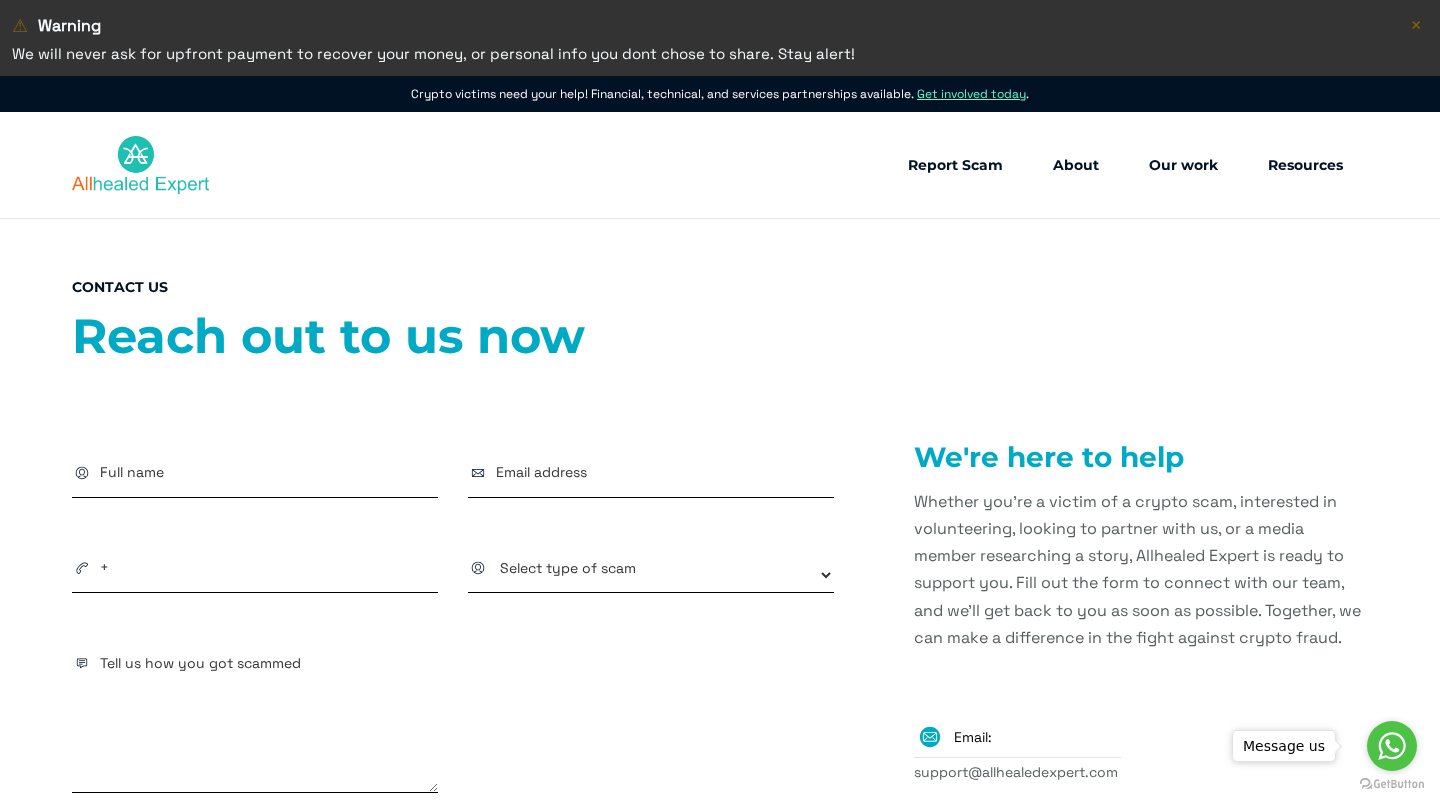
The homepage links the case button to a contact form. The visible fields ask for a full name, email, phone number, scam category and a description of what happened.
The supplied page code contains a confirmation message saying inquiries will be logged, but clients cannot be served yet. That message wasn’t visible on the blank form we inspected.
The Alliance’s site also contains similar confirmation copy, naming the Alliance instead. That reinforces the connection between the page designs; it is not a current tax-status check for either site.
This difference makes the destination important even if you never pay. You could provide enough personal and financial history to make a later call or email sound convincing.
We did not submit an inquiry or pay the site. This check did not establish that any visitor sent money or received a follow-up.
Step 4: A copied statistic makes the site look experienced
The Alliance’s site includes a 0–5% recovery figure in its FAQ. The equivalent passage on Allhealed Expert reproduces that figure and appends a coming-soon notice.
Nothing on the lookalike establishes that the figure reflects results obtained through its own inquiry form. It is not an audit, a success estimate for you or a money-back offer.
Both homepages also display broad figures about crypto scams. Do not mistake figures about an industry’s losses or victims for funds returned by the website.
Who Is Behind the Recovery Offer?
The known organization gives its own identity
The Alliance website names Crypto Recovery Alliance, Inc. in San Diego and publishes its federal ID and California registration number. Verify those details for that entity, not a similar domain.
A California registration number identifies a legal entity in one system. The federal ID can be used to search US tax records, which answer a different question.
Read the Alliance’s legal disclosure separately from the language inside its form template. If you need the organization’s tax status for a donation, verify it with the IRS.
The lookalike provides different contact information
Allhealed Expert’s contact page and footer give an email address on the alternate domain. A page using the same logo can still route the resulting conversation to someone else.
Do not infer that the people shown in the copied biography conducted any calls or correspondence. The pages we inspected do not establish who operates the alternate address.
A no-upfront-fee promise does not verify an operator
Allhealed Expert runs a banner saying it will not ask for advance payment. That assurance appears on the same website asking you to trust its collection route.
Before evaluating a price or promise, identify the organization independently. A copy may provide enough reassurance for a reader to share a phone number or financial history without paying anything.
Tracing and returning cryptocurrency are different jobs
A qualified analyst can document where a transaction moved. That does not give a private website authority over the receiving account or make a blockchain transfer reversible.
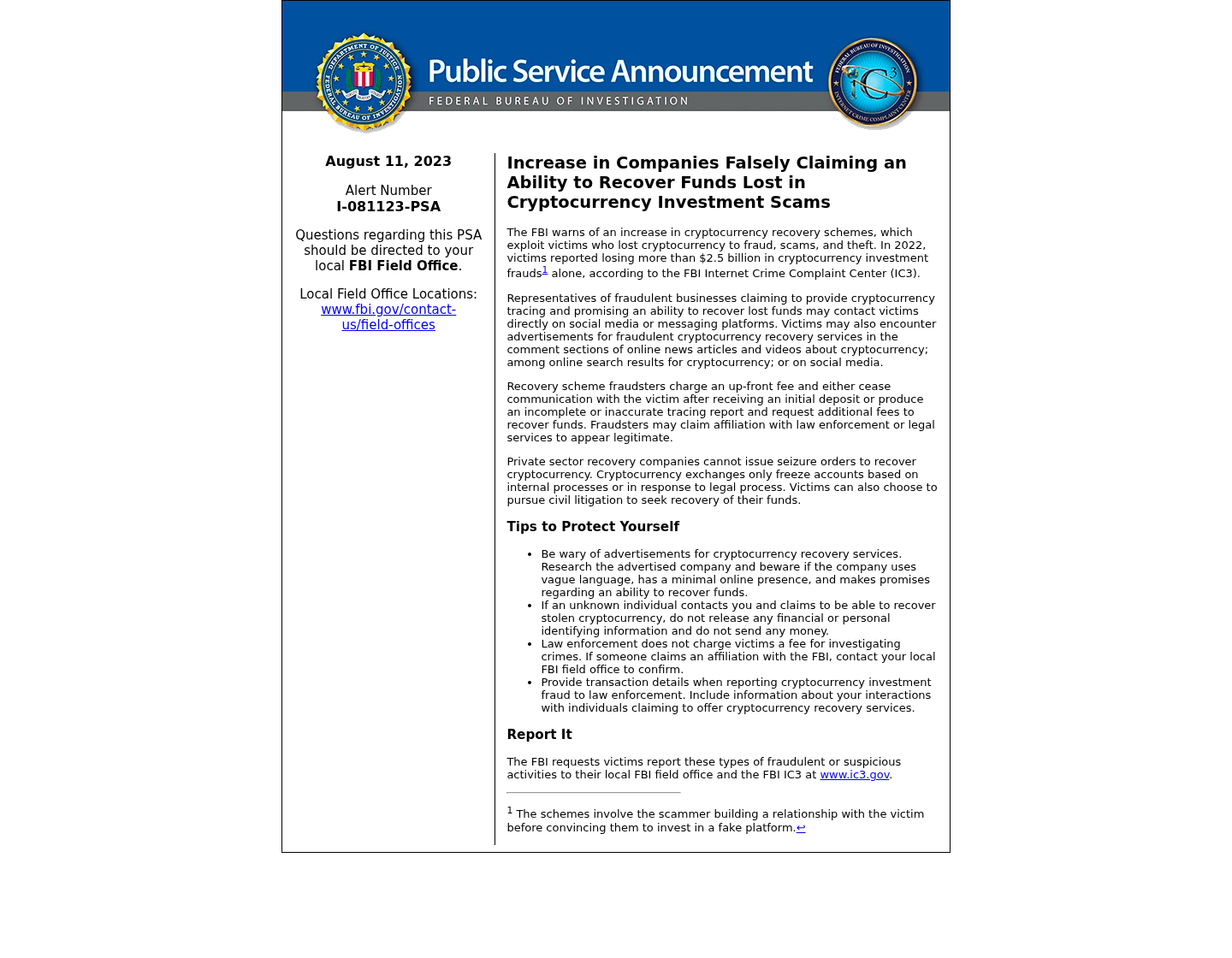
The FBI’s recovery-fraud alert says private recovery companies cannot issue seizure orders. Exchanges freeze accounts under their own procedures or in response to legal process.
Compare the Forms Before You Enter Your Details
On the Alliance’s Contact page, the published email ends in cryptorecoveryalliance.org. The visible form asks how you would like to get involved, along with a name and email.
The Allhealed Expert form labels its submission as a scam report. It adds a phone field and asks the visitor to categorize and describe the earlier fraud.
If someone sends you to the second form, don’t assume it transfers the information to the first organization. On the screens we inspected, the published destinations were not the same.
Write down the address shown in your browser before closing the page. A screenshot of the logo alone might not tell an investigator which site you saw.
When the contact starts in a comment or private message, save the profile and the date too. Keep those records if the sender later changes the message or username.
Don’t give a second contact more details just because they know the name of your exchange or the amount lost. Verify the organization that claims to be following up.
If you are asking the Alliance itself, use its own published route and ask whether it recognizes the alternate address. There is no need to include the entire transaction history.
If someone claims to represent both sites, the similarity of their pages does not settle it. Use a channel you found independently to confirm that the person is authorized.
How to Verify a Charity Claim Without Using the Suspect Form
Start with the legal name and federal ID listed on the organization you intended to contact. Do not use an image of a tax letter as your only check.
At the IRS tax-exempt organization search, choose a database such as Pub. 78 or Determination Letters. The IRS explains when each dataset can help.
Search for the employer identification number, then compare the returned legal name and location with the organization. You can also search by the legal name if the number isn’t available.
A match tells you about the named organization and the dataset you selected. It does not identify the operator of every website that quotes those values.
That caveat is important here because the lookalike reproduces names and site design. Finding an authentic record does not authenticate the copy’s email, form or requested payment route.
Locate the organization separately and verify your inquiry using the contact route it gives on its own domain. Start a fresh message rather than replying to the questionable one.
If the organization cannot confirm the other domain, do not give it a second opportunity to prove itself by showing documents you already saw on the copied page.
Save the alleged sender address and any exact wording about fees, access or the loss. Keep the records private so a later reply cannot simply repeat what you posted.
How to Tell a Trace Report From Another Payment Request
A transaction hash points to a transaction on a particular blockchain. Someone reading it might know the amount and destination without owning the recipient account or gaining legal access.
If a caller says the money has been located, ask which verifiable exchange or authority is handling it. Check with that organization separately without sending the caller more records.
If the person asks for a release fee, tax, wallet connection or security deposit, stop. Do not test the claim with a smaller transfer or a temporary wallet approval.
Never provide a seed phrase or private key to prove ownership. A valid request for evidence can be answered with public transaction details and records about your dealings.
If you used a hosted exchange, open your own account and use its independently located fraud channel. If a payment used a bank or card, notify that provider too.
The CFTC’s recovery fraud advisory warns victims about paying an unexpected party that claims it can get their funds back. A previously stolen amount does not create a new obligation.
Assess what the person is asking you to do, not just how sympathetic the message sounds. A request for a transaction reference is different from an instruction to authorize access.
What to Do If You Already Contacted Allhealed Expert
-
Record what you submitted, which address received it and how the conversation began. Keep messages, file names and any claimed case number without posting them publicly.
If you only viewed the page, close it and use the legitimate organization or your provider directly. A visit alone does not establish account compromise.
-
If you shared contact details or receipts, watch for calls that repeat facts from them. Those details are not proof that the caller found your funds or represents an investigator.
If any account details were submitted, contact that provider independently. Ask which credentials, connected devices or sessions require action based on what you actually shared.
-
If you authorized a transaction or approved wallet access, document the network and approval history. Get help through your wallet’s official support and the exchange involved, where applicable.
Do not revisit the recovery page to find a revocation service. Keep its instructions for the report rather than trying them a second time.
-
If you paid someone, preserve the account name, amount, time, transaction reference and destination. Ask the payment provider what steps are still available for that method and whether deadlines apply.
Separate the earlier theft from any later recovery payment. This makes it easier for a fraud investigator to identify where each transfer went.
-
In the United States, file an online-crime report at the FBI’s IC3 portal. Elsewhere, use your local police or national cybercrime reporting service found independently.
Report confirmed facts separately from what someone claimed in a message. Include the chronology and transaction references rather than guessing who controls an account.
Frequently Asked Questions
Is Allhealed Expert the Crypto Recovery Alliance?
The sites share content and homepage identifiers. The Alliance publishes a different domain and contact route, so do not treat an Allhealed Expert form as belonging to it.
Did Allhealed Expert offer to open a case?
The homepage explicitly invites readers to start a case. The contact form’s confirmation text says it cannot serve clients and describes logging inquiries instead.
Does the 0–5% figure prove the service recovered anything?
It appears in substantially matching text on the Alliance and lookalike sites. It does not document results for the Allhealed Expert form or predict what will happen in your case.
Can I trust the site if there is no upfront charge?
No, the promise concerns fees and tells you nothing about who receives your records. Verify the recipient without relying on its own branding or assurances.
What if I only entered my name and email?
Be wary of follow-ups that refer to your earlier loss. You do not need to assume a device or account was compromised if you only entered contact information.
Can the IRS confirm the website belongs to the charity?
The IRS tool can help verify an organization’s tax records. It does not confirm that a separate domain using the organization’s name is an authorized destination for your information.
The Bottom Line
Allhealed Expert uses matching Crypto Recovery Alliance content but directs readers to a different contact route. Do not send case records or rely on it to get your cryptocurrency back.
Use the organization you can verify and notify the exchange or payment provider that handled the loss. Keep the original transaction evidence and report any recovery offer separately.

Join the discussion
0 commentsShare your experience or ask a question about this article.
Community experiences
Did this happen to you?
Your experience could help someone recognize the same scam. Submit a private report for our team to review.
I experienced this tooReports are reviewed before publication. Sharing publicly is always your choice.
Discussion
Start the conversation
Have a question or something useful to share? Add the first comment.