


Your computer appears to freeze, and a warning tells you something is wrong. The person offering help soon starts asking questions about your money.
That shift deserves your full attention. In the Syed case, a supposed computer problem became the opening to a much larger financial deception.
Overview
A computer scare led into an account-protection story
The Syed fake support scam involved fraudulent computer warnings followed by people posing as technical support staff or government representatives.
Victims were told their accounts or information were compromised. The supposed solution was to move money or hand over valuables for protection.
The DOJ’s sentencing announcement describes cash, gold, gift cards, and at least one Bitcoin ATM payment among the methods used.
A laundering conviction established a real criminal operation
Ahmed Maqbul Syed was sentenced on October 27, 2026, to 96 months in prison after pleading guilty to conspiracy to commit money laundering.
The court also ordered approximately $2.4 million in restitution. That obligation isn’t proof that the victims have already recovered their money.
The case concerns a widespread operation targeting older people across the United States. The announcement doesn’t identify every caller, warning page, or victim transaction.
The claimed protection was the reason to stop
- A browser warning cannot establish that your bank account is compromised.
- Government impersonators used financial danger as a reason to demand assets.
- Some victims were frightened with false associations to serious crimes.
- Changing the requested payment method didn’t make the underlying story legitimate.
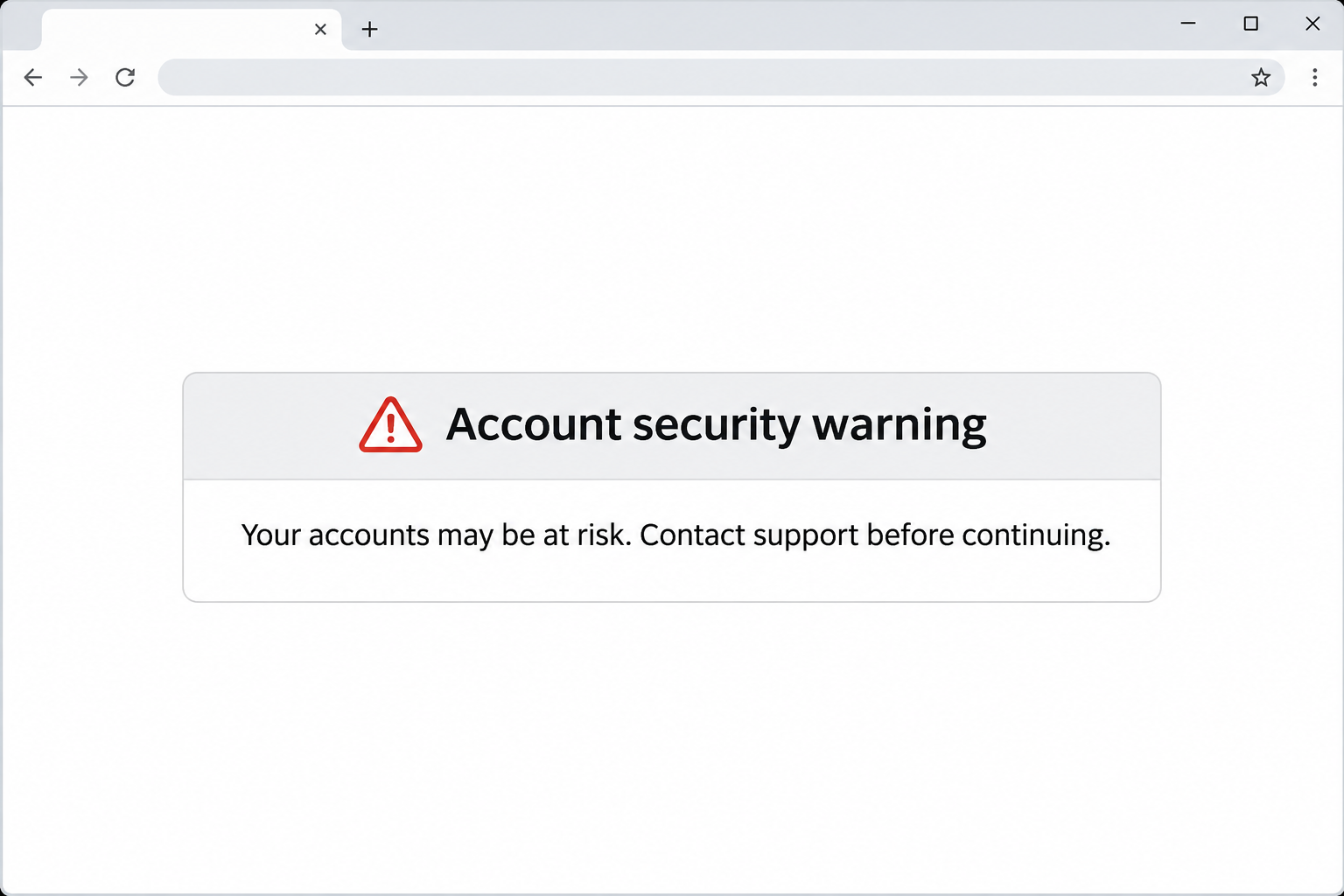
The lead image is an inert reconstruction of a warning. Its wording isn’t presented as a recovered popup or an exact message from this prosecution.
When Computer Help Turns Into Financial Instructions
A computer problem can be frustrating enough that a prominent support message feels useful. The page may appear to explain why everything stopped working.
But solving a browser issue and protecting savings are different tasks. A stranger who connects them needs scrutiny before you reveal financial information or move funds.
The Syed announcement describes victims being deceived by warnings or apparent computer freezing. Calling the offered assistance connected them with impostors rather than genuine help.
The decisive turn came when those impostors described endangered accounts and instructed victims to move assets. That wasn’t a normal repair procedure.
This distinction gives readers an earlier stopping point than a payment receipt. You can end the call as soon as supposed support begins directing financial decisions.
A caller’s confidence doesn’t establish access to your bank’s records. They may be repeating information you supplied or asserting a problem they haven’t demonstrated.
Nor does a frozen screen prove the entire device is controlled remotely. A frightening page can disrupt your browsing without proving every claim made beside it.
Keep the actual exposure separate from the story: a page appeared, a call happened, credentials were shared, software was installed, or money changed hands.
Each of those events requires a different response. Combining them into a vague belief that everything is hacked can make another false instruction seem necessary.
How the Syed Fake Support Scam Worked
Step 1: A warning creates an apparently urgent computer problem
Victims initially encountered fraudulent computer messages warning of a problem or causing the computer to appear frozen, according to the sentencing announcement.
The visible warning supplied both the problem and a route toward supposed assistance. Following that route gave the criminals an opportunity to guide the next interaction.
The safer choice is to stop interacting with the warning. You don’t need to diagnose the whole device before refusing a number supplied by a suspicious page.
Use the browser’s own controls rather than buttons drawn within the warning. If the page won’t close normally, seek help through someone you already know and trust.
Step 2: Impostors expand the story into compromised accounts
The scammers posed as support staff or government representatives and falsely told victims that their accounts were hacked or their information was compromised.
Some victims were also told their accounts were associated with child pornography or other crimes. Those false accusations made the supposed emergency more frightening.
Such allegations can discourage people from seeking help because they’re afraid of being judged. That isolation makes an impostor’s instructions harder to challenge.
You don’t need to answer a stranger’s accusations to protect yourself. End the interaction and verify any claimed government concern through an independently obtained official channel.
A real concern about a bank account can be checked directly with your bank. The person behind a computer warning shouldn’t control that verification.
Step 3: Moving assets is presented as a protective measure
Victims were instructed to withdraw or transfer funds under the claim that their assets needed safeguarding. The requested movement served the fraud rather than the victim’s security.
The announcement describes purchases of gold and withdrawals of cash, followed by handovers to people falsely posing as government officials.
A physical handover can feel more official than an online transfer, especially if someone arrives after a long conversation. Their presence doesn’t authenticate the claimed agency.
Before moving anything, disconnect from the caller’s instructions. Speak to your bank or a trusted person without letting the stranger remain on the line.
Don’t rehearse a cover story for bank staff or a seller. If someone wants you to conceal why you’re moving money, tell the institution exactly that.
Step 4: Other payment methods serve the same false story
Some victims purchased gift cards and supplied their numbers to people claiming they would help. At least one victim was directed to deposit cash into a Bitcoin ATM.
These weren’t separate legitimate solutions to different computer problems. They were ways for the operation to obtain value under the same protective pretext.
The method matters afterward because recovery routes differ. A bank wire, gift card code, cash handover, and cryptocurrency transaction leave different records and require different contacts.
Don’t let the caller treat a failed payment as a technical obstacle you should solve. Another card, wallet, or pickup arrangement simply continues the demand.
You can stop even after completing one step. Buying gold doesn’t require handing it over, and buying a gift card doesn’t require sharing its numbers.
Step 5: The proceeds enter a laundering operation
Syed’s established conviction concerns conspiring to launder proceeds from the fraud. It connects the financial handling with the deception that persuaded victims to part with assets.
The announcement identifies his laundering role without attributing every call or warning to him. Other participants could therefore appear between the original contact and the payment.
For a victim, records of the receiving account or collection arrangement remain useful even when the caller used a false name.
Investigators can examine those records alongside communications and financial transactions. You don’t have to identify the real person behind every voice before making a report.
Why the Payment Method Doesn’t Prove Government Authority
Scammers can switch methods while keeping the central story unchanged. If cash becomes inconvenient, they may suggest another way to carry out the same supposed protection.
The useful question isn’t whether the new method is familiar. It’s why a caller claiming government authority needs you to surrender money or valuables.
The FTC’s consumer guidance explicitly warns about impersonators telling people to move funds for protection or give cash or gold to someone.
A gift card has no role in establishing that a government investigation is legitimate. Providing its numbers can expose the value regardless of who holds the plastic.
Cryptocurrency also doesn’t make a fabricated emergency more credible. A Bitcoin ATM can process a transaction without verifying that the person instructing you is an official.
For gold, preserve the purchase receipt and any collection instructions. A valuable physical item should remain with you while you independently verify the situation.
If a stranger is already approaching your home for a pickup, contact local police promptly. Don’t arrange a confrontation or attempt your own sting operation.
Respond According to What Actually Happened
If you only saw the warning, stop interacting with it and close the page. Seeing a false alert isn’t, by itself, proof of account theft.
If you called but disclosed nothing, end contact and preserve the number from your existing call record. Don’t call again to test whether the story changes.
If you supplied a password or account information, protect that specific account through its genuine app or website. Use a trusted device if remote access occurred.
If you installed software or allowed remote control, disconnect the affected device from the internet and seek authorized technical help through an independently chosen support route.
Tell that support person what you installed or permitted. They need the real sequence to assess access, preserve relevant records, and determine appropriate cleanup.
If money or valuables moved, start the payment-specific response immediately. Don’t postpone bank notification while waiting for someone to inspect the computer.
For a work-managed computer, notify the organization’s IT team. Let its authorized staff handle evidence retention and access changes rather than resetting the device yourself.
What to Do if You Have Fallen Victim to This Scam
-
End the call and stop following payment instructions. Don’t tell the caller which bank, relative, or police office you intend to contact.
If a pickup is planned, keep the cash or gold and contact local police about the arrangement. Avoid meeting or confronting the collector yourself.
Ask a trusted person to help you make the necessary calls. Someone beside you can also help recognize renewed pressure from another number.
-
Contact your bank through its established app, a branch, or the number on your card. Explain the false support and asset-protection story.
Identify any withdrawals, transfers, account details disclosed, or upcoming transactions. Ask about a recall, restrictions, replacement credentials, and other protections that fit your situation.
Keep the bank’s case number and follow-up instructions. Explain whether you initiated each payment under deception rather than describing every transaction as automatically unauthorized.
-
For gift cards, contact the issuing company immediately using its genuine support channel. Provide the card details and receipts privately and explain the fraud.
Ask whether remaining value can be protected or a refund considered. Keep the physical cards and receipts even if you believe their value has gone.
If you haven’t shared the numbers, don’t send them now. A caller’s claim that disclosure is needed to cancel the process simply continues the risk.
-
For a cryptocurrency ATM payment, contact the ATM operator through the details on your receipt or its independently verified website.
Supply the transaction reference, time, amount, and destination information shown in your records. Ask what assistance or preservation steps are available for a fraud report.
Cryptocurrency transfers can be difficult to recover. Don’t pay another person who claims a private key, recovery tax, or release fee will unlock your loss.
-
Save messages, call records, receipts, account instructions, and any collection details you already have. Write a timeline while the sequence is fresh.
Record what each supposed representative claimed and how one contact led to another. Distinguish those claims from facts independently confirmed by your bank or police.
Don’t reopen the warning or contact the criminals to obtain better screenshots. Existing records are a useful starting point without another unsafe interaction.
-
Report the online-enabled fraud at IC3.gov through File A Complaint. Read the terms and supply the financial and communication details accurately.
Report to the genuine FTC service at ReportFraud.ftc.gov as well, particularly when someone impersonated that agency or another government body.
Save any confirmations and provide related case numbers to institutions handling the loss. Reporting doesn’t guarantee an individual response or completed reimbursement.
Protecting Someone Who Is Still Following the Caller
Begin with a concrete request to pause the payment. You don’t need to persuade your relative that every previous interaction was false before interrupting another withdrawal.
Offer to visit the bank with them or help call its genuine fraud team. Keep the support practical and avoid treating the conversation as a test.
If the caller claims police or government authority, verify it together through an independently located agency contact. Don’t use a number supplied during the supposed investigation.
Take false criminal accusations seriously as a source of fear, without treating them as verified facts. Your relative may be following instructions because they feel trapped.
Help them preserve records before deleting messages or discarding receipts. Those records may be easier to collect with calm assistance than through repeated questions later.
Agree on how to handle further calls, especially if the criminals return using another official-sounding identity. Changing the voice doesn’t make the original story true.
Once the immediate financial risk is contained, allow room for the emotional consequences. Respectful support makes it easier to disclose any payments that haven’t yet been mentioned.
Frequently Asked Questions
Was Syed actually sentenced in this case?
The DOJ announced a 96-month sentence imposed on October 27, 2026, following a guilty plea to conspiracy to commit money laundering.
The approximately $2.4 million restitution order is a legal obligation, rather than proof that victims have already received that amount.
Does a frozen browser mean my bank account is hacked?
A browser problem cannot establish a bank-account compromise. The case describes false computer warnings used to introduce fabricated claims about victims’ information and accounts.
Check financial concerns directly through your bank’s normal channel rather than through the person answering a number displayed by the warning.
Can a government official collect gold to protect my savings?
Don’t surrender cash or gold to someone making that claim. The Syed case describes that protective story as part of the fraudulent operation.
If a pickup is arranged, keep the assets and contact local police. Avoid confronting the proposed collector yourself.
What if I already bought gift cards but haven’t shared them?
Do not disclose their numbers or PINs to the caller. Contact the issuing company through its genuine support route if you need help with the purchase.
Keep the gift cards and their receipts. Buying a card doesn’t require completing the next instruction from the person who pressured you.
Does this prove the warning installed malware?
The public sentencing announcement doesn’t identify a particular installed malware family. A false popup alone doesn’t establish that additional software ran on the device.
If you installed something or allowed remote access, treat that separate exposure seriously and obtain authorized technical help through an independent route.
Should I wait for a computer scan before calling my bank?
Don’t delay reporting a payment while investigating the device. Your bank needs the transaction details promptly, especially if another transfer or pickup is pending.
Device access, account credentials, and money recovery are separate problems that may need attention at the same time.
The Bottom Line
Don’t let a computer warning dictate what happens to your savings. The Syed operation used false protection claims to obtain cash, gold, gift cards, and cryptocurrency.
End the contact, keep any assets you still hold, and notify the relevant financial provider immediately. Report the actual sequence and seek separate help for any genuine device exposure.

Join the discussion
0 commentsShare your experience or ask a question about this article.
Community experiences
Did this happen to you?
Your experience could help someone recognize the same scam. Submit a private report for our team to review.
I experienced this tooReports are reviewed before publication. Sharing publicly is always your choice.
Discussion
Start the conversation
Have a question or something useful to share? Add the first comment.