


A friendly online conversation turns into an invitation to a private video chat. Then the person on the other side changes what they’re asking for.
When a recording becomes part of that conversation, knowing what to do next matters more than finding the perfect reply to a threatening message.
Overview
An apparent private encounter became financial blackmail
The webcam sextortion scam described in the Sangare case involved false online identities, intimate recordings, threats to share them, and demands for payment.
The DOJ’s case-information page records Abdul Aziz Sangare’s October 8, 2026 guilty plea to charged offenses including threats, laundering, and wire fraud.
The broader case describes thousands of potential targets, primarily young men, including minors. Its payment trail connected threatening profiles with a wider financial operation.
Case-wide figures and individual outcomes need separate treatment
The broader charging account describes approximately $6.9 million sought and approximately $1.9 million obtained through Cash App and Apple Pay accounts alone.
Those are attributed scheme-wide figures, rather than an amount independently assigned to Sangare alone. The public page also distinguishes guilty pleas from defendants awaiting trial.
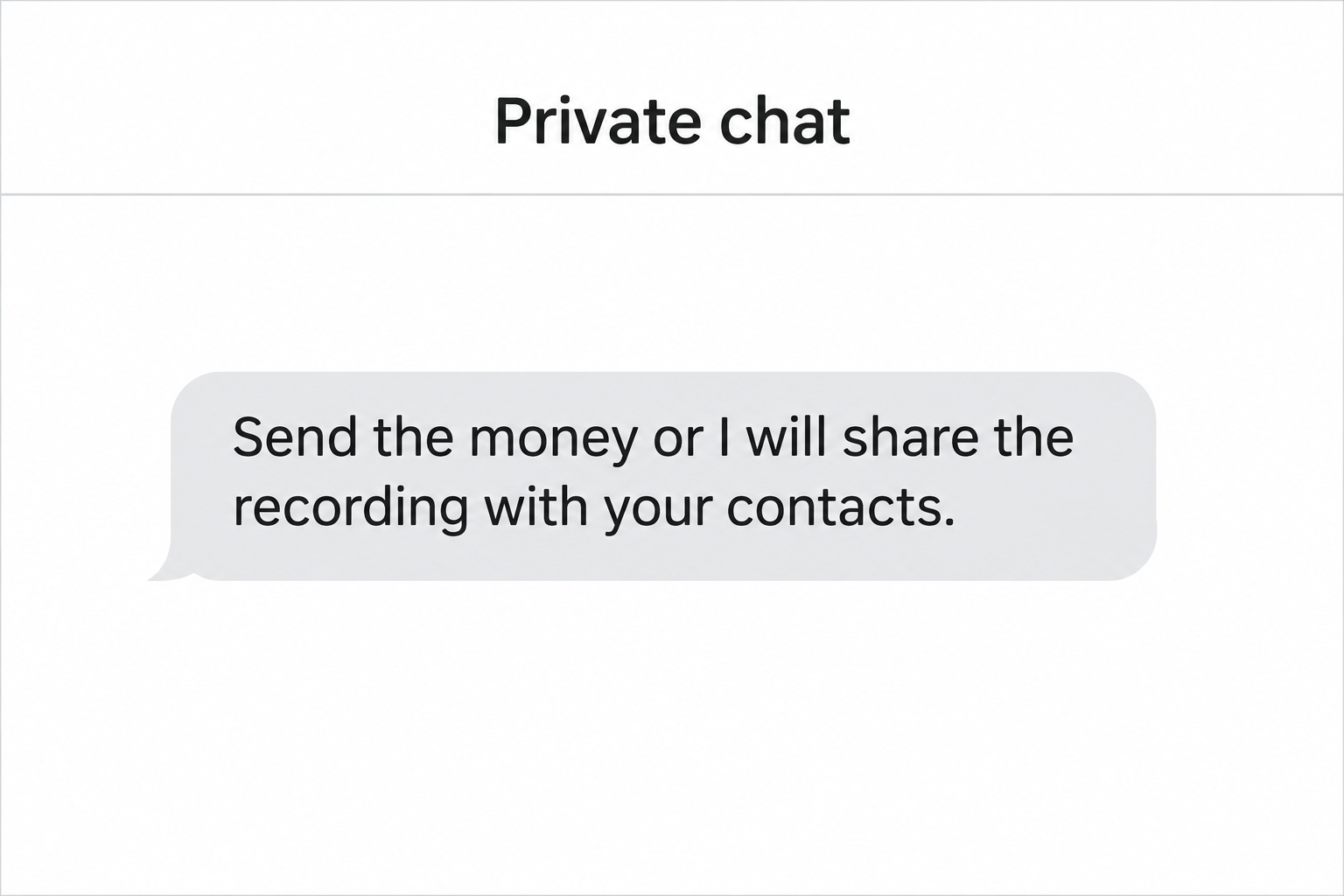
The lead image is a text-only reconstruction of a threat. It contains no victim imagery and isn’t an original message recovered from this investigation.
The response is about safety, evidence, and stopping payments
- A live-looking chat doesn’t prove who controls the account.
- Paying doesn’t give you control over an extorter’s copies.
- Preserve threat details without circulating intimate images to other people.
- Children and adults have different image-protection services available to them.
The practical steps below focus on financial sextortion. They don’t assume the person has hacked your device merely because they possess a recording.
The Moment a Conversation Becomes Extortion
Someone threatening to expose intimate material unless you pay is trying to control your decision through fear. Their demand doesn’t become legitimate because you joined a chat.
Embarrassment can make the deadline feel absolute. The extorter wants you concentrating on the next few minutes, rather than asking someone else for help.
A threat listing friends or coworkers can intensify that pressure. It may suggest surveillance even when those names were visible through ordinary social connections.
You don’t have to establish exactly how the extorter found every contact before taking action. Stop further disclosures and ask a trusted person to stay with you.
The scammer’s behavior also changes the meaning of the earlier interaction. What seemed private was used to create leverage for a financial demand.
That doesn’t mean the victim caused the crime. The deception, unauthorized recording described in the case, and threatening demands belong to the people carrying them out.
The next step shouldn’t depend on winning an argument with them. Trying to negotiate perfect wording can keep you inside the pressure they created.
If you’re helping a young person, begin by making clear they won’t face blame for asking for help. Immediate support matters more than reviewing their original choices.
How the Webcam Sextortion Scam Works
Step 1: A false identity makes the interaction feel personal
The broader charging account describes people posing as young women online and initiating conversations with potential targets. The account operator wasn’t the person portrayed.
An attractive profile and responsive messages can make a stranger feel familiar quickly. They don’t independently establish identity, age, consent, or control of the account.
The public case description doesn’t identify every platform or publish a script used against each target. Don’t assume one particular app is responsible for the entire scheme.
The warning attaches to the deceptive interaction and threats. A legitimate communication platform can be used by someone concealing who they are.
For someone still before the threatening stage, the safest interruption is to decline intimate exchanges with an unverified contact and stop responding to pressure.
Step 2: The encounter supplies a recording or other intimate material
The case alleges that webcam or live-video encounters were secretly recorded while victims believed they were interacting with the person presented in the account.
This matters because a live appearance can feel more convincing than a still photograph. It still doesn’t give you control over recording at the other end.
If someone says they have a recording, don’t send another image to prove or disprove it. Additional material can create further exposure without resolving the threat.
Also avoid installing software offered as a way to erase the recording. A stranger’s proposed fix shouldn’t become another route into your accounts or device.
Step 3: Threats turn social connections into pressure
The scheme description says victims were threatened with distribution to relatives, friends, partners, employers, coworkers, and wider online audiences unless they transferred money.
That audience is part of the coercion. The extorter isn’t simply requesting payment for a service; they’re threatening harm to obtain it.
A screenshot showing familiar names doesn’t prove the criminal has contacted everyone shown. Equally, you shouldn’t rely on an assurance that they will never share anything.
Base the response on actions you control: stop payments, preserve threat information, report the account, and use appropriate support and image-protection routes.
You don’t need to answer every accusation or insult. The conversation can remain threatening even when the extorter briefly sounds cooperative or offers a lower amount.
Step 4: Payments reach accounts used to move the proceeds
The broader case describes money collected through payment accounts and infrastructure used to send proceeds overseas. The charged scheme wasn’t confined to a single threatening profile.
That explains why the beneficiary or payment handle matters alongside the account sending messages. The two identities may represent different parts of the operation.
Don’t assume the named payment service endorses the threat. Record its transaction reference and contact that service through the app or website you normally use.
If you already paid, tell the provider you were extorted. Whether a payment was personally initiated and whether it was induced through threats are separate facts.
A guilty plea doesn’t mean every threatened person has been identified or repaid. Your own report should preserve the actual account and payment details you encountered.
What the Sangare Case Confirms
The current DOJ page records Sangare’s guilty plea and says he was awaiting sentencing. It separately records another defendant’s plea and other pending proceedings.
Other defendants were still awaiting trial, according to the case page. Sangare’s guilty plea doesn’t determine the outcome of those separate proceedings.
The page’s detailed scheme narrative appears under its charging account. Claims about the whole network and its totals therefore remain attributed to prosecutors.
For victims, the case shows that threats can be investigated beyond the profile that first contacted them. The payment trail can provide another line of evidence.
It doesn’t promise that an investigator can erase every copy or obtain an immediate refund. Practical protection and support shouldn’t wait for that possibility.
If You Have Already Received a Threat
Don’t pay or send more intimate material. Payment doesn’t provide a dependable way to make someone delete copies they control.
Stay near someone you trust while taking the next steps. If you’re a minor, tell a trusted adult, counselor, or another responsible person who can help.
Keep the account name, profile address, threat text, payment instructions, and transaction details. Preserve existing evidence safely without forwarding intimate images to friends or public groups.
Report the account through the platform’s safety tools before blocking where possible. Don’t keep communicating solely because you think you need more evidence.
If there is an immediate threat to physical safety, contact local emergency services. An online reporting form isn’t a replacement for urgent help nearby.
The same care applies if a friend is affected. Stay calm, help with the practical tasks, and don’t demand to see the intimate material.
What to Do if You Have Fallen Victim to This Scam
-
Stop the financial conversation and involve someone trustworthy. You can tell them that an online contact is threatening you without showing the images themselves.
Don’t agree to another call, additional content, or a new payment arrangement. Those demands can prolong the criminal’s control over your attention.
If you feel unable to manage the situation safely, stay with a trusted person and seek immediate local support rather than dealing with the threats alone.
-
Preserve the messages that show the threats, along with usernames, profile links, payment handles, timestamps, and receipts. Keep those sensitive records somewhere private.
Don’t download or redistribute sexual material involving anyone under eighteen to build an evidence folder. Tell the appropriate reporting service what exists and where it appeared.
Report the threatening account through its platform controls, then block further contact. If another account appears, preserve and report that approach without restarting negotiations.
-
If you paid, open the genuine payment app or contact your bank through its established channel. Locate the transaction and identify its reference and recipient.
Report the payment as connected to extortion and ask about available reversal, dispute, or recipient-reporting options. Explain accurately that threats induced the transfer.
Preserve the case number and response. Don’t send another payment because the extorter claims a refund, deletion, or account closure requires an additional fee.
-
For exploitation involving a child, use NCMEC’s CyberTipline and select its reporting route. Describe the threats, account, and any known location of the material.
Adults can report internet-enabled extortion through IC3.gov. Follow File A Complaint, read the terms, and retain the confirmation provided.
Local police can also receive threats and payment evidence. Explain any immediate safety concern directly rather than assuming an online report will be read immediately.
-
Choose image-protection help according to your age when the material was created. The next section explains the different services and their limits.
Use material already held on your device where the service requires it. Never obtain or share new copies of child sexual material to submit a request.
Keep any case number or access code securely. These services can help on participating platforms, but neither provides a whole-internet deletion guarantee.
-
Review what the threatening account can still see publicly, including contact lists and profile details. Restrict unnecessary visibility through the platform’s privacy controls.
If you disclosed a password or lost account access, use that service’s genuine recovery process. Threat possession alone doesn’t establish that every account was compromised.
Ignore unsolicited paid removal or recovery offers promising complete deletion. They may exploit the same fear, especially when the person demands secrecy or advance payment.
How to Use the Available Image-Protection Services
If the material was created when you were under eighteen
Take It Down is NCMEC’s free service for eligible intimate images or videos created when the person depicted was under eighteen.
You can use it even if you are older now. The relevant age concerns when the material was made, rather than when you seek help.
On its website, select Get Started and use an eligible file already on your device. The service generates a digital fingerprint locally rather than uploading the image.
That fingerprint is shared with participating platforms to help identify matching material on their public or unencrypted services. It isn’t a guarantee against every copy everywhere.
Do not download, request, or share a file simply to use this service. If you don’t possess it, report the situation through NCMEC’s support routes instead.
If the material was created when you were an adult
StopNCII.org offers a separate route for eligible adult intimate imagery. Review its eligibility questions and begin the case-creation process through its website.
Select the eligible material already on your device. Its process creates a fingerprint locally and sends that fingerprint, rather than the original image, to the service.
When a case is successfully created, save the case number and PIN securely. The service says lost access details cannot be recovered.
Use those details to check the case status later. Participating platforms assess matching content under their policies; the service cannot remove images from the entire internet.
Continue reporting the extorter’s direct threats separately. A fingerprinting request addresses image distribution, while police and payment-provider reports address the extortion and financial activity.
Frequently Asked Questions
Does a live video prove the account is genuine?
A live-looking interaction doesn’t prove who controls the account or whether it’s being recorded. The broader case describes deceptive webcam encounters used to obtain leverage.
Don’t send money or additional intimate material because the contact insists an earlier video made the relationship trustworthy.
Did Sangare plead guilty or merely face charges?
The DOJ’s case page records Sangare’s October 8, 2026 guilty plea and says he was awaiting sentencing. Other defendants had different procedural statuses.
The broader scheme figures remain attributed to the case account rather than treated as amounts assigned solely to him.
Will paying stop the recording from being shared?
Payment doesn’t give you control over copies held by an extorter. A promise to delete material isn’t a reliable basis for sending more money.
Stop payments, preserve the threats, and use reporting and image-protection channels appropriate to your circumstances.
Should I send the recording to friends as evidence?
Don’t circulate intimate material while seeking help. Preserve account and threat details, and explain the situation without showing people the images.
For material involving minors, don’t download or share additional copies. Use NCMEC’s reporting and support routes for guidance about the existing content.
Can Take It Down or StopNCII erase everything online?
Both services work with participating platforms and have specific eligibility requirements. Neither promises removal from every website, private message, or encrypted service.
Choose the appropriate route and keep reporting threats separately. Fingerprinting addresses matching content rather than payment recovery or the criminal’s behavior.
Do Cash App or Apple Pay operate the scam?
The case describes payment accounts used to collect proceeds, rather than finding that the legitimate services organized the extortion. Keep responsibility attached to the criminals.
If you paid through a service, report the actual transaction and recipient through that provider’s genuine support channel.
The Bottom Line
Don’t pay a webcam extorter or send more content. The documented scheme turned an apparently private encounter into threats designed to keep victims transferring money.
Preserve the threats, involve someone you trust, and report through the appropriate channels. Use age-appropriate image-protection help without downloading or circulating additional intimate material.

Join the discussion
0 commentsShare your experience or ask a question about this article.
Community experiences
Did this happen to you?
Your experience could help someone recognize the same scam. Submit a private report for our team to review.
I experienced this tooReports are reviewed before publication. Sharing publicly is always your choice.
Discussion
Start the conversation
Have a question or something useful to share? Add the first comment.