


An exhibition game can draw a big crowd before the regular season even begins. If someone offers you a share of the proceeds, the pitch sounds easy to picture.
There is a difference between knowing that a game exists and knowing who is entitled to make money from it.
Overview
The pitch used NBA preseason games to make an investment feel familiar
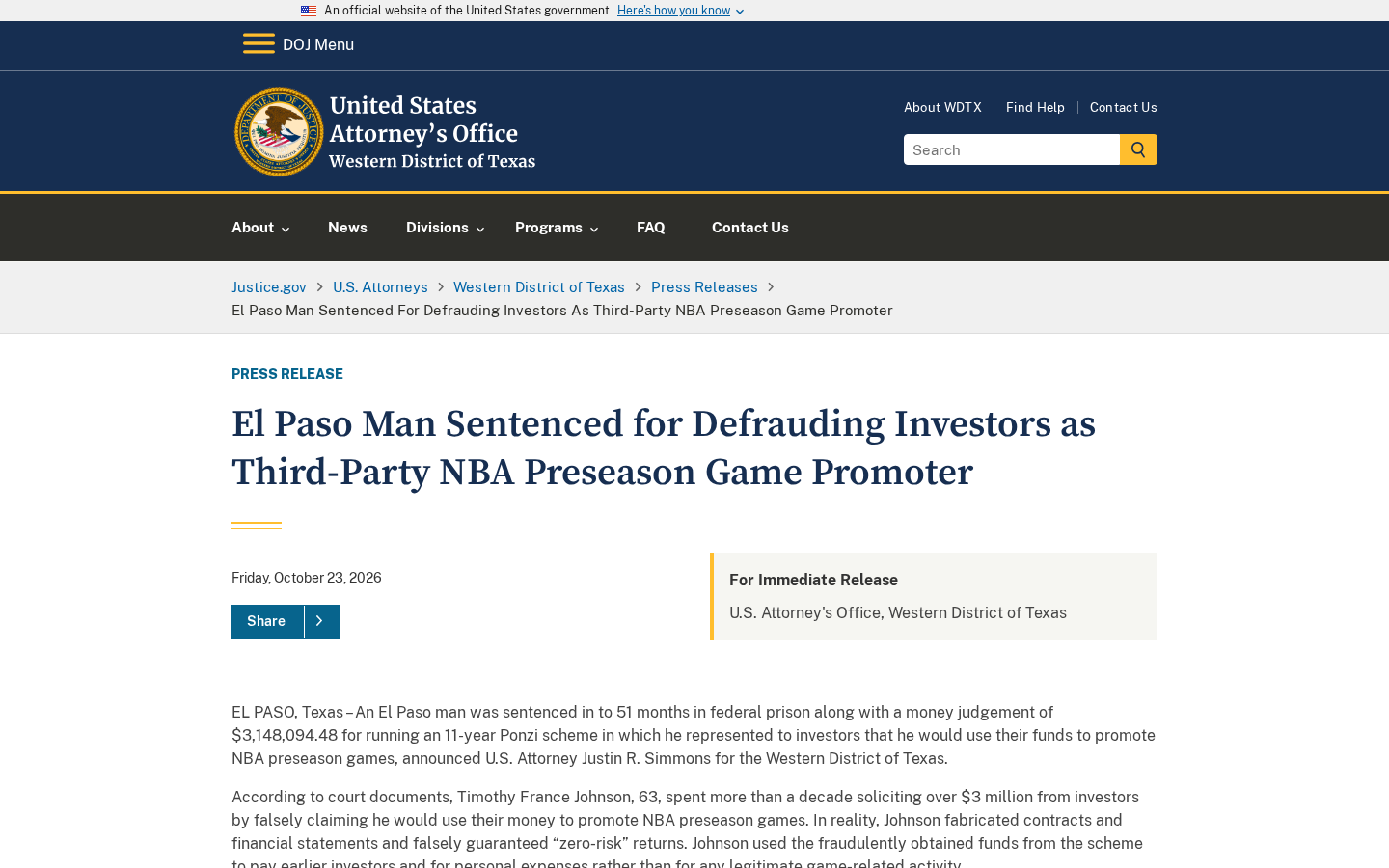
Timothy France Johnson, an El Paso promoter, offered investments tied to promoting NBA preseason games. He was a third party, not the NBA or a team selling shares to fans.
In an October 23, 2026 sentencing announcement, federal prosecutors said Johnson used forged contracts and financial statements and misrepresented the investments as having no risk.
Someone who follows basketball can immediately understand why a game might sell tickets. That knowledge does not tell you who has rights to a particular event or its takings.
The case involved investors, not customers buying tickets
An investor was being asked to put capital into a deal in the expectation of a return. A fan buying a seat is paying for admission, not financing the promoter.
For an investor, a public schedule can confirm when a game is listed. It cannot tell you whether a third party has a contract or what that contract actually provides.
This case does not establish that the NBA, its teams or every third-party promoter took part in wrongdoing. Prosecutors focused on what Johnson told investors and did with their funds.
What happened in federal court
Johnson pleaded guilty to seven counts of wire fraud in March 2026. The October announcement says his scheme operated for more than a decade.
He was sentenced to 51 months in prison. The $3,148,094.48 money judgment does not tell you that investors have been repaid.
- Confirm the promoter has rights to the exact game mentioned.
- Ask what money actually flows to that promoter under the contract.
- Find out whether earlier payments came from event revenue or other investors.
- Refuse to invest on the basis of a risk-free promise.
How the NBA Preseason Investment Scam Worked
Step 1: A recognizable event made the opportunity easy to imagine
When people hear the name of a team they know, they can picture an arena, a crowd and ticket sales. They do not have to understand the actual financing yet.
Johnson presented his offer as financing third-party preseason game promotion. The familiar part was the sport; the part requiring verification was what he claimed investors would be financing.
Write down the event, dates, counterparties and rights described in the proposal. If a seller cannot identify the deal precisely, there is nothing concrete for you to verify.
A city and a team name are not enough. Ask for the venue, the related event and the organization in a position to confirm the promoter’s obligations.
Step 2: Forged paperwork stood in for independent confirmation
The DOJ says Johnson presented forged contracts and financial statements. Those documents were supposed to make the opportunity and the financial picture look credible to prospective investors.
Reading a contract for professional language or a recognizable logo misses the point. You need to know that the named counterparty actually entered it and that this version is current.
Have your attorney use contact details found independently to request confirmation. Do not use a phone number or email address supplied only in the document you are trying to authenticate.
Some counterparties may not share confidential terms directly. Have your adviser ask about a secure way to get the confirmations you need, or stop if they cannot be obtained.
Step 3: The expected return was presented as having no downside
The investment was sold without the risk prosecutors say it actually carried. Even an authentic event can be moved, canceled or less profitable than a promoter’s projections suggest.
Ask what happens if sales are low or the event does not take place. Expenses, refunds, cancellation clauses and how contracts split revenue can all change what is left.
A guarantee is only useful if you can establish who owes the money and whether they can pay. A confident explanation does not tell you either one.
Read the downside scenario before the earnings projection. If the only answer to a delay or loss is that someone else will make it right, ask that party independently.
Step 4: Earlier investors were paid with other investors’ money
According to prosecutors, Johnson used investor funds to pay earlier investors and cover expenses. A payment that actually arrived was not necessarily a share of game revenue.
This is why a friend’s payment confirmation is not enough due diligence. They can tell you what they received; they may not know where the funds originated.
Ask for a reconciliation that connects proceeds to the event and then to the distributions. A transfer from the promoter’s account alone leaves that connection unproven.
If someone invites you to roll a payout into another event, pause. Treat it as a new investment, and verify the source of prior payments before you add money.
How to Check a Sports Promotion Investment Before Sending Money
Ask what the promoter owns or has permission to sell
Start with the exact organization that controls the rights being offered. A promoter could have a limited role that does not entitle it to share ticket or sponsorship revenue.
Imagine an arena confirms the date and opponent. Ask a second question: Does that confirmation identify the promoter as a party entitled to receive the revenue described in the proposal?
Calendar confirmation proves much less than a signed assignment or enforceable agreement. An adviser can separate confirmation that a game is happening from confirmation that a deal exists.
Get the legal names of the parties before paying, including the payee on the transfer. If it is a different entity, find out why and who owns it.
Where a venue rents out space, it may be able to confirm a rental without knowing who owns ticket revenue. Direct questions about money to the appropriate rights holder.
Ask the adviser checking the contract to confirm its scope and period. Rights to organize an earlier game are not evidence of rights to the next one.
Look for amendments or cancellation clauses that change the deal you were shown. A signed page on its own cannot show which obligations still apply.
Trace the financial claim to independent records
A promoter’s forecast can help explain its assumptions. It cannot serve as a receipt for sponsorship money that has not been collected or ticket proceeds it may not control.
For previous events, ask for final settlement records and have an independent adviser check whether the incoming proceeds and outgoing payments match the description you received.
For a future event, ask how the investment funds will be held and what you can verify before release. Obtain confirmation before you part with capital, not afterward.
If the promoter is raising money for more than one event, ask whether your investment can be used elsewhere. Read the agreement rather than assuming a specific game restricts spending.
Compare gross receipts to the expenses that have to come out first. An investor is not necessarily entitled to a fraction of every ticket sold.
For example, box office receipts may include amounts owed to other parties or owed back to customers. Check which figure the promoter actually used to calculate your proposed return.
If the payout date is before the expected event settlement date, ask which funds will be used. Have the answer independently checked rather than accepting another set of forecasts.
Know who is selling the investment and what they are promising
Use the SEC’s guidance on checking an investment professional when someone presents themselves as a broker or adviser. Search the actual person and firm independently.
Whether a registration should exist depends on the offering and the person’s role. Do not accept the argument that a search result authenticates the specific event or investment.
Ask your own adviser to check anything you cannot reconcile. If the promoter becomes evasive about counterparties, expenses or the source of funds, do not invest while you investigate.
If you were only trying to attend the game, use the venue or team’s official box office information. There is no reason to finance the event to get a seat.
Be careful when the next pitch comes through a friend
A friend who invites you into a deal may have been paid and may honestly believe the opportunity worked. Ask where that conclusion comes from without attacking their judgment.
Separate what they know firsthand from what the promoter told them. Proof that they were paid does not establish whether the last event actually generated enough to cover it.
If you already received funds, do not move them at a promoter’s request to qualify for a better deal. Save the records and consult your own adviser about your position.
Make a list of any colleagues or relatives you introduced. If the proposal is under investigation, tell them through a private channel so they can protect their own records.
If you invested alongside someone else, keep your transfer records separate. An investigator needs to know which person sent the funds, even when the investment was discussed as a group.
When an adviser says a particular record cannot be checked, ask what is missing. That is more useful than agreeing on a confidence level for the whole deal.
You may discover that the event happened, the promoter knew people there and the loan or partnership still did not exist. Do not let the first fact trump the last.
What to Do If You Fell Victim
-
Stop sending money into the deal now. Decline a new capital call, fee or rollover until you have verified the circumstances with your own lawyer or other adviser.
Contact the bank or payment service used for your most recent transfer. Describe why you suspect fraud and ask whether it can stop a pending payment or request a recall.
-
Put the promised and actual money flows side by side. Save the contract, financial statements, proposed return, exact dates, related event details and the records for each transfer.
Mark each payment as money you sent or money you received. Anything paid back to you may affect how an investigator calculates your possible loss.
Keep original attachments with the corresponding messages. If there are competing versions of an event agreement, save both and record how you received each one.
-
Ask an independent party to confirm the disputed transaction. For an event contract, contact the venue or other named counterparty using an address you obtained separately.
Do not send your personal bank details to confirm that a game was booked. Your adviser can ask which part of a document the counterparty can verify.
Keep a dated note of any response. If an organization only confirms the game, write that down and leave the promoter’s claimed rights marked as unverified.
-
Report online fraud and use an official contact for this case. Submit reports about online conduct to the FBI’s Internet Crime Complaint Center.
If you believe you invested with Johnson, use the Western District of Texas announcement to find its verified office and ask about the case.
Give the investigating office a way to reach you, the transfer dates and the names used in the deal. Ask where to submit supporting documents safely.
-
Do not treat a recovery message as a new investment opportunity. Someone can cite the judgment and still have no authority to distribute money.
Do not pay an upfront fee to claim a share of the judgment. Contact the official office independently and ask what process, if any, applies to you.
Frequently Asked Questions
Was the NBA itself charged in this case?
The cited case concerns Timothy France Johnson, a third-party promoter. It is not a finding that the NBA or its teams ran a fraudulent investment offer.
Can a game be real while the investment tied to it is fake?
Yes, the venue can have a real booking without the person pitching you holding the rights claimed. Verify those rights and the contract independently.
Does an earlier payout prove a sports investment was profitable?
It proves you received money, not that ticket or sponsorship sales produced it. Prosecutors say earlier investors were paid using other investor funds in this case.
How is this different from a fake NBA ticket scam?
The promise here involved returns on capital tied to promotion. A ticket scam normally takes a customer’s payment for admission the seller cannot provide.
Did the court announce that every victim had been paid?
The DOJ announced a money judgment and sentence. That notice does not establish a distribution of recovered funds or the amount any investor will receive.
Should I invest if the promoter asks for money before I can verify the paperwork?
Do not invest while the payee, rights or finances remain unclear. Let a deadline pass if you cannot get the answers from independent sources.
The Bottom Line
Do not put money into a preseason game investment on the strength of a team name, a PDF or an earlier payout. Verify the promoter’s rights and the finances independently.
If you invested and suspect fraud, stop further transfers and take your records to your bank, adviser and the responsible authorities. Do not pay anyone to unlock a judgment.

Reviews & discussion
0 commentsShare a firsthand experience, or ask a question.
Community reviews
NBA Preseason
Moderated reader experiences, not an editorial verdict.
Start the conversation
Have a question or something useful to share? Add the first comment.