


The financing offer came with paperwork that appeared to show money sitting in a bank. If it checked out, a large loan could be within reach.
Before sending a fee to the account named in the deal, there was one question the paperwork could not answer on its own.
Overview
Malom offered access to loans and investments
In the Malom Group financing scam, the people offering deals said they could arrange substantial loans or investments. Customers had to part with money first.
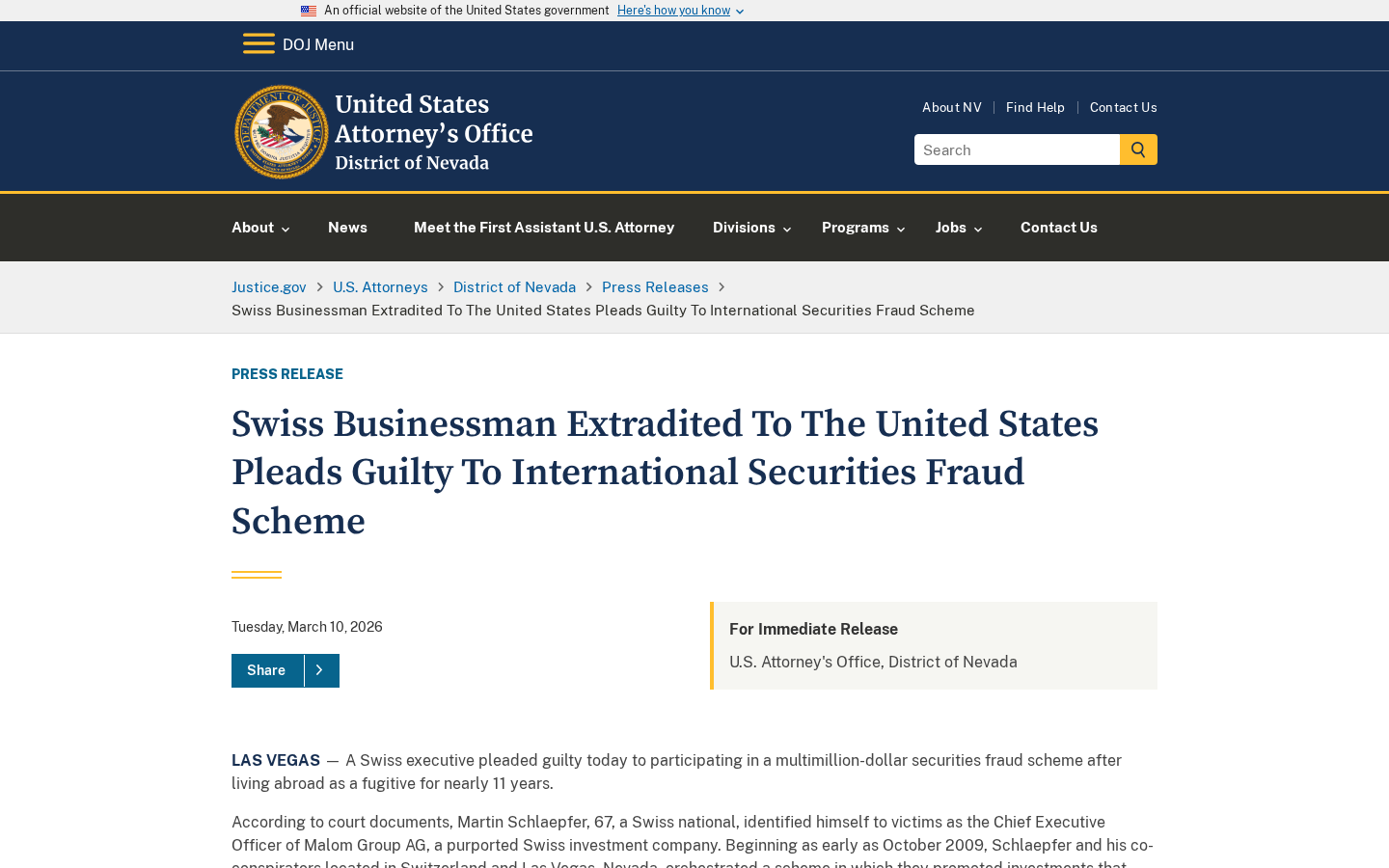
Martin Schlaepfer was presented as the chief executive of Switzerland’s Malom Group AG. The case involved financial opportunities sold to victims in the United States.
The advertised money was not available as promised. In its November 25, 2026 enforcement update, the District of Nevada described the scheme as costing victims approximately $6 million.
The case involved two different claims about money
First, the promoters needed victims to believe funding was there. Federal prosecutors described fake bank documents that purported to show the balances needed to support that story.
Second, they needed the victims’ own fees to feel protected. Money went to accounts presented as escrow, but prosecutors say people in the scheme controlled them.
Check each claim on its own. A real balance would not authorize a loan, and a legitimate bank could hold an account controlled by a fraudster.
The first document purported to answer whether a transaction could close. The second arrangement suggested your money would be safe if it did not.
What the court outcome means and what it does not
Schlaepfer pleaded guilty to conspiracy to commit wire fraud.
Prosecutors say he was sentenced on May 13, 2026, to time served and ordered to pay $6,475,000 in restitution.
Restitution was an order by the court. It was not a guarantee that a caller, email sender or private recovery agent could distribute money to you.
- Verify the funder and the agreement separately from whoever brought you the deal.
- Find out who owns the account that would receive your money.
- Have an independent adviser check how your deposit is released or returned.
If you cannot answer those questions before paying, the fact that a lender or bank name appears in the documents does not change the decision.
How the Malom Group Financing Scam Worked
Step 1: The promise made a large loan seem attainable
A large funding offer is particularly appealing when you have a project waiting for capital. The attraction is not just the money but the idea that work can start soon.
Prosecutors say Malom pitched both investments and large loans. A prospective borrower could hear the promise of funding; a prospective investor could hear the promise of an opportunity.
Before any real fee is on the table, find out what is being offered. An introduction, a conditional indication of interest and an underwritten commitment have different meanings.
Ask who can sign and which conditions still apply. Verbal assurances from the introducer are not direct confirmation from the party providing the money.
Step 2: Apparent bank records made the money look real
The case describes false records purportedly showing that money was on deposit. On paper, that made a promise about future funding look supported by a present fact.
In a legitimate transaction, the connection between money and purpose still needs to be established. A balance does not show who can use it or whether it has been pledged.
Suppose a broker forwards a letter about funds in a third party’s account. Ask your own adviser what authority ties that third party to the deal you were offered.
Do not call a number only because it appears on the letter. Start with the institution itself and let it tell you how it handles authentication requests.
A bank may not disclose another customer’s information. That is a reason to work through independent advisers and authorized procedures, not a reason to trust the attachment.
Step 3: The fee went into an account sold as escrow
Escrow is supposed to keep money with a third party until agreed conditions are met. It is the independence and the written duties that matter, not the label.
According to federal prosecutors, the people in the Malom scheme controlled the accounts they told customers to use. The fee did not get the protection the term implied.
You can check a legitimate escrow arrangement without knowing every detail about how a bank operates. Ask who the independent agent is and who can authorize a release.
If the promoter says you can only communicate through them, pause. You have not established that the person holding the funds is independent of the person asking for them.
Step 4: The promised financing did not arrive
Prosecutors say money from victims was diverted to the participants’ personal use. They describe the opportunities as fictitious, rather than genuine deals that fell through during underwriting.
That difference matters when someone tries to reframe the loss as a normal closing delay. A delay does not explain a fee diverted from the purpose agreed to.
If documents show that your fee was meant to be held until closing, keep those documents. A bank investigator will need the promised conditions as well as the transfer receipt.
Do not extend a deadline or send another fee simply because the promoter says the first payment will be lost. Get advice independent of the deal.
Check Who Would Actually Hold the Money
Confirm the lender or investment firm, not just the arranger
Get the exact legal name of the institution expected to fund your transaction. Ask the institution through its public number whether the representative has authority to make the offer.
If the deal involves someone offering investment advice or selling securities, the SEC’s investment professional lookup guidance explains how to check the person’s registration and background.
Search the firm and the individual, then use independent contact details. A legitimate registration can be copied, and it does not guarantee that the proposal itself is genuine.
For financing outside those registration systems, ask which regulator or business register is relevant, if any. A result in the wrong database tells you little about the claimed role.
If the person says they represent a foreign company, find the official registered name and jurisdiction. Compare both with the name and location written in the financing agreement.
A listing can establish that a named legal entity exists. It does not show that the person you are speaking to represents it or that it controls the advertised funds.
If two entities are involved, establish which signs the loan and which receives the fee. Do not wire to a third company because someone describes it as a local partner.
Read the terms governing the deposit before sending it
Read the signed escrow agreement rather than the email summary. Identify the account owner, who authorizes disbursement, when the money moves and who is entitled to a refund.
Determine what happens if the lender walks away, if the borrower declines revised terms or if a deadline expires without funding. Ask who can change those conditions.
Ask your attorney to confirm the independent agent and payment instructions through separately verified contacts. Do it before opening the banking app, not while someone waits for your screenshot.
If a wiring instruction changes, stop and verify the new version directly. Even a legitimate transaction can be targeted by someone impersonating a person who works on it.
Review what the agreement says about deductions if no loan closes. A vague right to charge expenses can leave your written terms very different from the promoter’s spoken promise.
Find out how deposit acknowledgments are issued and which account name appears on them. Ask your adviser to reconcile those records with the verified payment instructions.
If the proposal uses a trust or client account, ask the named professional to confirm their role directly. An intermediary should not be your only route to that person.
Separate ordinary expenses from a demand for access to capital
Legitimate transactions can involve fees for legal, appraisal or other work. You should be able to tell who performs the work and what you are paying for.
The question is not whether you have ever paid a professional in advance. It is whether this fee buys an identifiable service or supposedly releases otherwise unverifiable money.
A fee said to be refundable deserves at least as much scrutiny as one described as nonrefundable. Find out who can actually make the refund and what triggers it.
Set that reasoning down in writing with your partner or adviser. If you cannot describe the payee and conditions in a sentence, do not send the payment yet.
A deal can involve several legitimate costs, but each one should be explainable. Ask what happens to any amount not used for the stated work.
If you are already committed to contractors or other expenses, do not treat the proposed funds as available. Keep the project’s commitments separate until independent confirmation is in place.
Ask a colleague to review the payment without the sales call in their ears. The aim is to catch mismatches between the agreement, verified payee and actual wiring instructions.
Tell your business partners that the fee has not been independently verified. That may stop a payment you did not know about.
Keep your written questions and the answers you receive. If an intermediary repeatedly answers a different question, the missing answer is itself a reason to wait.
What to Do If You Fell Victim
-
Call your bank before trying to renegotiate the deal. Give the bank the date, amount and destination of each transfer, and say why you now suspect fraud.
Ask whether a recall or bank-to-bank notice is possible. The options depend on the transfer and its timing, so act promptly and ask for a reference number.
-
Put the paperwork in the order you received it. Keep the offer, fee invoice, supposed bank proof, escrow agreement, transfer instructions and any later changes to the payment destination.
Match every transfer to the promise that prompted it. In a business, include who approved the payment and when they learned the account might not be independent.
Keep original copies with their timestamps. You can summarize the documents for a report without overwriting the messages or attachments that might help an investigator.
-
Notify the people responsible for your remaining financial records. If you shared bank statements, account access, identity documents or corporate credentials, tell your bank and your own advisers.
A wire normally does not hand an outsider your password. If you also gave anyone credentials, secure the affected account through the institution’s normal sign-in or fraud channel.
For a business, tell staff authorized to pay invoices that the instructions are disputed. Have them confirm any future payment change through an established contact.
-
Use an official route to share the case and its evidence. The FBI’s Internet Crime Complaint Center accepts reports about digitally facilitated fraud.
Include what was promised, how you obtained the account details and whether the recipient claimed to be an independent escrow agent. Preserve originals separately from the online report.
If the same people contacted you in connection with the Malom case, start with the Nevada district’s official announcement to find the responsible office.
-
Verify any restitution message without paying the sender. Keep the case name and your bank records handy, but do not send them to a newly introduced recovery agent.
Contact the responsible government office through an official site and ask whether the instructions are genuine. An order alone does not prove that a stranger can get you paid.
Frequently Asked Questions
Was the Malom Group financing offer legitimate?
The Nevada case describes fictitious investments and loans offered for fees. Schlaepfer pleaded guilty to a wire fraud conspiracy and received a sentence and restitution order.
Does a bank name on a deposit letter authenticate the money?
A name or logo does not prove who produced the letter. Your adviser can ask the independent institution about its verification process and what the document actually establishes.
Can someone use a real bank to make a fake escrow look convincing?
Yes, a real bank can hold an account controlled by a party to the deal. Check who controls the funds and what conditions bind that person or organization.
Is every financing fee a scam?
No, fees can pay for real work by known parties. Refuse to pay if you cannot verify the service, the payee or the funding the fee supposedly unlocks.
Can a bank reverse my wire after settlement?
It may be able to request a recall or alert the receiving institution. Neither action guarantees recovery, so contact the bank quickly and preserve your transaction details.
Does the restitution order mean funds are available to me today?
The court ordered restitution, which is different from confirming that money has been collected or distributed. Ask the responsible office about your own circumstances through a contact you verified.
The Bottom Line
Do not wire a fee for funding you cannot verify or to an escrow agent the promoter controls. Bank paperwork is not a substitute for independent confirmation.
If you have already paid, give your bank the transfer details now, keep the proof of what was promised and report the case through a channel you found independently.

Join the discussion
0 commentsShare your experience or ask a question about this article.
Community experiences
Did this happen to you?
Your experience could help someone recognize the same scam. Submit a private report for our team to review.
I experienced this tooReports are reviewed before publication. Sharing publicly is always your choice.
Discussion
Start the conversation
Have a question or something useful to share? Add the first comment.