


QuietReports presents itself as a place to warn others about a scam. Its homepage emphasizes anonymous reporting and shows examples of people who supposedly got help.
The promise sounds useful after a loss. Before sending a report, compare what the site says about anonymity with what its actual form and public records show.

Overview
The report form asks for identifying details up front
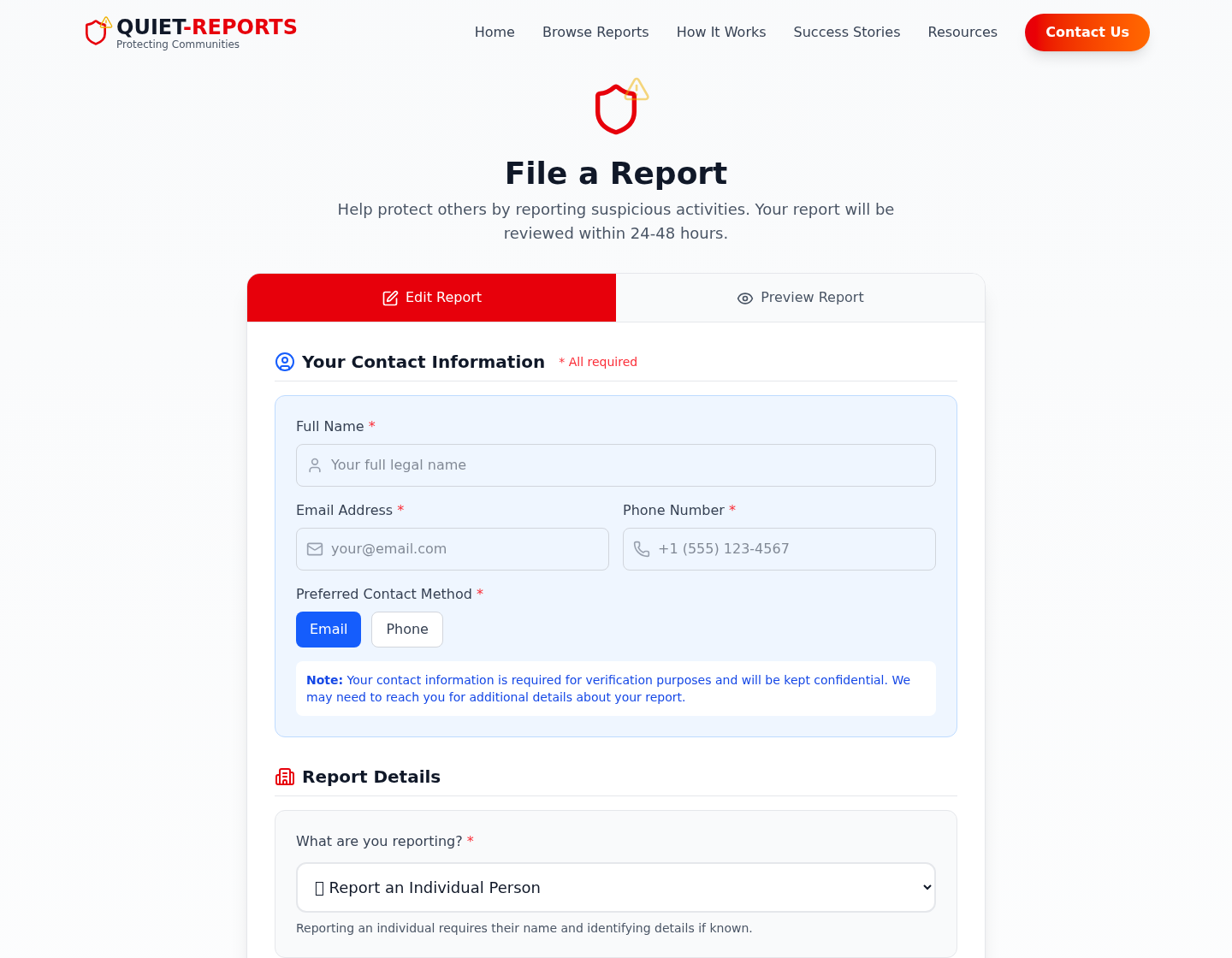
QuietReports says visitors can report safely without revealing their identity. The form requires a full legal name, email address, phone number and a preferred contact method.
The form says those details will be kept confidential. Keeping a name out of a public report is different from letting someone file without identifying themselves to the site.
The homepage and public reports page disagree on scale
The homepage displays more than 12,543 scams reported. The Browse Reports page separately labels its total as 15 reports, including 11 active and four resolved cases.
A large difference can have an explanation, such as different time ranges or unpublished submissions. The two screens do not tell a reader how their counts relate.
Check where the report goes before sending evidence
- Identify the organization that receives the name, phone number and information about your previous loss.
- Separate a consumer warning site from a bank dispute, police report or official fraud complaint.
- Check whether a guarantee of mediation or recovery is backed by a verifiable case or authority.
The specific concern is the invitation to send detailed information about a previous loss to this private site. I would use an independently located official reporting route instead.
How the QuietReports Reporting Process Looks Before Submission
Step 1: The homepage offers a place to tell your story
The branding emphasizes community protection, public reports and self-mediation. It invites readers who feel stuck after a bad deal to share what happened with a team.
That language is different from an explicit offer to return your money. A site can use the language of consumer protection without having authority to recover anything.
Step 2: The public reports page supplies social proof
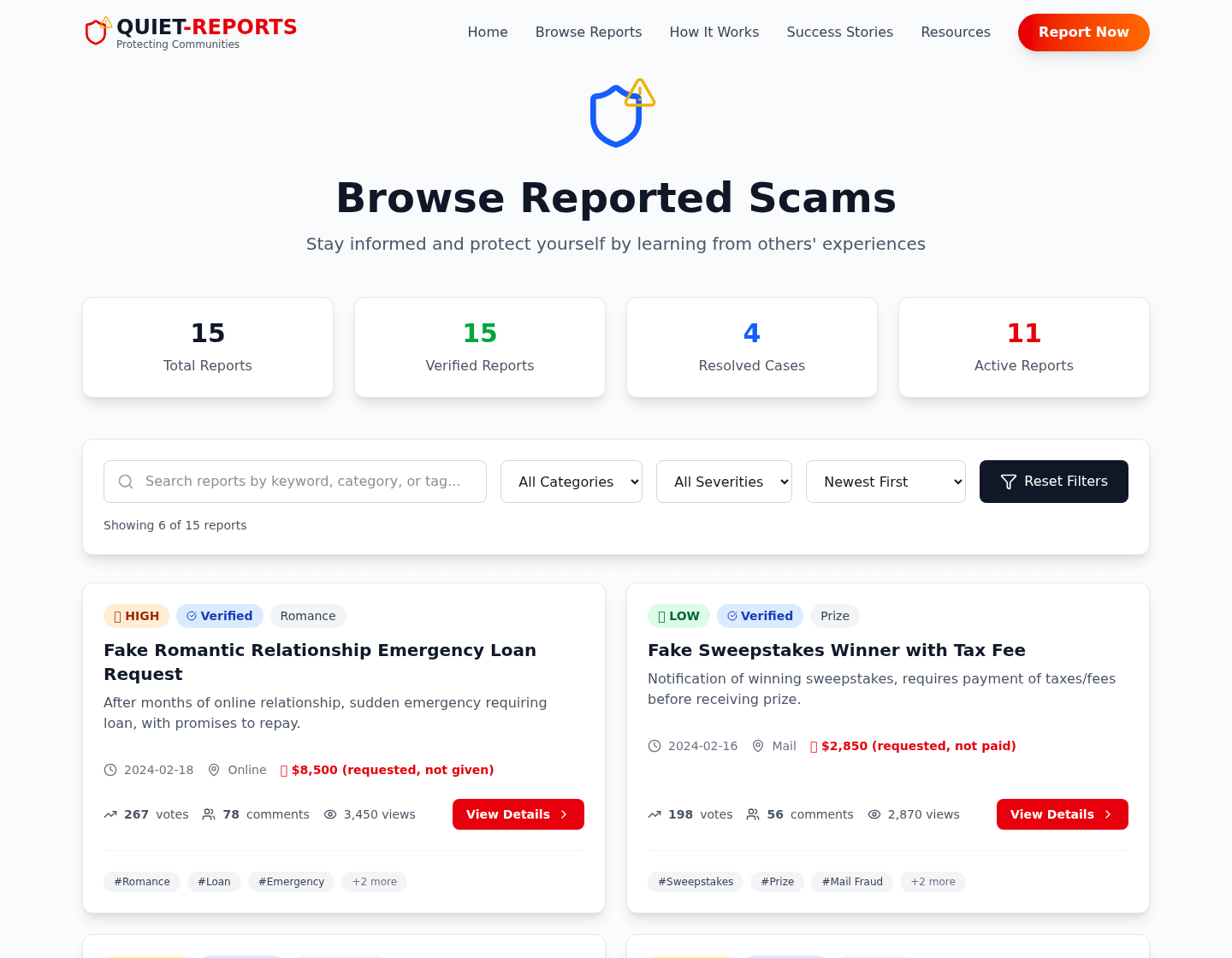
Browse Reports shows 15 total and 15 verified reports. Two of the visible examples involve an emergency loan in a romance scam and taxes on alleged sweepstakes winnings.
The first two cards describe requested payments of $8,500 and $2,850, respectively, and say the money wasn’t paid. Those are not examples of amounts recovered for readers.
Check how a verification badge is explained before treating it as official. An internal label on a report card is not a police finding, bank record or legal decision.
Step 3: The form asks for a way to contact you
The linked form says reports are reviewed within 24 to 48 hours. It starts by collecting the reporter’s name, contact details and preferred method of contact.
The next section asks the reader to describe a person or company and what happened. A preview tab concerns the report as displayed, not the information the operator receives.
The site says it may contact people for more details. A promise not to publish your phone number does not explain who may later use it to reach you.
Step 4: Support offers a separate messaging route
The public contact page shows emergency reporting, legal support and victim support cards. All three point readers to the same WhatsApp-only number.
Three labels are not three independently verified services. Before sharing case files, you would need to identify who answers, who handles your data and what their authority is.
We checked the public pages without submitting anything, calling the number or opening a conversation. No fees or recovery outcome were tested.
Who Receives Your Information and What Can They Do?
The domain registration and the advertised history differ
QuietReports says it has been protecting communities since 2024. The registry record for quietreports.net dates this domain’s registration to January 17, 2026.
A service can predate its latest domain. You would need a verifiable earlier organization, site or record to connect that activity to the team collecting new submissions.
Confidential data is still identifiable data
There can be valid reasons for a reporting body to ask for contact details. The useful question is which organization receives them and which information is necessary for its task.
Here, required contact fields appear before the account of the incident. Don’t proceed on the assumption that a report is anonymous because the public page uses that word.
The site describes mediation, not the power to reverse a payment
QuietReports describes reviewing and publishing reports and facilitating mediation. That is not a card issuer’s dispute process, a court order or a cryptocurrency exchange’s freeze procedure.
A successful-looking testimonial cannot demonstrate the method without corroborating records. Ask who actually returned any money before relying on a recovery claim in a similar situation.
One homepage story claims that $15,000 was recovered. The text alone does not tell us which institution returned the money or provide independent proof of that outcome.
A requested follow-up is not independent verification
The form gives the operator a reason to call or write after a submission. If a caller knows details you sent, that doesn’t establish they’re with an official agency.
Contact a bank, exchange, lawyer or police service using information you find independently. Do not use a return number or private chat supplied by an unsolicited recovery contact.
Why Someone Who Already Lost Money Needs a Different Reporting Route
A loss report may include enough detail for someone to sound convincing later. The transaction amount, company name and payment method can make a follow-up sound like an investigation.
The FTC’s recovery scam guidance explains how follow-up fraud uses details about an earlier loss to justify an advance fee or a request for financial information.
The pattern is a risk to understand, not evidence that QuietReports sent a particular follow-up. The concern here starts with the gap between the private form and its public promises.
People who need a payment reversed have a practical reason to act promptly. Starting an unrelated private mediation process does not open a card dispute or extend a provider’s deadline.
For cryptocurrency, a transaction hash can support a report about where a payment went. It does not grant access to the recipient’s wallet or cancel a completed transfer.
The FBI’s alert on cryptocurrency recovery schemes warns that private recovery businesses cannot issue seizure orders. Treat an offer to unlock funds for a fee as a separate risk.
How to Check a Reply That Mentions Your Loss
Start with the sequence of events. Write down who contacted you first, what details you had already shared and whether the caller introduced a second organization.
Suppose a message names the amount you entered and says a review is complete. Repeating that amount does not establish that the sender independently traced or seized the payment.
Look for a case number on an account or confirmation you already control. A genuine reference can help a verified investigator locate a file, but a number alone proves nothing.
If the message names your card issuer, call using the number on your card or open the app directly. Ask whether there is an issue or dispute on your account.
If it names a police agency, find its published contact details and ask how to verify the officer and reference. Do not use a number supplied in the message.
Treat two supposed organizations directing you back to the same private chat as one unverified lead. A change of logo or job title does not establish independent confirmation.
A proposed release fee changes the nature of the conversation. Save the request, stop engaging and tell your payment provider about the new demand separately from the first loss.
There is a difference between reporting a loss and authorizing someone to act on your behalf. A form submission is not a reason to grant remote access or account permissions.
Keep notes on whatever has already happened rather than trying to test the service with another payment. A small transfer doesn’t establish who controls the destination or whether funds exist.
What to Do If You Sent a Report or Received a Recovery Offer
-
Write down what you submitted, who can contact you and whether you included an attachment. Keep a copy private and separate it from the records of the original payment.
If you only looked at the blank form, close it. You do not need to file another report just because you visited the page.
-
If you shared contact details, don’t confirm an unexpected callback with more information. A caller may use the amount or transaction date from your report to sound familiar.
End the conversation and verify the claimed organization using a number you find yourself. Keep its real name separate from the one supplied in the message.
-
If you paid by card or transfer, contact your issuer or bank through its official app or number. Give the date, amount and exact method used.
Ask whether it can stop a pending transfer, protect the account or open a dispute. Request a case reference and keep the filing deadline.
-
For a cryptocurrency payment, keep the network, transaction hash, amount, date and destination address. Contact the exchange you used through its independently verified support channel.
Do not reveal a wallet recovery phrase or private key. Neither is needed to show an investigator the details of a public transaction.
-
In the United States, open the FTC reporting portal independently and choose the relevant fraud category. For online crime, use the FBI’s IC3 site to start a complaint.
Give the facts and preserve the confirmation. Outside the United States, start with your local police, consumer protection authority or provider’s fraud channel.
What You Can Safely Keep for a Real Fraud Report
Make a short timeline covering when the first message arrived, when you paid and what happened after payment. Note which details come from receipts rather than promises.
Keep screenshots that show the address, date and wording, but redact unrelated account and contact information before public sharing. Give complete records only to a verified investigator or provider.
If a company asks for identification, confirm that the submission form belongs to that company and that the request fits the case. Never send a password or security code.
Separate a Public Warning From Your Private Evidence
A public warning can explain what happened without revealing the documents a bank or investigator might need. Make a copy before you redact anything, and preserve the original privately.
Crop unrelated messages, visible contact lists and other transactions. Keep enough of the relevant message to show when it arrived, what it requested and where it claimed to come from.
Do not post card numbers, identity documents or the codes in account notifications. If you chose to share an identification document privately, record exactly which image or page you uploaded.
Cryptocurrency transaction records can be public on a blockchain, but attaching your name to a wallet address can reveal more than you meant to show. Share that connection selectively.
A payment screenshot with a bank balance adds little to a public warning. A private report can contain the transaction details a provider needs without exposing your available funds.
When you send original records to an organization you’ve verified, ask how to use its secure submission route. Record who received them and the complaint number you were given.
If an attachment was already submitted and contained a security code, password or card details, prioritize the affected account. Contact the provider directly and tell it what was disclosed.
Frequently Asked Questions
Is filing with QuietReports the same as reporting to police?
No, submitting to the private site does not open a police report. Use the official police or national reporting channel appropriate to what happened.
Can I use the QuietReports form anonymously?
The form we checked requires a name, email and phone number. The promise to keep those fields confidential is not the same as collecting none of them.
What does the site’s 15-report total mean?
It is the number displayed on the public reports page. The site separately advertises a much larger count without making the relationship clear in those screens.
Does its mediation promise mean it can recover crypto?
Mediation does not give a private site power to seize assets or reverse a transaction. Report the payment to your exchange and the appropriate official authority.
Should I pay a fee if someone contacts me after I submitted?
Do not pay a surprise recovery fee or share account access. Verify the caller’s organization yourself, and contact the provider used for the original transaction.
What if all I sent was my name and phone number?
Watch for follow-ups using details from the report, but do not assume that means someone accessed your account. Prioritize anything more sensitive you actually sent.
The Bottom Line
Do not send a financial-loss report through QuietReports. Its public anonymity pitch does not remove the required identifying fields, and its counters do not verify recovery authority.
If you already submitted information, refuse unsolicited recovery fees and contact the institution that handled the payment. File your complaint through an official route you found independently.

Reviews & discussion
0 commentsShare a firsthand experience, or ask a question.
Community reviews
quietreports.net
Moderated reader experiences, not an editorial verdict.
Start the conversation
Have a question or something useful to share? Add the first comment.