

Amazon Prime is one of the most popular membership programs, offering free fast shipping and access to movies, TV shows, music and more. Unfortunately, scammers have taken advantage of Prime’s popularity with a sneaky email phishing scam.
This scam targets Prime members with fake renewal notices, trying to steal login credentials and credit card information. Read on to learn all about how this Amazon Prime scam works, how to spot the fraudulent emails, and what to do if you receive one.
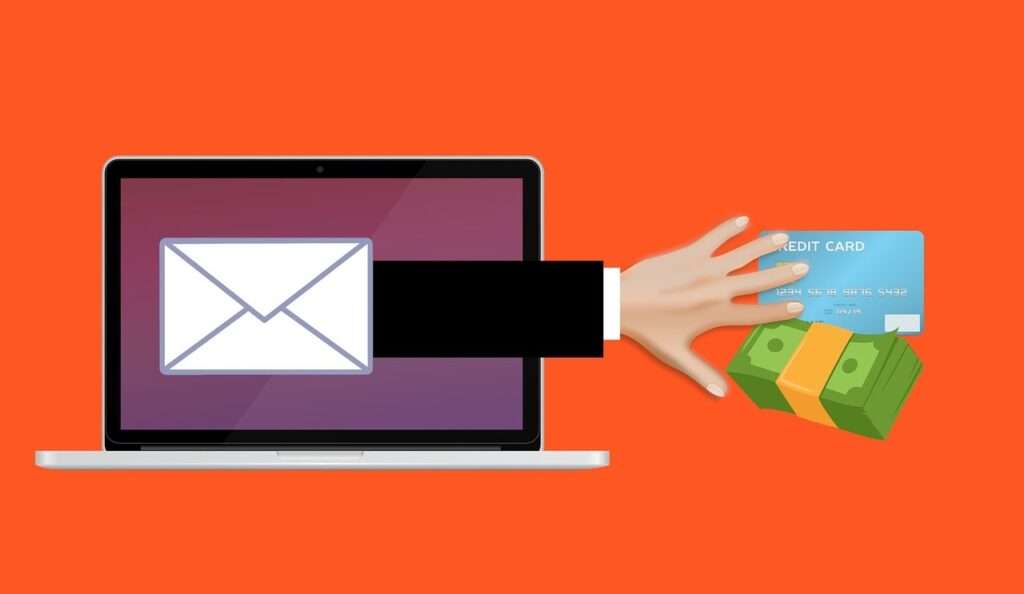
Overview of the Fake Amazon Prime Renewal Scam
The fake Amazon Prime renewal scam starts with an email that looks almost identical to a legitimate message from Amazon. The email claims your Prime membership is about to renew, but there is a problem processing your payment.
You are prompted to update your payment details through a link, which leads to a fake Amazon login page controlled by the scammers. If you enter your username and password, the criminals will steal your Amazon account credentials.
In other cases, the fake renewal email might ask you to provide a credit card number to continue your Prime benefits. This is just a phishing attempt to collect sensitive financial information.
Amazon Prime scams like this have become increasingly common over the past few years. These fraudulent emails are carefully designed to appear trustworthy, often including the Amazon logo and stylistic elements copied from official notifications.
However, a close look reveals small differences that expose the emails as fakes. Once scammers gain access to someone’s Amazon account, they can steal gift card balances, make fraudulent purchases, and access connected apps or services like Audible.
This type of scam is known as phishing – pronounced “fishing” – because the attackers use bait (fake emails) to “catch” sensitive personal information from victims. Prime membership renewal scams are just one example of phishing attacks targeting Amazon customers.
How the Fake Amazon Prime Renewal Scam Works
The criminals behind this scam put a lot of work into making their fake emails look authentic. Here is a step-by-step look at how they construct the phishing messages and collect information from victims.
1. Scammers obtain email addresses
The first step for the scammers is gathering a large list of potential victim’s email addresses. There are a few common ways they obtain these:
- Data breaches: When a website gets hacked and account information is stolen, email addresses are among the details typically leaked. The scammers can buy the leaked data.
- Public databases: Some public records and online directories include names and emails, which scammers can harvest.
- Malware spam bots: Networks of infected computers called botnets are used to send malware and gather victim email addresses.
So while the scammers may not have your email directly from Amazon, they can still collect addresses of many Amazon customers from various sources.
2. Spoofing the “From” address
A key technique used in phishing scams is email spoofing. This makes a message appear to come from an trusted entity, like Amazon, when it actually originates elsewhere.
By spoofing the “From” address with an Amazon email, the scam messages bypass spam filters. The recipients see “Amazon” in the sender field and are more likely to trust the contents.
3. Copying logos, colors and style
Skilled scammers will carefully mimic the look of real Amazon emails. For example:
- The Amazon logo is placed prominently at the top
- Template colors match Amazon’s typical blue/orange scheme
- Links use “Amazon.com” in the text, to appear official
- Relevant Amazon services like Prime or Kindle are referenced
- Order numbers, dates, and other details are included to sound authentic
Even minor stylistic aspects like font choice can make phishing emails seem more believable.
4. Crafting the scam content
The subject line and body content of the email are designed to cause urgency or panic, so victims act without thinking. Some examples:
- “Your Prime membership is about to renew”
- “There is a problem with your Prime payment method”
- “Your Prime benefits are at risk of cancellation”
- “Update your payment details immediately”
Fear of losing Prime or having an account shut down pressures recipients to follow the scam instructions.
5. Inserting links to fake pages
Once a sense of urgency is established, the scam emails include links for you to “correct” the payment problem. But the pages you land on if clicking are completely fake.
The links may lead to convincing copies of the Amazon site with a login prompt. Or, pages mimicking Amazon’s style asking for a credit card to renew membership.
Either way, any information entered goes straight to the scammers.
6. Harvesting entered credentials and information
When victims are tricked into entering their Amazon username and password or credit card data, the scammers capture it instantly.
They may use the credentials to log in to your real Amazon account and steal funds or make purchases. Or, sell the collected financial details online.
Currently active payment methods linked to the account can also be abused to renew stolen Prime memberships.
7. Rinsing and repeating
Unfortunately, the low effort required to spam out these faked emails means the scammers can keep targeting new victims endlessly.
Even if only a small percentage of recipients are fooled, it generates a steady stream of accounts to steal from.
What to Do If You Receive the Fake Amazon Prime Email
If a suspicious Prime renewal email arrives in your inbox, stay calm and avoid acting on impulse. Here are the proper steps to take:
Carefully examine the email contents
Look for any oddities in the sender name, subject line, grammar, formatting and included links before clicking anything.
Search online for phrases in the email to see if the same scam message is being reported elsewhere. There are often small giveaways that reveal phishing attempts.
Check the sender’s email address
Don’t just glance at the displayed “From” name. Click to expand and look at the actual email address used by the sender.
Amazon only sends emails from addresses like @amazon.com, @email.amazon.com or @notifications.amazon.com. Anything else is a scam.
Avoid entering any information
Whether prompted for your Amazon credentials or credit card details, do not enter anything into the email links. Fake login screens are designed to capture your info.
Contact Amazon customer support
If you suspect an email is a scam attempt, forward it to Amazon for review at stop-spoofing@amazon.com. You can also chat with customer support and ask them to confirm whether a renewal notice is legitimate.
Reset your Amazon password
Play it safe and change your Amazon password immediately, in case scammers already collected your login credentials from the fake site. Use a strong, unique new password.
Remove any stored payment details
To prevent additional fraud, delete any credit cards or bank accounts stored on your Amazon account, then add them back individually after changing your password.
Review recent account activity
Login to your real Amazon account and look for any signs of unauthorized purchases or other suspicious activity. Report anything abnormal to Amazon’s fraud department.
Update account security settings
Strengthen your defenses by turning on two-factor authentication and confirming your contact info is up to date in case Amazon must send you account notices.
Is Your Device Infected? Run a Free Malware Scan
Slow performance, constant pop-ups, or strange behavior? These are classic signs of a malware infection. The fastest way to find out is to scan your device with Malwarebytes Anti-Malware Free — one of the most trusted malware removal tools available.
The free version detects and removes the most common threats, including:
- Adware — the cause of those annoying pop-ups
- Browser hijackers — unwanted redirects and changed homepages
- Trojans and spyware — hidden programs stealing your data
- Potentially unwanted programs (PUPs) — software you never asked for
👉 Select your device below — Windows, Mac, or Android — then follow the simple steps to download Malwarebytes, scan your system, and remove any threats it finds. The whole process takes about 5 minutes.
Run a Malware Scan with Malwarebytes for Windows
Malwarebytes is one of the most popular and trusted anti-malware tools for Windows — and it’s completely free for removing infections. It catches threats that many antivirus programs miss, including adware, browser hijackers, and trojans. Follow the steps below to scan and clean your PC in just a few minutes.
Download Malwarebytes
Click the button below to download the latest version of Malwarebytes for Windows from the official source. The free version is all you need — it will scan your computer and remove adware, browser hijackers, and other malicious software at no cost.
Download MalwarebytesOfficial installer for Windows 11 and 10. Your download starts right away.Want real-time protection? See Malwarebytes Premium Malwarebytes Free for WindowsScans and removes malware at no cost
-
Install Malwarebytes
When the download finishes, open your Downloads folder and double-click the MBSetup file. If Windows shows a User Account Control pop-up, click “Yes” to allow the installation.
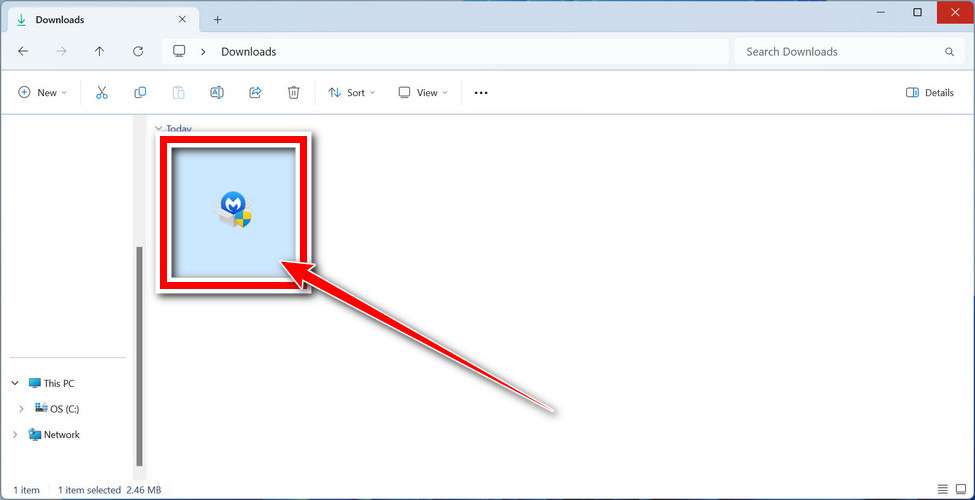
Follow the On-Screen Prompts to Install Malwarebytes
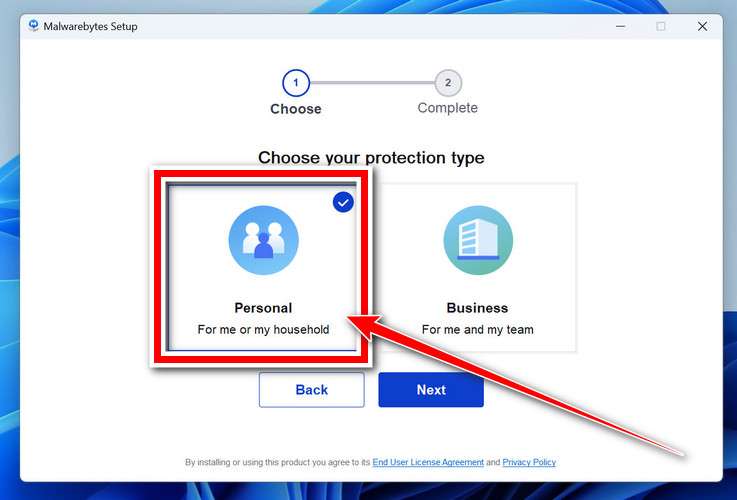
The setup wizard will walk you through a few quick screens:
-
Choose where you’re installing the program — “Personal Computer” or “Work Computer” — then click Next.
-
Malwarebytes will now install on your device. This usually takes under a minute.

-
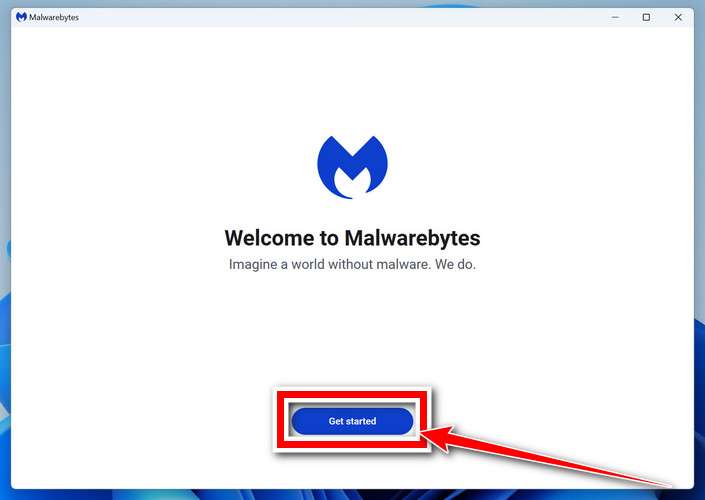
When installation is complete, the “Welcome to Malwarebytes” screen will open automatically.
-
On the final screen, click Open Malwarebytes to launch the program.

-
Enable “Scan for Rootkits”
Before scanning, turn on rootkit detection so Malwarebytes can find even the most hidden threats. Click the Settings gear icon on the left side of the screen.
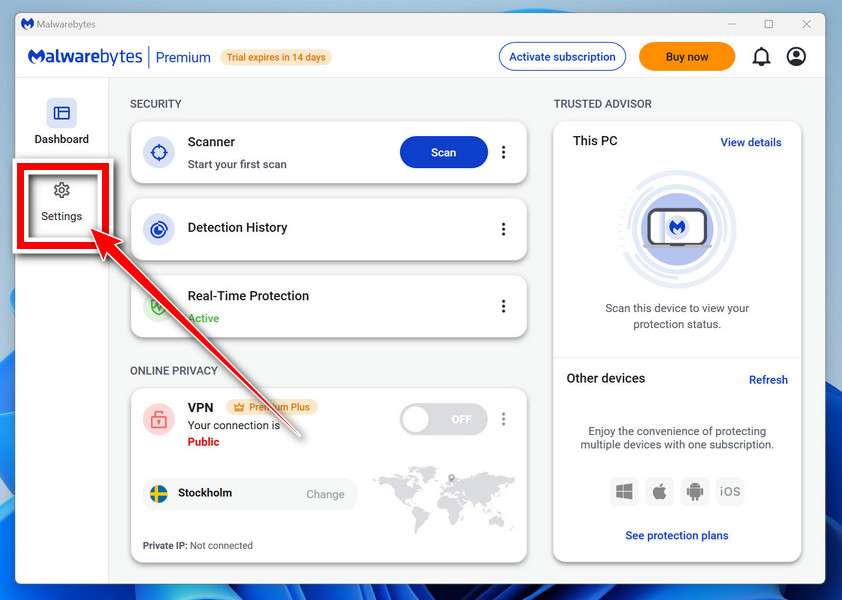
In the settings menu, find “Scan for rootkits” and click the toggle so it turns blue.

Done? Click “Dashboard” in the left pane to return to the main screen.
Start the Scan
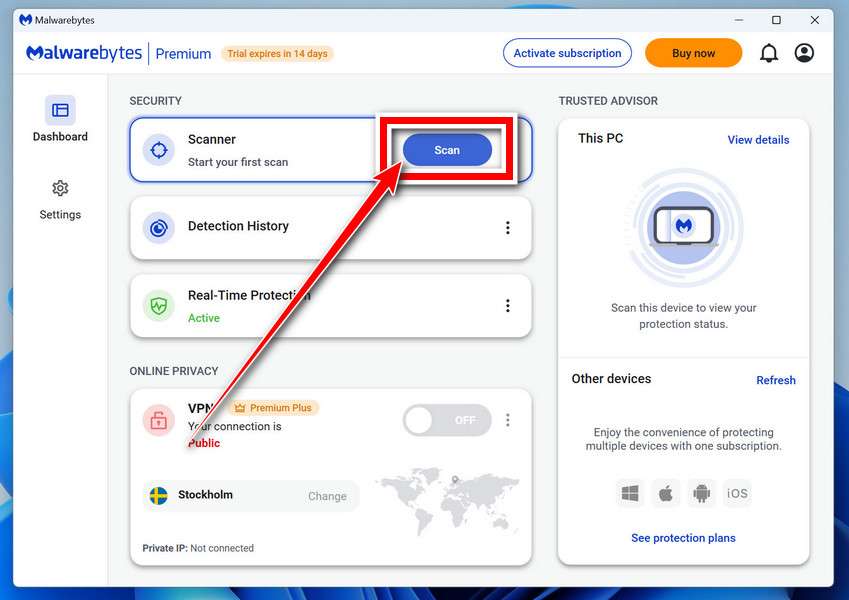
Click the blue Scan button. Malwarebytes will automatically update its virus database and start checking your computer for malware.
-
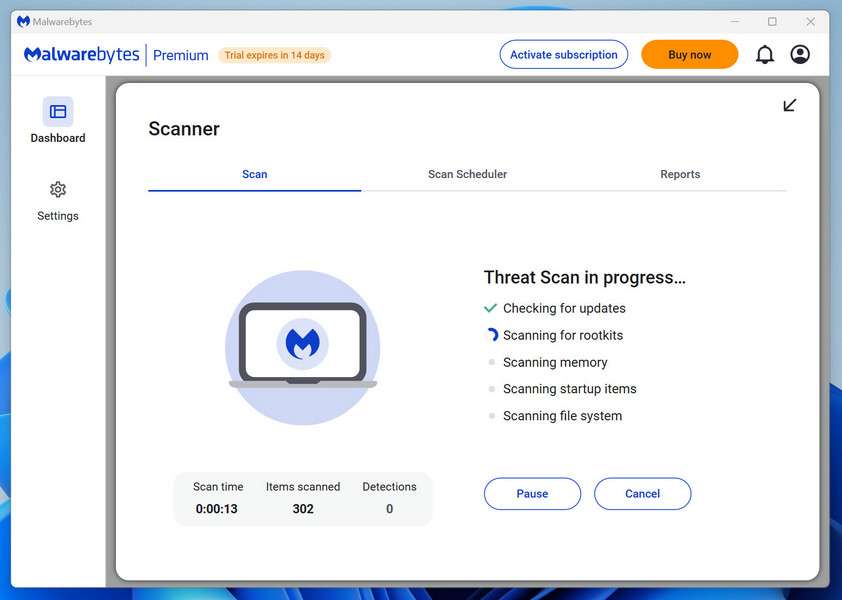
Wait for the Scan to Finish
The scan checks your entire system for browser hijackers and other malicious programs, so it can take 5 to 20 minutes depending on your computer. Feel free to do something else — just check back occasionally to see the progress.
-
Quarantine the Detected Threats
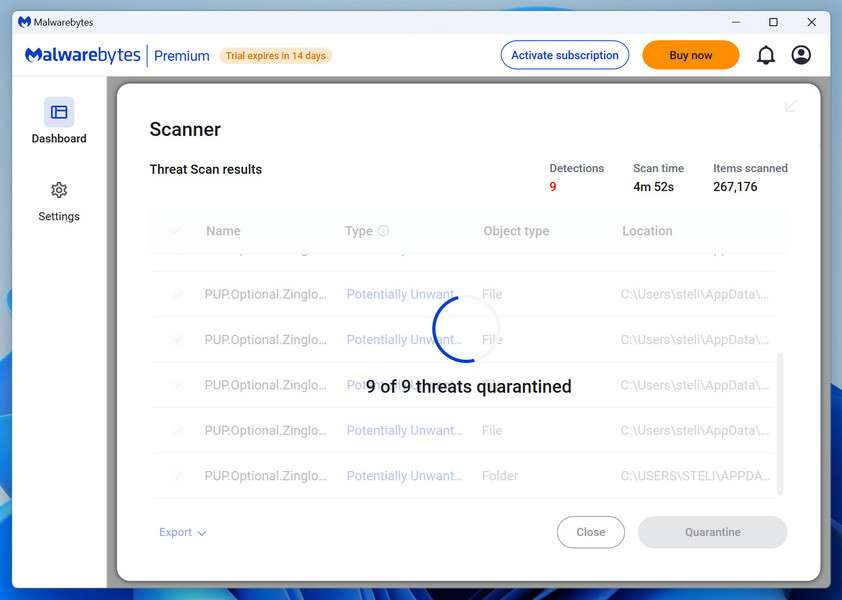
When the scan is done, you’ll see a list of everything Malwarebytes found — malware, adware, and potentially unwanted programs. Click the “Quarantine” button to remove all of them at once.
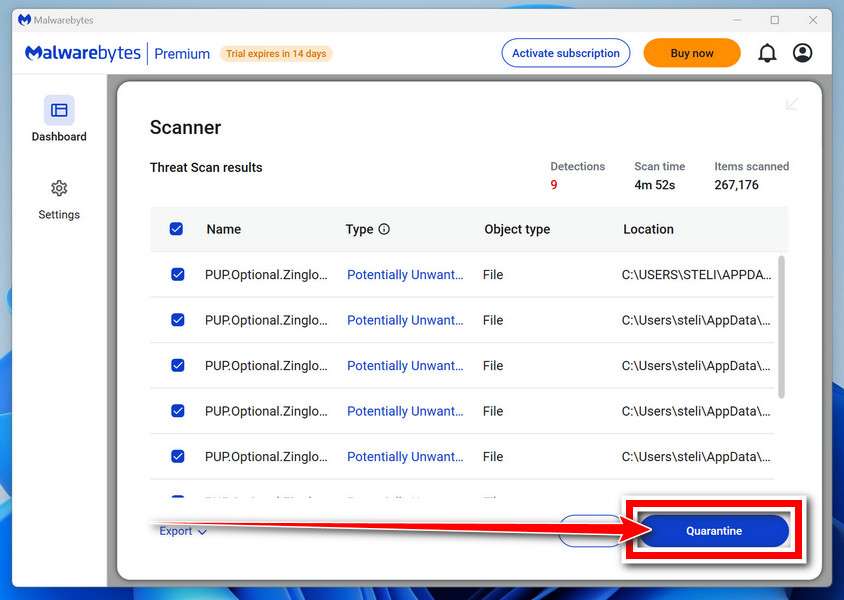
Malwarebytes will now remove the malicious files and registry entries and move them safely into quarantine.
-
Restart Your Computer
Some threats can only be fully removed after a reboot. If Malwarebytes asks you to restart, click Yes. Once you’re logged back in, continue with the next step below to make sure nothing was left behind.
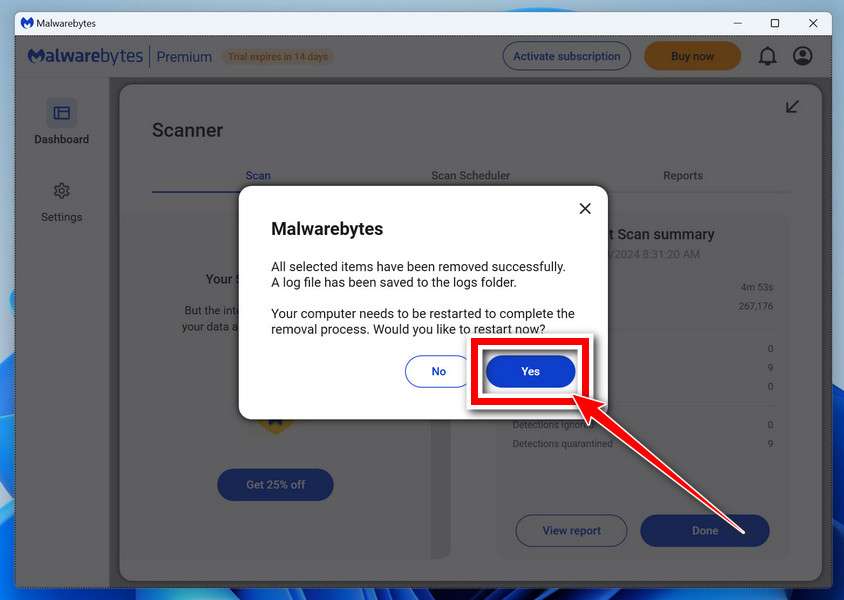
When the scan finishes, click Quarantine to remove everything Malwarebytes found. That’s it — your Windows PC is now clean of trojans, adware, and other malware, and should be back to running smoothly.
If you are still having problems with your computer after completing these instructions, then please follow one of the steps:
- Run a computer scan with ESET Online Scanner
- Ask for help in our Windows Malware Removal Help & Support forum.
Run a Malware Scan with Malwarebytes for Mac
Malwarebytes for Mac is a free on-demand scanner that removes the malware other security software tends to miss — adware, browser hijackers, and unwanted programs included. Cleaning an infected Mac with Malwarebytes has always been completely free, and it’s our go-to recommendation. Follow the steps below to scan and clean your Mac in just a few minutes.
-
Download Malwarebytes for Mac
Click the button below to download the latest version of Malwarebytes for Mac.
Download MalwarebytesOfficial installer for macOS. Your download starts right away.Want real-time protection? See Malwarebytes PremiumMalwarebytes Free for MacScans and removes malware at no cost -
Open the Malwarebytes setup file
When the download finishes, open your Downloads folder and double-click the setup file to begin the installation.

-
Follow the On-Screen Prompts to Install Malwarebytes
The Malwarebytes for Mac Installer will guide you through a few quick screens. Click “Continue” and keep following the prompts until the installation completes.



When the installation is complete, Malwarebytes opens to the Welcome to Malwarebytes screen. Click “Get started“.
-
Select “Personal Computer” or “Work Computer”
Malwarebytes will ask what type of computer you’re installing it on. Click either Personal Computer or Work Computer, whichever applies.

-
Start the Scan
Click the “Scan” button. Malwarebytes will automatically update its detection database and begin checking your Mac for malware.

-
Wait for the Scan to Finish
Malwarebytes will scan your Mac for adware, browser hijackers, and other malicious programs. This can take a few minutes, so feel free to do something else — just check back occasionally to see the progress.

-
Quarantine the Detected Threats
When the scan is done, you’ll see a list of everything Malwarebytes found. Click the “Quarantine” button to remove all the threats at once.

-
Restart Your Mac
Malwarebytes will now remove all the malicious files it found. Some threats can only be fully removed after a reboot — if Malwarebytes asks you to restart, allow it. Once you’re logged back in, your Mac is clean.

Once the scan is done, remove every threat it detected. Your Mac is now free of adware, rogue browser extensions, and other potentially harmful software.
If you are still experiencing problems while trying to remove a malicious program from your computer, please ask for help in our Mac Malware Removal Help & Support forum.
Run a Malware Scan with Malwarebytes for Android
Malwarebytes for Android automatically detects and removes dangerous threats like malware and ransomware so you don’t have to worry about your most-used device being compromised. Aggressive detection of adware and potentially unwanted programs keeps your Android phone or tablet running smooth.
-
Download Malwarebytes for Android.
You can download Malwarebytes for Android by clicking the link below.
MALWAREBYTES FOR ANDROID DOWNLOAD LINK
(The above link will open a new page from where you can download Malwarebytes for Android) -
Install Malwarebytes for Android on your phone.
In the Google Play Store, tap “Install” to install Malwarebytes for Android on your device.

When the installation process has finished, tap “Open” to begin using Malwarebytes for Android. You can also open Malwarebytes by tapping on its icon in your phone menu or home screen.

-
Follow the on-screen prompts to complete the setup process
When Malwarebytes will open, you will see the Malwarebytes Setup Wizard which will guide you through a series of permissions and other setup options.
This is the first of two screens that explain the difference between the Premium and Free versions. Swipe this screen to continue.
Tap on “Got it” to proceed to the next step.
Malwarebytes for Android will now ask for a set of permissions that are required to scan your device and protect it from malware. Tap on “Give permission” to continue.
Tap on “Allow” to permit Malwarebytes to access the files on your phone.
-
Update database and run a scan with Malwarebytes for Android
You will now be prompted to update the Malwarebytes database and run a full system scan.

Click on “Update database” to update the Malwarebytes for Android definitions to the latest version, then click on “Run full scan” to perform a system scan.

-
Wait for the Malwarebytes scan to complete.
Malwarebytes will now start scanning your phone for adware and other malicious apps. This process can take a few minutes, so we suggest you do something else and periodically check on the status of the scan to see when it is finished.

-
Click on “Remove Selected”.
When the scan has been completed, you will be presented with a screen showing the malware infections that Malwarebytes for Android has detected. To remove the malicious apps that Malwarebytes has found, tap on the “Remove Selected” button.

-
Restart your phone.
Malwarebytes for Android will now remove all the malicious apps that it has found. To complete the malware removal process, Malwarebytes may ask you to restart your device.
After the scan, tap Remove Selected to delete all detected threats. Your Android phone is now clean — no more malicious apps, adware, or browser redirects.
If your current antivirus allowed a malicious app on your phone, you may want to consider purchasing the full-featured version of Malwarebytes to protect against these types of threats in the future.
If you are still having problems with your phone after completing these instructions, then please follow one of the steps:
- Restore your phone to factory settings by going to Settings > General management > Reset > Factory data reset.
- Ask for help in our Mobile Malware Removal Help & Support forum.
Stay Protected: Block Ads and Malicious Sites
Now that your device is clean, keep it that way. Most infections start with a malicious ad or a fake download button — so blocking them at the source is your best defense.
We recommend AdGuard, which blocks malicious ads, phishing pages, and dangerous redirects before they can reach you.
👉 Download AdGuard and browse safely
Frequently Asked Questions About the Fake Amazon Prime Renewal Scam
1. How do I recognize a fake Amazon Prime renewal email?
Carefully inspect any renewal notice for odd grammar, formatting, sender address, urgency cues (“act now”), and other red flags. Links should always go to Amazon.com domains. Amazon never asks for personal info over email.
2. What are some examples of fake Prime renewal email subject lines?
Watch for suspicious subject lines like “Your Prime Order Cancelled”, “Prime Membership Expiring”, “Update Billing for Prime”, “Action Needed: Prime Membership Payment Issue”, and similar urgency themes.
3. What happens if I click the links in a fake Prime email?
The links typically redirect to convincing fake pages impersonating Amazon’s website. Entering any login or payment details sends your sensitive information directly to scammers.
4. Can I tell if an email is fake just by looking at the sender?
No, scammers spoof the sender details. Carefully double check that any @amazon or @prime type email address extension is 100% accurate.
5. What should I do if I get a suspicious Prime renewal email?
Do not click any links or enter information. Forward the email to Amazon at stop-spoofing@amazon.com for review. Change your Amazon password immediately and enable two-factor authentication for increased security.
6. How do scammers get my email address for the fake Prime emails?
Your email may have been part of a data breach, harvested from public records, or collected through malware. Scammers cast a wide net with these phishing attempts.
7. Can the scammers hack my Amazon account with just the email?
Not directly, but the fake renewal notice is aimed at tricking you into providing your password or credit card number they can use to access the account. Never enter this data.
8. What should I do if I entered my Amazon login on a fake site?
Immediately change your Amazon password, remove any saved payment methods from your account, and monitor recent orders for unauthorized activity. Enable two-factor authentication as well.
9. Is there a way to stop these fake Prime emails entirely?
Unfortunately no, but remaining vigilant about phishing red flags, avoiding unknown links and sender addresses, and keeping software up to date can reduce risk.
10. Who can I contact for help if my account is compromised?
If you believe your Amazon account security has been compromised, contact Amazon customer support immediately. They can investigate suspicious activity and help protect the account.
The Bottom Line
While this Prime renewal phishing scam can seem quite convincing, there are tried and true ways to detect and avoid being victimized. With some caution and skepticism applied, these fake emails can be spotted and blocked without falling prey or losing any personal information.
The most secure path is avoiding clicking links or entering any data into emails directly. Instead, log in to your Amazon account independently through the real website and use the official account tools to manage your membership and payment details.
By understanding the tactical tricks used in Prime phishing scams, customers can confidently identify and report the fraudulent emails, protecting both your account and financial data. Remaining vigilant for new variants of the scam is key as well, since malicious actors constantly refine their techniques.
With the rise in online shopping, Amazon phishing attempts aimed at stealing credentials or credit card information are only becoming more frequent and advanced. But savvy internet users can stay a step ahead of scammers by learning their tactics inside and out.








