

Qinux VultrioX follows the same dropshipping-style rebranding formula seen across other Qinux offers: a generic commodity gadget is given a proprietary-sounding name, surrounded by polished advertising, and sold at a premium. A real steel-cable head may arrive, but that does not make the “most powerful head” claims or permanent 50% discount credible.
This is not a newly engineered Qinux invention. It is a widely available type of steel-cable trimmer attachment sold through a high-pressure funnel, with edited or AI-assisted marketing capable of making ordinary performance look exceptional.
Overview
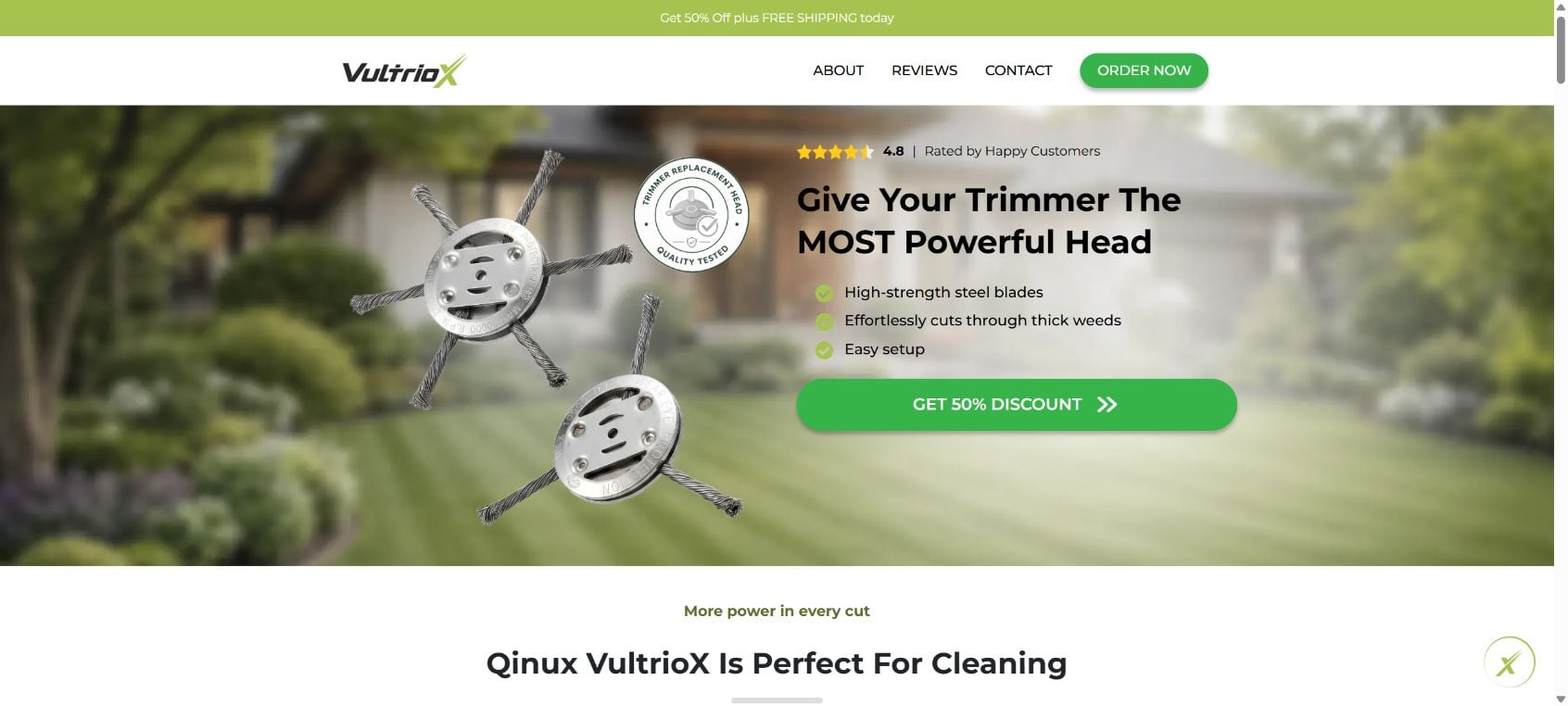
Qinux VultrioX is not a complete grass trimmer. It is an aftermarket replacement head with three or six short lengths of braided steel cable. The customer removes the original nylon spool from an existing brush cutter or string trimmer and installs the metal head in its place.
The official landing page claims the attachment cuts thick grass, weeds, moss, and roots while lasting longer than conventional trimmer line. It displays a 4.8 rating, says 94% of users would recommend the product, and repeatedly offers a 50% discount with free shipping.
The basic idea is not unique. Steel-wire and braided-cable trimmer heads are sold under many names through marketplaces and tool sellers. Listings for visually similar products make it clear that buyers are not paying for a newly invented cutting technology.
The bigger concern is safety. A normal string trimmer is designed around a lightweight nylon cutting line and a guard sized for that system. Metal cables have more mass, behave differently when they strike concrete or stones, and can release metal pieces if the strands or mounting hardware fail.
The UK Health and Safety Executive has warned that fitting non-standard cutting attachments to brush cutters creates a risk of death or serious injury from ejected metal components. Numerous string-trimmer manuals also instruct owners not to replace approved cutting line with metal wire or unsupported heads.
That does not prove every VultrioX head will break. It means the seller’s broad “compatible with most brush cutters” language is not enough. Compatibility must include manufacturer approval, correct speed rating, secure mounting, guard clearance, and safe operation—not merely whether the center hole can be made to fit.
What Qinux VultrioX promises
- High-strength steel cables that resist wear.
- Faster cutting through thick vegetation.
- Removal of weeds, moss, and shallow roots.
- Easy installation and broad trimmer compatibility.
- Fewer interruptions and replacement heads.
What the sales page does not establish clearly
- A model-by-model compatibility list.
- Approval from the manufacturer of the customer’s trimmer.
- The actual manufacturer and country of origin.
- Independent testing at different shaft speeds.
- How the cables and fasteners behave after repeated impacts.
- Whether the original guard provides adequate protection.
- Independent verification of the displayed customer rating.
The legal terms name ECOMM MOVADGENCY SL in Madrid as the seller, but they do not identify the factory that made VultrioX. Orders normally cannot be cancelled once placed. The stated withdrawal window is 14 days, the item must be new and complete in its original packaging, and the buyer pays return transport to Spain. For a relatively cheap generic attachment, that return can be impractical even though a policy exists on paper.
How the Qinux VultrioX Sales Funnel Works
Step 1: The ad focuses on a familiar frustration
Anyone who has stopped repeatedly to replace broken nylon line understands the problem. The advertisement begins with that real annoyance and presents metal cable as the permanent solution.
Step 2: Edited or AI-assisted demonstrations make the head look unstoppable
Promotional footage shows dense weeds and neglected areas disappearing quickly. Whether the clips are selectively edited, enhanced, or AI-assisted, they are advertising—not a controlled test. The page does not name the trimmer used, show its shaft speed, provide a continuous comparison, or document what happens after prolonged contact with rocks, fencing, and concrete.
Step 3: A generic attachment is presented as a premium innovation
The Qinux VultrioX name, polished graphics, and “quality tested” badge create a premium branded appearance. In reality, the same general steel-cable design is sold under unrelated names. This is the core dropshipping tactic: rebrand generic hardware, increase the price, and let the advertisement create the perceived value.
Step 4: The permanent discount pushes a quick order
The landing page repeatedly advertises 50% off and free shipping. Buyers should judge the current amount against comparable heads—not against a reference price chosen by the marketer.
Step 5: The buyer discovers compatibility and return limits later
A head can physically arrive yet still be unsuitable for the customer’s machine. If exact models are not listed, the buyer may discover mounting, guard, vibration, or safety problems only after opening the package. At that point, the 14-day return clock, unused-condition requirement, and customer-paid postage can turn the advertised guarantee into an expensive obstacle.
The Safety Problem With Steel-Cable Trimmer Heads
At several thousand revolutions per minute, even a small component carries substantial energy. A cable end, screw, or fragment released from the head can travel fast enough to cause severe injury. Hard contact can also throw stones and debris farther than users expect.
Metal cable is also far less forgiving around vehicles, windows, pets, bystanders, young trees, irrigation lines, and decorative surfaces. A device that cuts tougher material can also damage more when control is lost.
Do not install it unless all of these are true
- Your trimmer manufacturer explicitly permits this type of metal head.
- The attachment is rated for the machine’s maximum shaft speed.
- The mounting hardware, thread direction, and arbor size are exact—not improvised.
- The original guard is approved and correctly positioned for the attachment.
- The head has no frayed cables, loose fasteners, cracks, corrosion, or deformation.
- You can operate it in a large cleared area with proper eye, face, leg, foot, and hearing protection.
If the owner’s manual says to use only manufacturer-approved line or attachments, that instruction should override a seller’s claim of “universal” fit.
Red Flags in the Qinux VultrioX Marketing
- A 50% discount repeated as though it is temporary.
- Broad compatibility without a detailed supported-model list.
- On-page ratings that are difficult to verify independently.
- Heavy emphasis on results and little attention to machine-specific safety.
- Claims about roots and hard surfaces that encourage high-impact use.
- Multiple promotional and advertorial pages repeating brand-provided language.
- Visually similar products available elsewhere under other names.
What to Check Before Buying
- Find your exact trimmer model and read the attachment section of its manual.
- Ask the manufacturer whether a braided-steel cable head is approved.
- Request the VultrioX speed rating, arbor dimensions, hardware list, and safety certification in writing.
- Compare the real checkout total with similar metal heads from established tool retailers.
- Read the return rules for opened or installed products.
- Confirm the legal seller, return country, and who pays tracked return postage.
- Avoid ordering if the only evidence of performance is the seller’s own video and review widget.
What to Do If You Already Ordered VultrioX
If the head has not shipped, request cancellation in writing. If it has arrived, do not install it until you confirm manufacturer approval and exact compatibility.
- Photograph the packaging, labels, hardware, and cable condition.
- Compare the delivered configuration with the advertisement.
- Check for missing speed ratings, instructions, warnings, or mounting parts.
- Request a return immediately if your model is unsupported or the documentation is inadequate.
- Use tracked postage and keep proof of delivery.
- Dispute the charge if the seller materially misrepresented compatibility, contents, or return rights and refuses to resolve the problem.
The Bottom Line
Qinux VultrioX is a dropshipping-style rebrand of a generic steel-cable trimmer attachment, not a unique breakthrough. The item may arrive, but the campaign turns widely available hardware into a premium “permanent solution” while giving too little attention to product origin, returns, compatibility, and high-speed safety.
We would not install it on a string trimmer unless the machine’s manufacturer specifically approves that type of head. Saving time on nylon line is not worth adding an unverified high-speed metal attachment that could damage the tool, eject components, or injure someone nearby.








