


The page has the bank’s familiar colors, and the questions sound like routine account verification. You recognize the logo before you notice everything the form wants.
A guilty plea involving ready-made phishing kits shows why that moment deserves a closer look. The people collecting your answers may never have worked for your bank.
Overview
A convincing bank page could be bought off the shelf
Abdellah Belmili created and sold phishing kits that copied financial institutions’ login pages. Buyers could use those pages to collect information entered by unsuspecting bank customers.
The DOJ account of his guilty plea identifies imitations of JPMorgan Chase, American Express, Bank of America, and Wells Fargo. Those institutions were impersonated, rather than operating the scam.
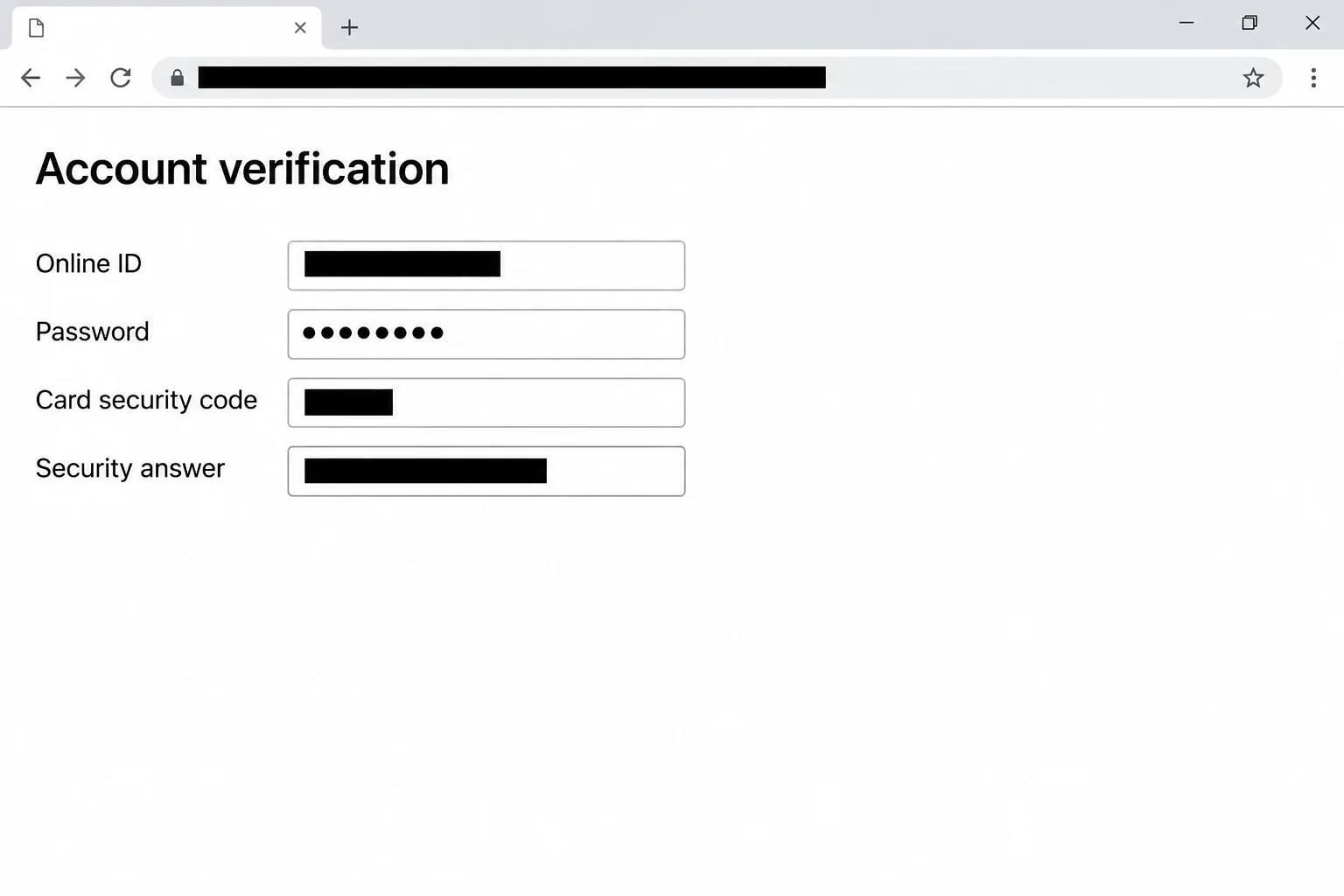
The form illustrated above is a reconstruction of the information request. It is not a recovered Belmili website or an original bank customer’s screen.
The criminal case confirms what the forms were doing
Belmili, also known as Dila Belmili and SPOX, pleaded guilty to conspiracy to commit bank fraud on November 17, 2026. His conduct covered March 2020 through January 2023.
He sold kits through online marketplaces he operated and a Telegram channel. The kits were used more than 1,000 times, generating approximately $75,793 in sales for him.
That figure describes the kit seller’s revenue. It should not be mistaken for the total taken from bank customers or the amount lost in every attack.
The danger begins with the information request
One kit imitated a Chase website and collected more than a username and password. It also sought payment-card details, a security code, and a mother’s maiden name.
- A familiar logo cannot establish who receives a submitted form.
- Bank login information and card information create different problems when exposed.
- Security answers deserve attention even after a password has been replaced.
- Contact the actual bank through an independently established route after disclosure.
How the Fake Bank Login Page Scam Works
Step 1: Someone acquires the machinery for the deception
The seller did not need to conduct every customer-facing attack personally. His buyers received tools that helped them present fraudulent pages resembling established financial institutions.
That division of work matters when several messages look strikingly similar. A common design can spread because different criminals purchased the same underlying tools.
For the person receiving a message, however, identifying its developer is unnecessary. Your immediate decision concerns whether to give private information to the page in front of you.
The criminal market behind that page explains its polish. A professional appearance can be part of the purchased package, rather than evidence of professional banking support.
Step 2: A message directs the customer toward the imitation
Phishing uses fraudulent emails or texts that claim a connection with a legitimate organization. The message creates a reason to visit somewhere outside your established banking routine.
The exact subject line can change without changing the destination’s purpose. A request to verify access and a warning about an account problem can lead toward similar information demands.
Those are possible approaches, rather than recovered quotations from every Belmili attack. The plea announcement confirms the counterfeit pages and the information they were designed to capture.
Before following an unexpected banking message, open the bank’s existing app yourself. If you need help, use the number on your card or a genuine statement.
Step 3: Familiar branding lowers the customer’s guard
The kit generated a login page resembling the real company’s page. That resemblance encouraged people to treat a criminal-controlled form as an ordinary banking screen.
A customer might recognize the layout while overlooking how they arrived there. Recognition of a visual design answers a different question from recognition of a trusted destination.
An address displayed inside a message or document can also be mere text. What matters is the actual destination, which may differ from the wording presented to you.
You do not have to inspect a suspicious page repeatedly to settle the question. Leaving it and checking the account independently avoids handing that page another opportunity.
Step 4: The form collects several kinds of useful information
The Chase imitation sought identifying information alongside account credentials and card details. Those extra questions expanded the exposure beyond the ability to sign into one account.
A security answer may remain useful after a password changes. A replacement password also does not replace a card number that was entered into the same form.
This is why the bank needs an accurate description of what you submitted. Saying only that you clicked a link can leave important information out of the response.
Write down the categories you entered without creating another document containing the actual secrets. A list such as password, card details, and security answer is sufficient.
An answer based on a family fact is different from a temporary password. Replacing the password does not change the underlying fact someone may now know.
Ask the bank whether the exposed security answer needs replacement or another recovery method. Have its staff confirm how future identity checks will be handled.
If you used the same answer at another financial institution, include that institution in your follow-up. Keep the actual answer out of messages sent to explain the exposure.
For a shared account, tell other authorized users about the incident and the bank’s instructions. That helps prevent somebody else from answering a follow-up impersonation call.
Step 5: The answers go to the kit’s customer
The information entered into the fraudulent page was transmitted to the criminal who bought the kit. The bank’s branding concealed that change in recipient.
An error message after submission would not necessarily mean nothing happened. A dishonest page can collect information without giving you any useful confirmation in return.
Similarly, reaching a genuine bank page afterward would not undo earlier disclosure. The important question is which information left your control before that final page appeared.
If you submitted details, stop testing the page and contact the real institution. Repeating the process with a second account would only enlarge the information exposed.
What the Undercover Purchase Actually Showed
An FBI employee working undercover created an account on Belmili’s marketplace in December 2020. The employee made several purchases, including the kit imitating a Chase website.
That purchase connected the marketplace to an actual tool for collecting customers’ private information. The later guilty plea supplies the criminal outcome behind the warning.
The finding is more specific than a complaint about a bank’s customer service. It concerns software sold to impersonate banks and redirect information to criminals.
It also explains why the seller’s income and the victims’ losses are separate measures. A kit can be sold once and used repeatedly by its purchaser.
Imagine a hypothetical criminal buying a reusable form template. The purchase price tells you what the template cost, rather than the amount every subsequent victim might lose.
Belmili’s case therefore should not be reduced to a comparison between a small software sale and a large bank balance. The sale enabled further deception downstream.
The institutional names are useful recognition points, but they do not confine the wider problem. The same principle applies whenever a page borrows another organization’s identity.
This article addresses the documented Belmili operation. It does not claim that every suspicious banking message circulating today came from his kits or his customers.
Work Out What You Exposed Before Choosing the Response
You received the message but entered nothing
Keep the message long enough to record its sender and report it. Avoid replying to argue with the sender or asking them to prove their identity.
There is no need to replace every financial account merely because a fraudulent message arrived. Check for an actual disclosure or unauthorized transaction before describing the incident.
If the message mentions a transaction you recognize, inspect that transaction in your genuine banking app. Authentic purchase information still cannot authenticate an unrelated incoming message.
You opened the page but submitted no information
Close the suspicious page and return to your established banking route. Opening a phishing page alone does not establish that malicious software infected your device.
If you also downloaded or installed something, tell the bank and appropriate device support separately. That additional action changes the exposure and should not be omitted.
Do not clear useful messages while still trying to remember what happened. Record the sequence first, including whether you typed, submitted, downloaded, or approved anything.
You entered private information or approved a transaction
Prioritize the bank’s fraud team because it can inspect account access and payment activity. A generic warning page cannot tell you whether a specific transfer is pending.
Explain whether you supplied only credentials, additional card information, or an authorization code. If money moved, include its time, amount, recipient, and transaction reference.
Your account may need more than a password reset. Ask the bank which access methods and payment instruments must be restricted or replaced for your particular disclosure.
What to Do if You Have Fallen Victim to This Scam
-
Call the real bank before returning to the suspicious page. Use the number printed on your card or a statement you already had.
Tell the representative that you entered information into a counterfeit bank page. Ask to reach the fraud team and explain whether any transfer has appeared.
Request an incident reference and write down the time of your call. If the first representative cannot handle account compromise, ask for the appropriate escalation.
-
Describe each category of information that you disclosed. Include your login, card details, security answer, and any code you supplied, when applicable.
Ask the fraud team to identify the protective changes needed for those items. Confirm whether online access, unknown sessions, linked devices, or payment methods require restriction.
If you cannot safely regain access, continue through the bank’s identity-verification process. Avoid relying on recovery links sent by the original caller or message sender.
-
Address any reused password as a separate exposure. Tell the bank if that same password protected another financial service, and contact that service independently.
Do not send the old password through email to explain the incident. State that it was reused and ask the affected provider to secure that account.
Keep a checklist of the services contacted and the changes confirmed. An unresolved account should remain on that list rather than disappear after one telephone attempt.
-
Ask about suspicious payments using their actual transaction status. Have the amount, date, destination, and reference available before speaking with the bank’s payments team.
For a pending instruction, ask whether it can be stopped. For a completed transfer, request the available fraud investigation and recovery measures without assuming success.
Get written acknowledgment of the report or instructions for providing one. Follow the bank’s stated deadline, and retain copies of every response you receive.
-
Preserve the message and report the online deception. Keep the sender, full destination address, screenshots without visible secrets, and your banking incident reference.
The Western District of New York office lists 716-843-5700 for Buffalo. Ask how to direct information concerning the Belmili case.
If the office needs additional information, request its authorized submission route. Do not email full passwords, authentication codes, or an unredacted card image to a general mailbox.
-
Continue checking the specific items the bank identified. Review the transactions and account-access notices relevant to your disclosure, keeping new suspicious activity with the original report.
A caller who offers guaranteed recovery for an upfront payment creates another risk. Verify any claimed investigator through the office’s published number before discussing the case.
If the bank confirms a protective change, record that confirmation. If unexpected access or charges continue, reopen the incident using your reference and the new evidence.
Frequently Asked Questions
Were the named banks running the phishing operation?
The banks were impersonated by counterfeit pages. Belmili’s customers received information submitted to those pages, so the real institution’s branding should not be read as its endorsement.
Does the $75,793 figure show the total customer loss?
That approximate amount describes Belmili’s revenue from selling the kits. The announcement does not identify it as the combined losses suffered by everyone targeted afterward.
Were the kits sold more than 1,000 times?
The official announcement says they were used more than 1,000 times. A use count is different from a verified count of individual purchases or affected bank customers.
Does changing my password solve every disclosure?
A password change addresses only part of the problem when card information or security answers were also submitted. Give the bank the complete list of exposed categories.
Does visiting the page automatically mean I installed malware?
A visit alone does not establish an infection. Report any separate download or installation accurately, while treating submitted banking information as an account-security issue needing prompt attention.
Is the illustrated form an original criminal website?
The image is an inert reconstruction showing the information request. The factual findings come from the guilty plea announcement, rather than an invented claim about recovered screenshots.
The Bottom Line
Do not provide banking information through an unexpected verification link. Belmili’s case shows that convincing bank pages could be packaged and sold to criminals as reusable tools.
If you already entered details, call the real bank now and describe everything you disclosed. Keep the incident reference and pursue any unresolved account or payment issue.

Join the discussion
0 commentsShare your experience or ask a question about this article.
Community experiences
Did this happen to you?
Your experience could help someone recognize the same scam. Submit a private report for our team to review.
I experienced this tooReports are reviewed before publication. Sharing publicly is always your choice.
Discussion
Start the conversation
Have a question or something useful to share? Add the first comment.