


A text warns that someone has used your bank account. Before you have time to investigate, another person calls and offers to help resolve the problem.
The timing makes the call feel reassuring. In a confirmed fraud case involving Marvell Jackson, that apparent coordination was part of what made the approach dangerous.
Overview
The text and the caller worked together
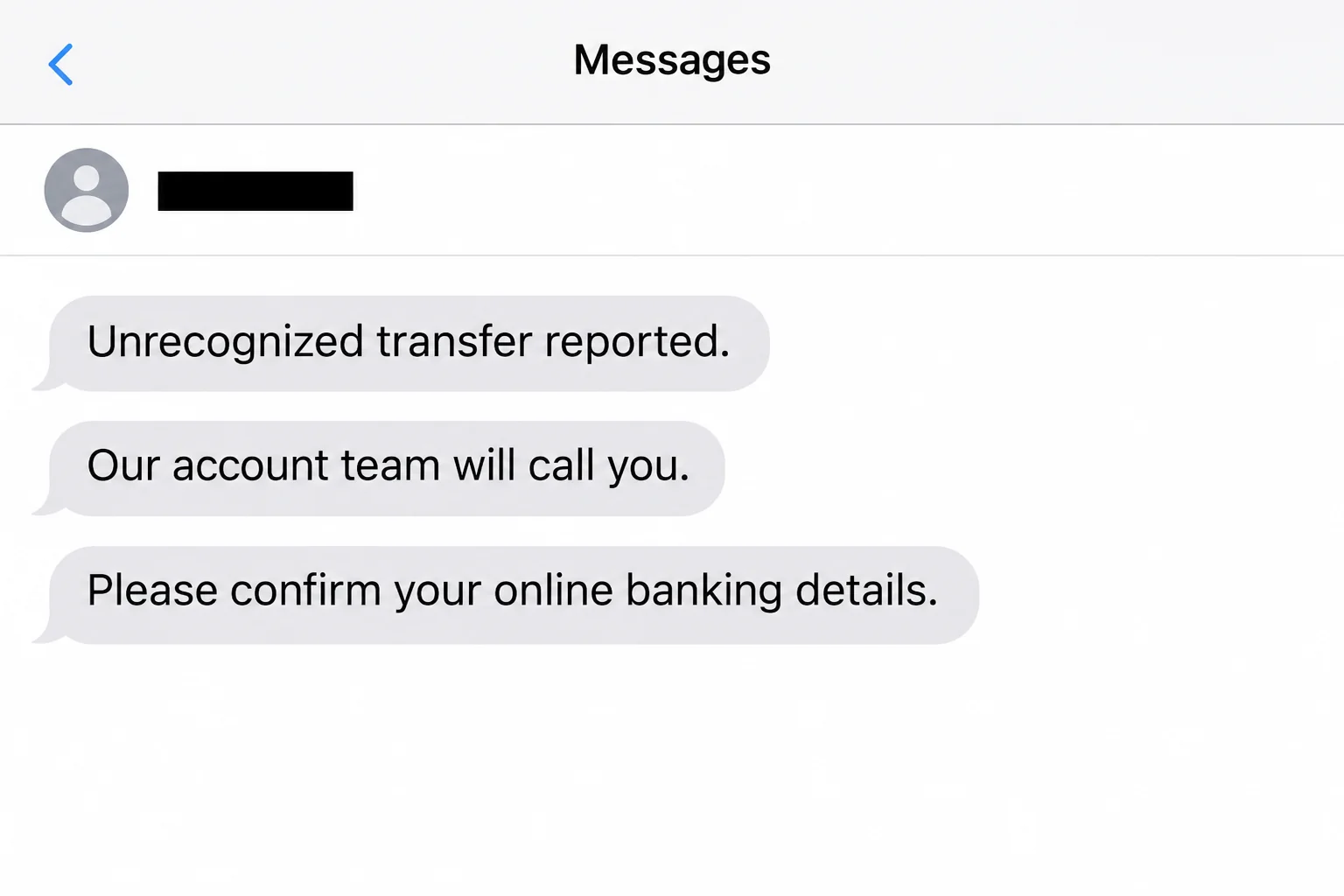
A Louisiana fraud conspiracy sent banking customers texts falsely reporting unauthorized financial transactions. Some recipients then received calls from people pretending to be employees of their banks.
The aim was to obtain credentials and other confidential account information. Conspirators used the information to access accounts and make unauthorized electronic transfers.
The pictured conversation is a reconstruction of the text-and-callback approach. Its wording illustrates the tactic, rather than reproducing an original message recovered in the Jackson case.
A guilty plea and prison sentence establish the fraud
Marvell Trevenski Jackson Jr. received a 48-month federal prison sentence in August 2026. His guilty plea covered a conspiracy involving smishing, stolen mail, and fraudulent checks.
The sentencing announcement attributes over $300,000 in losses to smishing. It separately lists $378,394 in restitution for the broader case, which included other conduct.
A November 23, 2026 DOJ account describes the follow-up calls and Instagram recruitment. Those details explain how stolen access connected with accounts receiving the money.
There were two different ways to be pulled in
Bank customers were approached for confidential information. Other people were recruited to provide accounts that could receive proceeds and pass money onward after retaining a share.
- Verify an alert inside your existing banking app before discussing it with an incoming caller.
- End the call and contact your bank through a number you already trust.
- Never make your bank account available to someone offering a cut of transferred funds.
- Report suspicious access and any unfamiliar payments using their actual transaction references.
Why the Callback Can Feel More Convincing Than the Text
An unexpected text may initially look untrustworthy. A call arriving afterward can seem like a second source confirming that something really happened to your account.
But two communications do not provide independent confirmation when the same group controls both. The second person can reinforce a story introduced by the first message.
That is the important distinction in this case. The caller’s apparent awareness of the warning did not show that the caller worked for a financial institution.
You may also feel that answering promptly helps prevent a loss. The scam turns that reasonable intention into a reason to disclose information before checking the caller.
A useful interruption is to end the conversation while you still control your account. Open the bank’s genuine app or call the number on your card.
Explain that someone contacted you about a supposed transaction. Ask whether the bank can identify that transaction and whether there is an actual account-security problem.
If the bank cannot match the warning, preserve the message and provide its details through the bank’s reporting route. There is no need to return to the caller.
If the bank does identify a real concern, keep handling it through that independently established contact. A genuine problem does not authenticate the person who called first.
How the Fake Bank Fraud Text Scam Works
Step 1: A false transaction creates an immediate problem
The messages claimed that unauthorized financial activity had occurred. That framing gave recipients an understandable reason to pay attention to their banking information quickly.
Unlike a message advertising a prize, the text offered a way to avoid losing something already owned. The emotional pressure came from protecting the account.
You can respond to that concern without responding to the message. Check recent activity through your usual app, including whether the supposed transfer appears at all.
Do not treat an absent transaction as permission to click around the suspicious page. Its purpose may be to create the disclosure that enables a later theft.
Step 2: The approach asks for confidential banking information
Recipients were directed to provide login credentials and other account details. The claimed security issue supplied the reason for asking customers to reveal that information.
Keep a clear distinction between identifying yourself to a bank you contacted and answering an unexpected caller. The first begins with an independently chosen destination.
The second begins with the caller’s claim about their own identity. A convincing explanation of the problem cannot settle that identity question by itself.
If you have already disclosed something, describe it accurately when contacting your actual bank. A username, password, security answer, and authorization code are different items.
Step 3: A supposed employee reinforces the story
In some instances, conspirators followed the fraudulent texts with telephone calls. They impersonated banking staff to obtain additional personal and confidential information about customers’ accounts.
The call therefore should not be treated as a helpful rescue from the suspicious message. In the documented operation, it could extend the same attack.
You can end an unexpected banking conversation without persuading the caller that you have good reasons. Verification works best after you have left their communication channel.
Use the number printed on your payment card or a genuine statement. Ask the bank to check the alleged transaction and the information you were asked to provide.
Step 4: Stolen information enables unauthorized transfers
The conspirators used customers’ banking information to access their accounts. Money was then transferred electronically into accounts held by money mules at the financial institutions.
That movement explains why identifying the receiving account matters after a loss. A transfer can look like an ordinary banking transaction while resulting from stolen access.
Tell the fraud team whether you initiated a payment yourself or discovered an unauthorized transfer later. Do not replace the actual sequence with what the caller claimed happened.
The bank needs that distinction to investigate the account activity. Keep the exact amount, time, recipient information, and reference associated with each suspicious movement.
Step 5: Other people provide the receiving accounts
Jackson advertised the scheme using Instagram and recruited people to open accounts for receiving unauthorized transfers. Recruits could keep part of the proceeds for their participation.
This created another audience for the fraud operation. Someone offered easy income might focus on the promised share while ignoring where the incoming money originated.
A real banking app and an account in your own name do not make somebody else’s transfer legitimate. You could be providing the destination that victims need traced.
Do not open another account, move another payment, or accept a different explanation to help the organizer finish. Contact your own bank and describe the instructions received.
Step 6: The proceeds are withdrawn or sent onward
Jackson directed money mules to withdraw the stolen funds or transfer them electronically to him or other conspirators. That additional movement separated proceeds from the original accounts.
Once money has moved, recovery becomes a question for the institutions and investigators handling the actual transactions. A promise from the caller is no substitute for their response.
Preserve every receiving-account detail and payment reference available to you. Even if the balance has changed, those records can still help explain the path of a transfer.
The Instagram Offer That Turns Your Account Into Someone Else’s Tool
An offer to earn money by receiving transfers deserves a different response from an offer for ordinary work. Ask what product or service you are actually providing.
If the work consists of opening an account, receiving funds, and forwarding most of them elsewhere, your account is central to the arrangement rather than incidental.
The promised percentage can make the transaction feel like a legitimate commission. In the Jackson conspiracy, retaining a portion was part of how money mules were recruited.
Do not assume that temporarily holding the money makes you its rightful owner. The person directing the transfer may be relying on access stolen from someone else.
If somebody you know introduced the arrangement, ask what work the payment actually compensates. A familiar contact does not explain why an unfamiliar person’s money needs your account.
You can decline that arrangement without deciding how much the contact understands about it. Preserve the offer and let your bank examine any funds already received.
If you are already involved, keep the recruitment messages and bank records. Explain to your bank which funds arrived, what instructions you received, and what you already transferred.
Avoid sending money back through new instructions from the recruiter. Let your bank’s fraud team explain how the funds should be handled and document its advice.
The aim is to stop additional movement while preserving a truthful account of your involvement. If you need advice about your own legal position, consult an independent attorney.
Do not delete the conversation because it feels embarrassing. The messages explaining the offer and the promised share may help distinguish your account from the organizer’s claims.
What to Do if You Have Fallen Victim to This Scam
-
Break the text-and-call sequence before giving any more information. End the conversation, keep the message, and open your bank through its existing app.
If you need telephone assistance, call the number on your card. Ask the representative to verify the supposed unauthorized transaction and check for actual security concerns.
When the records do not match the caller’s story, report the message through that genuine contact. Do not call the original person back for an explanation.
-
Tell the fraud team exactly what you disclosed. Include passwords, security answers, card information, and any approval you gave during the conversation, where applicable.
Ask what restrictions or credential changes are needed for those particular disclosures. Request confirmation that unknown access and payment instructions have been reviewed.
If you cannot regain safe access, use the bank’s identity-verification process with its authorized staff. Keep your incident reference and the instructions given for follow-up.
-
Report each unfamiliar transfer using its banking reference. Give the amount, date, receiving account details, and whether you personally approved any part of the payment.
Ask whether pending funds can be held or stopped, and what recovery request applies to completed transfers. Neither a report nor a recall request guarantees reimbursement.
Obtain written acknowledgment or the bank’s instructions for submitting your account. If another suspicious payment appears, add it to the existing incident immediately.
-
Stop using an account supplied to someone offering commission. Tell your bank about incoming funds and any instruction to withdraw or forward them.
Keep the Instagram profile details, recruitment conversation, promised share, and transfer records. Ask the fraud team how to handle money still present in the account.
If you already moved funds, explain the sequence honestly rather than hiding individual transactions. Seek independent legal advice when you need help understanding your position.
-
Give investigators a concise record of the online approach. List the message, callback details, relevant accounts, payment dates, and your bank’s incident number.
The Middle District of Louisiana office publishes 225-389-0443. Ask how to direct information relating to Marvell Trevenski Jackson Jr.’s case.
Confirm the authorized route before transmitting sensitive records. A public contact lookup identifies where to ask, rather than confirming that your submission has already been accepted.
-
Check that the bank’s protective actions actually took effect. Record which access methods were changed, which payments remain disputed, and when another response is expected.
Follow up using the same incident number if an action remains incomplete. Preserve each reply so you can explain the outstanding issue without reconstructing the whole story.
Reject anyone requesting another transfer to release stolen money. Verify a claimed investigator independently, using the published office rather than details supplied by that person.
Frequently Asked Questions
Does a call after the text prove the alert was genuine?
The Jackson conspiracy sometimes used follow-up calls to impersonate bank staff. A second communication is not independent verification when the same operation controls both contacts.
Did the smishing losses equal the entire restitution order?
The sentencing announcement describes over $300,000 in smishing losses and $378,394 in restitution for the broader case. Its other conduct included stolen mail and fraudulent checks.
Were the banks named in the case operating the fraud?
The financial institutions and their customers were defrauded. The deception came from conspirators pretending to send legitimate alerts and using stolen information to move customers’ money.
Why would a scammer need somebody else’s bank account?
Money mules provided receiving accounts and then withdrew or forwarded proceeds. That let the conspirators move stolen funds through accounts held by other people in the network.
Is a commission for receiving money an ordinary job offer?
In this case, a share of transferred funds helped recruit people into the scheme. Do not provide your account for receiving and forwarding money at another person’s direction.
Should I keep talking so I can obtain more evidence?
Stop giving information and preserve what you already received. Your bank and investigators can work from those records without requiring you to continue a risky conversation.
The Bottom Line
Do not use an incoming call to verify a banking text, and do not lend your account to a stranger promising commission. Jackson’s scheme used both sides of that arrangement.
If you shared details or handled suspicious funds, contact your own bank through a known route. Preserve the instructions, identify every transaction, and obtain a recorded fraud response.

Join the discussion
0 commentsShare your experience or ask a question about this article.
Community experiences
Did this happen to you?
Your experience could help someone recognize the same scam. Submit a private report for our team to review.
I experienced this tooReports are reviewed before publication. Sharing publicly is always your choice.
Discussion
Start the conversation
Have a question or something useful to share? Add the first comment.