


The car looks right, the seller appears established, and the paperwork explains where to send the money. Delivery is promised only after the wire.
Before you authorize that payment, the website and the receiving account deserve separate attention. A nationwide criminal case shows how convincing business identities concealed a different destination.
Overview
Buyers thought they were dealing with legitimate businesses
A fraud operation used websites impersonating genuine businesses to attract buyers of consumer products, including cars and equipment. Customers were persuaded to pay by bank wire.
The money went to accounts associated with shell companies created using fraudulent identity documents. The person helping establish those accounts was Claudiu Pesteleu, according to his plea admissions.
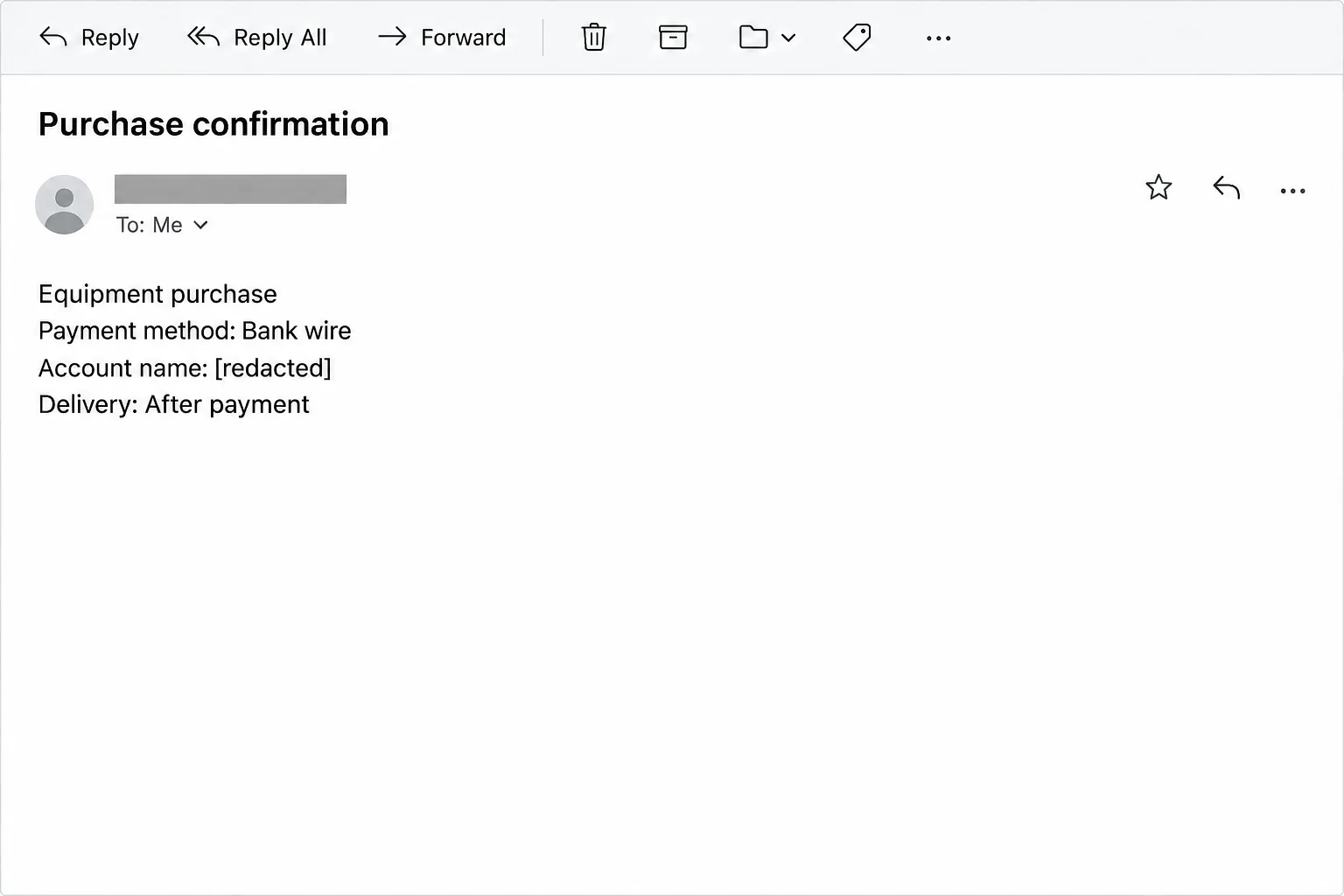
The purchase email illustrated above is a reconstruction of the payment request. It is not a recovered invoice or a capture of a particular seller’s website.
The admitted scheme collected approximately $1.8 million
The District of New Mexico announcement describes Pesteleu’s admitted participation from May 2023 through June 2024. Approximately $1.8 million reached accounts he controlled.
His role included obtaining false identity documents, creating sham businesses, opening their accounts, and conducting transactions to conceal the money’s source. Buyers were making payments for supposed legitimate purchases.
For someone checking an old purchase, the account trail matters. Match the beneficiary on your wire receipt with the entities identified in the case before reporting a possible connection.
A business name does not connect every part of a purchase
The case separated three things a buyer might assume belonged together: the business shown online, the person providing instructions, and the company receiving the payment.
- Contact the genuine business through a route independent of the website selling the item.
- Confirm that the business recognizes the exact vehicle or equipment and the proposed transaction.
- Have the actual seller explain any different company named as the bank beneficiary.
- Ask your bank about fraud recovery promptly if a wire has already gone to a suspicious recipient.
How the Fake Car and Equipment Website Scam Works
Step 1: A fraudulent website borrows a business identity
The operation impersonated legitimate businesses online. That made the purchase appear connected with an established seller rather than a stranger asking for money without any business context.
For a buyer, the existing business name could become a shortcut for trust. Finding that a real company exists would not resolve whether it controlled the website.
That is the first separation worth making. Verify the connection between the genuine business and the particular offer before relying on the business’s reputation to approve a payment.
Use contact details obtained independently, such as records from a prior genuine relationship. Do not let the questionable website be the only source confirming its own identity.
Step 2: The buyer believes a real product is being purchased
Victims believed they were paying for legitimate consumer goods, including automobiles and equipment. The apparent purpose of the transfer was an ordinary purchase rather than an investment.
This helps explain why a payment request could feel reasonable. A buyer expecting a substantial item already understands that meaningful money must change hands somewhere in the transaction.
The question is whether the person requesting that money can deliver the specified item. A professional-looking invoice is part of the seller’s claim, rather than independent verification.
For a vehicle, record its advertised identification number and seller details before paying. For equipment, record the make, model, serial information, and the description of what is included.
Step 3: Payment instructions introduce a shell-company account
The buyers were directed to send funds into bank accounts associated with sham entities. Those accounts had been opened using businesses and identities supported by fraudulent documents.
The receiving account therefore gave the deception somewhere practical to collect money. A wire confirmation could show successful delivery of funds without proving a successful product purchase.
Compare the beneficiary with the contracting seller before authorizing the transfer. If the names differ, ask the genuine business to explain that relationship through your independent contact.
Do not accept an explanation merely because it appears on another document supplied by the same person. The connection needs confirmation outside the material directing your payment.
Step 4: Different aliases help maintain the account structure
Pesteleu used several aliases while establishing the businesses associated with the receiving accounts. The case identifies false passports and other fraudulent identity documents as part of that process.
That meant the apparent paperwork supporting a company account was itself part of the deception. A buyer could encounter formal business details without reaching the person actually controlling them.
For investigators, those identities help explain the movement of money. For buyers, the practical lesson is to verify the actual transaction, rather than collecting more impressive-looking documents.
Ask the genuine seller to confirm the item, price, contract, and exact receiving account together. A fragmented answer leaves a material part of the purchase unresolved.
Step 5: Additional transactions conceal where the money went
After victims’ funds reached the accounts, Pesteleu conducted numerous financial transactions intended to conceal their source. Those movements hindered efforts to identify the scheme and seize proceeds.
The $1.8 million figure concerns money directed into accounts he controlled. It is not a guarantee that an equal amount remains available for returning to individual buyers.
Once you suspect a fraudulent wire, the next useful conversation is with your bank’s fraud or wire team. Ask about the actual payment rather than arguing over the website.
Give the beneficiary details and payment reference promptly. The bank can explain available measures, although a tracing request or fraud report cannot promise that the money will return.
The Business Names Behind the Receiving Accounts
Real businesses supplied the identity shown to buyers
The fraudulent websites impersonated legitimate businesses. Those businesses should not be treated as participants merely because their identities helped persuade customers to consider a purchase.
The distinction matters when you call a genuine dealer or equipment supplier. Explain the website and transaction you were shown, and ask whether the business recognizes them.
If its staff says the offer is unrelated, preserve that response. It can help your bank understand why a payment naming a business may have reached somebody else.
Avoid publicly accusing an unrelated real firm based only on a copied name. Keep your report tied to the actual website, communications, and beneficiary instructions you received.
Shell companies supplied the bank destinations
The announcement names Zammer Equipment LLC, Super Exotic Deals LLC, Premier E. Liquidators LLC, and Adler Pre Owned LLC among the entities used in the case.
It also identifies Bittman Motors LLC, Nikkos Cargo LLC, and Becker Automotive LLC. These are historical case-specific account entities, not a blanket finding about every similarly named business.
A company designation in payment instructions could make the destination appear commercial. In this scheme, that appearance did not establish that the account belonged to an authorized product seller.
The names are useful when matching your own records with the case. They should be compared with the actual beneficiary on a transfer, rather than remembered approximately.
One participant used multiple supporting identities
The case connects company names with aliases including Matthias Zammer, Samuel Der Saar, Fred Laport, Boris Adler, Fritz Bittman, Nikos Adonis, and Karl Becker.
Pesteleu also used the name Thomas Muller. Those aliases explain how the account structure was supported, rather than providing evidence against unrelated people who happen to share a name.
If your paperwork includes one of these identities, keep the full document privately. Record where the name appeared and which transaction or communication it accompanied.
Names alone can be ambiguous, while a name combined with the specific account, website, and payment date gives investigators a more useful picture of what happened.
Independent confirmation needs to cover the beneficiary
Suppose a buyer confirms a dealership exists, then pays a separate equipment company named on the invoice. The payment relationship still needs independent confirmation.
The buyer needs the genuine dealership to confirm that this different beneficiary is authorized for that transaction. Recognizing the dealership’s name answers only part of the identity question.
If the business cannot confirm that relationship, stop before sending the wire. Let the verified seller supply corrected arrangements through the contact route you independently established.
If the person selling the item insists that outside verification will ruin the deal, preserve that exchange. Pressure does not make an unexplained beneficiary relationship less important.
Check the Actual Item Before the Payment Deadline Takes Over
Cars and equipment are substantial purchases with identifying details. Those details give you concrete questions to resolve, rather than a general feeling that a website looks established.
Ask who owns the item, where it can be inspected, and which business is signing the sale agreement. Keep the answers with the listing and payment instructions.
If an independent inspection is arranged, confirm the inspector’s identity separately. A person introduced only by the seller may not provide the independent check you expected.
An item identification number helps organize the inquiry, but a number printed on a page does not prove possession. Connect the number with the actual item and authorized seller.
Likewise, photographs can describe what is being offered without establishing where it is or who can sell it. Do not turn a photo comparison into confirmation of ownership.
If a buyer cannot resolve ownership and payment identity without sending money first, the uncertainty falls on the buyer after payment. Keep the funds under your control while checking.
A seller may explain its process clearly and provide verifiable answers. The aim is to confirm those answers through the genuine transaction participants, rather than trust a document’s appearance.
What to Do if You Have Fallen Victim to This Scam
-
Call your sending bank’s wire or fraud team immediately. Use its established number and explain that a purchase wire may have gone to an impersonation scheme.
Provide the amount, date, beneficiary, receiving institution, and transaction reference. Ask whether the transfer remains pending and what stop, recall, or tracing options are available.
Request a case number and written acknowledgment of your report. Keep following the bank’s instructions without assuming that a submitted recovery request guarantees returned funds.
-
Put the sale and payment records together before changing anything. Save the listing address, advertised item details, invoice, correspondence, and wire confirmation.
Write a short timeline explaining when you contacted the seller and received payment instructions. Identify any change between the advertised business and the receiving account.
Redact private financial details from anything posted publicly. Give investigators complete records only through a submission route they have confirmed is appropriate for the case.
-
Contact the genuine business independently of the questionable website. Ask whether it recognizes the item, your supposed salesperson, contract, and exact bank beneficiary.
Explain that you are checking possible impersonation rather than accusing its staff. Ask for confirmation in writing if the offer or receiving account is unrelated.
Provide that response to your bank using the incident number. If a legitimate transaction remains possible, resolve its terms separately before authorizing any additional payment.
-
Report a possible case connection through the published investigative route. The DOJ announcement directs potential Pesteleu victims to Homeland Security Investigations at 866-347-2423.
Explain the company name and beneficiary shown in your records, payment date, amount, and relevant website. Ask how to submit the supporting documents securely.
Keep any reference or follow-up instructions supplied during that contact. A report identifies information for investigation; it does not itself create a confirmed reimbursement entitlement.
-
Refuse further payments to fix a purchase you cannot authenticate. A new charge for delivery, release, or recovery should be verified independently before money moves.
If the same contact supplies another company’s account, preserve the new instructions with the original records. Do not treat a different beneficiary as a fresh, unrelated purchase.
Return to your bank or assigned investigator with the update. Do not use someone claiming guaranteed recovery as the intermediary for another transfer.
Frequently Asked Questions
Was this just a dispute over an expensive product?
Pesteleu admitted involvement in a fraud operation using impersonation websites, fraudulent identity documents, shell companies, and concealed financial transactions. That establishes deception beyond an ordinary delivery or quality dispute.
Did every company name on the websites belong to the criminals?
The scheme impersonated legitimate businesses while directing payments to separate account entities. Keep the genuine business’s identity distinct from the fraudulent website and the beneficiary requesting the wire.
Does a company bank account guarantee that a seller is genuine?
The case describes accounts opened for sham businesses using fraudulent documents. An account’s existence does not establish that its controller owns the advertised item or represents the business shown online.
Was approximately $1.8 million definitely recovered for buyers?
The announcement identifies funds wired to accounts controlled by Pesteleu. It does not establish that the entire amount was recovered, remains available, or will be distributed to particular buyers.
Should I pay again to resolve a delivery problem?
Verify the seller, item, and beneficiary independently before sending more money. A new delivery or release charge should not override an unresolved concern about who received the original wire.
What should I give my bank first?
Start with the wire reference, amount, date, and beneficiary information. Explain the suspected impersonation, ask what immediate action remains possible, and retain your bank’s incident number and written instructions.
The Bottom Line
Do not wire money for a car or equipment purchase until the actual seller, item, and beneficiary connect through independent confirmation. A convincing business identity did not protect buyers here.
If the transfer has already left, contact your bank’s wire team now. Preserve the website and payment records, then report any connection to the case through the published HSI route.

Join the discussion
0 commentsShare your experience or ask a question about this article.
Community experiences
Did this happen to you?
Your experience could help someone recognize the same scam. Submit a private report for our team to review.
I experienced this tooReports are reviewed before publication. Sharing publicly is always your choice.
Discussion
Start the conversation
Have a question or something useful to share? Add the first comment.