


The inquiry sounds like a catering job worth taking. A customer wants food for a parent’s birthday, asks sensible menu questions and is ready to pay a deposit.
After you prepare the quote and contract, another request appears. The customer needs a small favor concerning somebody else involved in the party.
Overview
A detailed party inquiry becomes a request to move money
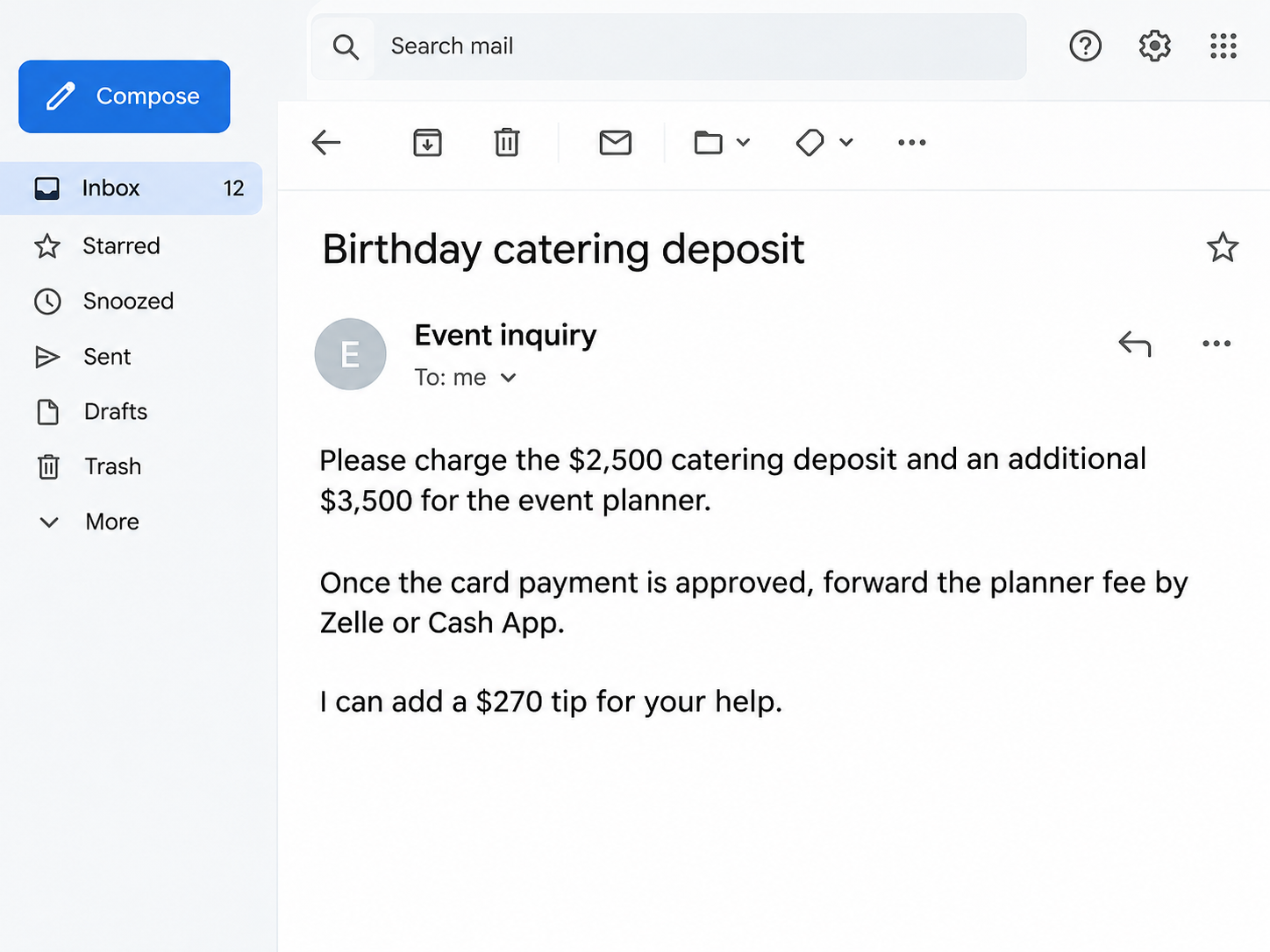
In this catering deposit scam, a supposed client asked a business to add $3,500 to a card charge and forward it to an event planner.
The catering deposit itself was $2,500. The customer also offered a $270 tip for handling the extra payment, which would be sent by Zelle or Cash App.
The business posted its email exchange in an r/Scams report. It said no transactions had occurred and ended the exchange by asking to discuss the request.
The business would send a separate payment from its own funds
The proposed arrangement puts a card payment on one side and a transfer to a stranger on the other. They can have very different outcomes.
If the incoming card charge is fraudulent or successfully disputed, the merchant can lose that amount after already sending the planner’s money.
The request contains several details that matter more than the polished menu discussion.
- The client insists that a credit card is their only available payment method.
- The additional recipient has no established payment relationship with the caterer.
- The requested transfer exceeds the catering deposit by $1,000.
- An extra tip rewards the caterer for handling the payment.
This is an established overpayment mechanism targeting businesses
Lethbridge Police describes overpayment scams involving a seemingly legitimate client, excess funds and a request to send money elsewhere before the original payment is verified. Police warning
The catering report shows an attempted version of that arrangement. It does not establish a completed charge, a stolen card or a particular bank’s eventual decision.
The email image is an editorial reconstruction of the payment request. It preserves the reported amounts while omitting personal details and payment destinations.
The Menu Discussion Is What Makes the Favor Harder to Refuse
The inquiry began with a parent’s birthday celebration. The person asked for information, looked at the menu and requested food for approximately 75 guests.
They discussed savory and sweet options, sandwiches, a grazing table and setup. These are ordinary questions for a business that customizes catering to an event.
The caterer then spent time proposing a menu and calculating quantities. By the time the favor arrived, the business had already done much of the work of winning a customer.
That effort can make a complicated payment feel like the last obstacle before a valuable booking. The promised deposit gives the business another reason to keep talking.
The customer also repeated that they would cover card processing fees. That sounds considerate while preparing the ground for charging more than the catering deposit.
Offering to cover processing fees leaves the cardholder’s identity and authorization unresolved. It also cannot show that a later transfer will be recoverable if something goes wrong.
The Wisconsin Restaurant Association warns restaurant operators about fraudulent prepayments and overpayments tied to reservations. A detailed event story can be part of the approach.
Hospitality businesses are accustomed to solving last-minute problems. This request exploits that habit by treating a stranger’s payment arrangement as one more service the caterer can provide.
How the Catering Deposit Overpayment Scam Works
Step 1: An ordinary inquiry draws the business into planning
The client responds to an online advertisement and describes an event. The discussion gives the merchant enough details to prepare a real proposal.
In the reported exchange, the business answered questions about service, cleanup and the meal. It then offered a $5,200 total quote, including card processing.
Those details make the inquiry seem commercially useful. They still need to be considered separately from any request to move money for another vendor.
Keep a normal approval process around the quote. A new client’s enthusiasm should not quietly expand the business’s role into handling payments for unrelated people.
Step 2: The client asks for the normal deposit link
The supposed customer accepted the proposal and requested a secure link for the $2,500 deposit. The business supplied its payment route and a catering services contract.
Up to that point, the conversation resembles a booking moving toward confirmation. The later request relies on that progress to feel like a small adjustment.
A genuine payment platform can process a transaction that later becomes disputed. Receiving a request through your own payment link doesn’t settle the client’s identity or authorization.
Before changing the amount, ask why the new charge belongs on your catering invoice. A vendor’s fee needs a real business reason beyond the client’s promise.
Step 3: The additional planner fee changes the purpose of the charge
The client then said the planner could not take cards. They asked the caterer to collect another $3,500 and forward it after the charge was approved.
The proposed recipient would be paid by Zelle or Cash App. That creates a second transaction with its own recipient, rules and recovery process.
The caterer would be sending money to a planner it had neither hired nor verified. The payment would also fall outside the food and service originally quoted.
Consumer Affairs Victoria identifies overpayment scams involving checks, money orders or cards followed by a transfer to another account or supposed service provider. Overpayment explanation
Step 4: A tip and an absence story encourage cooperation
The email offered an additional $270 tip and said the client was away for surgery. These details gave a reward and an explanation for the inconvenient arrangement.
The writer said they would take full responsibility for card charges. That assurance cannot decide what an issuer will do if the cardholder disputes a transaction.
Medical circumstances also make refusal feel less comfortable. You can express sympathy while requiring the client to arrange payments directly with the vendors they hired.
The party can proceed through ordinary contracts if the client is genuine. Your business does not need to accept an unrelated transfer request to demonstrate good service.
Step 5: The outgoing transfer can remain after the card money disappears
The financial risk appears when the merchant pays the extra recipient and later loses the incoming funds. The two payments do not automatically cancel each other.
Stripe explains that a disputed amount and associated dispute fee can be withdrawn from a merchant’s balance while the card network process runs. Stripe dispute guidance
For this particular report, no payment was completed. The danger lies in the arrangement requested, and the business recognized it before reporting any transfer.
If your processor flags a similar charge, follow its instructions. Ask about the actual transaction status before issuing any refund or sending money through a different service.
Why Approval on a Card Screen Is Only Part of the Story
A payment approval can make a customer’s request feel settled. You see a transaction in your business account and assume the associated money is safe to spend.
The overpayment scam depends on that assumption. A later dispute can create a loss after the business has already made the requested separate transfer.
Ask your processor what the status means and how it handles suspected fraud. Different transaction stages matter when you are deciding whether to provide goods or issue a refund.
If a customer genuinely pays too much, use your processor’s established refund procedure. Avoid turning the correction into a payment to a newly supplied person or bank account.
Keep the transaction reference with the request for a refund. That helps the processor connect the customer’s email with the exact charge it needs to examine.
A client’s signature, typed promise or willingness to cover fees cannot replace that process. They may be useful records, but they do not guarantee the payment’s final outcome.
For staff taking reservations, make the escalation point clear. An unfamiliar third-party payment should reach the business owner or payment administrator before anybody agrees to it.
A Practical Reply Before Any Money Moves
Tell the client that you can accept payment for your own catering services under the agreed contract. The event planner should collect its fee directly.
Avoid debating whether their story is true. You can decline the arrangement based on how your business processes payments and who your contract covers.
If the client says a deadline makes direct payment impossible, keep the same boundary. Urgency doesn’t make the planner your vendor or establish what it provided.
Ask your team to retain the entire exchange. The request may be easier to recognize when the menu discussion and later payment change appear together.
Record whether the quote, deposit amount or recipient changed. These differences can help explain why a booking that initially seemed routine became suspicious.
If the person withdraws after you refuse, preserve that response too. You can report an attempted fraud without sending money to obtain further proof.
When sharing the warning with other caterers, remove client names, addresses and payment details. The useful lesson is the transaction pattern, which can be reused with another event story.
Check the Numbers Before the Booking Reaches Your Kitchen
The proposed planner fee was larger than the food deposit. Staff reviewing the invoice should see that the largest immediate outgoing payment would benefit somebody outside the catering contract.
Ask the person managing payments to compare the agreed deposit with the amount requested through the checkout. Keep the additional fee clearly identified when reporting the attempt.
If the inquiry has already reached kitchen staff, tell them the booking remains unconfirmed while payment concerns are reviewed. That can prevent preparation expenses arising from a disputed arrangement.
Keep the inquiry’s status visible to the people scheduling the event. A second employee should not send the planner’s payment after the first employee declined it.
What to Do if You Have Fallen Victim to This Scam
-
Stop the extra payment and alert anyone who can authorize business transfers. Preserve the quote, proposed contract, deposit link and request concerning the outside vendor.
-
Contact the card processor through your merchant dashboard or established support details. Explain the overpayment request and provide the charge reference if a payment was taken.
-
If you already paid the supposed planner, notify the bank or payment app immediately. Ask what recall or fraud-reporting options apply to that specific transfer.
-
Ask the processor how to handle the incoming charge and any refund. Keep any return of funds within its approved process and retain written instructions.
-
Review any dispute notice promptly and note the response deadline. Submit the relevant correspondence through the processor instead of relying on assurances from the alleged client.
-
Report the attempted or completed fraud to the appropriate authorities. In the United States, use FTC ReportFraud and keep references with your business records.
If the client supplied card information by email, ask your processor how to handle that sensitive material. Avoid forwarding it to coworkers or including it in public warnings.
If several employees spoke with the client, gather their records before reconstructing the timeline. A detail in another inbox may explain who changed the amount or recipient.
Keep the original invoice and any amended version. The difference can show that the planner fee was introduced after the catering price and deposit were agreed.
Record bank debits separately from processor adjustments. That helps your bookkeeper reconcile what actually moved while the fraud or dispute inquiry remains open.
If a dispute arrives after you report the scam, tell the processor about the earlier case reference. Meet its stated response deadline even when another investigation is running.
Frequently Asked Questions
Why would a fake client spend time discussing an actual menu?
The discussion makes the inquiry feel like a genuine booking. It also leaves the caterer invested in completing the job before the unusual payment request appears.
Is paying by credit card the warning sign by itself?
Card payments are ordinary for catering deposits. The problem here is collecting extra money and forwarding it to an unverified third party through another payment method.
Does a promise to accept responsibility protect the business?
Keep that promise as evidence, but discuss the transaction with your processor. A sender’s statement cannot establish that the cardholder authorized the charge or prevent a dispute.
What if the planner really cannot accept cards?
The client can arrange payment directly with that vendor. Your catering business can decline to process unrelated funds while still offering its own contracted services.
Should I refund a suspicious payment as soon as it arrives?
Ask the processor how to handle it first. Use its approved refund process so the correction stays connected to the original transaction and recipient.
Can I report the inquiry if no money was lost?
You can report the attempted arrangement and provide the exchange. State clearly that no payment occurred, and preserve the request showing how the client wanted funds redirected.
The Bottom Line
Decline a catering customer’s request to send an extra card payment to their planner. Keep your invoice limited to services your business actually provides.
If funds already moved, contact the processor and outgoing payment provider promptly. Save the whole exchange and follow their instructions for the charge, transfer and any dispute.

Join the discussion
0 commentsShare your experience or ask a question about this article.
Community experiences
Did this happen to you?
Your experience could help someone recognize the same scam. Submit a private report for our team to review.
I experienced this tooReports are reviewed before publication. Sharing publicly is always your choice.
Discussion
Start the conversation
Have a question or something useful to share? Add the first comment.