

A western shirt, a familiar Texas story, and a first-order discount can make an unfamiliar clothing shop feel surprisingly close to home.
Cowgirl Elf builds on that feeling. Before trusting the name, follow the order details, the customer accounts, and the promises that matter after delivery.
Overview
A local-sounding name needs more than a western logo
Cowgirl Elf sold western-style clothing at cowgirlelf.com. Meta’s advertising library identifies a promotional page using the name “Cowgirlelf · Made in Texas.”
That wording matters when shoppers want locally made clothes or expect an order to arrive quickly. A regional story can influence the purchase before anyone reads the policies.
The historical storefront displayed a COW10 first-order code and free shipping over $59. Those are sales incentives, not answers about the garment’s maker or return destination.
The complaints describe problems beyond a late parcel
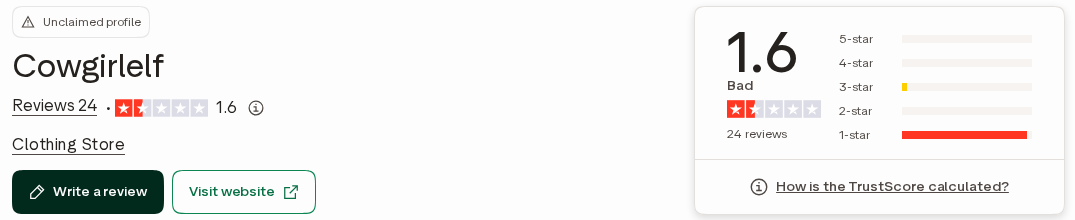
The Cowgirlelf Trustpilot profile shows 1.6/5 from 24 reviews. Customers describe incorrect clothing, disputed amounts, delivery problems, and offers to keep disappointing goods for a small credit.
Some describe tracking from outside the US after expecting a Texas purchase. A shipment’s starting point and a garment’s manufacturing origin are separate questions.
The useful warning is about what customers were promised, what they say arrived, and whether the proposed remedy actually addressed their order.
The old store is unavailable, while similar offers remain
Cowgirlelf.com is not currently a working storefront through the checked secure and plain-web routes. Do not place a new order or send another payment there.
A separate site, cowboywearco.com, uses a closely matching discount banner and COW10 code. Its current return restrictions deserve scrutiny in their own right.
- Keep Cowgirl Elf’s receipt separate from any Cowboy Wear transaction.
- Distinguish the payment amount from an advertised unit price or currency display.
- Preserve garment labels and parcel labels, which answer different questions.
- Read the sale exclusions before relying on a general refund promise.
- Ask for a complete authorized return address before buying postage.
What Cowgirl Elf Reviews Actually Describe
Read the Cowgirlelf customer profile as a collection of accounts, not a factory inspection. The problems described are still specific enough to take seriously.
In one March 2026 account, a buyer says the wrong item arrived from the UK and a purchase exceeding $100 produced a $16 credit offer.
Another describes an expected $139.60 charge becoming $167.52, an incorrect arrival, and a proposed $14 compensation after being told the requested item was unavailable.
A January account describes three shirts ordered on November 23 and received on December 29, with tracking pointing to Italy and complaints about the cut.
That customer says a proposed $10 allowance rose to $13 against a $72 purchase after an objection. The disagreement concerned the remedy, not merely transit time.
One more favorable account reports a sweatshirt arriving in early January after a late-November order. The buyer liked its appearance and material despite the wait.
A parcel in hand does not settle a wrong item, a disputed charge, or an inadequate remedy. The full transaction matters.
A partial credit may leave the shopper paying most of the price for an unwanted item. Before accepting, find out whether it settles the entire complaint.
The Texas Claim: Manufacture Is Not the Same as Dispatch
Separate three promises that shoppers often combine
A business can be based in Texas, sell clothing made elsewhere, and use another location for fulfillment. Those are different arrangements and should be described clearly.
The FTC distinguishes US manufacture, US assembly, and shipping from the US. A domestic shipping point alone does not establish domestic production.
The reverse also matters here. An overseas tracking event does not, by itself, identify the factory that made a particular shirt.
Ask which claim persuaded you: local production, a nearby business, or domestic delivery. Save the actual wording rather than replacing it with an assumption.
Keep the advertisement and the garment label together
If the advertisement influenced your order, preserve the page name, product description, and any statement about where the clothing was made.
Photograph the garment’s sewn-in labels and packaging after arrival. Record missing labels as missing, rather than supplying a country the item does not identify.
The carrier label documents dispatch or handling. The garment label may identify origin, fiber content, and care instructions. Neither should be substituted for the other.
This distinction strengthens a complaint. It lets you show a concrete mismatch without relying on a guess about the entire supply chain.
The buying decision does not require solving every factory question. An unavailable shop and documented customer difficulties are already reasons not to send it another payment.
How the Cowgirl Elf Offer and Complaint Pattern Unfolds
Step 1: The regional story supplies familiarity
A Texas-branded page and western clothing give the shopper an easy story to recognize. That familiarity can make an unknown retailer seem established.
Before treating a social page as a local boutique, look for the business accepting the order and the terms attached to the specific product.
Step 2: The discount encourages a larger clothing order
The historical COW10 offer reduced a first purchase, while the $59 threshold made another item look like a way to unlock free shipping.
That calculation concerns the journey to you. It says nothing about what returning several unsuitable pieces will cost or whether sale merchandise qualifies.
Price the basket you actually want. Adding another top can increase your exposure if the retailer later offers only store credit or a limited cash allowance.
Step 3: The confirmation becomes the important document
Save the selected garments, sizes, colors, currency, shipping amount, and final authorized total. Those details matter more than the advertisement once a billing problem arises.
If the statement differs, compare the transaction currency and any separately disclosed fees. Then ask the payment provider to explain the specific discrepancy.
Do not label every difference theft before checking the records. Equally, do not accept an unexplained increase simply because the parcel eventually arrives.
Step 4: Delivery and clothing quality become separate issues
A delayed parcel, a wrong item, and a poorly described size need different evidence. A generic message saying the purchase was disappointing can obscure the strongest point.
Use carrier tracking for the delivery question. Use photographs, measurements, and the accepted listing for the merchandise question.
If tracking shows delivery somewhere you cannot identify, request the carrier’s delivery information. Avoid publishing your address or a full tracking label in public comments.
If a garment differs from the listing, show the difference before altering, washing, or disposing of it. Keep its tags and the outer packaging.
Step 5: A small allowance may replace the return discussion
A keep-the-item offer can sound simpler than arranging an international return. But compare its amount with the purchase price and the actual problem.
Ask whether the offer is money back, credit for another purchase, or a replacement. Those outcomes do not leave you in the same position.
Keep the proposal even if you reject it. It helps explain what was offered and why the underlying delivery, billing, or merchandise issue remains unresolved.
Who Runs Cowgirl Elf, and What Connects the Similar Stores?
The available contact record is not a complete business identity
The preserved Cowgirl Elf terms image identifies support@cowgirlelf.com. It does not provide a complete company-and-return arrangement through which a customer can now obtain service.
With the storefront unavailable, start from the merchant name on your own receipt and statement. Ask the payment provider to identify the receiving merchant when necessary.
The registration dates identify domains, not a clothing factory
The current .com registry record dates cowgirlelf.com to May 7, 2025. Cowboywearco.com has a separate registration dated June 30, 2026.
Both records name Alibaba Cloud’s HiChina registrar. That identifies the registration service, not the clothing manufacturer, dispatch warehouse, or beneficial owner.
A domain remaining registered also does not mean a shop remains operational. Registration, website availability, and order fulfillment are different things.
Cowboy Wear repeats concrete storefront details
Cowboy Wear’s live banner combines free shipping over $59, 10% off a first order, and COW10. Its centered logo and surrounding navigation follow a similar arrangement.
Those visible overlaps justify comparing the offers. They do not establish a legal rebrand or prove one operator controls both domains.
Its published support address is support@cowboywearco.com. Use that contact for a Cowboy Wear order, not as an assumed replacement for Cowgirl Elf’s historical inbox.

Related western-wear reports help identify the right offer
Our earlier Cowboyelf.com report concerns another western-apparel domain. Keep that older case distinct from the Cowgirl Elf transaction on your receipt.
For a Cowboy Wear purchase, read our separate Cowboywearco.com investigation on the current seller’s own return restrictions.
Cowboy Wear’s Return Policy Is a Warning of Its Own
The current policy gives 15 days from purchase to send merchandise back. It does not start that opening period when the parcel reaches you.
That is a serious practical restriction for clothing that must travel to the customer before fit or quality can be checked.
The same document excludes sale items from refunds. Discounted products are prominently displayed on the homepage, so the exclusion is not a remote technicality.
Before relying on any refund reassurance, ask whether the exact discounted item qualifies and how the purchase-based deadline works with its delivery estimate.
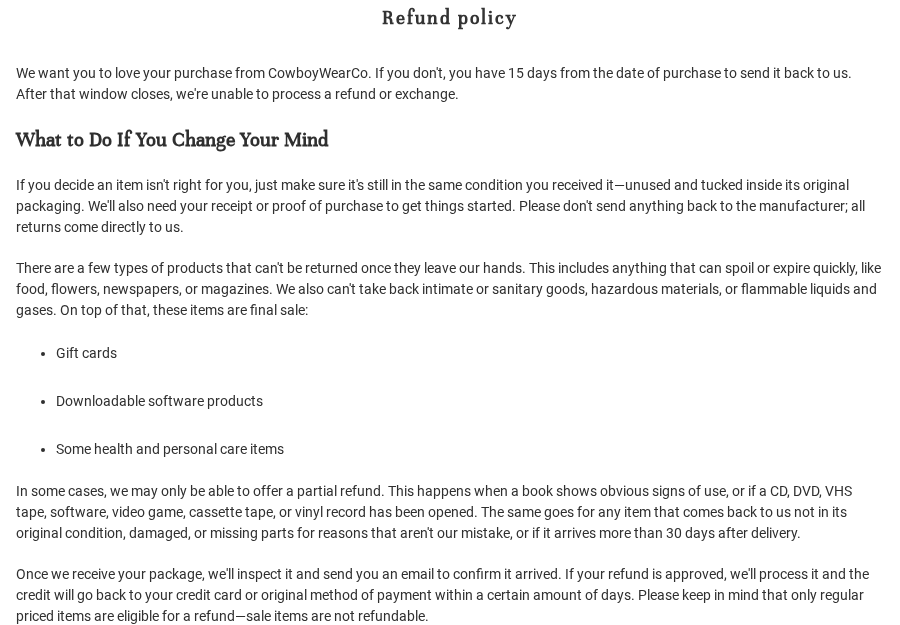
The document also contains a later reference to goods arriving back more than 30 days after delivery. That does not clearly resolve the opening 15-day condition.
A shopper should not have to guess which clock governs. Obtain an answer covering your item before placing an order, not after both periods become disputed.
For damaged or defective goods, the policy describes replacement with the same item. Its direction to send goods to CowboyWearCo supplies no complete street address.
It also assigns return postage to the buyer and describes shipping charges being deducted from a refund. Ask for the complete destination and proposed deduction.
Our Jess & Anne Boutique report addresses the same practical question: whether the discount removes the return flexibility a clothing buyer expects.
Do not buy from Cowboy Wear while relying on easy returns. Its purchase-based clock and sale exclusion make that expectation unsafe.
How to Spot Fake Western Wear Stores
Fraudulent shopping websites often share common patterns that make them easier to detect once you know what to look for. Before entering personal information or making a payment, take a few minutes to check for these warning signs:
- Unrealistic prices and discounts
If a website offers products at prices far below trusted retailers, it’s often a red flag. Many of these sites advertise luxury or high-demand products at massive discounts to create a sense of urgency. A $300 product listed for $49.99 should immediately raise suspicion. - Recently registered or suspicious domain names
Many fraudulent websites operate on newly created domains that disappear after a few weeks. Look for signs like random characters in the URL, misspellings of well-known brands, or hyphenated domains.
You can check a site’s age using tools like WHOIS lookups or ScamAdviser. - Missing or vague company details
Legitimate businesses clearly display their company name, tax information, phone numbers, physical address, and return policies. Fraudulent sites often provide incomplete, fake, or no company details at all. A lack of verifiable contact information is a major warning sign. - No reliable customer service
Real businesses provide clear ways to contact support—email, phone, live chat, or physical return addresses. Fake stores often list nonfunctional contact forms, invalid phone numbers, or reply with generic automated messages. - Poor website quality and structure
Many fake stores are set up quickly with low-effort templates. Look for poor grammar, spelling errors, low-resolution product images, broken links, or missing legal pages (Terms of Service, Privacy Policy, Return Policy). A sloppy website often signals something isn’t right. - Copied product descriptions and images
Fraudulent sites often lift product listings directly from real retailers or marketplaces. If you reverse image search a product photo and find it on multiple unrelated websites, the listing is likely not original. - Lack of credible reviews or suspicious review patterns
A real store will usually have a mix of customer reviews across different platforms. Warning signs include no reviews at all, obviously fake five-star reviews, or multiple identical reviews posted on the same day. Searching “[website name] reviews” or “[website name] scam” on Google often reveals warnings from other consumers. - Unclear or unfair return and refund policies
Fake stores often use vague language around returns and refunds—or avoid the topic entirely. If you can’t easily find clear instructions for how to return an item or get a refund, proceed with caution. - Aggressive urgency and pressure tactics
Fraudulent websites commonly use fake scarcity (e.g., “Only 2 left in stock!”) or countdown timers (“Sale ends in 10 minutes!”) to push you to buy before you think it through. Legitimate stores don’t rely on fabricated urgency to make sales.
Quick Steps to Verify a Website’s Legitimacy
Before entering payment or personal details on a new shopping website, take a few simple precautions:
- Search for the store’s name along with words like “reviews” or “complaints” on Google and Trustpilot.
- Check the website’s domain registration using Whois.com.
- Use trusted tools to scan for malicious or fraudulent links:
- Malwarebytes ScamGuard – detect scams and unsafe links before they reach you on Android and iOS phone.
- Malwarebytes Browser Guard – block dangerous or fake websites on Windows and macOS browsers.
- Verify the business address on Google Maps to ensure it’s a legitimate location.
- Review the store’s accepted payment methods – credit cards and PayPal are traceable and safer than cryptocurrency or bank transfers.
- Trust your instincts; if something feels off, it’s better not to proceed.
How to Spot Similar Scams on Social Media
Many fraudulent shopping websites rely heavily on sponsored social media ads to draw in large numbers of potential buyers. These ads often promise extraordinary discounts—sometimes up to 90% off—and use emotionally charged language to push users into buying immediately.
They frequently appear on Facebook, Instagram, and TikTok, blending in with legitimate content. However, these ads follow predictable patterns that make them easier to identify once you know what to look for.
Spotting Fraudulent Facebook Ads
Facebook’s advertising platform is a favorite tool for fake online stores because of its massive reach. These ads often feature “unbelievable” offers designed to create urgency and bypass critical thinking. Warning signs include:
- Extreme, unrealistic discounts such as “90% OFF,” “Store Closing Sale,” or “Final Liquidation.” Real retailers rarely discount new products this aggressively.
- Poor grammar, awkward phrasing, or inconsistent language throughout the ad or website, indicating low-effort, mass-produced content.
- Generic stock photos or images with watermarks, suggesting the images were taken from legitimate brands or stolen from other sources.
- Recently created Facebook Pages, which is common for temporary fraudulent campaigns. Check the “Page Transparency” section to see when the page was created.
- Limited or no engagement from real customers. Authentic brands usually have reviews, comments, and visible user interaction.
If an ad raises doubts, search for reviews of the website or reverse image search the product photos to see if they’re copied from elsewhere. Never provide payment information until the site is verified.
Spotting Fraudulent Instagram Ads
Instagram is another major platform used to promote fake shopping sites through eye-catching visuals and short-lived “flash sale” captions. Warning signs to look for:
- New or disposable accounts with few posts and followers, often created just weeks or days before launching ads.
- Lack of tagged users in product posts. Legitimate stores often feature real customers, influencers, or product usage.
- Unsecured checkout pages. If the website linked in the bio does not use HTTPS, do not enter payment information.
- Fake or missing customer reviews. Fraudulent stores rarely have authentic purchase feedback.
- Unclear or restrictive return policies, often hidden or written vaguely to make refunds difficult.
When in doubt, search for independent reviews before buying, and only enter payment details on verified, secure websites.
Catching Fake TikTok Ads
TikTok is increasingly used to promote questionable shopping deals through short, persuasive videos. While many ads look polished, the same red flags apply:
- Links to unknown stores that don’t appear in search results or have no external reputation. Many of these sites are temporary and disappear after a short time.
- No verification badge on the TikTok account. While not every legitimate store is verified, the lack of a badge is one more indicator to check further.
- Aggressive countdown timers or “one-day only” promotions designed to rush decision-making.
- Lack of genuine customer reviews or real user content demonstrating the product in actual use.
- Comment sections filled with complaints or warnings from other users. This is often the first place victims speak up.
TikTok scams often rely on impulse buying. Take a moment to verify the website, read independent reviews, and use trusted browser protection before visiting external links.
What to Do If You Ordered From Cowgirl Elf
Identify the exact transaction before contacting anyone. Keep the order confirmation, merchant descriptor, payment date, transaction currency, and the final amount you authorized.
If the statement is higher, request an explanation of that difference. A wrong-item complaint and an unexplained charge need distinct supporting details.
Match delivery evidence to the carrier. Check tracking through the carrier’s official service and retain the result, including any failed delivery or customs information.
If a parcel arrived, photograph its label before discarding the packaging. Ask about a disputed delivery location without posting your home address publicly.
Show the specific merchandise problem. Photograph the garment, sewn-in labels, size, and relevant measurements beside the description accepted when you bought it.
Explain an incorrect item or material mismatch precisely. Keep the condition unchanged while seeking instructions, rather than destroying the evidence to demonstrate disappointment.
Get the remedy and return destination in writing. Ask whether the proposal is a cash refund, store credit, replacement, or a payment for keeping the item.
Before mailing, obtain a full authorized address, deadline, postage arrangement, and expected reimbursement. Do not guess that another western retailer will accept the parcel.
Take an unresolved payment issue to the provider. Use the issuer’s official app or the payment account on your receipt. Supply the timeline and actual disputed obligation.
Ask which deadlines and evidence requirements still apply, especially for older orders. A merchant’s continuing emails do not necessarily preserve a payment dispute window.
Report misleading conduct through the appropriate official route. US consumers can submit the domain, advertised origin claim, order records, and correspondence through FTC ReportFraud.
Reporting supports enforcement information, not an automatic refund. Reject any stranger’s demand for a new payment, access code, or remote connection to release your supposed reimbursement.
Frequently Asked Questions
Is Cowgirl Elf legit or a store to avoid?
Do not order through the unavailable Cowgirl Elf storefront. Customer accounts describe serious merchandise and refund problems; a delivery alone would not resolve those concerns.
Is Cowgirl Elf clothing made in Texas?
The promotional page uses that claim, but the available material does not establish the origin of every garment. Compare the exact advertisement with the item’s labels.
Where do Cowgirl Elf orders ship from?
Customers report overseas tracking, including Europe and Hong Kong. That documents their reported delivery experience, not one verified dispatch arrangement for every order.
Are Cowgirl Elf and Cowboy Wear the same company?
Shared discount details, layout, and registrar are established. Shared ownership is not. Keep their receipts, support addresses, and policies separate when seeking help.
Can sale clothing be returned to Cowboy Wear?
Its current policy excludes sale-item refunds and opens with a 15-day purchase-based deadline. Ask how those restrictions apply before relying on a return.
Can I still pursue an old Cowgirl Elf refund?
Ask the actual payment provider which procedure and deadline remain available for your transaction. An unavailable website does not itself guarantee reimbursement or reopen expired deadlines.
The Bottom Line
Do not send another payment to Cowgirl Elf. Its unavailable storefront and specific customer complaints make this a poor place to trust with a clothing order.
If you already paid, document the actual mismatch and pursue the appropriate merchant or payment-provider route. Treat Cowboy Wear separately, with its own restrictive refund terms.
This article is for informational purposes only and should not be relied upon for financial or business decisions. We identify potential scams using research, user experiences, and expert analysis. However, all claims should be independently verified. Mistakes may occur, and legitimate products could be flagged. We strive for accuracy but make no warranties regarding the completeness or reliability of the information.

If you are the owner of the website or product in question and wish to offer clarifications regarding your business or website, please reach out to us via our Contact form.

Join the discussion
0 commentsShare your experience or ask a question about this article.
Discussion
Start the conversation
Have a question or something useful to share? Add the first comment.