

A serum promising less unwanted hair can sound wonderfully simple. CyperGlow places that promise beside a glossy bottle, glowing reviews, and a long money-back window.
The important questions come later, when you choose a package and consider what happens if the serum does not work for you.
Overview
The verdict: the trial promise does not match the written return rule
CyperGlow sells a cosmetic serum positioned as a way to slow unwanted hair growth. Its product page presents a 365-day money-back guarantee.
But the published refund policy generally accepts only products in original, unopened packaging. Opened or used products are excluded unless defective.
That is a serious limitation for a product whose claimed benefit requires repeated use. A year-long deadline offers little comfort if testing the serum removes ordinary return eligibility.
We would not treat the prominent guarantee as a risk-free trial. Ask for written confirmation about opened bottles before paying, especially for a multi-bottle order.
The order page has a meaningful subscription choice
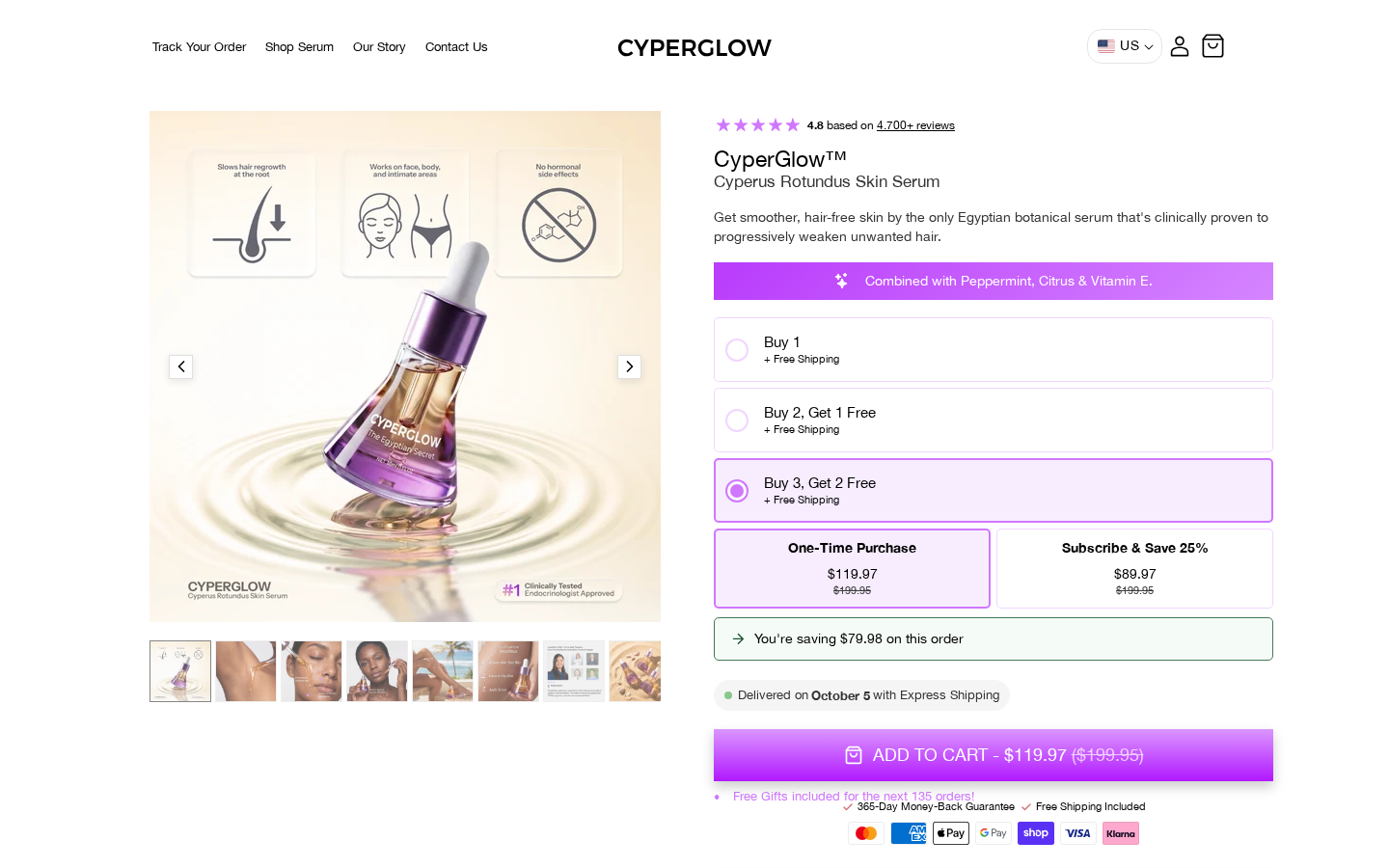
At review time, the page displayed three package choices. The largest, “Buy 3, Get 2 Free,” was selected in our captured view.
The panel offered a one-time price of $119.97 or a lower $89.97 “Subscribe & Save 25%” price. These were distinct options, not evidence that every buyer subscribes.
CyperGlow’s subscription policy authorizes repeat charges at the selected frequency and automatic renewal until cancellation.
A shopper who sees the lower price and overlooks the recurring selection could face later shipments. The correct question is what the checkout actually records.
Customer feedback adds urgency to those checks
Public Trustpilot feedback includes complaints about recurring charges, missing deliveries, cancellation problems, and slow responses, alongside customers who liked the product.
Reviews are individual reports, not proof that every order follows the same path. The written policy and captured package panel independently establish the buyer risks.
Before ordering, check these five points:
- Whether the cart contains one bottle or the selected multi-bottle bundle.
- Whether the price is one-time or tied to automatic refills.
- When the next charge would occur and how to stop it.
- Whether an opened bottle can actually be returned for dissatisfaction.
- Which company, address, and payment descriptor will appear after checkout.
Why the 365-Day Guarantee Needs a Closer Reading
The product page tells shoppers they can seek a full refund if they are not satisfied within the first 365 days.
That sounds like permission to try the serum for months, assess the result, and return it if the promised improvement never appears.
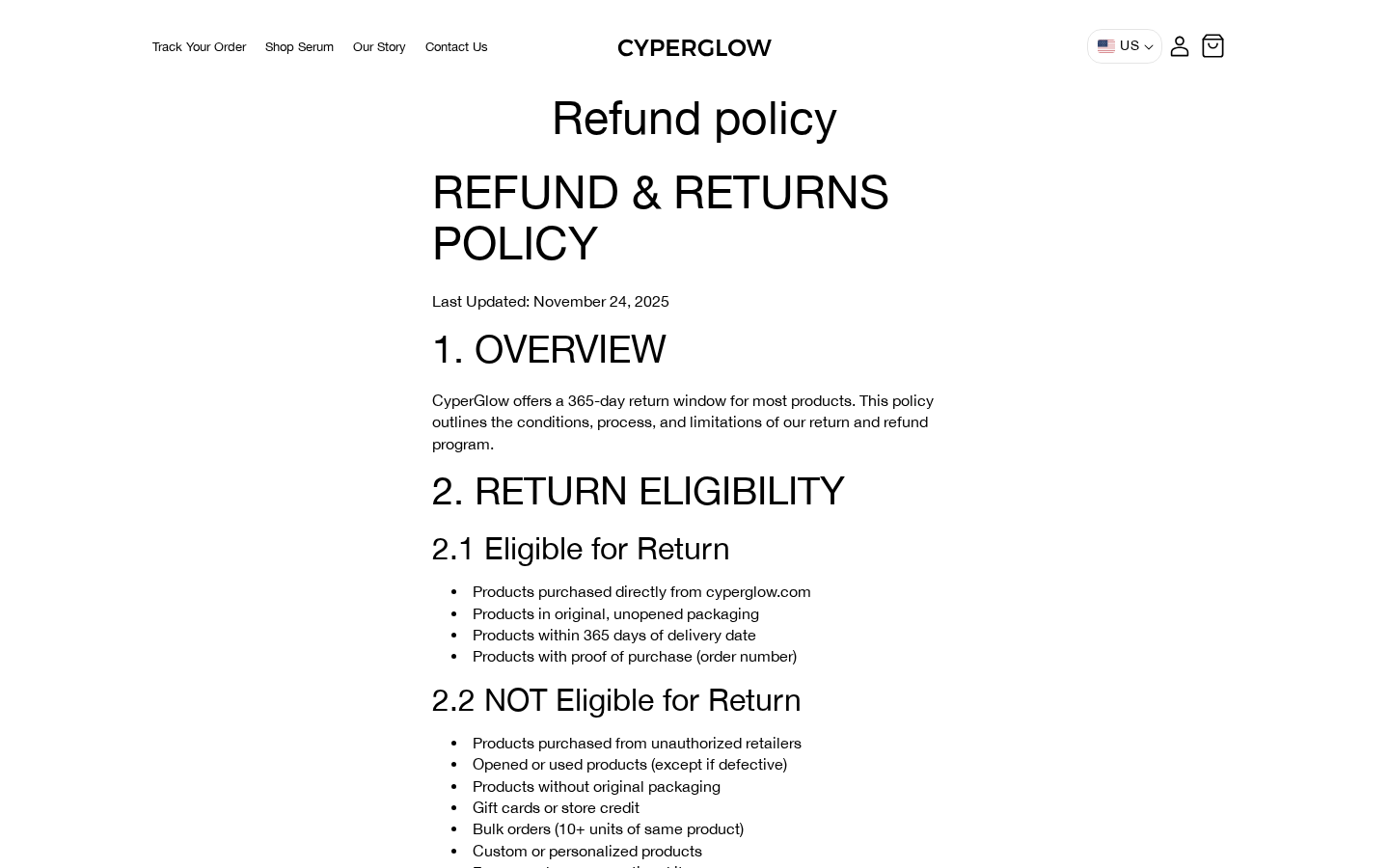
The formal policy tells a narrower story. It lists unopened packaging among eligibility requirements and explicitly excludes opened or used goods, except defective products.
A cosmetic serum is not like a jacket that can be examined with its tags attached. The buyer must open it to test skin tolerance and performance.
That practical conflict sits at the heart of this CyperGlow review. The long window is not the same as a usable satisfaction guarantee.
The policy also says buyers ordinarily pay return shipping, original shipping is not refunded, and deductions may include restocking or processing fees.
It does not specify one fixed amount for every possible deduction. Ask support for an exact calculation before spending money to mail a return.
For damage or defects, the rules differ. The page asks buyers to report problems within 48 hours and says the seller covers return shipping.
That is not the same as disappointment with results after weeks of use. Describe your situation accurately when requesting help.
One product page says shoppers can send back unopened bottles if they are unsatisfied. That may help a bundle buyer, but it still limits recovery after use.
If you ordered five bottles and used one, ask whether the four sealed bottles qualify individually. Obtain the refund amount in writing.
Do not assume a partial refund will equal the displayed per-bottle price. Promotional bundle math can change how a seller values each unopened item.
We did not submit a test return or receive a binding interpretation from CyperGlow. The written contradiction is enough to reject any claim of an uncomplicated trial.
How the CyperGlow Sales Journey Works
Step 1: A personal frustration opens the pitch
Unwanted hair can be expensive and tedious to manage. A serum promising gradual reduction speaks to people tired of shaving, waxing, or irritation.
CyperGlow calls its formula clinically proven on the product page. The screenshot also places endorsements and review figures close to the buying controls.
Those are marketing claims. A buyer should request the actual trial, formulation tested, sample size, outcome measure, and relevance to the current bottle.
A study of an ingredient, if one exists, would not automatically prove the finished product performs as advertised for every user.
The site itself says results vary. That qualification matters more than a dramatic before-and-after photograph when deciding whether to commit to several bottles.
Step 2: A bundle makes the initial order larger
The captured product page offered “Buy 1,” “Buy 2, Get 1 Free,” and “Buy 3, Get 2 Free.” The five-bottle option was selected.
A selected bundle is not an unauthorized charge. It is still easy to miss on a busy phone screen while focusing on a headline price.
Read the quantity line, the number of parcels expected, and the total charge immediately above the final payment button.
If you only want to test one bottle, manually select the one-bottle option and verify the total again after any page refresh.
Do not calculate value from the claimed free bottles alone. Compare the real total against comparable cosmetic products with clearer return terms.
Step 3: The lower price can become a recurring commitment
The same captured panel presented “One-Time Purchase” and “Subscribe & Save 25%.” For the selected bundle, the subscription price was lower.
The subscription terms say recurring charges can be weekly, monthly, or quarterly, depending on the plan selected.
They also say subscriptions renew automatically until canceled. Cancellations take effect for the next billing cycle, not a cycle already charged.
That means a shopper can cancel correctly and still owe for an order already processed. Check the next billing date, not just the cancellation button.
Save a screenshot of the final checkout choice. If a later receipt says “subscription” despite a one-time selection, that screenshot is important evidence.
We did not verify a hidden prechecked subscription in every checkout. The documented risk is the side-by-side recurring option and its financial consequences.
Step 4: Delivery and actual use test the promise
Once an order arrives, photograph the shipping label, seal, quantity, and expiration information before opening anything.
Compare the bottle label with the online description. Note ingredient concentrations, warnings, lot information, and the name of the responsible company.
Patch-test a cosmetic product according to its instructions. Stop using it if significant irritation occurs, and seek professional advice for persistent reactions.
Do not confuse a cosmetic claim about hair appearance with medical treatment. Sudden or unusual hair growth can have causes a serum cannot address.
Keep unopened bundle bottles sealed while evaluating the first. Under the current written return policy, that distinction may control eligibility.
Step 5: A refund request exposes the gap
If the serum disappoints, the broad 365-day promise may send you to support expecting a full refund.
The formal policy gives support a basis to reject an opened bottle. It asks for contact first and supplies a return address only after instructions.
Ask support to cite the exact clause governing your order and to reconcile it with the product page’s satisfaction language.
Request a breakdown for every sealed bottle, the original shipping charge, return postage, and any proposed deduction.
Do not send items to an address found on a package without written authorization. A warehouse label may not be the approved returns destination.
Step 6: A future charge may arrive before the dispute is resolved
People sometimes focus entirely on the first refund and forget the next scheduled subscription payment.
Check the account dashboard and confirmation email immediately. Cancel an unwanted plan through the stated route and keep proof of cancellation.
Watch the card statement for the merchant descriptor and amount. A different processing name does not automatically prove fraud, but it can complicate recognition.
If support does not resolve a documented unauthorized or wrongly described charge, contact the card issuer before its dispute deadline.
Do not wait for a package to arrive if the next billing date is imminent. Treat cancellation and refund as separate tasks.
The Product Claim Is Not the Same as Proof
CyperGlow uses the phrase “clinically proven” for gradual weakening of unwanted hair. A consumer needs more than that phrase to evaluate efficacy.
Ask whether the evidence involves Cyperus rotundus alone or the exact formula sold now. Concentration, formulation, and how often it was applied all matter.
Look for a published protocol, comparison group, objective hair-count method, and results that include people with different skin and hair types.
Without those details, a testimonial cannot tell you how likely your own result is. Hair growth changes naturally and can vary with hormones and treatments.
The product page shows thousands of reviews. We did not independently audit the store-hosted reviews or verify that they all concern the current formulation.
External feedback is mixed. Some buyers report satisfaction, while others describe little effect, delivery trouble, or billing frustration.
Neither group proves a universal outcome. For a buyer, the more reliable decision point is whether the cost and return rules remain acceptable if the product fails.
A large bottle bundle raises that downside. A low-confidence product trial should not require committing to months of inventory.
Company, Address, and Fulfillment Checks
A brand name does not identify the legal merchant
CyperGlow is the name on the bottle and website. Before paying, identify the legal entity taking the payment and handling a dispute.
Check the terms, receipt, statement descriptor, shipping label, and any subscription confirmation. Those names should form a coherent trail.
If they do not, ask support which company is responsible for product safety, delivery, and refunds. Record the answer.
A return address is not automatically headquarters
The refund page says CyperGlow sends return instructions after contact. It does not give a universal destination for every parcel.
Do not treat a warehouse, forwarding facility, or parcel label as proof of where the company is managed or where the serum is made.
Ask for the approved destination before opening sealed bottles you may need to return. Calculate tracked postage against the expected refund.
Support must answer the difficult question
Email support@cyperglow.com before purchasing and ask one direct question: can you obtain a refund for a bottle after using it as instructed?
Follow with the five-bottle example. Ask whether each unopened bottle has a refundable value and whether a subscription can be stopped before shipment.
A useful answer cites terms and amounts. A generic “365-day guarantee” repeated without addressing opened products does not settle the issue.
Public reviews allege slow or frustrating support in some cases. That is not proof your request will fail, but it makes advance written clarity valuable.
The formula needs traceable safety information
Check the full ingredient label, manufacturer or responsible importer, batch number, expiration date, and clear directions before applying anything to skin.
Country of origin alone would not decide safety. Ingredient disclosure, manufacturing controls, and a way to identify a faulty batch are more useful.
If you have eczema, allergies, broken skin, or take a treatment affecting skin sensitivity, ask a qualified clinician before use.
We have not established contamination or undisclosed ingredients in CyperGlow. The point is to verify the actual product, not to invent a hazard.
What to Do If You Ordered CyperGlow
- Confirm the order type immediately. Open the receipt and account page. Record bottle count, total charge, selected one-time or subscription option, renewal interval, and next billing date.
- Cancel an unwanted subscription now. Use the management dashboard or email support@cyperglow.com. Request written confirmation and save the page or email showing the effective cancellation date.
- Document what arrived. Photograph the package, bottles, seals, lot details, and shipping label. Keep unopened units sealed while you decide whether the first bottle is worth trying.
- Ask for the exact refund calculation. Cite the 365-day product-page promise and the unopened-product restriction. Request the amount available for each item and the approved returns address.
- Challenge an incorrect charge promptly. If a charge does not match your saved checkout choice or continues after confirmed cancellation, give the issuer your receipt, screenshots, and support correspondence.
- Address a skin reaction separately. Stop applying the serum, keep its label and batch details, and seek medical advice if irritation is significant or persistent. Do not rely on a refund conversation for health guidance.
- Watch for follow-on billing. Review the next statements even after a refund request. A current-order refund and future subscription cancellation are different protections.
There is no reason to panic if you have already bought it. A dated record and an early written request give you a clearer route to a remedy.
Frequently Asked Questions
Is CyperGlow a confirmed scam?
We found a real product page and published terms, not proof that every sale is fraudulent. The contradiction between the satisfaction pitch and unopened-only returns is concrete.
Can I return a used CyperGlow bottle?
The written policy generally excludes opened or used goods except defective items. Ask support to explain any exception before relying on the 365-day guarantee.
Does every CyperGlow order start a subscription?
No. The reviewed page offered both one-time and recurring choices. Your final checkout and receipt determine what you authorized.
How many bottles were selected in the reviewed screenshot?
The “Buy 3, Get 2 Free” package was selected, representing five bottles. Other choices were available, and a buyer can select a different option.
Is the serum clinically proven to stop hair growth?
The seller makes a clinical-evidence claim. We did not independently verify a trial of the exact current formula establishing that outcome for every user.
What if CyperGlow charges me after I cancel?
Save the cancellation proof and charge details. Ask support to reverse the charge, then contact your card issuer if the answer or timing is unsatisfactory.
The Bottom Line
CyperGlow’s attractive price and 365-day language obscure the practical question: can you use the serum and still return it if it fails?
The written policy says generally no. Do not choose a five-bottle bundle or recurring plan until CyperGlow resolves that contradiction in writing.

Join the discussion
0 commentsShare your experience or ask a question about this article.
Discussion
Start the conversation
Have a question or something useful to share? Add the first comment.