

A DHL message says a courier tried to reach your address. The parcel can supposedly continue after one quick confirmation.
The label number and yellow button make the notice feel useful. Before responding, compare that small story with a real delivery record.
Overview
The email announces a delivery that may never have existed
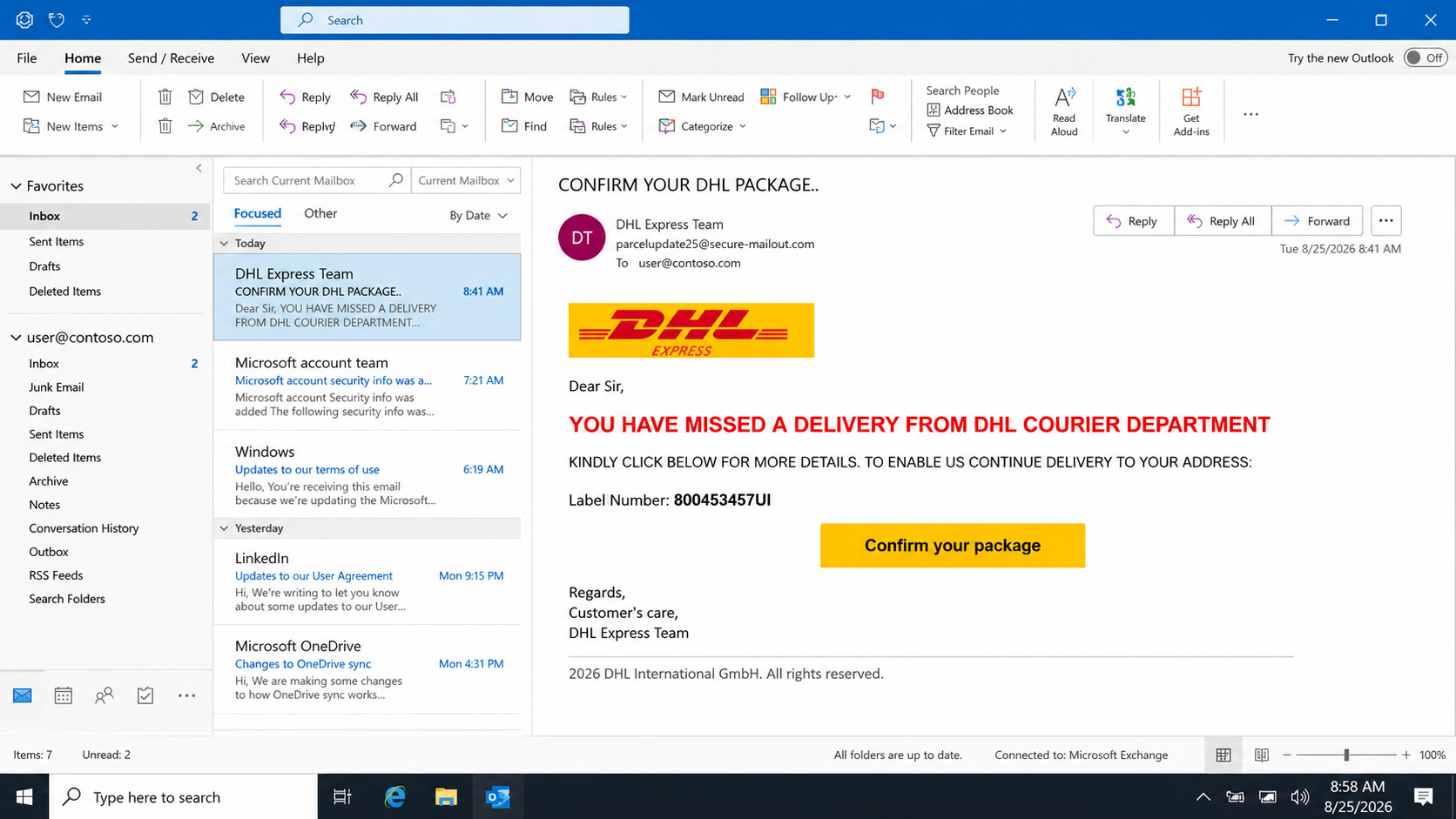
The DHL Missed Delivery email scam claims the DHL Courier Department could not complete a package delivery.
An observed message used the subject “CONFIRM YOUR DHL PACKAGE..” and addressed the recipient only as “Dear Sir.”
It displayed label number 800453457UI, then asked the recipient to confirm the package so delivery could continue.
A tracking-like code creates specificity, but the message provides no sender, shipment origin, destination, delivery date, or authentic tracking history.
DHL International GmbH is not connected with the campaign. Criminals copied its name, colors, and delivery language.
The confirmation link leaves DHL completely
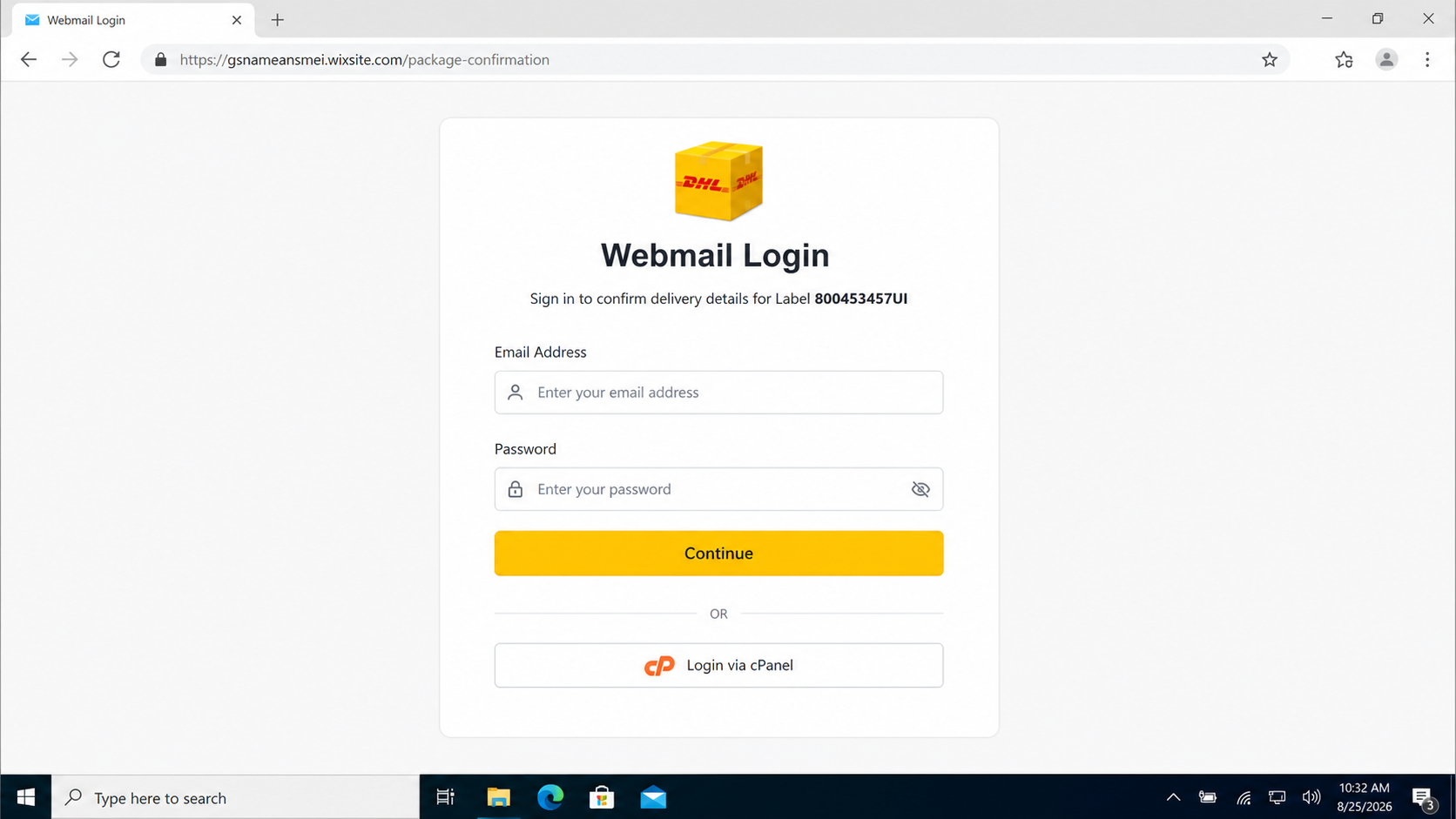
The yellow button does not open a verified DHL property. It leads to a page under gsnameansmei.wixsite.com.
Wix is a legitimate website-building platform. A user-created page on its service does not become a DHL page.
The decisive domain is wixsite.com, not the DHL name or package artwork placed inside the page.
Hosting platforms can remove reported abuse, but operators frequently create replacement pages or move the same lure elsewhere.
Always evaluate the current destination. A safe-looking button label reveals nothing about the link hidden beneath it.
The package page asks for webmail credentials
The destination displays a generic Webmail login with fields for an email address and password.
It also offers a cPanel login option, despite the original story concerning courier delivery.
DHL does not need a recipient’s mailbox password to locate, reschedule, or confirm a package.
Anything submitted can be captured by the page operator and tested against the victim’s real email provider.
The campaign’s most useful warning signs are:
- The recipient is not identified by name.
- No expected shipper or real purchase connects the person with the package.
- The label number cannot be confirmed independently.
- The button points to a wixsite.com address rather than DHL.
- A courier confirmation unexpectedly demands an email password.
- The page mixes DHL imagery with Webmail and cPanel authentication.
- The message provides urgency but almost no verifiable shipment context.
Opening the message does not give criminals the password. A click alone usually leaves the mailbox credential undisclosed.
The central compromise happens when the form is completed. Any unexpected download should be assessed separately as a possible device threat.
Why a Random Label Number Can Feel Like Evidence
Tracking systems train customers to expect long combinations of letters and digits.
When an email includes such a code, the reader may treat its presence as proof that a database generated the notice.
In reality, a scammer can type any sequence into a template. The number has meaning only when an independent carrier system recognizes it.
The safest test is simple. Open DHL’s known website manually and enter the code there, without using the email button.
A nonexistent result does not always prove fraud because new labels can take time to activate.
It does mean the recipient should contact the sender or carrier through separately obtained information before sharing anything.
Expected parcels provide another anchor. Check retailer accounts, order confirmations, and messages from people who may have shipped something.
If nobody can identify the parcel, the label number is decoration rather than a reason to surrender account access.
How The Scam Works
Step 1: A mass campaign relies on ordinary delivery coincidences
Large numbers of people are awaiting online orders, replacement cards, workplace shipments, gifts, or returns on any given day.
Attackers do not need to know which recipient expects DHL. Random timing supplies enough convincing matches.
Email lists may come from breached databases, public contact pages, marketing records, or previous phishing operations.
A business address can be especially responsive because receiving departments handle packages from unfamiliar senders.
The message only needs a fraction of recipients to connect it with something already on their minds.
Step 2: DHL branding turns uncertainty into a familiar task
Yellow and red graphics, an Express Team signature, and courier vocabulary resemble common shipping notifications.
Brand elements are images and text. Their presence does not demonstrate that the company sent the email.
The generic greeting suggests the campaign lacks reliable customer details.
Awkward phrases such as “Customer’s care” and unnecessary capitalization also weaken the professional appearance.
Those clues matter, but polished language would not make an unofficial sender trustworthy.
Step 3: The label number supplies false precision
Number 800453457UI gives the recipient something that resembles an internal shipment reference.
The message does not provide a matching order, sender, destination city, parcel weight, or attempted-delivery time.
Real tracking details form a coherent record. One isolated code cannot replace that record.
Recipients who are curious may press the button simply to discover what the package contains.
That information gap is deliberate. Curiosity becomes the engine that moves the user toward the phishing page.
Step 4: “Confirm your package” disguises the domain transition
The button describes an action instead of showing the website that will perform it.
Hovering over the button on a computer can reveal the real destination before opening it.
On many phones, pressing and holding the link displays a preview where the domain can be read.
The observed address used gsnameansmei.wixsite.com, which has no valid role in DHL account or parcel management.
HTTPS merely encrypts the connection to that Wix-hosted page. It does not certify the page as a carrier service.
Step 5: The page changes a parcel question into an email login
Instead of showing tracking events, the landing page asks for an email address and password.
Generic Webmail wording lets the same form target users of many different providers.
The cPanel option broadens that reach further toward custom business domains and hosted mailboxes.
The package reference helps preserve continuity, but the requested credential remains unrelated to delivery.
A legitimate carrier may request an account login on its own domain. It will never need the password for another company’s email service.
Step 6: The stolen password is tested against the real provider
After submission, the page may show an error, reset the form, or redirect to unrelated content.
The victim may assume the package link malfunctioned while the operator begins testing the captured credential.
Successful mailbox access reveals contact lists, receipts, identity records, invoices, and password reset messages.
A repeated password creates additional exposure across shopping accounts, cloud platforms, banking portals, and workplace tools.
Even unsuccessful access attempts can trigger more targeted lures using the confirmed email address.
Step 7: Inbox control produces more believable fraud
An intruder can send messages from the genuine account, making later delivery or invoice scams harder for contacts to reject.
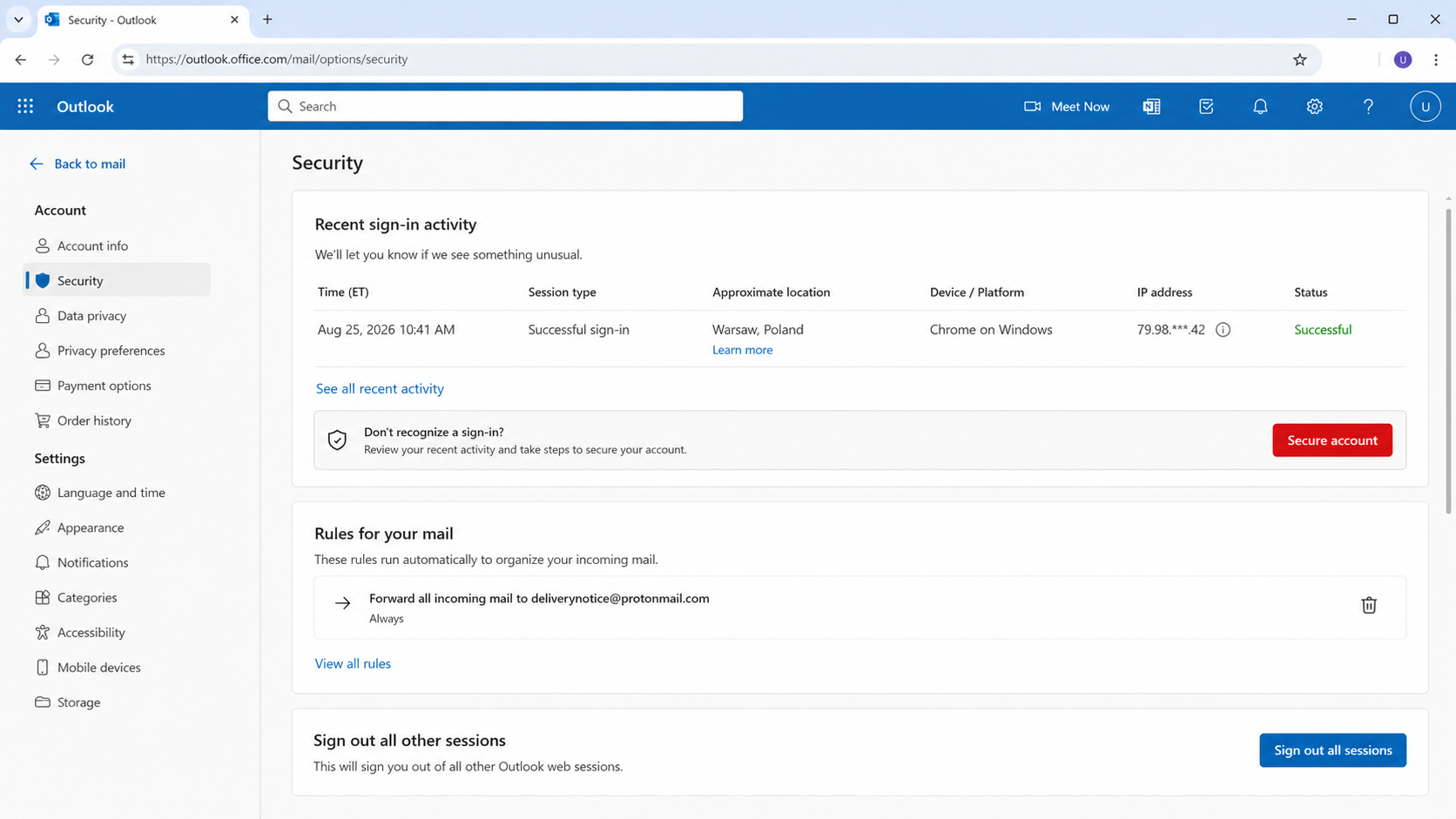
They may create forwarding rules, add recovery methods, or register application passwords before the owner notices.
Business correspondence can reveal suppliers and payment schedules useful for bank-detail substitution.
Personal inboxes expose retailers and services where password recovery begins with an emailed link.
The fake package therefore threatens much more than one delivery. It can turn the victim’s own mailbox into criminal infrastructure.
What a Legitimate Missed-Delivery Notice Should Let You Verify
A real notice should connect with a shipment record that exists independently of the email.
The tracking number should work on the carrier’s official site or application after any normal activation delay.
Order records should identify the retailer or sender. Business shipments should match purchasing, receiving, or vendor documentation.
Tracking history commonly shows when the parcel entered the network, which facilities handled it, and when delivery was attempted.
Available details vary by service and privacy rules, so one missing field does not automatically prove deception.
The important point is consistency. Information from the carrier, seller, and recipient’s own records should describe the same shipment.
Households can ask whether another resident placed an order. Businesses can compare the claim with reception logs and purchase records.
These checks create context that a random label and borrowed logo cannot manufacture.
The destination should remain within a recognized carrier environment, even when a documented delivery partner handles the final stage.
Account authentication belongs to the carrier’s domain. Mailbox, banking, or social-media passwords have no place in parcel confirmation.
Legitimate support should be reachable using telephone numbers and help pages found outside the notice.
A genuine issue survives independent checking. A phishing story collapses when the recipient refuses its button and chosen contact route.
That difference matters more than perfect spelling, impressive logos, or whether the page shows a padlock.
Sender, Label, Domain, and Mailbox Checks
Expand the complete sender information
Ignore the display name until the actual From and Reply-To addresses are visible.
Compare their domains with official DHL communications connected to genuine orders.
Free mailboxes, unrelated businesses, recently invented carrier domains, and mismatched replies require independent confirmation.
Technical authentication results can assist administrators, but a matching logo or friendly name never authenticates the sender.
Reconstruct the parcel without touching the link
Check retailer accounts, payment receipts, shipping confirmations, household orders, and workplace receiving records.
Enter the label on the official DHL website reached through a fresh browser tab.
Ask the expected sender which carrier and tracking number they used.
If the supposed parcel exists only inside one unsolicited message, do not treat its label as evidence.
Read the registrable domain in the browser
Focus on the portion that identifies the website owner, not brand words placed in page text or subdomains.
Gsnameansmei.wixsite.com is a Wix-hosted page, not DHL infrastructure.
Legitimate platforms can be abused by individual users, so their general reputation does not certify every page they host.
Report fraudulent platform pages, but remember that the hosting company is not necessarily the scam operator.
Treat mailbox settings as part of recovery
After credential exposure, review sign-in history, active sessions, forwarding, inbox rules, recovery contacts, delegated access, and connected applications.
Changing the password may not remove access already preserved through a session or application token.
Check Sent, Trash, and Archive for conversations or deletions you do not recognize.
Tell financial staff to verify recent account-change requests if a workplace mailbox was involved.
What to Do if You Have Fallen Victim to This Scam
- Close the fraudulent page. Do not retry the form, use its cPanel option, or download anything offered after a failed login.
- Change the mailbox password. Use a trusted device and open the provider’s established website or application independently.
- End unauthorized access. Sign out other sessions and remove strange devices, recovery contacts, application passwords, rules, and forwarding destinations.
- Update every reused login. Replace the exposed password on shopping, financial, social, cloud, and workplace accounts where it appears.
- Strengthen authentication. Add an authenticator code or security key, save recovery codes safely, and refuse unexpected approval prompts.
- Check real deliveries. Confirm outstanding parcels through retailer records and the official carrier site in case the lure coincided with a genuine order.
- Alert affected people. Warn colleagues, customers, and personal contacts if messages may have been sent from the compromised inbox.
- Run a device scan. Use Malwarebytes if files downloaded, browser behavior changed, or the page triggered unfamiliar software prompts.
- Block dangerous destinations. AdGuard can prevent many known phishing and redirect pages, but account recovery remains necessary after password disclosure.
- Report the campaign. Mark the email as phishing and submit the Wix page and impersonation details through appropriate reporting channels.
Is Your Device Infected? Run a Free Malware Scan
Slow performance, constant pop-ups, or strange behavior? These are classic signs of a malware infection. The fastest way to find out is to scan your device with Malwarebytes Free — one of the most trusted malware removal tools available.
The free version detects and removes the most common threats, including:
- Adware — the cause of those annoying pop-ups
- Browser hijackers — unwanted redirects and changed homepages
- Trojans and spyware — hidden programs stealing your data
- Potentially unwanted programs (PUPs) — software you never asked for
👉 Select your device below — Windows, Mac, or Android — then follow the simple steps to download Malwarebytes, scan your system, and remove any threats it finds. The scan usually takes 5 to 20 minutes.
Run a Malware Scan with Malwarebytes for Windows
Malwarebytes is one of the most popular and trusted anti-malware tools for Windows — and it’s completely free for removing infections. It catches threats that many antivirus programs miss, including adware, browser hijackers, and trojans. Follow the steps below to scan and clean your PC in just a few minutes.
Download Malwarebytes
Click the button below to download the latest version of Malwarebytes for Windows from the official source. The free version is all you need — it will scan your computer and remove adware, browser hijackers, and other malicious software at no cost.
Download MalwarebytesOfficial installer for Windows 11 and 10. Your download starts right away.Want real-time protection? See Malwarebytes Premium Malwarebytes Free for WindowsScans and removes malware at no cost
-
Install Malwarebytes
When the download finishes, open your Downloads folder and double-click the MBSetup file. If Windows shows a User Account Control pop-up, click “Yes” to allow the installation.

Follow the On-Screen Prompts to Install Malwarebytes
The setup wizard will walk you through a few quick screens:
-
Choose where you’re installing the program — “Personal Computer” or “Work Computer” — then click Next.

-
Malwarebytes will now install on your device. This usually takes under a minute.

-
When installation is complete, the “Welcome to Malwarebytes” screen will open automatically.

-
On the final screen, click Open Malwarebytes to launch the program.

-
Enable “Scan for Rootkits”
Before scanning, turn on rootkit detection so Malwarebytes can find even the most hidden threats. Click the Settings gear icon on the left side of the screen.

In the settings menu, find “Scan for rootkits” and click the toggle so it turns blue.

Done? Click “Dashboard” in the left pane to return to the main screen.
Start the Scan
Click the blue Scan button. Malwarebytes will automatically update its virus database and start checking your computer for malware.

-
Wait for the Scan to Finish
The scan checks your entire system for browser hijackers and other malicious programs, so it can take 5 to 20 minutes depending on your computer. Feel free to do something else — just check back occasionally to see the progress.

-
Quarantine the Detected Threats
When the scan is done, you’ll see a list of everything Malwarebytes found — malware, adware, and potentially unwanted programs. Click the “Quarantine” button to remove all of them at once.

Malwarebytes will now remove the malicious files and registry entries and move them safely into quarantine.

-
Restart Your Computer
Some threats can only be fully removed after a reboot. If Malwarebytes asks you to restart, click Yes. Once you’re logged back in, Malwarebytes has finished removing the threats it found.

That’s it — your Windows PC is now clean of trojans, adware, and other malware, and should be back to running smoothly.
If you are still having problems with your computer after completing these instructions, then please follow one of the steps:
- Run a computer scan with ESET Online Scanner
- Ask for help in our Windows Malware Removal Help & Support forum.
Run a Malware Scan with Malwarebytes for Mac
Malwarebytes for Mac is a free on-demand scanner that removes the malware other security software tends to miss — adware, browser hijackers, and unwanted programs included. Cleaning an infected Mac with Malwarebytes has always been completely free, and it’s our go-to recommendation. Follow the steps below to scan and clean your Mac in just a few minutes.
-
Download Malwarebytes for Mac
Click the button below to download the latest version of Malwarebytes for Mac.
Download MalwarebytesOfficial installer for macOS. Your download starts right away.Want real-time protection? See Malwarebytes PremiumMalwarebytes Free for MacScans and removes malware at no cost -
Open the Malwarebytes setup file
When the download finishes, open your Downloads folder and double-click the setup file to begin the installation.

-
Follow the On-Screen Prompts to Install Malwarebytes
The Malwarebytes for Mac Installer will guide you through a few quick screens. Click “Continue” and keep following the prompts until the installation completes.



When the installation is complete, Malwarebytes opens to the Welcome to Malwarebytes screen. Click “Get started“.
-
Select “Personal Computer” or “Work Computer”
Malwarebytes will ask what type of computer you’re installing it on. Click either Personal Computer or Work Computer, whichever applies.

-
Start the Scan
Click the “Scan” button. Malwarebytes will automatically update its detection database and begin checking your Mac for malware.

-
Wait for the Scan to Finish
Malwarebytes will scan your Mac for adware, browser hijackers, and other malicious programs. This can take a few minutes, so feel free to do something else — just check back occasionally to see the progress.

-
Quarantine the Detected Threats
When the scan is done, you’ll see a list of everything Malwarebytes found. Click the “Quarantine” button to remove all the threats at once.

-
Restart Your Mac
Malwarebytes will now remove all the malicious files it found. Some threats can only be fully removed after a reboot — if Malwarebytes asks you to restart, allow it. Once you’re logged back in, your Mac is clean.

That’s it — your Mac is now free of adware, rogue browser extensions, and other potentially harmful software.
If you are still experiencing problems while trying to remove a malicious program from your computer, please ask for help in our Mac Malware Removal Help & Support forum.
Run a Malware Scan with Malwarebytes for Android
Malwarebytes for Android automatically detects and removes dangerous threats like malware and ransomware so you don’t have to worry about your most-used device being compromised. Aggressive detection of adware and potentially unwanted programs keeps your Android phone or tablet running smooth.
-
Download Malwarebytes for Android.
You can download Malwarebytes for Android by clicking the link below.
Get Malwarebytes for AndroidOpens Google Play in a new tab.Want real-time protection? See Malwarebytes Premium for AndroidMalwarebytes for AndroidScans your phone and removes malware at no cost -
Install Malwarebytes for Android on your phone.
In the Google Play Store, tap “Install” to install Malwarebytes for Android on your device.

When the installation process has finished, tap “Open” to begin using Malwarebytes for Android. You can also open Malwarebytes by tapping on its icon in your phone menu or home screen.

-
Follow the on-screen prompts to complete the setup process
When Malwarebytes will open, you will see the Malwarebytes Setup Wizard which will guide you through a series of permissions and other setup options.
This is the first of two screens that explain the difference between the Premium and Free versions. Swipe this screen to continue.
Tap on “Got it” to proceed to the next step.
Malwarebytes for Android will now ask for a set of permissions that are required to scan your device and protect it from malware. Tap on “Give permission” to continue.
Tap on “Allow” to permit Malwarebytes to access the files on your phone.
-
Update database and run a scan with Malwarebytes for Android
You will now be prompted to update the Malwarebytes database and run a full system scan.

Click on “Update database” to update the Malwarebytes for Android definitions to the latest version, then click on “Run full scan” to perform a system scan.

-
Wait for the Malwarebytes scan to complete.
Malwarebytes will now start scanning your phone for adware and other malicious apps. This process can take a few minutes, so we suggest you do something else and periodically check on the status of the scan to see when it is finished.

-
Click on “Remove Selected”.
When the scan has been completed, you will be presented with a screen showing the malware infections that Malwarebytes for Android has detected. To remove the malicious apps that Malwarebytes has found, tap on the “Remove Selected” button.

-
Restart your phone.
Malwarebytes for Android will now remove all the malicious apps that it has found. To complete the malware removal process, Malwarebytes may ask you to restart your device.
That’s it — your Android phone is now clean — no more malicious apps, adware, or browser redirects.
If you are still having problems with your phone after completing these instructions, then please follow one of the steps:
- Restore your phone to factory settings by going to Settings > General management > Reset > Factory data reset.
- Ask for help in our Mobile Malware Removal Help & Support forum.
Stay Protected: Block Ads and Malicious Sites
Now that your device is clean, keep it that way. Most infections start with a malicious ad or a fake download button — so blocking them at the source is your best defense.
We recommend AdGuard, which blocks malicious ads, phishing pages, and dangerous redirects before they can reach you.
👉 Download AdGuard and browse safely
Frequently Asked Questions
Is label number 800453457UI genuine?
The number appeared in the fraudulent message and should not be trusted by itself.
Test any tracking code directly through the official carrier website and compare it with a known order.
Why would package confirmation need my email password?
It would not. The password request exists because the page is targeting mailbox access rather than resolving delivery.
Carrier account authentication should occur only on the carrier’s verified domain.
Is Wix responsible for the phishing page?
Wix is a legitimate hosting platform that can be misused by an individual account holder.
Report the specific abusive page without assuming the platform itself organized the scam.
What if I clicked but entered nothing?
Close the page and remove any unexpected downloads. The mailbox password generally remains safe if it was never submitted.
Scan the device when prompts, extensions, files, or unusual browser activity appeared.
Could a real DHL parcel still be waiting?
Yes, coincidence is possible. Verify expected deliveries through retailer accounts, known senders, and DHL’s official tracking service.
A real parcel does not make the phishing email or its webmail form legitimate.
Should I change my password after typing it but not pressing Continue?
Yes. Some pages can capture entries before final submission through scripts attached to the fields.
Replace the password, end sessions, and inspect the account rather than relying on the missing button press.
The Bottom Line
The DHL Missed Delivery email scam uses a generic delivery notice and fabricated label to attract a package confirmation click.
The observed link moved to a wixsite.com page that requested Webmail or cPanel credentials instead of showing tracking details.
Confirm shipments through known orders and DHL’s official services. No courier needs your separate email password to continue delivery.
If information was entered, secure the entire mailbox, update reused credentials, warn exposed contacts, and check the device for additional activity.

Join the discussion
0 commentsShare your experience or ask a question about this article.
Discussion
Start the conversation
Have a question or something useful to share? Add the first comment.