


A Farfetch return can show as delivered while you are still waiting for the money. The carrier, the boutique, and your payment provider track different parts of it.
Before sending anything back, check which return route applies and where the refund will go. Choosing account credit changes what you get back.
Overview
Check the policy for your destination and item
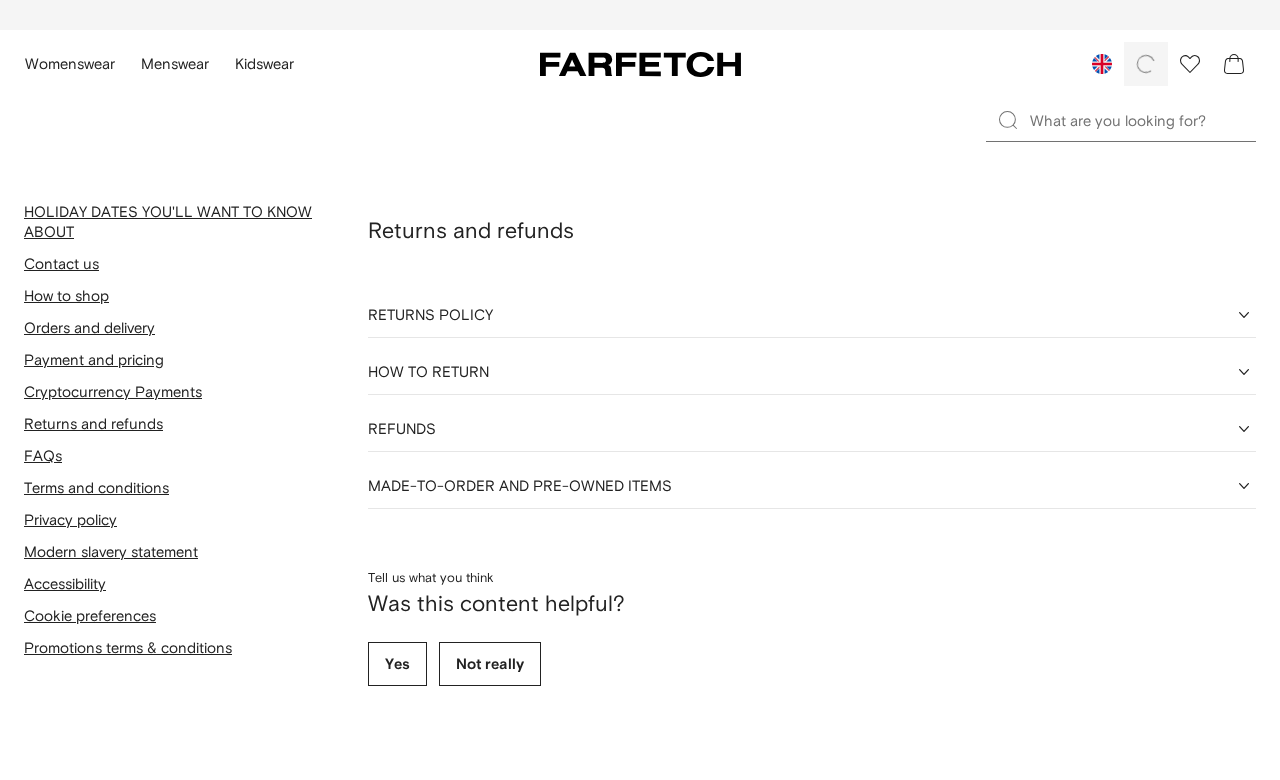
The UK Farfetch policy describes 30 days from delivery for standard returns. Final-sale, made-to-order, and certain opened or unsealed items have narrower terms.
The retailer also publishes separate seasonal instructions. An extension is useful only if your order qualifies and you follow the collection route it specifies.
Delivered is not the same as accepted
A courier scan can establish that a parcel arrived. The brand or partner boutique still checks the returned item before the refund is approved.
Do not put returns for different boutiques into one box without instructions. The platform explicitly calls for separate parcels and matching labels in that situation.
Check what you will receive before selecting a refund
- Original payment: usually the right choice if you want the funds back rather than another purchase.
- Farfetch account: store balance where offered, not withdrawable cash.
- Cryptocurrency: separate provider and claim process; the number of tokens may change.
- Wrong or faulty item: contact customer service and preserve evidence before sending it.
This guide uses Farfetch’s UK pages. The retailer is not a confirmed scam; the practical concern is choosing a return and refund route that fits your order.
How a Farfetch Return Moves From Your Account to a Boutique
Step 1: Check the exact item and its return status
Find the order in Orders & Returns. Guest buyers can use their guest order details through the official site, rather than creating a new order or account.
Check the delivery date for the item you want to return. If different parcels arrived on different days, record each date and ask which deadline applies.
A sale price is not necessarily a final-sale designation. Look for the specific label and keep the product listing and order confirmation that show what you agreed to.
If an item arrived wrong, faulty, or damaged, use that description when contacting support. Changing your mind and receiving the wrong item can lead to different remedies.
Photograph any damage before trying on or using the item. Include the shipping label and product tag in your records so support can match your evidence.
For an ordinary return, leave the security tag in its original position. Check shoes on a clean surface and avoid marking the soles before you decide.
Check the condition rules for your category. Jewellery may need its original documents, while beauty products generally need intact seals. Rules for hygiene seals are also stricter.
Step 2: Use the return option offered for your order
Select the individual items, then check whether collection or drop-off is available for your location. Use the authorized option rather than paying for a new label yourself.
Farfetch says its standard collection or drop-off should be in the country or region to which you ordered. Taking the item abroad can complicate a return.
The UK policy says returns made from another country can leave you responsible for costs and risk. It lists exceptions for incorrect, damaged, or faulty goods.
If you need to return something while traveling, ask how the policy applies before shipping. Do not assume the nearest boutique is authorized to accept it.
If a collection is missed, save the booking and any message from the courier. Ask about rebooking through the order and keep the original deadline in view.
Step 3: Match every parcel to its own label
Farfetch says returns for different brands or boutiques should be packed separately. Put the matching label on each box, even if the purchases were made together.
Keep the branded box, dust bag, supplied accessories and tags with the product. Put shoe boxes and other branded packaging inside a protective shipping box.
If beauty products arrived in separate boxes, the UK instructions say to return them that way with new labels. Do not combine them to simplify collection.
Before handing over multiple parcels, check that each label matches the corresponding item. A photo of the packed contents and each label can help later.
For example, two pairs of shoes from different boutiques can arrive under one order number. Use the return documents for each pair, rather than one box and two labels.
Take any irrelevant delivery labels off the outer box or use fresh packaging. The carrier needs to scan the return label, not the one used to deliver your order.
Step 4: Get proof of handoff and watch for acceptance
Ask the courier or authorized drop-off point to scan the label. Keep its receipt and the waybill number for each parcel you send.
The UK help page says processing can take up to six calendar days after the brand or boutique receives the parcel. Acceptance is the next milestone to check.
For applicable payment methods, the page says a refund may then take up to 14 days to show. Check when it was issued before counting days.
If one item in a multi-partner order was refunded, do not assume all were. Compare the refund amount with the accepted items and each parcel’s tracking.
Holiday Returns and the UK Cancellation Route Are Different
The current UK holiday page gives an extension for orders placed November 12 through December 7. It requires the free collection service, not just any return method.
The page says to request the return by January 6 and schedule collection by January 8. Check your order before relying on either date.
Do not assume those dates apply every year. If your order is outside the eligible range, start with the normal policy and the dates in your order record.
The holiday page says to sign in. If you checked out as a guest, ask Farfetch how the extension applies before your standard deadline passes.
Separately, GOV.UK explains statutory cancellation for eligible distance purchases. This normally requires notice within 14 days of receiving the item, followed by a further 14 days to return it.
That right and Farfetch’s voluntary 30-day return policy are different routes. The retailer’s UK terms discuss statutory cancellation separately, including the return arrangements.
For an eligible statutory cancellation, GOV.UK says paid standard delivery is normally refunded. Farfetch’s ordinary return page generally excludes delivery costs from the refund.
Farfetch’s terms also say you may need to arrange and pay for return shipping under its statutory cancellation route. Compare that with the free commercial option.
To use statutory cancellation, give clear notice through the contact route in the UK terms. Save the dated message instead of relying solely on a courier booking.
If shipping costs matter or the item is faulty, tell customer service which problem you are raising. Do not assume a final-sale label removes any rights you have.
Who Handles a Farfetch Return and Refund
Use the invoice to identify the seller
The terms describe Farfetch acting as an agent for relevant partners in many orders, while some purchases are from a Farfetch entity. The invoice helps identify your seller.
The name on the shipping box, the website where you paid, and the seller named on the paperwork can differ. Keep the invoice with the order confirmation.
The courier tracks the parcel, not the returned items
If the tracking says delivered but support cannot locate the item, ask which parcel they checked. A label for a different boutique will not resolve the discrepancy.
When disputing a missing return, identify the carrier, waybill, and item together. A delivery screenshot without its reference number is harder to match to the order.
Ask Farfetch to clarify the boutique’s decision
Start with official Farfetch customer service if a partner is involved. The terms say Farfetch can liaise with the partner; you should not need an unofficial intermediary.
If inspection is complete but the return is rejected, ask for the item, reason, and any evidence. A generic account update may not answer which item failed inspection.
The payment destination determines where to follow up
When an approved refund is missing, ask for the payment method and reference. Do this before sending a bank statement or any other sensitive document.
If your purchase used credit as well as a payment card, ask for the amount allocated to each. A single total will not tell you what to expect.
Where the Refund Goes: Card, Account Credit, or Crypto
The ordinary return process describes sending an accepted refund back to the original payment method. Ask how this works if the card or account has since changed.
Where account credit is offered, Farfetch describes applying it to a future purchase. Its UK policy gives it a five-year expiry from acceptance of the return.
Under the terms, if your next purchase costs less than the credited amount, the unused difference stays in the account. It does not become a cash refund.
The policy says this balance cannot be withdrawn, transferred to someone else, or converted to cash. If you need the money back, do not select account credit.
For crypto orders, the UK help pages name TripleA as the payment provider. After acceptance, you need to claim the refund; it does not behave like a card credit.
Farfetch’s crypto payment guidance says the returned item’s price is converted into the original cryptocurrency at the current rate. You may receive a different number of tokens.
The returns page says to claim within 30 days of being emailed. Check the order record and verify the provider through official guidance before sharing any requested information.
A public receiving address is not a recovery phrase. Never send wallet secrets, approve unexpected spending, or pay an unsolicited fee to unlock a refund.
If you did not pay in crypto, a stranger asking for your wallet details to return a card payment is not following the process described for your purchase.
What to Do When a Farfetch Refund Stalls
- Match the item and parcel. Save the item name, partner where listed, correct return label, acceptance scan and delivery status. Keep each parcel’s waybill separate.
- Ask for the status that matters. Find out whether the boutique received, inspected, and accepted the item. Ask which item or document is missing if it was rejected.
- Confirm the destination. Ask whether the refund was sent to your payment method, credited to your account, or sent to a payment provider for claiming.
- Get the record in writing. Request the amount, date and refund reference. Compare it with your account or statement, not just an email subject line.
- Escalate if the records disagree. Give the evidence to official support and check your payment provider’s deadline before waiting through another promised update.
If you have already shipped the parcel, do not start a second return just to get a fresh label. Keep the original tracking and ask support to locate it.
If your card was replaced, ask the issuer how it handles credits to the old card number. A replacement does not prove the refund failed.
In your first message, state the remedy you want. For example, request proof of a card refund if the account shows credit you did not select.
Keep the order emails, refund decision and parcel receipt in one place. If you dispute a payment, those records explain the timeline better than the latest status alone.
We checked published UK policies and guidance. We did not order an item, send a return, test customer support, or claim a cryptocurrency refund.
Frequently Asked Questions
When do Farfetch’s standard 30 days start?
The UK policy starts them when the order is delivered. Check your actual delivery date and whether your item qualifies for a different holiday or statutory route.
Can I return two different boutiques’ items in one box?
The policy says to package them separately with the correct return labels. If the order instructions appear different, get written confirmation before combining anything.
Can I return an item marked final sale?
Not for an ordinary change of mind under the published policy. If it arrived faulty, damaged or wrong, contact support promptly and check your applicable rights.
Why does tracking say delivered but no refund appears?
Delivery is not acceptance or payment. Check the boutique’s processing status, the refund destination and the actual issue date with Farfetch.
Can I withdraw a refund credited to my Farfetch account?
The published policy says no. Account credit is for future Farfetch purchases and can expire. Choose the original payment route when available if you want funds back.
Will a crypto refund return exactly the same number of tokens?
Not necessarily. The crypto guidance describes conversion at the current rate. Verify the genuine claim route, note its deadline and never share recovery words.
The Bottom Line
Use the right label for each Farfetch return and keep the carrier scan. Do not choose account credit if you need the money back outside Farfetch.
If tracking shows delivery but no refund, ask when the item was accepted and where the money was sent. Keep the answer and follow up before deadlines expire.

Join the discussion
0 commentsShare your experience or ask a question about this article.
Discussion
Start the conversation
Have a question or something useful to share? Add the first comment.