


First Liberty Building & Loan offered an investment story built around business loans and regular payments. For people planning around that income, the paperwork felt consequential.
Now another document deserves their attention: the official claims notice. Understanding what it asks for matters more than any old account balance or reassuring sales message.
Overview
The lending pitch and the person behind it
Edwin Brant Frost IV ran First Liberty Building & Loan LLC, presenting investors with a business-lending opportunity and promised returns supported by those loans.
The pitch included returns of 8–18%, with monthly payments. That should not be confused with a claim that investors earned 8–18% every month.
For an investor, the practical attraction was recurring income from business financing. The crucial question was whether borrower repayments could actually support those distributions.
A guilty plea and a prison sentence
Frost pleaded guilty to wire fraud in May 2026. On October 26, 2026, he received a 15-year prison sentence, according to federal prosecutors in Georgia.
The case involved more than 300 investors and a restitution order of $76,454,374.39. New investor funds covered payments while loan defaults and the shortfall were concealed.
This was a confirmed deception about the use and performance of investor money. It was not simply a disagreement over the quality of financial advice.
The deadline investors need to recognize
The official First Liberty claims notice sets December 26, 2026, as the claims deadline. Investors should use the actual claims instructions, rather than assume a contact form completes the process.
- The claim calculation concerns documented net loss, rather than unpaid promised profits.
- Investors can review and dispute the receiver’s proposed transaction history.
- A signed claim and supporting documents may require different steps depending on that history.
- A criminal restitution order does not guarantee immediate repayment of every loss.
Why the First Liberty Story Requires More Than a Ponzi Label
Some investment frauds invent an entire business activity. First Liberty’s case involved loans that defaulted and an income shortfall that Frost concealed from investors.
That difference helps explain how reassuring paperwork can coexist with a fraudulent arrangement. A real lending business still needs honest information about collections, defaults, and available cash.
If the money supporting distributions changes, investors need to know. Calling a payment interest does not establish that it came from the loan portfolio’s earnings.
The government’s account also describes false assurances about SBA preapproval. A reference to a familiar government program can make an investment feel independently checked.
An investor hearing that claim should separate the borrower, the lender, the proposed financing, and any actual government involvement. They are different parts of the transaction.
Shared religious or political interests also featured in the solicitation. Familiar values can encourage trust, but they cannot establish what happened inside business accounts.
That is a lesson about verification, rather than a judgment about a community. People can share your convictions and still provide false information about an investment.
How the First Liberty Scam Works
Step 1: A business-loan opportunity offers regular income
Investors were offered returns from money supposedly supporting business loans. Monthly payments gave the arrangement a practical role in people’s financial plans.
Predictable payment dates can make an investment feel dependable. However, a schedule describes when money should arrive, rather than proving where that money will originate.
Before committing savings to such an arrangement, the missing question is whether actual borrower collections can cover the promised payments and operating costs.
Step 2: Borrower problems undermine the income supporting payments
Loans defaulted, and the business could not generate enough income to meet its obligations. Investors were not given an honest picture of that shortfall.
A lending business can lose money without committing fraud. The deception arises when an operator conceals material problems and continues obtaining money through false assurances.
For someone deciding whether to invest or renew a note, that withheld information changes the decision. They cannot weigh a risk they are falsely told is covered.
Step 3: New money maintains the appearance of reliable returns
Fresh investor funds were used to pay existing investors. Payments therefore continued even though the underlying lending income did not support the arrangement as represented.
An investor looking only at their own deposits might see an apparently successful history. The problem becomes visible when the source of those deposits is examined.
Imagine receiving a scheduled payment immediately before deciding whether to renew an investment. Without accurate information, that payment can encourage another commitment under a mistaken understanding.
The arrival of money does not independently verify the company’s explanation for earning it. A bank entry and a profitable loan portfolio are different evidence.
Step 4: False assurances help conceal the gap
Claims about loan use and SBA preapproval added reasons to feel comfortable. Those assurances mattered because investors were deciding whether to entrust substantial sums.
The government’s case describes personal use of investor funds as well. Money presented as business funding was not confined to the purpose investors were promised.
For an investor reviewing old messages, identify the specific representation attached to each transfer. A dated assurance can explain why you sent money or renewed an agreement.
Step 5: The aftermath moves into a supervised claims process
Once the scheme ended, account balances could no longer be treated as ordinary promises of future payment. Actual transfers became central to identifying losses.
The receivership process gives investors a way to review transaction information and submit a claim. It also has eligibility requirements and a deadline that deserve attention.
Being known to the company, appearing in its records, or receiving a newsletter is not the same as completing the required claim submission.
First Liberty, Frost, and the Receivership
The investment company and the criminal case
Match First Liberty Building & Loan LLC and Frost with the names in your own records. Preserve any other entity names appearing on receipts or transfer confirmations.
Do not assume every similarly named financial business is connected. The specific company and the actual recipient of your money are what investigators need to identify.
The guilty plea concerns Frost’s conduct. It does not make every employee, relative, introducer, or separate business responsible for the same deception.
The court-appointed receiver’s role
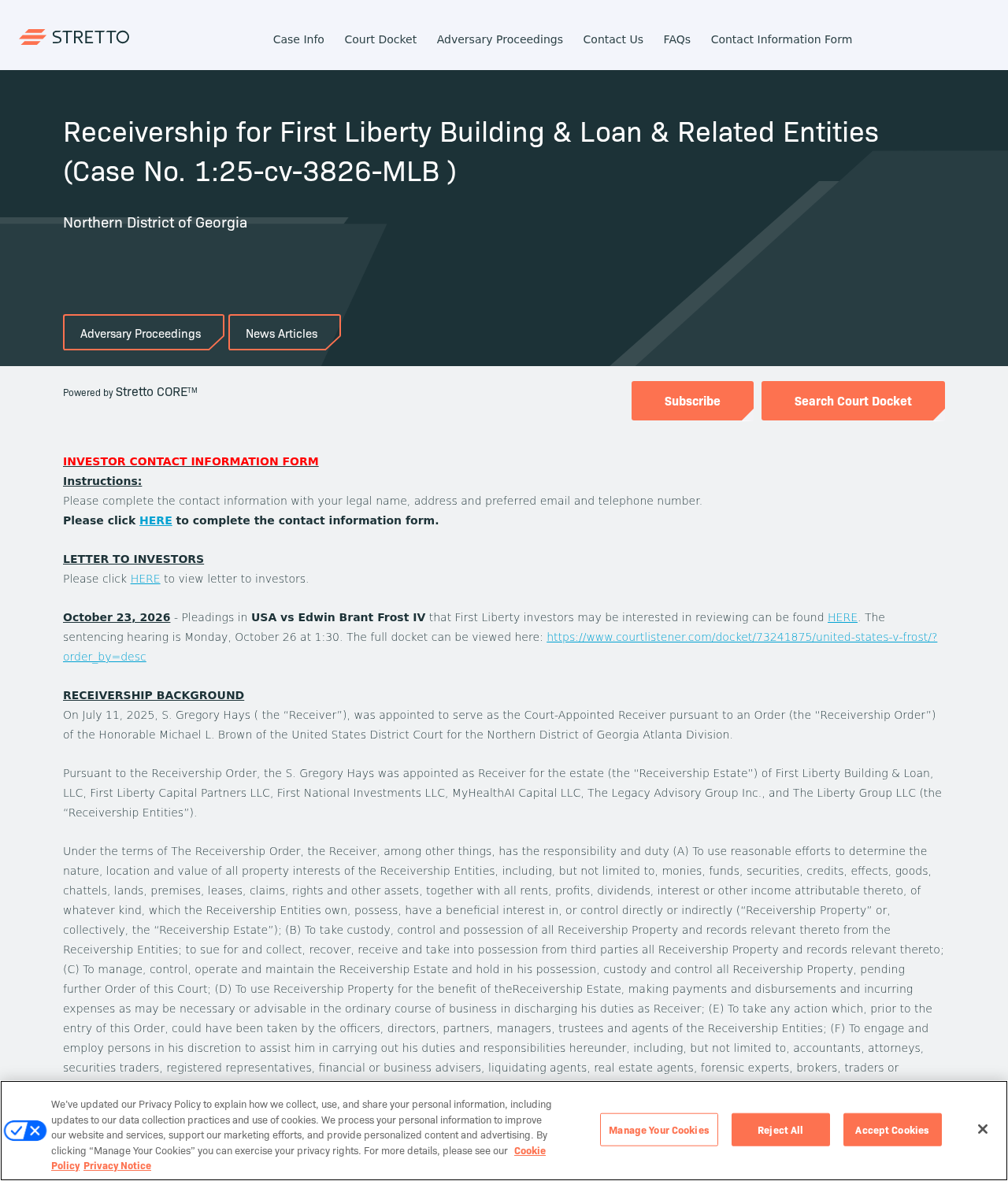
The federal court appointed S. Gregory Hays as receiver in the related SEC action. The official Stretto case portal identifies the receivership and publishes its documents.
The receiver’s job includes handling assets and the court-supervised claims process. That role is different from a promoter continuing to sell the original investment.
Use case number 1:25-cv-3826-MLB when checking whether a document belongs to this proceeding. A familiar logo alone is a weaker identifier.
The contact form and the claim form serve different purposes
The case portal includes a contact information form. Updating your details there helps maintain contact, but should not be mistaken for a signed proof of claim.
The claims notice provides instructions and certification requirements. Review that document even if you already supplied an email address or previously reported the loss elsewhere.
If you are unsure whether a submission counted, ask the administrator directly. Keep the answer and any acknowledgment rather than relying on a page you once visited.
A judgment amount is different from an available payout
The restitution order expresses a criminal repayment obligation. A receiver’s distribution depends on the claims process, available assets, and court decisions governing those assets.
Do not budget around a full repayment merely because the court ordered restitution. Similarly, a proposed allowed claim amount is not a promise of an immediate check.
The safest approach is to meet the documented requirements, preserve your rights, and verify any later distribution notice through the established case contact.
What the Claims Paperwork Is Actually Asking You to Confirm
The court-approved process uses a money-in, money-out calculation. It generally concerns funds transferred minus amounts already returned, with consolidation where appropriate.
Unpaid promised interest, profits, and fees are excluded from that calculation. Keep those old statements, but do not substitute their projected balances for documented transfers.
Known investors may receive a prefilled transaction history and proposed net loss. Compare every entry against your bank records before agreeing to the amount.
If the proposed history is wrong, the form allows a dispute with supporting documentation. Explain the specific missing or incorrect transfer, rather than submitting an unexplained larger total.
If the receiver could not calculate your claim, complete the requested history and provide support. Do not assume that an empty figure means there was no loss.
The certification also addresses eligibility and insider relationships. Read each statement carefully, and ask the receiver about any statement you cannot truthfully certify.
Some accounts or payments can require individual treatment under the notice. A joint account, retirement account, or related transaction should be identified accurately rather than casually combined.
Keep copies of what you send, including supporting pages. Label the corresponding entries so the person reviewing a disputed transfer can find the bank confirmation without guessing.
If a payment was returned under a different description, include that record too. Leaving out money received can make the proposed net loss inaccurate.
Before mailing, check that every page belongs to the same claimant and that signatures are present. A complete ledger does not replace the required certification.
For email submissions, retain the sent message and the actual attachments. If delivery fails or an acknowledgment is missing, use the published inquiry contact to resolve it promptly.
What to Do if You Have Fallen Victim to This Scam
- Obtain the official claims notice through the Stretto case portal or the linked notice above. Confirm the case identity and the December 26, 2026 deadline before preparing your submission.
- Gather your investment agreements and bank records showing deposits and payments received. Use actual transfers to check the proposed claim amount, keeping promised but unpaid profits separate.
- Review your prefilled ledger, if supplied. If every entry is correct, follow the agreement and certification instructions; the notice says extra transaction support is not needed for that agreement.
- If you dispute the ledger or received no completed calculation, use the relevant option and complete the requested transaction detail, including Exhibit B and supporting copies.
- Read the eligibility certifications, complete the identification and contact fields, and obtain every required claimant signature. Ask the administrator before signing anything you cannot accurately certify.
- Use the submission route in the official notice. Its postal address is First Liberty Claims, c/o Hays Financial Consulting LLC, 2964 Peachtree Rd NW, Ste 555, Atlanta, GA 30305.
- Keep the completed form and supporting documents together, send copies rather than irreplaceable originals, and retain proof of mailing. Follow the notice’s postmark deadline rather than waiting for a reminder.
- The notice also publishes firstlibertyclaims@gmail.com for claim submissions. Verify that address in the original notice before emailing the signed documents; do not trust an unsolicited replacement address.
- For questions or missing paperwork, contact FirstLibertyInquiries@stretto.com or 404-926-0060, as published in the notice. Ask what remains outstanding and retain the response with your claim copy.
- Confirm receipt through the published case contact if acknowledgment is missing. Updating the portal’s contact form alone should not be treated as confirmation that your claim was filed.
- If somebody offers guaranteed recovery for an advance payment, stop and verify independently. Do not send money, account passwords, or banking codes to obtain a supposed priority position.
The claims notice includes sensitive identification fields. Send that information only through a route authenticated against the official documents, and never post your completed form publicly.
If you already reported the fraud to law enforcement, keep that report number too. It helps organize your history but does not replace the receivership’s claim requirements.
Frequently Asked Questions
Is First Liberty’s case established fraud or only a complaint?
Frost pleaded guilty to wire fraud and received a 15-year sentence. Those facts support calling the described investment conduct a confirmed scam.
Is the claims deadline December 26, 2026?
That is the deadline stated in the official claims notice. Review the live case documents for any court-authorized change before relying on a later date.
Does the contact information form file my claim?
Do not assume that it does so. The official claims process requires the applicable claim paperwork, certifications, signatures, and supporting information described in the notice.
What if the receiver’s proposed loss amount looks wrong?
Compare the listed transfers against your records, select the dispute option, and provide the requested details and support. Ask the administrator about any unclear entry.
Can I claim all the interest I was promised?
The published process excludes unpaid promised interest, profits, and fees from the allowed claim calculation. Preserve those statements while documenting actual money transferred and received.
Will the restitution order repay my entire investment?
The order does not guarantee a full or immediate payout. The claims process and available assets affect recovery, so complete the required paperwork without assuming a particular distribution.
The Bottom Line
Do not send further money into the First Liberty investment arrangement. Concealed loan problems and payments funded with new deposits made the promised income story false.
If you lost money, obtain the official notice, check your transfer history, and submit the required signed claim by December 26, 2026, unless the court changes that deadline.

Join the discussion
0 commentsShare your experience or ask a question about this article.
Community experiences
Did this happen to you?
Your experience could help someone recognize the same scam. Submit a private report for our team to review.
I experienced this tooReports are reviewed before publication. Sharing publicly is always your choice.
Discussion
Start the conversation
Have a question or something useful to share? Add the first comment.