


A trading algorithm does the difficult work, and investors collect a predictable monthly return. Price Physics wrapped that appealing idea in the language of sophisticated market expertise.
For anyone who received the pitch, the important question was whether the technology actually existed. The federal case against Matthew Melton gives that question a concrete answer.
Overview
The algorithm and the guaranteed monthly returns
Matthew Melton promoted Price Physics as an investment vehicle using a proprietary algorithm to trade futures contracts. Investors were promised guaranteed returns of up to 12% monthly.
He said he would retain 2% as compensation. That fee explanation helped frame the promised results as the output of an operating trading strategy.
The combination offered a simple proposition: trust the specialist and let the technology handle the market. Investors still needed proof of both the technology and the trading.
What the criminal case established
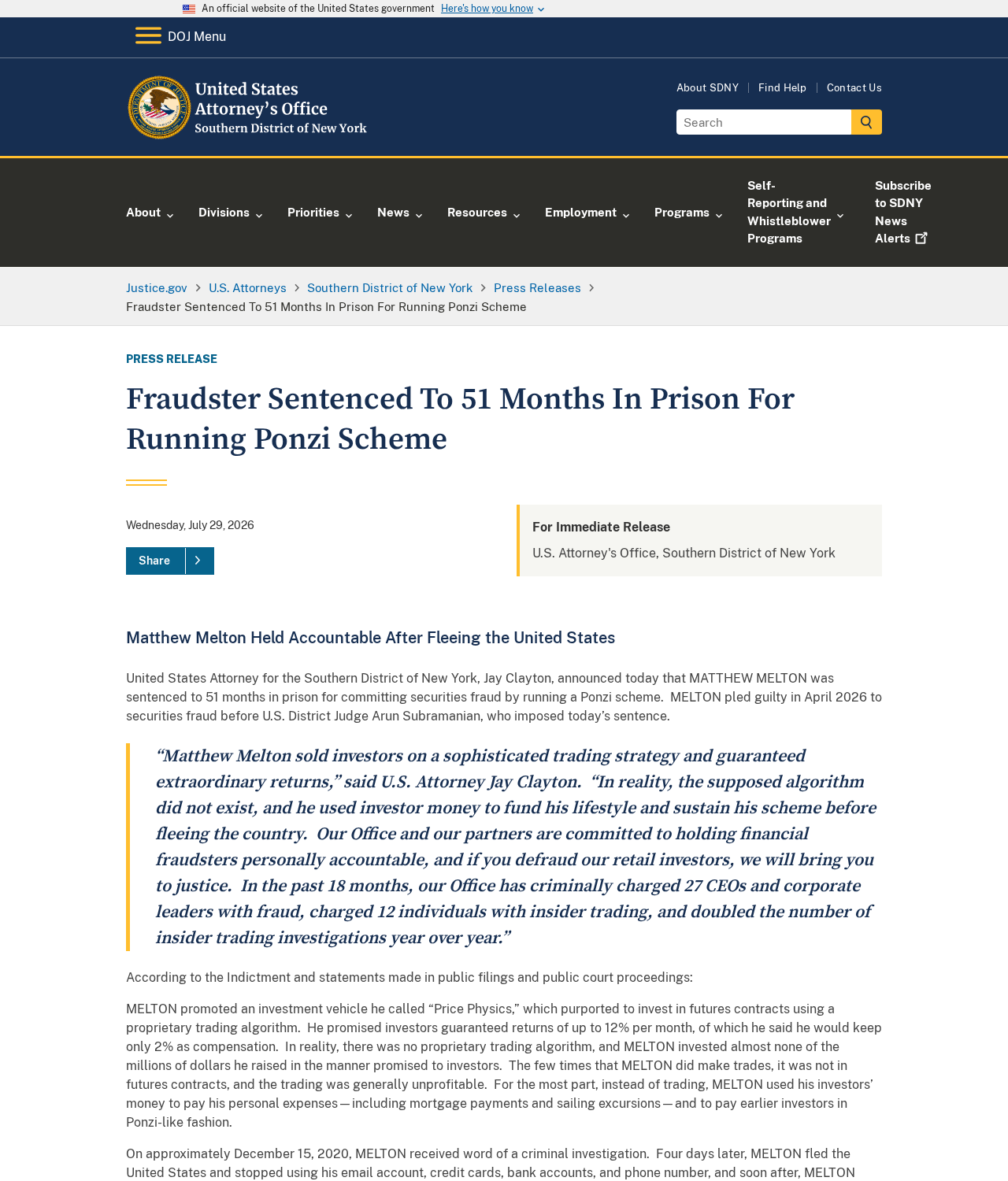
Melton pleaded guilty to securities fraud in April 2026. On July 29, 2026, a federal judge sentenced him to 51 months in prison.
The sentencing announcement says the supposed algorithm did not exist. Almost none of the money was invested as promised, while funds covered personal expenses and payments to earlier investors.
The case therefore concerns a fabricated explanation for returns and misuse of investor money. It is not merely an automated trading system suffering market losses.
What investors should take from the case
Price Physics illustrates how technical language can make an ordinary promise of extraordinary returns sound like a specialist service outsiders cannot easily evaluate.
- A proprietary strategy still needs independent evidence of actual operations.
- Payments to earlier investors do not demonstrate profitable trading activity.
- A management fee does not make an unsupported guarantee credible.
- A criminal sentence does not automatically restore every investor’s lost money.
Why the Technology Story Was Such an Effective Distraction
The word algorithm describes a set of instructions. It does not establish that those instructions are profitable, implemented, or even present in the advertised investment.
For someone unfamiliar with futures trading, that distinction can disappear behind a confident explanation. The operator seems to possess knowledge that ordinary investors lack.
That creates an awkward situation for a prospective investor. Asking basic questions can feel like admitting ignorance, while accepting the explanation feels like trusting expertise.
A legitimate specialist should be able to explain what evidence supports the investment without requiring blind faith in secret technology. Confidential methods do not excuse nonexistent operations.
An investor does not need source code to ask whether a brokerage account exists. Nor should they confuse a presentation about trades with independently verifiable trading records.
The same applies to a performance chart created by the promoter. A rising line can summarize claimed results without proving that any customer money generated those results.
Price Physics also offered a fee structure alongside the guaranteed return. Describing compensation can make a proposal feel complete, even while the central performance claim remains unsupported.
The essential question comes before the fee calculation: what actually produces the money that investors are promised, and what independent records show that activity?
How the Price Physics Scam Works
Step 1: A sophisticated-sounding strategy explains extraordinary returns
The advertised vehicle supposedly traded futures through a proprietary algorithm. Investors were offered guaranteed monthly results that sounded disconnected from ordinary uncertainty in financial markets.
The technology supplied an explanation for that apparent advantage. Instead of asking whether the promised return was credible, a listener could focus on the supposed specialist running it.
That shift matters because expertise and evidence serve different purposes. A convincing explanation of a strategy does not establish that the strategy exists or operates with investor funds.
Step 2: The guarantee reduces the perceived need to examine risk
A guarantee can make an uncertain investment sound settled before any independent checks occur. The investor hears a promised outcome rather than a range of possible results.
But a promise is only as useful as the obligation and resources behind it. Labeling a return guaranteed does not supply the money needed to pay it.
For a hypothetical illustration, a 10% monthly promise on $10,000 implies $1,000 arriving every month. That arithmetic is simple; proving the income source is the difficult part.
Someone considering a similar arrangement should ask what happens when trading loses money. An answer that merely repeats the guarantee leaves the central problem unresolved.
Step 3: Investor money is used outside the advertised strategy
The criminal case describes almost none of the money being invested as promised. The limited trading that occurred was not the advertised futures activity and was generally unprofitable.
Investor funds instead helped pay personal expenses, including mortgage payments and sailing excursions. The gap was between what investors were sold and what happened to their money.
This is why a genuine expense record can matter more than an impressive technical explanation. It traces a destination rather than simply describing a proposed use.
An investor cannot determine that destination from a balance displayed by the same operator. Independent account records are needed to test whether the claimed activity occurred.
Step 4: Payments create a misleading track record
Some money paid earlier investors in Ponzi-like fashion. Those payments could make the arrangement look successful to someone considering another deposit or recommending it to a friend.
The recipient may honestly believe they witnessed the strategy working. What they actually witnessed was a transfer into their account, with an explanation supplied by the operator.
That difference is crucial when evaluating testimonials. A satisfied investor can describe their personal experience accurately while being wrong about the source of the payment.
A payment record should therefore be paired with evidence about the business producing it. Without that connection, apparent performance can conceal dependence on fresh deposits.
Step 5: The criminal proceedings expose the missing foundation
Melton fled the United States in December 2020, was arrested in the United Kingdom in October 2023, and was extradited in December 2025.
Those events are described in the official extradition announcement. The later guilty plea and sentence establish the case beyond that earlier charging stage.
For investors, the outcome replaces the technology story with a practical task: document transfers and seek accurate information about victim participation and recovery.
It does not make a displayed balance collectible overnight. The financial aftermath still depends on the proceedings, available assets, and the instructions applicable to each investor.
Price Physics, Melton, and the Trading Records
The investment vehicle and the named operator
The public case identifies Price Physics as the investment vehicle Melton promoted. Match those names with the contracts and payment records you actually received.
Do not assume that every business using similar financial terminology is connected. The relevant link is the specific operator, account, agreement, or communication in your transaction.
If someone introduced you to the offer, preserve their messages without guessing their knowledge. Your report should distinguish a statement they made from a conclusion about their intent.
The algorithm claim and the missing operating evidence
The supposed proprietary algorithm was central to the explanation for returns. The sentencing account says it did not exist, making that technical foundation false.
This is different from a dispute about whether a working strategy was sufficiently sophisticated. Investors were given a nonexistent mechanism to explain where their money would earn returns.
In a comparable offer, ask which institution holds the trading account and whether records can be independently authenticated. A software demonstration does not answer that custody question.
The brokerage account and the investor statement
A statement issued by an investment promoter can record what the promoter claims you own. It does not automatically establish the contents of an independent brokerage account.
Look for the legal account holder, custodian, dates, and transaction history. Verify the institution through contact details obtained separately from the person selling the investment.
If access is only through a promoter-controlled dashboard, record that limitation before paying. A working login does not establish that the displayed money exists elsewhere.
The SEC action and the later criminal outcome
The SEC also brought a civil case concerning Melton, described in its 2023 litigation release. That document predates the guilty plea and prison sentence.
Its allegations provide background, while the 2026 criminal outcome establishes admitted securities fraud. Keep those dates and procedural stages separate when reading older search results.
Likewise, amounts described as money raised, personal spending, forfeiture, and restitution are different figures. They should not be added together or presented as individual refund entitlements.
How to Check an Algorithm Pitch Without Becoming a Programmer
Start with the claim you are being asked to believe. Is it that software exists, that trades occurred, or that the strategy consistently produced the advertised returns?
Each claim requires its own supporting evidence. A working application might establish that software runs while revealing nothing about whether your money reaches a real trading account.
A trading record might show genuine activity while leaving the advertised return unsupported. A promoter could highlight selected wins and omit losses, fees, or unsuccessful accounts.
Ask whether the performance record covers the full period being advertised. Separate actual customer results from simulations, hypothetical calculations, and figures supplied only by the seller.
Check who controls withdrawals and where the assets are held. An operator controlling every source of information also controls what an investor can independently verify.
If secrecy prevents examination of every material claim, the uncertainty remains with your savings. You do not have to prove a crime before declining an unverifiable investment.
Avoid letting a successful small payment settle every question. The Price Physics case shows why payments and profitable operations must be assessed separately.
For money already committed, keep factual questions focused on records. Ask for existing documents rather than negotiating another deposit in exchange for a promised explanation.
What to Do if You Have Fallen Victim to This Scam
- Stop further transfers or reinvestment instructions connected with Price Physics. If a payment is pending, contact your bank through its published number and ask about cancellation or recall.
- Give the bank the exact recipient, amount, date, and reference. Explain that the transaction relates to the Melton securities fraud case and request a written reference for the report.
- Ask what the bank can still do for that payment method. Record whether money was recovered, a recall was requested, or further information is required; these are different outcomes.
- Download the contracts, statements, emails, and original payment confirmations available to you. Keep a second copy before an account closes or a message service becomes inaccessible.
- Prepare a table of money sent and money received. Preserve advertised account balances separately so that claimed profits cannot be mistaken for actual repayments.
- Contact SDNY Victim & Witness Services at 1-866-874-8900. Identify Matthew Melton and Price Physics, then ask how to provide victim information securely.
- Ask whether your records are already associated with the case and how to receive relevant updates. Follow the verified office’s documentation instructions rather than an unsolicited recovery message.
- Keep the staff member’s name, submission acknowledgment, and any follow-up date. If you receive no confirmation, call the published number again to establish what remains outstanding.
- Consult the appropriate account or tax professional if retirement funds or unusual reporting issues are involved. Supply the actual transaction history rather than assuming the correct treatment.
- Reject requests to pay an advance release fee for recovered funds. A promise of guaranteed repayment is not made credible by knowing your investment name or approximate loss.
If somebody claiming to represent the case contacts you first, end the conversation and independently call the published office. Explain the approach before sending sensitive documents.
Do not share banking passwords, remote computer access, or one-time codes to receive a supposed restitution payment. None is needed to describe your investment history.
Frequently Asked Questions
Was Price Physics simply an unsuccessful trading strategy?
The criminal case established securities fraud, including a nonexistent algorithm and misuse of investor funds. That goes beyond a genuine strategy producing disappointing returns.
What monthly return did Melton advertise?
The sentencing announcement describes guaranteed returns of up to 12% monthly, with Melton saying he would retain 2% as compensation. Those were promotional claims, not established performance.
Did any trading actually take place?
The government’s account describes limited, generally unprofitable trading outside the promised futures strategy. That does not validate the advertised algorithm or the use of most investor funds.
Why do earlier payments fail to prove profitability?
Payments can come from later investors instead of market gains. Without tracing their source, a recipient cannot determine whether the advertised investment produced the money.
Does the sentence establish my individual recovery amount?
The prison sentence does not itself calculate your payout. Preserve your actual transfers and ask the verified victim-witness office about current case instructions and recovery information.
How should a Price Physics investor contact the authorities?
Call SDNY Victim & Witness Services at 1-866-874-8900 using the published contact page. Name the Melton case and request the appropriate secure route for records.
The Bottom Line
Do not send money into the Price Physics arrangement described in this case. The advertised algorithm was nonexistent, and investor payments disguised the lack of promised trading income.
If you invested, organize your transfers and contact SDNY through its verified victim-witness number. Keep any recovery process separate from another stranger’s promise of guaranteed returns.

Join the discussion
0 commentsShare your experience or ask a question about this article.
Community experiences
Did this happen to you?
Your experience could help someone recognize the same scam. Submit a private report for our team to review.
I experienced this tooReports are reviewed before publication. Sharing publicly is always your choice.
Discussion
Start the conversation
Have a question or something useful to share? Add the first comment.