


A business needs a short loan, you provide the money, and interest arrives when that business repays. Hedgehog Investments made that arrangement sound reassuringly straightforward.
For investors holding its promissory notes, the important question was what happened after the money left their accounts. The answer reached federal court in Utah.
Overview
The short-term lending story investors were sold
Hedgehog Investments LLC offered investors exposure to bridge loans for businesses needing financial assistance. Short-term promissory notes were supposed to connect investor money with that lending activity.
The appeal was understandable: a defined purpose, a repayment story, and returns supposedly generated by businesses paying back their loans.
A promissory note can look more concrete than a speculative investment. However, its value still depends on the borrower, the underlying transactions, and available repayment money.
What Matthew Bates admitted in federal court
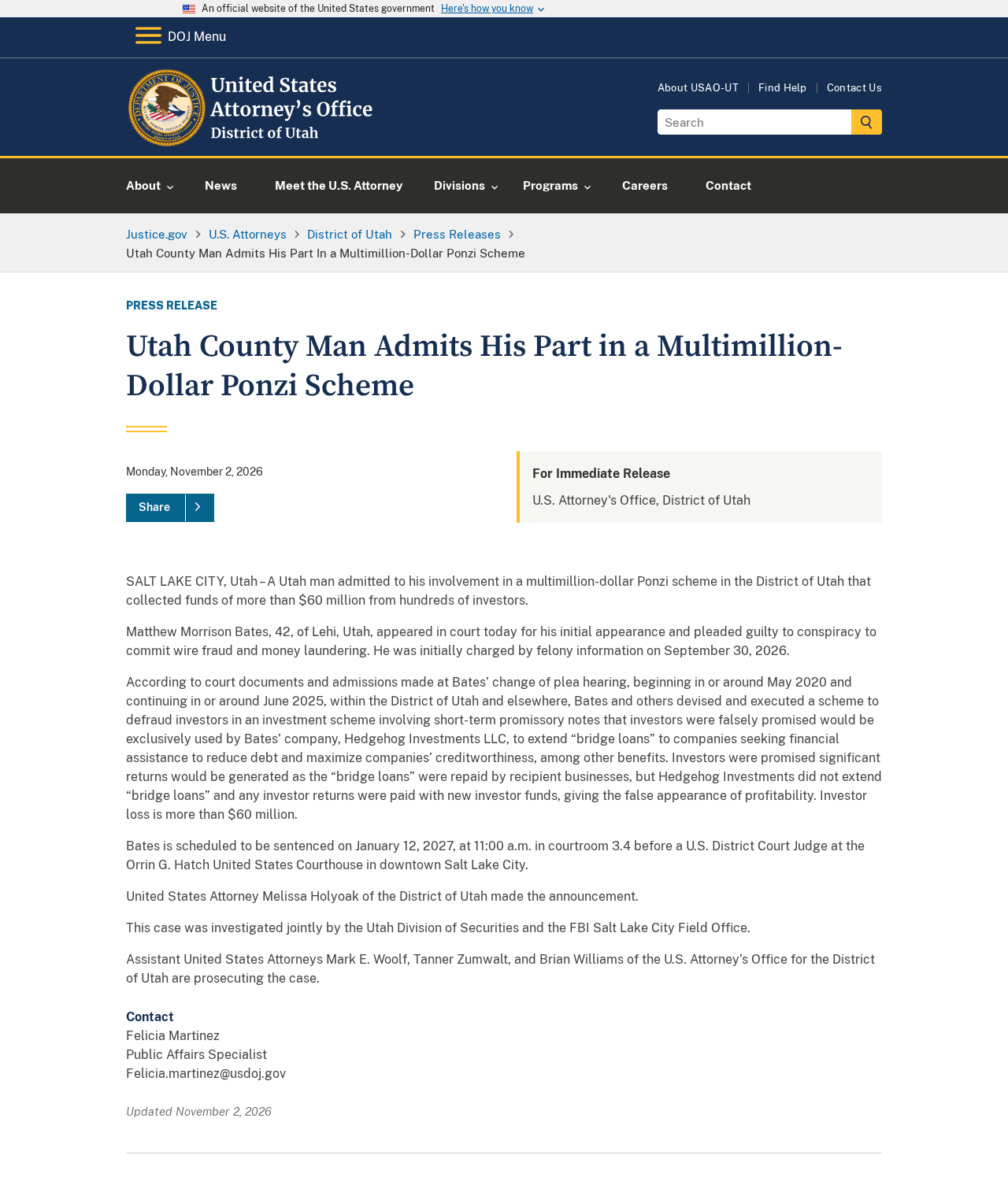
On November 2, 2026, Matthew Morrison Bates pleaded guilty to conspiracy to commit wire fraud and money laundering, according to the Utah federal prosecutor’s announcement.
The admitted scheme involved more than $60 million collected from hundreds of investors between approximately May 2020 and June 2025.
Hedgehog did not extend the bridge loans investors were promised. Payments to investors instead came from newer investor funds, creating an appearance of profitability.
What affected investors should focus on now
The central problem was a false explanation of how returns were earned. It was not merely a genuine lending portfolio having an unusually disappointing year.
- The promised lending activity did not produce the advertised investment returns.
- Receiving an earlier payment did not authenticate the supposed bridge loans.
- Investors should preserve their notes, transfers, communications, and repayment histories.
- Case information and recovery instructions should come through independently verified official contacts.
Why a Bridge Loan Can Sound Safer Than It Is
Bridge financing has an ordinary business meaning: temporary funding intended to cover a gap before another source of money becomes available.
That familiar explanation can make an unfamiliar investment feel manageable. You can picture a business receiving money today and repaying it after another transaction closes.
The picture leaves several essential questions unanswered. Who received the loan, what obligation required repayment, and what happens if the expected transaction never closes?
Even a genuine bridge loan carries risk. A promised business purpose does not provide the same protection as independently confirmed assets and an enforceable repayment agreement.
With Hedgehog, the admitted problem came earlier in the chain. The loans described to investors were not being extended in the first place.
That distinction changes how an investor should interpret a payment history. Money arriving on schedule can demonstrate that somebody paid, without revealing where the money originated.
Consider a simple hypothetical example unrelated to any individual Hedgehog account. You deposit $20,000 and later receive $1,000 described as investment income.
Your bank statement confirms that $1,000 arrived. It cannot establish whether the payment came from a business borrower, another investor, or the original deposited money.
Calling the payment interest does not settle that question either. The label describes how the payment was presented, rather than proving its economic source.
The useful evidence sits behind the label: the underlying borrower, actual disbursement, repayment records, and independent confirmation that those transactions occurred.
How the Hedgehog Investments Scam Works
Step 1: An ordinary business need supplies the investment story
The pitch began with businesses supposedly needing short-term assistance. Investors were told their money would fund bridge loans designed to improve those businesses’ financial positions.
That explanation offered a believable reason for collecting money and a believable source of future returns. Investors were not simply being asked to trust unexplained profits.
The danger was that the explanation itself was false. An investment story can contain familiar financial vocabulary while misrepresenting the activity behind the paperwork.
Step 2: A promissory note turns the story into an apparent obligation
Investors supplied money through short-term promissory notes. The note gave the arrangement a recognizable form, with a named obligation instead of a casual verbal promise.
Paperwork matters when documenting a claim, but it cannot create the transactions that an operator says are happening elsewhere.
A signed note and an actual loan portfolio answer different questions. One records a promise to an investor; the other would show the business activity supporting repayment.
Someone considering a comparable offer should ask who owes the money under the note. That may differ from the business supposedly receiving a downstream loan.
Step 3: The advertised loans never generate the promised returns
Bates admitted that Hedgehog did not extend the bridge loans described to investors. This removed the supposed engine that would have earned their returns.
When the underlying activity is missing, attractive projections cannot repair the arrangement. They are calculations resting on a source of income that was never established.
An investor may reasonably assume that detailed explanations reflect detailed operations. In a fraud, a coherent explanation can instead hide the absence of those operations.
The practical warning is specific: confirm the money’s destination and the claimed repayment source before treating a narrative as a functioning business.
Step 4: New deposits create the appearance of successful investing
New investor money paid earlier investors, according to the admitted scheme. Those payments made the arrangement appear profitable without the promised lending revenue.
That is why an early recipient can sincerely report receiving money while misunderstanding the investment. Their experience describes a payment, not the system supporting it.
A recommendation from somebody who received returns therefore needs the same underlying verification as the original offer. Personal confidence does not trace a payment’s source.
Reinvesting apparent earnings can also leave an investor’s money exposed. A balance carried forward on a statement is different from money safely returned to their bank.
Step 5: The investor is left documenting a loss rather than collecting normal interest
Once the deception becomes apparent, the task changes. Investors need a reliable account of what they transferred, what they received, and which agreements cover those transactions.
Different people may have different net losses even when their account statements show similar balances. Promised profits should be kept separate from actual transfers.
The federal guilty plea confirms the fraud mechanism. It does not, by itself, calculate every person’s claim or guarantee that sufficient money remains for repayment.
Hedgehog, Bates, and the Investment Paperwork
The company named in the admitted scheme
The federal announcement identifies Hedgehog Investments LLC as Bates’ company. Keep that exact name alongside the names appearing on your own contracts and bank records.
A similar business name elsewhere is not enough to connect another company with this case. Match the legal entity and transaction details before making an accusation.
If your payment went to a differently named recipient, preserve the explanation you received. That discrepancy may help investigators connect the receiving account with your particular investment agreement.
The person who entered the guilty plea
Matthew Morrison Bates is the person identified in the November 2026 guilty-plea announcement. The admission concerns his participation in the described investment scheme.
Avoid assuming that every acquaintance, introducer, employee, or business contact had the same knowledge. A case against one participant does not automatically establish another person’s conduct.
For a victim report, describe what each person actually told you or received. Original messages are more useful than conclusions drawn from an association.
What a website or business listing can establish
A website, company registration, or public business listing may help identify an operator. None substitutes for evidence that the advertised lending actually occurred.
Likewise, an inaccessible website today cannot explain how a particular investor was recruited years earlier. Preserve the materials you personally received instead of reconstructing them from memory.
This case is supported by a guilty plea and admissions about the money. A polished brand or an old promotional announcement cannot override those facts.
Which records connect your money to the offer
Keep the complete promissory note, including signature pages, schedules, amendments, and any renewal agreement. A cropped signature page may omit the provisions identifying the actual obligation.
If a note was renewed without a new bank transfer, mark that clearly. It helps distinguish another contractual promise from additional money actually invested.
Match each transfer to its date, amount, receiving institution, and beneficiary name. Save the bank’s transaction confirmation, including its unique reference number, alongside any balance screenshot.
Keep any explanation of a changed recipient or delayed payment. Include the complete conversation, since an isolated message may omit the question being answered.
Questions That Would Expose the Missing Lending Activity
The most useful question is not whether an operator can describe bridge lending. It is whether someone independent can confirm the particular loans supporting your investment.
Ask for the legal borrower, the funded amount, and evidence of disbursement. A projected schedule does not show that money actually reached a borrower.
Ask who independently services the loan and receives repayments. Verification should use contact information obtained separately, rather than a telephone number supplied as part of the pitch.
If confidentiality prevents disclosure, that leaves a limit on what you can verify. It does not turn the undisclosed activity into a confirmed source of returns.
A refusal does not automatically prove fraud in every investment. It does mean that a crucial assumption remains unsupported before you risk your savings.
Be particularly careful when apparent success is demonstrated only through statements produced by the same operator. Those statements may repeat the claim instead of independently testing it.
The same reasoning applies to testimonials about quick withdrawals. A withdrawal is reassuring only when considered alongside the source of the funds and the business’s actual obligations.
These checks cannot eliminate investment risk. Their purpose is to prevent a specific mistake: treating professional presentation as evidence that the promised economic activity exists.
What to Do if You Have Fallen Victim to This Scam
- Stop sending money connected with the investment. If a transfer is pending, call your bank immediately using its published number and ask whether cancellation or recall remains possible.
- Tell the bank that the transfer concerns the Hedgehog Investments fraud case. Provide the date, amount, recipient, and transaction reference, then request a written case number.
- Ask what action the bank actually completed. A request for recall is not confirmation that funds were recovered; record any deadline and the next follow-up date.
- Build a chronological transfer list showing money paid out and money received. Keep promised account growth in a separate column so it cannot be confused with cash returned.
- Save contracts and messages in their original formats where possible. Make a second copy outside the account or device holding your only set of records.
- Contact the District of Utah victim-witness unit at 801-325-3211. Identify the Bates/Hedgehog case and ask how to provide your information securely.
- Explain whether you have already reported the investment and whether your contact details have changed. Ask about case notifications and any current victim documentation instructions.
- If that number does not connect, call the office’s published 801-524-5682 number and request victim-witness assistance. Do not use a replacement number sent by an unsolicited caller.
- Retain the submission confirmation or staff member’s name and follow-up instructions. If you receive no acknowledgment, contact the verified office again rather than paying someone for access.
- Treat unsolicited recovery offers as a separate risk. Do not pay a release fee, share banking passwords, or provide a verification code to somebody promising guaranteed restitution.
When contacting officials, begin with a concise summary and your contact details. Send sensitive identity documents only through the method the verified office tells you to use.
If retirement or joint accounts were involved, preserve statements showing the actual account owner. Ask the relevant professional how to handle account-specific reporting without guessing the treatment.
Frequently Asked Questions
Is the Hedgehog Investments case a confirmed scam?
The November 2026 announcement describes Bates’ guilty plea and admitted use of new investor funds to pay returns. That establishes more than an unverified customer complaint.
Were the promised bridge loans actually made?
According to Bates’ admissions described by federal prosecutors, Hedgehog did not extend the bridge loans investors were told would generate their returns.
Does receiving an earlier payment mean my investment was legitimate?
An earlier payment proves that money reached you, but not that a business borrower earned it. In this scheme, newer deposits funded investor payments.
Should I count the full statement balance as my cash loss?
Keep the statement, but separately calculate actual money sent and received. The authority handling a claim determines the applicable calculation and required supporting documents.
Does the guilty plea guarantee that investors get everything back?
A guilty plea does not guarantee that sufficient assets exist for full repayment. Ask the verified victim-witness unit about the process and current case instructions.
Who should I contact about the Bates case?
Start with the District of Utah victim-witness unit using the independently published contact details above. Identify Hedgehog Investments and Matthew Morrison Bates when requesting assistance.
The Bottom Line
Do not put money into the Hedgehog bridge-loan arrangement described in this case. The promised loans were absent, and investor payments concealed that missing source of income.
If you invested, stop further transfers, organize your actual payments, and contact the verified Utah victim-witness unit. Keep recovery decisions separate from anyone demanding another upfront payment.

Join the discussion
0 commentsShare your experience or ask a question about this article.
Community experiences
Did this happen to you?
Your experience could help someone recognize the same scam. Submit a private report for our team to review.
I experienced this tooReports are reviewed before publication. Sharing publicly is always your choice.
Discussion
Start the conversation
Have a question or something useful to share? Add the first comment.