

A free Kobalt tool set from Lowe’s? That’s what suspicious emails and sponsored social media ads are promising. The offer looks convincing, complete with Lowe’s branding, congratulatory messages, and even a chance to reveal your prize.
But there’s a catch that isn’t obvious at first glance. Here’s what you need to know before claiming your reward.
Scam Overview: What’s Behind the Lowe’s Kobalt Tool Set Giveaway?
The Lowe’s Kobalt Tool Set Winner scam uses the name of a trusted home improvement retailer to promote what appears to be a free product giveaway.
The offer is straightforward enough to get attention. You’ve supposedly been selected to receive a Kobalt tool set, and the only expense is a modest shipping or handling charge.
Some versions arrive as congratulatory emails claiming to represent Lowe’s Rewards. Others appear as sponsored advertisements on Facebook, Instagram, and similar platforms.
Both approaches direct people toward promotional websites that resemble legitimate giveaway pages.
Once visitors arrive, they may be asked to complete a short interaction, select a gift box, or participate in a simple prize-reveal game.
The result is typically the same: a congratulatory message announces they’ve won the tool set.
The next screen asks for their name, delivery address, and payment card information to cover shipping.
That’s where the actual financial risk begins.
The payment process may include an introductory trial or subscription agreement hidden in the terms and conditions. Instead of authorizing only a one-time shipping payment, the visitor may unknowingly provide card details for recurring charges.
Those charges can appear under unrelated merchant names, making them harder to connect to the original giveaway.
The promised tools may never arrive, and attempts to cancel the subscription can lead to confusing websites, unresponsive support departments, or repeated billing.
This isn’t evidence of a promotion being operated by Lowe’s. It’s an impersonation scheme that uses the retailer’s recognizable name and Kobalt product branding to encourage trust.
Similar tactics have appeared in other tool giveaway promotions, including the fake DeWalt Power Tool Kit Giveaway scam.
The particular email examined here establishes the impersonation attempt. The mystery-box checkout and subscription behavior describe the associated scam pattern; individual landing pages may differ in their terms, charges, and payment arrangements.
The Fake Lowe’s Kobalt Tool Set Winner Email
One example of the campaign uses the subject line:
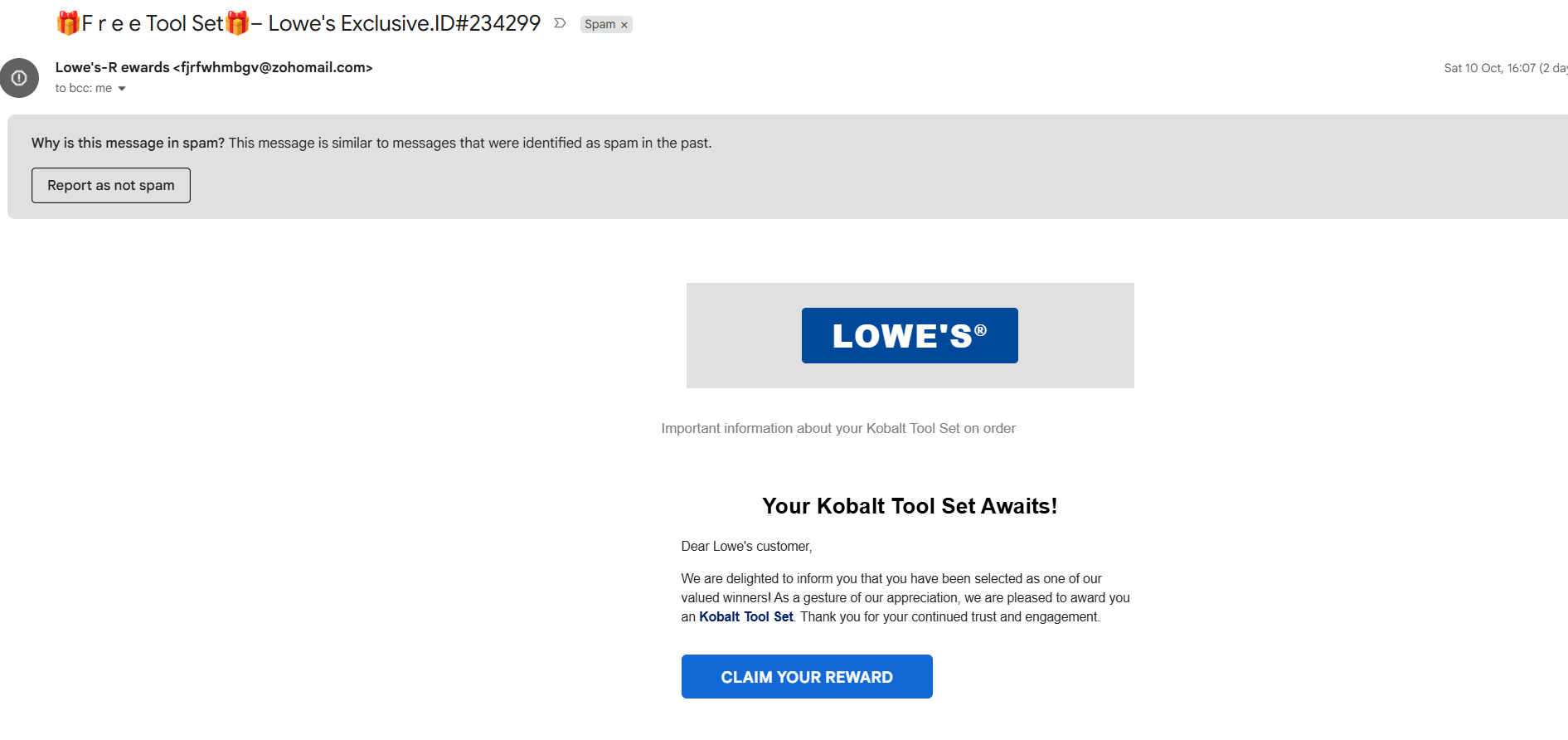
“🎁F r e e Tool Set🎁 – Lowe’s Exclusive.ID#234299”
The unusual spacing in “F r e e” and the inclusion of gift emojis are designed to attract attention.
The sender appears as “Lowe’s-R ewards”, making the message look like a notification from the retailer’s loyalty program.
But the actual sender address is fjrfwhmbgv@zohomail.com.
That address has no apparent connection to Lowe’s and is one of the strongest warning signs in the message.
The email itself uses a simple design. A large Lowe’s logo appears near the top, followed by text describing important information about a Kobalt tool set.
The main headline announces:
“Your Kobalt Tool Set Awaits!”
Below it, the message tells the recipient they have been selected as one of the company’s valued winners.
The text thanks the recipient for their continued trust and engagement, attempting to make the promotion feel like a personal reward for customer loyalty.
A prominent blue “CLAIM YOUR REWARD” button appears beneath the announcement.
There are several problems with this message.
The recipient isn’t told which promotion they entered, when the drawing took place, or why they were selected. There’s no reference to official giveaway rules or a verifiable customer account.
The email also implies a product is already on order while simultaneously announcing that the recipient has just been chosen as a winner.
These details may seem minor individually, but together they reveal an offer that doesn’t behave like a normal retail reward notification.
The objective is to get the recipient to click the button and continue the process on an external website.
The Gmail example was automatically placed in the Spam folder, with a warning that it resembled previously identified spam.
That warning was appropriate for this suspicious message, although spam filtering alone cannot catch every version of the campaign.
The Scam Isn’t Limited to Email
The same general promotion also appears through paid social media advertisements.
A person browsing Facebook or Instagram might see a sponsored post featuring a Kobalt tool set and a message about an exclusive Lowe’s giveaway.
The advertisement may describe the reward as a customer appreciation gift, a special loyalty promotion, or a limited-time opportunity.
The visual presentation can look convincing, especially when professional product images and familiar branding are used.
Some advertisements direct visitors straight to a prize-selection game, while others first present a short promotional landing page.
This allows the operators to reach people who might never respond to an unsolicited email.
Social media advertisements can be particularly effective because they appear alongside legitimate retailers’ promotions.
A sponsored label, however, doesn’t mean that Lowe’s approved the advertisement or has any relationship with the website behind it.
Fraudulent advertisers can imitate company names, reuse product photographs, and pay to distribute misleading offers.
Users should judge the actual destination and the terms of the promotion, not simply the appearance of the advertisement.
How the Lowe’s Kobalt Tool Set Winner Scam Works
The deception is designed as a series of small, seemingly harmless actions.
Rather than immediately requesting a large payment, the website builds excitement around the prize and introduces the financial commitment only after the visitor believes they’ve won.
Step 1: An Email or Sponsored Ad Promises Free Kobalt Tools
The process begins with an unexpected reward announcement.
An email may claim the recipient has been selected by Lowe’s Rewards. A social media advertisement may promote a free Kobalt tool kit available to selected customers.
Both versions rely on the appeal of receiving valuable tools without paying retail price.
The branding makes the offer seem familiar, while the promise of a free reward creates an incentive to act.
The email’s claim button or advertisement link leads away from the original platform and toward an external promotional website.
Step 2: The Visitor Lands on a Giveaway Website
The linked page may display Lowe’s branding, Kobalt product photographs, and messages about an exclusive reward.
The website can resemble an official retail promotion without actually being connected to the retailer.
Visitors may see congratulatory text, eligibility claims, or statements suggesting a limited number of tool sets remain available.
The domain name is important here.
A page that contains a retailer’s logo isn’t necessarily hosted or operated by that retailer. Fraudulent sites can use unrelated domains, redirects, and familiar-looking graphics to imitate a legitimate promotion.
The page’s purpose is to keep the visitor engaged and encourage them to complete the next step.
Step 3: A Mystery Box Game Reveals the Prize
One distinctive part of this scam is the box-selection game.
Visitors are presented with several gift boxes and asked to choose one to reveal what’s inside.
After selecting a box, an animation may play before the website announces the result.
Some versions of these prize games allow multiple attempts, increasing the likelihood that the visitor will eventually receive a winning message.
There’s no reason to assume this represents a genuine random drawing.
A website can be programmed to show every visitor the same prize, regardless of which box they choose.
The game is useful to the scam operator because it changes how visitors perceive the offer.
Instead of simply being promised free tools, they now feel they’ve actively won them.
That sense of accomplishment can make the next request seem like a normal part of claiming a prize rather than a suspicious financial transaction.
Step 4: The Website Asks for Shipping Information
After announcing the win, the page explains that the tool set needs to be shipped.
Visitors are asked to provide their full name, address, email, and possibly a phone number.
These details appear reasonable because a physical product would require a delivery address.
The website may then display a checkout screen showing the product as free, with only a small delivery or processing fee remaining.
This is the critical transition.
The visitor believes they’ve already won the prize and only needs to complete a routine shipping payment.
At this point, questioning the website can feel less important than finishing the order.
Step 5: The Small Shipping Fee Introduces the Payment Trap
The website requests a credit or debit card to cover the supposed shipping charge.
Because the amount appears small compared with the value of the tool set, many visitors may consider it an acceptable risk.
But the payment form may authorize more than the displayed delivery expense.
In deceptive versions of this scheme, the checkout can also enroll the visitor in an automatically renewing membership or trial subscription.
That information may be placed in small print, buried in the terms, or described using vague language.
A person who thinks they’re paying to ship a Kobalt tool set may actually be entering a billing agreement with an unrelated subscription company.
The email screenshot does not establish an exact shipping amount or monthly subscription price. Those details can vary depending on the destination website.
What makes the arrangement deceptive is the difference between the prominently advertised one-time payment and the ongoing financial obligation that may follow.
Step 6: The Hidden Subscription Begins Charging the Card
After completing checkout, the visitor may receive a confirmation message suggesting the tool set is being prepared for shipment.
That message helps maintain the appearance of a legitimate order.
Meanwhile, the payment may have initiated a trial membership that later converts into recurring billing.
Additional charges can begin appearing after the introductory period ends.
The billing descriptor may identify a digital membership, online service, or another company rather than Lowe’s.
That difference makes the payments harder to recognize.
Someone who completed the giveaway several weeks earlier may not immediately connect an unfamiliar monthly charge to the tool set promotion.
If the charge goes unnoticed, more payments may follow.
The operator’s ongoing revenue can come from these subscriptions rather than from selling or delivering any tools.
Step 7: Canceling the Unwanted Subscription Becomes Difficult
People who discover the recurring payments may attempt to cancel the service.
Unfortunately, some deceptive subscription operations make this unnecessarily complicated.
The cancellation process might require contacting a separate company, finding a poorly displayed support page, or submitting requests that receive no meaningful response.
A support agent may insist that the customer accepted the membership terms during the original checkout.
Even if those terms were technically presented, that doesn’t establish that the customer knowingly agreed to the recurring service.
In other cases, a cancellation request may be acknowledged without subsequent billing actually stopping.
The customer is left dealing with an unfamiliar merchant for a product they never intended to purchase.
This is why it’s important to preserve evidence of the original offer and involve the card issuer if the charges continue.
The Real Scam Is the Subscription, Not Just the Shipping Fee
The most damaging part of these offers isn’t always the initial payment.
It’s the possibility of recurring charges that continue long after the promotional website has disappeared from the visitor’s memory.
The shipping fee acts as the gateway.
A customer who would never knowingly purchase an unrelated monthly membership might still provide their card details to receive a valuable tool set for a few dollars.
That small commitment makes the transaction feel low-risk.
The checkout then uses the customer’s participation to create an apparent basis for future billing.
The Federal Trade Commission warns that some free-trial offers result in recurring charges, particularly when companies fail to disclose renewal terms clearly or make cancellations difficult.
Its consumer guidance on free trials and negative-option subscriptions specifically addresses cases where consumers are asked to pay shipping or other small fees for supposedly free products.
This is the same underlying issue with the deceptive Kobalt tool set offers.
The customer is drawn in by a free physical product, but the payment process may involve an entirely different service.
Even if the subscription operator argues that the terms were disclosed, customers may have been led to believe the transaction involved only shipping.
That distinction matters when challenging the charges.
The problem isn’t simply that someone changed their mind about a subscription.
It’s that the subscription may never have been presented as the real reason for the payment.
Red Flags That Reveal the Fake Lowe’s Giveaway
The Lowe’s Kobalt Tool Set Winner scam has several characteristics worth checking before entering personal or payment details.
An unexpected winner announcement. The message claims you’ve won a valuable product without identifying a contest you knowingly entered. A specific-looking reference number doesn’t prove the prize is real.
A sender address unrelated to Lowe’s. In the captured example, the message uses @zohomail.com while claiming to represent Lowe’s Rewards.
An unfamiliar website. The giveaway takes place on an external promotional page rather than through a verified Lowe’s account or official promotion.
A mystery box game. The website uses an interactive prize reveal to create excitement, but that doesn’t establish that a genuine contest occurred.
A free product that requires card information. The offer moves from a supposed prize to a payment request for shipping or handling.
Hidden membership language. Terms mentioning automatic renewal, introductory trials, or recurring services are particularly concerning when the advertised offer is simply a free tool set.
Difficult-to-identify merchants. The checkout or later transactions may name a company unrelated to Lowe’s or Kobalt.
Pressure to act immediately. Countdown timers, limited availability messages, and urgent redemption instructions discourage independent verification.
The strongest warning is the combination of these elements.
A free product advertised through an unrelated account, followed by a game and a card payment on a third-party website, is not something to trust without verification.
What To Do If You Paid for the Lowe’s Kobalt Tool Set Scam
If you’ve entered your card details or noticed recurring charges after claiming the supposed reward, act promptly.
Contact Your Credit Card Company or Bank
Call the number on the back of your card or use your bank’s official app.
Explain that you entered your card information to pay what appeared to be a one-time shipping fee for a free Kobalt tool set.
If you were subsequently enrolled in a subscription without your informed consent, make that clear.
Ask the issuer to investigate the charges, explain your dispute options, and help prevent further unauthorized payments.
Depending on the circumstances, the issuer may recommend replacing the card or taking additional steps to stop recurring billing.
Ask specifically about merchant-initiated recurring payments, because replacing a card number may not always terminate every existing payment arrangement.
Identify the Subscription Charges
Review your transaction history for the original shipping payment and any subsequent unfamiliar charges.
The recurring payments may not appear under the name Lowe’s.
Record the merchant names, dates, and amounts.
Look for repeating transactions and identify when the first unexpected payment occurred.
This information will help your bank investigate the billing.
Request Cancellation in Writing
If you can identify a legitimate contact channel for the subscription operator, request immediate cancellation and written confirmation.
Don’t provide additional sensitive payment details to an untrusted website simply to access a supposed cancellation form.
Save your cancellation request and any reply.
If the operator is unresponsive or continues charging, contact your card issuer rather than waiting indefinitely.
The FTC advises consumers to dispute charges with their card issuer when unwanted subscription payments aren’t resolved by the merchant.
Dispute Charges You Didn’t Agree To
If you authorized a shipping fee but did not knowingly consent to monthly subscription payments, explain that distinction in your dispute.
Provide the original email, screenshots of the advertised prize, payment confirmation, and any terms you retained.
A clear account of what was advertised and what was charged can be more useful than simply reporting an unfamiliar merchant name.
Contact your issuer promptly because payment disputes may be subject to deadlines.
Protect the Information You Shared
If you entered your name, address, phone number, or email, be alert for additional suspicious messages.
Scammers can reuse contact information to send further offers, fake delivery notifications, or payment-related phishing messages.
If you entered a password on the suspicious website, change it anywhere else you’ve reused it and enable multifactor authentication.
Entering a shipping address alone doesn’t establish that any of your accounts were compromised, but it does justify caution about follow-up messages.
Report the Advertisement or Email
Use your email provider’s phishing-reporting feature for the suspicious message.
If you encountered the offer through Facebook or Instagram, report the advertisement and the account promoting it.
You can also notify Lowe’s through its official website that someone is using the company’s branding in a misleading promotion.
For U.S. consumers, the FTC accepts fraud reports at ReportFraud.ftc.gov.
Keep the original email, suspicious URLs, screenshots, and transaction records as evidence.
Monitor Your Account After Cancellation
Continue checking your card statements even after you receive confirmation that the subscription has been canceled.
A cancellation email doesn’t guarantee the next payment won’t be attempted.
If another charge appears, contact the bank immediately and provide your earlier dispute or cancellation reference.
Transaction alerts can make new attempts easier to spot.
Frequently Asked Questions
Is the Lowe’s Kobalt Tool Set Winner email a scam?
The captured email shows strong signs of a scam. It claims to represent Lowe’s Rewards but comes from an unrelated email address and announces a prize without verifiable contest details.
It should not be treated as an authentic Lowe’s notification.
Does Lowe’s really give away free Kobalt tool sets?
Lowe’s can run legitimate promotions, but that doesn’t make every online giveaway using its name genuine.
Verify the specific offer by visiting Lowes.com independently or contacting the retailer through official support channels.
Why does the website ask me to choose a box?
The mystery box game makes visitors feel they’ve participated in a prize drawing.
However, an on-screen game can be programmed to show predetermined results. Selecting a winning box doesn’t prove that the prize exists.
Why do I have to pay shipping for a free Kobalt tool set?
The shipping charge makes the offer seem plausible while encouraging visitors to provide payment information.
In the deceptive version of this promotion, the checkout may also enroll customers in recurring subscriptions.
The FTC warns that requests for payment to collect supposed prizes are a major sign of prize fraud.
Can the Lowe’s Kobalt giveaway charge my card every month?
Yes. Deceptive versions using a subscription-based checkout can result in monthly charges after the initial shipping payment.
The merchant, amount, and billing schedule can vary, so check the terms and your transaction history.
What if I only clicked the email link?
If you clicked but didn’t enter personal or payment information, close the page and don’t continue the process.
A click alone doesn’t prove your card or accounts have been compromised.
If you downloaded software, installed an extension, or granted unusual browser permissions, investigate those separately.
What if I already entered my credit card?
Contact your card issuer promptly, explain the misleading giveaway, and ask for help identifying and stopping unauthorized recurring charges.
Monitor your transactions and preserve any evidence of the offer.
How do I cancel the subscription?
Identify the merchant responsible for the charges and request cancellation through a verifiable channel.
Keep a record of the request.
If you cannot reach the merchant or billing continues, ask your card issuer about stopping payments and disputing charges that weren’t properly authorized.
Will I receive the Kobalt tools after paying shipping?
There’s no reliable reason to assume that an unverified third-party giveaway will deliver the advertised tools.
An order confirmation or prize-reveal animation doesn’t establish that a product has been dispatched.
Are the Lowe’s giveaway advertisements on Facebook legitimate?
Not necessarily. Fraudulent advertisers can pay to distribute sponsored posts that imitate major retailers.
Check the advertiser and the destination website independently. A sponsored label doesn’t mean Lowe’s authorized the promotion.
Is the Kobalt Tool Set Winner scam a virus?
The primary risk is financial rather than malware-related.
These offers are designed around personal information collection, deceptive checkout processes, and possible recurring billing.
If you haven’t installed anything, your first priority should be securing your payment information.
The Bottom Line
The Lowe’s Kobalt Tool Set Winner scam turns the promise of free tools into a reason to enter payment information on an unverified website.
Whether the offer arrives through an unsolicited email or a sponsored social media advertisement, the process can follow the same pattern: a supposed prize, a mystery box game, a shipping form, and a small payment that may lead to recurring subscription charges.
The most important detail is what happens at checkout.
A few dollars for delivery can seem harmless, especially when the advertised tool set is supposedly worth much more. But if that payment starts a subscription you didn’t knowingly agree to, the financial consequences can continue long after the original offer.
Don’t claim unexpected prizes through suspicious links, and don’t enter card information unless you’ve independently verified both the promotion and the company processing the payment.
If you’ve already paid, contact your card issuer promptly, document the charges, and take steps to prevent additional billing.
A free Kobalt tool set shouldn’t leave you paying for a monthly membership you never wanted.








