

A new product claims to deliver Tirzepatide, the powerful injection used in FDA-approved drugs like Mounjaro and Zepbound, via a painless microneedle patch. Marketed under the name NIDDK Tirzepatide Microneedle Patch, it promises quick weight loss—up to 20 pounds in weeks—while appearing endorsed by top institutions such as Stanford Medicine and using official-sounding labels like “FDA Approved” and “GMP Certified.” But is this too good to be true?
In this article, we’ll thoroughly examine the product, the marketing funnel, red flags, what to do if you’ve already purchased, and whether this patch is just another deceptive weight-loss scheme.
Overview
The Grand Promises
- Drop 20–35 lbs fast
- Zero pain, 24/7 controlled release
- 90% blood sugar reduction
- Gummies of scientific logos and institutional endorsements
- “Recommended by Stanford professors” or “NIDDK-backed”
Product Presentation
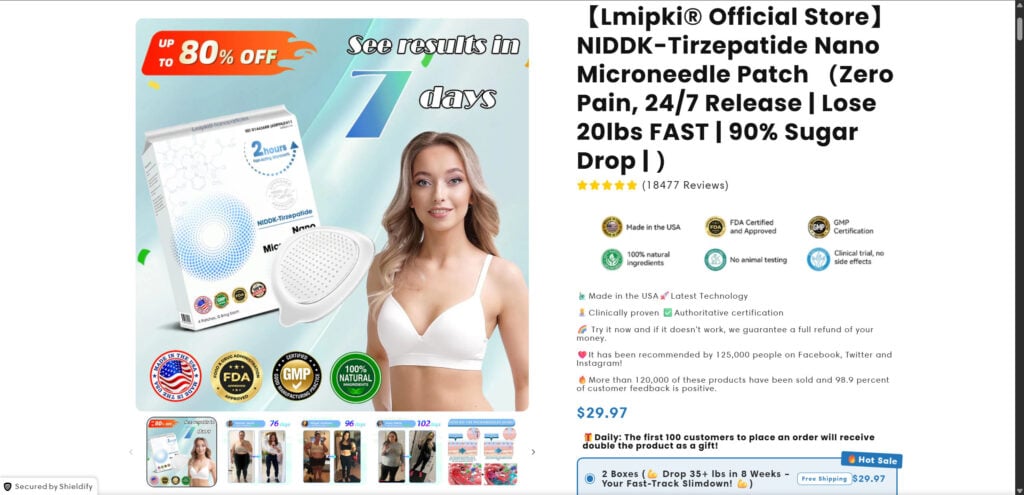
The site mimics a medical portal: a smiling doctor (labeled Dr. Ralph DeFronzo, University of Texas diabetes expert) appears, citing professional credentials. Vibrant badges—FDA, GMP, Made in USA—alongside bold banners like “Up to 80% Off,” “See results in 7 days,” and star ratings—give off medical-grade credibility. There’s also a dramatic before-and-after weight loss photo.
The Substance (or Lack Thereof)
Despite high-tech packaging and persuasive visuals, several areas stand out:
- NIDDK Tirzepatide Microneedle Patch uses words like “NIDDK,” “Nano Microneedle,” and “Semaglutide,” indicating it delivers an oral drug-like treatment through patch technology.
- Miracle claims that it mimics injectable tirzepatide (the actual prescription drug only available via licensed medical providers).
- Institutional affiliation is implied—not confirmed (no official NIDDK or Stanford medical endorsements exist).
- Price is around $29.97–$49.99 for limited supply “starter kits.”
- Real healthcare compliance credentials are missing: there is no FDA registration for home-use drug patches.
Powder Coating of a Scam?
Products like Ozempic, Mounjaro, and Zepbound are FDA-regulated injectables. No over-the-counter, self-administered patch can safely or legally provide a controlled dose of an active peptide hormone. The marketing suggests “pain-free microneedles,” “24/7 continuous 2-hour release,” and “no injections required,” yet fails to mention any manufacturer license or clinical data supporting safety or effectiveness.
Medical Realities vs. Website Claims
- Tirzepatide is a prescription medication: approved under strict medical supervision to lower blood sugar and promote weight loss among certain patients.
- Microneedle patches are experimental: while research exists, none have FDA approval for delivering weight-loss peptides.
- Clinical rigor missing: No peer-reviewed trials, no official labeling, no packaging inserts or prescribing info.
Fake Reviews and Testimonials
The site features glowingly positive testimonials: “Lost 35+ lbs in 8 weeks!” featuring before/after images. But:
- Identical images show up on unrelated diet sites.
- Reviews lack medical verification.
- “Recommended by professors” appears as a stock photo of Stanford faculty (likely not connected).
Urgency and Scarcity Tactics
- Countdown timers (“Offer ends in 10:14:27”)
- Low stock alerts (“Only 7 kits left”)
- “First 100 customers get bonus patch” offers
- Retargeting via ads and follow-up emails create pressure to buy
Summary of the Overview
The NIDDK patch positions itself as a revolutionary, prescription-grade fix. But beneath the high-tech presentation lies a problematic combination of:
- Unsubstantiated medical claims
- No verifiable clinical data or regulatory approval
- Emotional marketing using fake endorsements
- Pricing tactics designed to rush purchases
This raises strong doubt about legitimacy—though it stops short of calling it outright fraudulent, the apparent misdirection and lack of transparency warrant caution.
How the Scam Works
1. Initial Hook
Users encounter ads that read:
- “Pain-free patch delivers weight loss medication daily.”
- “Endocrinologists shocked—Lose 20 lbs without needles.”
- “UP TO 80% OFF today only!”
Ads feature medical imagery—a doctor in a white coat, scientific badges, or animated dashboards showing weight graphs.
2. Clickthrough to Landing Page
You land on a professional-looking website with:
- Bold banners: “NIDDK-Tirzepatide Nano Microneedle Patch”
- Fake professor endorsements (e.g., Stanford, Texas Diabetes Institute)
- Intriguing copy: “Insulin secretion, fat burning, glucose reduction”
Yet there is no real medical literature or legal disclaimers. Visuals include patches, boxes, doctors, and glowing product shots.
3. The Long-Form Sales Video
Many flows embed a video 30–60 minutes long—evoking trust with:
- Dramatic storytelling
- Charts comparing injections vs. patch
- Claims of a painless 24-hour release
- Fake urgency (“Sale ends soon”)
The patch and its benefits are introduced late—after viewers invest time and emotion.
4. The “Clinical Study” Section
The site may feature bullet points claiming:
- 98.6% customer satisfaction
- Recommended by Stanford Med
- GMP and FDA Certified
But links are missing; no actual study PDFs or clinical documents are available.
5. Checkout Funnel Stages
You click “Add to Cart”—then face:
- Tiered packages (1 patch, 2 patch + discount, 3 patches + bonus)
- “Recommended” quantities, encouraging upsell
- Hidden auto-renew checkbox
- Fake countdown timers
- “Safer with subscription” prompt
Buy now? A “money-back guarantee” page and checkout finalize your purchase—often with limited disclosure of recurring charges.
6. Payment and Post-Purchase
You pay $29.97–$49.97. Immediately afterward:
- You’re presented with “upsell: 80% off second box”
- You may be enrolled in auto-ship without clear consent
- Support links are generic; phone numbers may not connect
7. Shipping and Delivery
- Shipping takes 2–4 weeks from overseas
- Brandings differ from the landing page
- No documentation, no information sheet, no prescribing instructions
8. Aftermath
If taken, users may notice:
- Minimal or no weight loss
- No medical supervision
- Potential side effects
- Difficulty canceling auto-pay or requesting refunds
Lay users may feel misled—tricked into thinking they were receiving a legitimate pharmaceutical treatment.
What to Do if You’ve Bought This Product
- Request Cancellation and Refund
- Email or call support referencing “unsatisfied with product as described.”
- If unresponsive, escalate to your credit card company.
- Initiate a Chargeback
- Sue your bank if refund requests are ignored.
- Argue false marketing and absence of promised benefits.
- Cancel Recurring Billing
- Check bank or card statements for auto-charges.
- Contact bank to block future charges from merchant.
- Report Fraudulent Sites
- Submit complaints to FTC, Better Business Bureau, or your national consumer agency.
- Watch for Side Effects
- Consult a doctor if any suspicious health issues arise, especially related to glucose, endocrine function, or skin irritation.
The Bottom Line
- The NIDDK Tirzepatide Microneedle Patch claims to deliver prescription-level weight-loss medication via a patch—without medical oversight.
- The sales model is emotionally manipulative: long videos, false acclaim, fake urgency.
- No verifiable studies, no FDA approval, and no official institutional endorsements.
- While not evidently dangerous, users may waste money or delay effective treatment.
- For proven results, consult licensed physicians and use FDA-approved options.
This product skirts the line of legitimacy. It’s marketed like a pharmaceutical—but acted out like an unregulated dietary supplement. That discrepancy is the core of the concern. When healthcare claims outpace evidence, skepticism is warranted.








