


Someone you’ve grown close to online says he’s working on an oil rig. He talks about coming home, but something keeps changing his plans.
Then a problem at sea becomes part of your everyday conversations. Before you agree to help, take a closer look at the story you’re being told.
Overview
The offshore job explains why you can’t meet
The oil rig romance scam uses a fictional relationship to turn someone else’s supposed emergency into your financial responsibility. The offshore job keeps the person conveniently out of reach.
He may describe himself as an engineer, contractor or business owner. His work sounds successful, while his location explains postponed visits and difficulties accessing money.
The job itself isn’t the warning. The problem is an unverified online partner who needs your money to solve obstacles that keep preventing your first meeting.
The same story appears in documented fraud
Australia’s National Anti-Scam Centre specifically identifies oil rig work among the stories used to explain both distance and requests for financial help.
A federal prosecution in Utah also described offshore business personas who promised relationships, then sought advances to finish projects before they could leave.
These tactics appear in established fraud cases. An individual person’s occupation, accent or photograph still doesn’t establish whether that person is committing a crime.
The requests often sound temporary and personal
The supposed solution can change as the relationship develops. Watch for a combination of these details rather than waiting for one particular phrase:
- A wealthy partner says his own accounts are frozen.
- Gift cards are requested for calls or emergencies.
- A work project must finish before he can visit.
- Each payment leaves another obstacle to coming home.
- You’re asked to receive or forward someone else’s money.
Don’t pay an online-only partner to unlock his money, fund his work or bring him home. A promised repayment doesn’t make those requests safe.
Why an Oil Rig Makes Such a Useful Cover Story
The story gives the stranger two things at once: a reason to seem financially secure and an explanation for being unable to help himself.
That contradiction can be easy to overlook when the conversations already feel like a relationship. You’re thinking about someone you care about, rather than assessing a payment request.
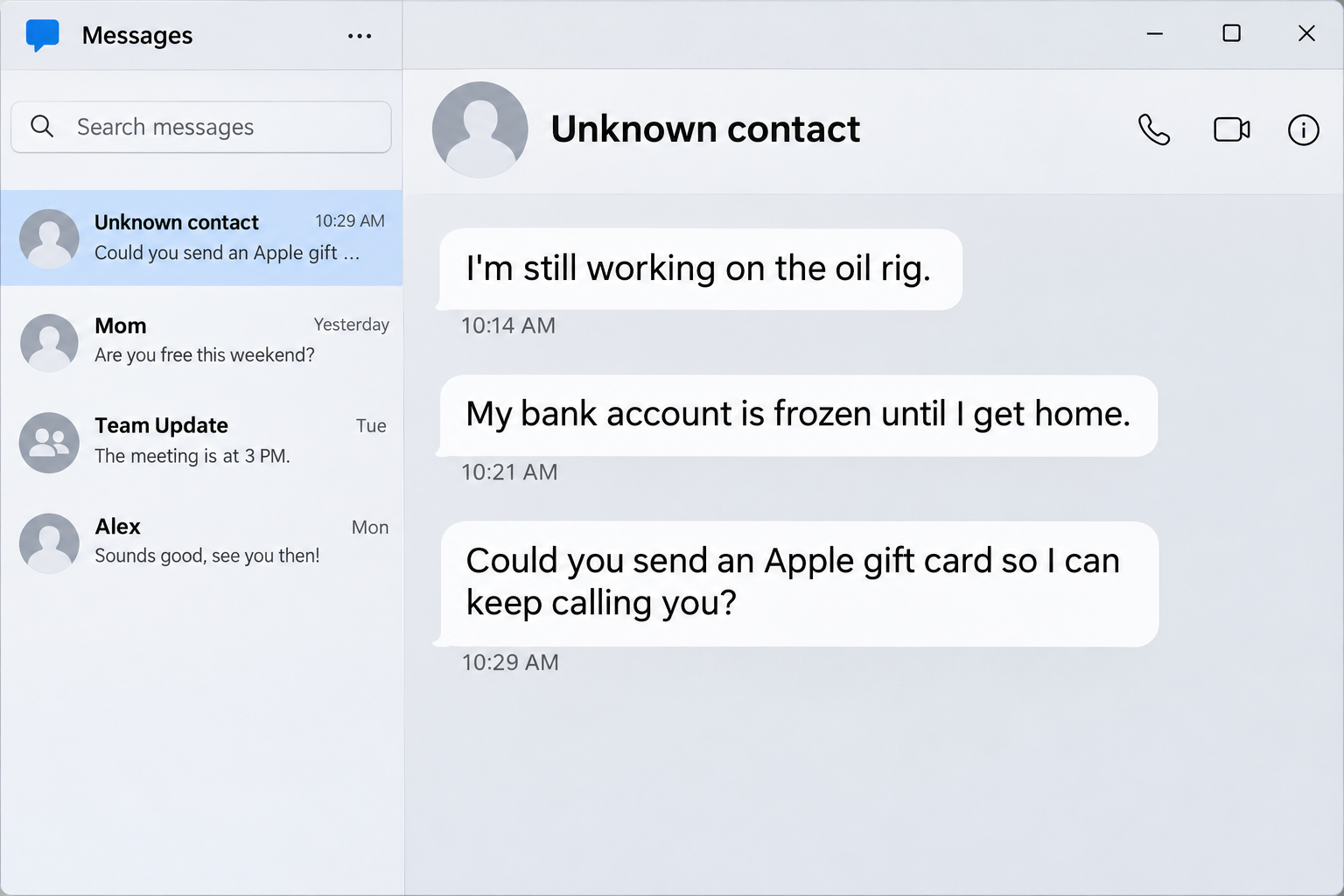
The chat illustration recreates that shift using fictional messages. It shows the offshore explanation becoming a frozen-account excuse, followed by a request for an Apple gift card.
One reported oil rig scheme began through Trivia Crack. The conversation moved to phone calls, and the man claimed to have substantial wealth he couldn’t access.
The family described Apple gift card requests for calling minutes and a daughter’s medical emergency. They said the victim lost several thousand and also received physical gifts.
That report is a family’s account, not a bank investigation. It illustrates how an ordinary game and an apparently affectionate relationship can lead to repeated payments.
The wider mechanism is independently documented. You don’t need to decide whether every detail in one online account is accurate to recognize the dangerous financial request.
How the Oil Rig Romance Scam Works
Step 1: An ordinary conversation becomes a private relationship
The first contact may happen somewhere you weren’t looking for a date. A game opponent, social media contact or fellow community member starts talking regularly.
Moving into private messages lets the relationship develop away from the original community. Other people no longer see the conversations or the promises being made.
The stranger learns what matters to you through everyday exchanges. Work, bereavement, loneliness and family worries can become subjects that make the connection feel unusually close.
Regular contact can build trust without establishing identity. Knowing your routines and remembering a difficult anniversary says something about the conversations, but doesn’t verify the person behind them.
Keep the original profile information when a new contact changes platforms. If problems emerge, a display name in your phone may be harder to trace than the initial account.
Step 2: The offshore assignment keeps a meeting out of reach
The claimed job puts the person somewhere difficult for you to visit. A contract, rotation or unfinished project stands between today’s conversation and the promised relationship.
A delay can sound reasonable on its own. The pattern becomes clearer when every proposed meeting depends on resolving another problem you are expected to finance.
Check concrete facts separately from the person’s explanations. Search the named platform or employer using sources you find yourself, rather than documents or websites he sends.
A recent Discord account described someone claiming to work aboard Deepwater Horizon. The recipient recognized the contradiction and ended contact.
NOAA’s incident timeline records that the rig sank on April 22, 2010. A current assignment aboard that rig cannot explain someone’s absence.
A less obvious story can still be fraudulent. Finding a real platform with the same name verifies the platform, not the stranger’s employment or identity.
Step 3: Supposed wealth makes a request look like a short loan
The person describes valuable contracts, savings or an impressive bank balance. Then he explains that a temporary restriction prevents him from using any of it.
This makes your payment seem like a bridge to money that already exists. Instead of asking whether you should pay, you start wondering how quickly he’ll repay you.
Don’t use banking credentials supplied by the stranger to inspect his supposed funds. A balance displayed through a link he controls doesn’t independently verify anything.
You also shouldn’t move money through another person’s account to demonstrate trust. The relationship gives you no reliable way to establish where that money came from.
His difficulty accessing funds is not a reason to grant access to yours. Keep your account login, verification codes and financial documents out of the conversation.
Step 4: An urgent problem supplies the reason to pay
The request may involve a relative, a work expense or a problem keeping him offshore. It is presented as an immediate obstacle to the future you’ve discussed.
The Utah prosecution described rig and pipeline personas seeking advances to complete projects. Victims were assured that the money would be returned.
In that broader romance and money laundering case, one defendant received a prison sentence after pleading guilty. The case involved more than 350 victims across several impersonation stories.
The emotional pressure can arrive without a direct demand. Someone who repeatedly describes a crisis may be steering you toward offering money yourself.
Ask what you’re actually being asked to fund. Caring about the person doesn’t establish that the hospital, contractor, travel arrangement or claimed emergency is genuine.
Step 5: The payment method puts your help beyond easy recovery
A request for a gift card can feel smaller than a bank transfer. Sending a photo of the code may seem like helping with one manageable expense.
The code is what gives the recipient access to the card’s value. Keeping the plastic card in your possession doesn’t protect the money after you’ve shared its redemption details.
Apple’s gift card warning says its cards pay for Apple products and services. They don’t pay hospital bills or government fees.
If the supposed emergency requires Apple gift cards, the payment explanation doesn’t fit the bill. Stop there instead of trying to find a smaller amount you can afford.
A bank account in your country isn’t sufficient reassurance either. The Utah case described local accounts used to collect money for impersonators operating elsewhere.
Step 6: Another obstacle keeps the payments and promises going
A payment doesn’t produce the promised visit. Instead, the relationship continues while a new problem makes another payment seem necessary.
The National Anti-Scam Centre’s romance fraud report explains that smaller emergency payments can continue for months or years.
Its account also describes pressure to borrow or sell assets, and situations where victims are drawn into moving stolen money.
Watch for requests that change your role from partner to payment intermediary. Receiving a deposit and forwarding it elsewhere exposes you to problems beyond the money you’ve already sent.
Don’t make one final payment to recover earlier payments. The earlier loss is a reason to contact your payment provider, not a reason to finance the next excuse.
What Photos, Calls and Gifts Can Actually Tell You
A convincing picture can show that a real person exists somewhere. It doesn’t establish that the account sending it belongs to that person.
Search profile images and distinctive biographical details independently. A match under another identity can reveal a contradiction; no match doesn’t prove the profile is genuine.
A phone conversation establishes that someone spoke with you. It doesn’t verify the job, the available bank balance or the emergency that follows.
Physical gifts can be especially persuasive because they arrive outside the chat. But a delivered package doesn’t confirm who arranged it or make a later money request legitimate.
Bring the discussion back to the financial decision. Would you send this payment without the relationship and the promised repayment? What independent evidence makes it safe?
You don’t need a confession, a reverse-image match or a complete identification of the scammer to stop sending money and seek help.
What to Do if You Have Fallen Victim to This Scam
-
Stop payments and save the conversation. Keep the original profile link, usernames, messages and payment instructions before blocking. Don’t announce a plan to investigate or negotiate.
Save any emails, gift receipts and transaction references together. Note which payments have been completed and which are scheduled, so you can explain the situation clearly.
-
Contact the provider that handled each payment. Use the bank’s app, your card or the provider’s official website. Explain that an online relationship led to a fraudulent request.
Ask whether a pending transfer can be stopped or a completed payment recalled. Describe accurately what you authorized; don’t present a payment you sent as a card theft.
If you used several services, contact each one. A report about a bank transfer doesn’t automatically reach the gift card issuer or a separate payment app.
-
Report any gift card codes you shared immediately. Contact the issuing brand through its genuine support channel. Keep the card, purchase receipt and the message containing the request.
For Apple cards, follow Apple’s scam-support guidance and explain whether the code was shared. Ask what can still be protected; a refund isn’t guaranteed.
-
Tell your bank about incoming money too. If the person had you receive funds, give the bank the transaction details and the instructions you received.
Don’t forward, withdraw or independently return an unexplained deposit. Let your bank assess the payment and advise how to handle it through the proper process.
-
Protect the personal information you already disclosed. List what you shared, such as account credentials, identity documents or card details. Give the relevant provider that specific information.
If you reused a disclosed password, replace it on your own affected accounts using their genuine settings. Don’t accept account-recovery help from the person who requested the money.
-
Report the impersonation where it began. Use the original game’s, community’s or social platform’s reporting tools. Include the account identifier rather than only the display name.
In the United States, report internet-enabled fraud through IC3. Keep the acknowledgment alongside your payment records, and use your country’s official reporting route elsewhere.
-
Let someone trustworthy help you step away. Tell a friend or relative what happened. Ask them to sit with you during the first calls if that helps.
Don’t pay anyone who contacts you promising guaranteed recovery. A new request for an advance fee can exploit the same hope that kept the original payments going.
If Someone You Love Still Believes the Story
Start with the payment, not an argument about whether the relationship was real. Suggest a pause while you call the bank together through a trusted number.
Ask permission to look at one concrete claim, such as the rig’s name or the reason a hospital supposedly needs gift cards. Avoid turning the conversation into a public confrontation.
Offer practical company without financing the next request. You can help save messages or make a report while declining to lend money for the supposed emergency.
If the person isn’t ready to disengage, keep communication open. Being able to tell you about the next demand may matter more than winning today’s argument.
Frequently Asked Questions
Is every person who works on an oil rig a scammer?
Real offshore workers aren’t the target of this warning. The concern is an unverified relationship that turns distance, inaccessible wealth and recurring emergencies into requests for your money.
Why would someone wealthy ask for gift cards?
The claimed wealth makes repayment sound likely, while the frozen-account story explains the request. Neither claim verifies the person, and gift cards don’t pay hospital bills.
Does receiving a gift mean the relationship is genuine?
A package confirms that something was delivered. It doesn’t authenticate the sender’s identity, employment or financial claims, and it doesn’t make a later payment request safe.
Should I log into his bank account to check the balance?
Don’t follow a stranger’s banking link or use supplied credentials. A page he controls can show whatever balance he wants, without proving that money exists.
Can I be targeted if I have little money?
Limited savings don’t remove the risk of pressure to borrow or move funds. Don’t accept deposits or forward payments on behalf of an unverified online partner.
Will reporting guarantee that I get my money back?
Recovery depends on the payment and its status. Contact the provider promptly, preserve the records and make an official report without paying anyone to guarantee a result.
The Bottom Line
Don’t send money or gift card codes to an online-only partner to fix an offshore emergency. Promised wealth and a future visit don’t secure your payment.
If you’ve already paid, stop contact and call the relevant payment provider now. Save the messages and receipts, then let someone you trust help you make the report.

Join the discussion
0 commentsShare your experience or ask a question about this article.
Community experiences
Did this happen to you?
Your experience could help someone recognize the same scam. Submit a private report for our team to review.
I experienced this tooReports are reviewed before publication. Sharing publicly is always your choice.
Discussion
Start the conversation
Have a question or something useful to share? Add the first comment.