


You have a Traders Domain statement, a claim number or a folder of payment records. Then an update appears in the case, and you want to know what changed.
What you need is the document that speaks to your claim.
Overview
Why there is a receivership for Traders Domain
The Commodity Futures Trading Commission filed a civil case against Traders Domain FX Ltd. and other defendants in a federal court in Florida in September 2024.
The CFTC’s case page lists the complaint and orders. The receivership site is a separate source for claims information, official updates and the receiver’s reports.
A receiver is appointed by the court. This is not the same person or company that sold you a trading account or invited you to deposit money.
The CFTC’s customer alert describes an alleged fraud and says the agency sought restitution in its civil case. Seeking that result is different from paying each customer.
What the ninth report says about claims
The ninth status report, filed October 23, 2026, describes reviewing objections and adjusting recommendations. It says approved claims will be used as a basis for a proposed distribution plan.
That is a sequence, not a payout announcement. A recommendation concerns what amount the receiver believes the court should recognize. It does not say how much cash a claimant gets.
Use the report to understand where a question belongs. A dispute over what you deposited is not the same as a delay in sending a distribution.
The survey, claim and objection were different records
The CFTC warned that answering its voluntary survey did not count as filing a claim. An email to the agency is not necessarily proof of filing either.
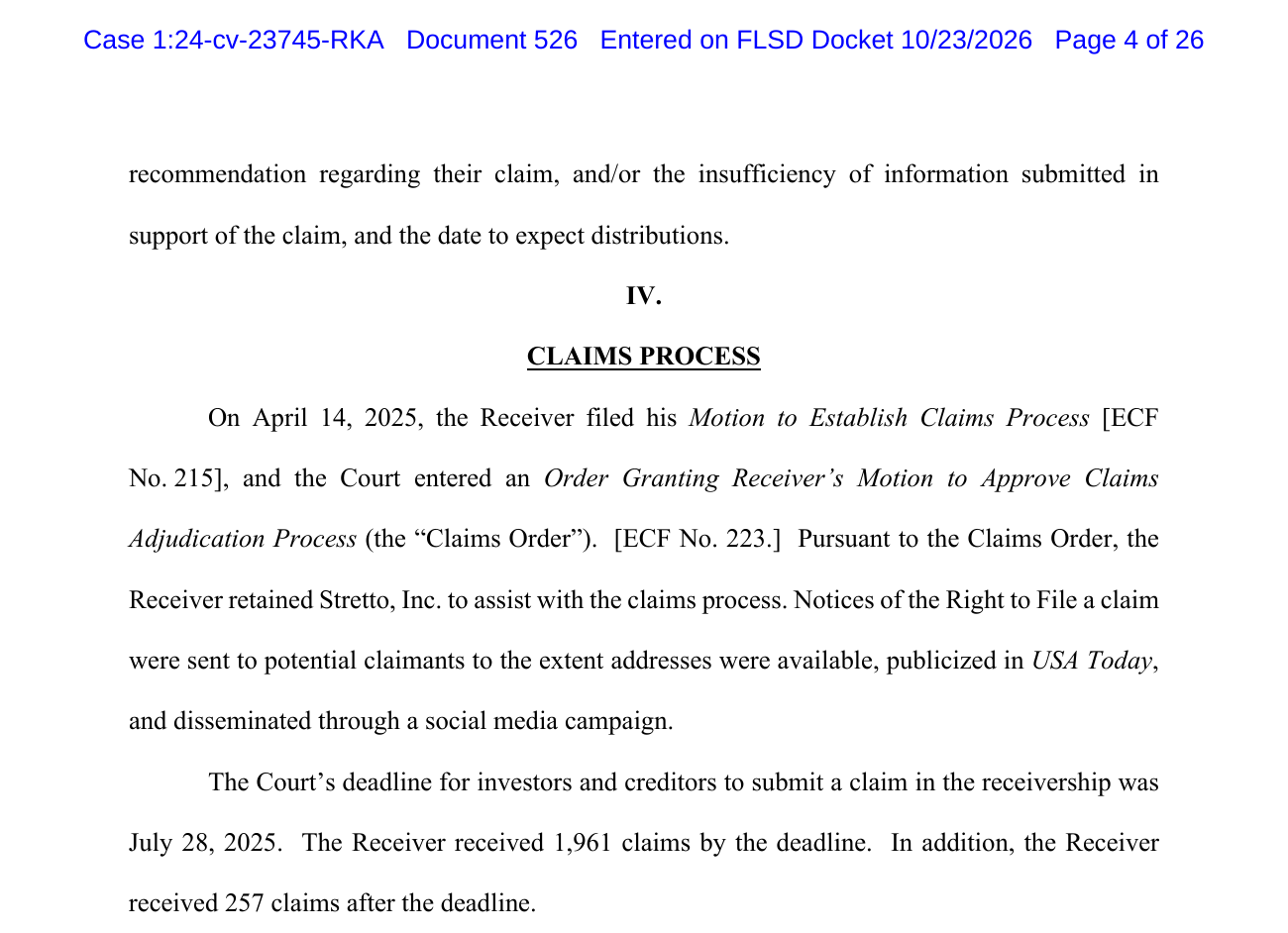
The published deadline for filing a claim was July 28, 2025. The receiver separately identified March 5, 2026 as the deadline for objections to the amended claims report.
- Find the submission confirmation for your own claim before assuming a survey or complaint covered it.
- Do not make a second filing or miss another instruction based only on a social media post.
- Distinguish an approved claims list, a proposed distribution plan and an order authorizing payment.
- Treat unsolicited refund offers as suspicious even when the sender quotes a genuine case number.
What Each Stage of the Claims Process Means
Step 1: Find out whether your records show a filed claim
Start with your email or saved receipts. Look for a confirmation from the official process, not a message from the person who introduced you to the trading platform.
The CFTC’s claim deadline alert told customers that a previous voluntary survey did not replace a filed claim. This distinction may matter more than how many messages you sent.
If you cannot tell what you filed, compare the records with the receivership’s instructions. Do not reply to a new email asking you to start the process over.
If someone else submitted information on your behalf, ask for the acknowledgment. Make sure it belongs to the correct claim, legal name and transaction history.
Step 2: Read the recommendation without treating it as a payment
The receiver’s report describes evaluating what investors and creditors submitted. It also shows why claims figures can change as objections are resolved and supporting records are considered.
The report says the receiver retained Stretto to help administer claims. If you see that name in an email, verify it using the official case website before responding.
A large figure may be a total across claimants. It does not tell you how much the estate holds or how much a claimant will receive.
Start by checking which number the document describes. Submitted amounts, recommended claims, court-approved amounts and recoverable assets each answer a different question.
If your figure is different from the balance you saw online, keep both records. An account screen is evidence of what was displayed, not necessarily money held for you.
Step 3: Separate a disagreement from a missed deadline
The receiver’s report describes an objections process for people who disagreed with the amended report. Its posted deadline is different from the deadline to submit a claim originally.
If an old notice does not match your situation, ask the verified receiver or claims administrator what applies. Do not assume that an email today extends either deadline.
The October report notes that late claims were received. Receiving a submission does not prove it was allowed, and it does not create a new general filing period.
For an individual legal issue about a deadline, get case-specific advice. A broker, promoter or remote recovery agent cannot reliably tell you what the court will do.
Step 4: Look for court action before acting on a payment story
The report describes what would happen after claims review. It does not, by itself, authorize a transfer to each approved claimant or specify a final recovery rate.
Watch for a notice or order addressing the distribution itself. If the newest document concerns selling an asset, it is about recovering property, not necessarily sending checks.
Before you update bank details for a supposed payment, check the instruction against the receiver’s known public website. Use the office’s independently listed contact channel if you are unsure.
If a text claims your refund will be lost unless you pay a verification fee, leave it alone. Do not transfer funds while you check who sent it.
What the Numbers in the October Report Measure
The court-appointed receiver reported 1,961 claims received by the July 2025 deadline and 257 received after it. Those figures describe intake, not an approval total.
The report also describes 340 objections filed after the amended claims report and says 190 had been resolved before an April filing. It lists later work on remaining claims.
These figures have different dates and definitions. Comparing a deadline count with a later recommendation without checking the footnotes can make normal changes look like missing money.
The October report mentioned possible final claims approval in the first quarter of 2027. That was the receiver’s estimate, not a court-ordered date for sending payment.
For example, a claims total can move because different paperwork changes what is recommended. It does not follow that recovered assets grew by that same amount.
Look for a document that actually names the claimant or claim reference. The estate-wide totals in a public status report cannot answer every question about an individual submission.
Do not publish someone else’s account number or unredacted claim details to ask which category applies. Use verified channels to discuss personal records and addresses.
What to Do If You Paid Into Traders Domain
-
Start with the official case and claims pages. Use the CFTC’s case page and follow the receiver information from there. Save that path somewhere you can find again.
Check the case number against the heading on the document you received. If an update comes by email, compare the attached information with the official source before acting.
-
Build a record of the money you actually sent. Keep statements, confirmations, transaction IDs and the names of recipients. Record any withdrawals or repayments separately from transfers in.
Save account statements even when you think the balances were misleading. They can establish what you saw without proving that the underlying trades happened.
-
Locate your claim acknowledgment and correspondence. Save the reference, submission date and any later reply. If you only remember answering a survey, do not claim you filed without checking.
Use the official claims contact for status questions. Ask which proceeding and claim reference apply if you were involved through an intermediary or a related entity.
-
Ask about your own situation rather than starting over. If you believe you missed a notice or deadline, verify what options exist with the relevant office or a lawyer.
Keep a copy of any answer you get. Do not assume that uploading the same packet several times will put you in a different stage of the case.
-
Do not pay strangers to accelerate a distribution. The CFTC warns about recovery fraud targeting people who already lost money. A convincing case reference is not verification.
Never share a recovery phrase or one-time code to release a court refund. If someone asks for a payment, check the demand with the receiver’s verified office.
-
If you already paid a recovery service, report that separately. Contact your bank, card issuer or exchange through its verified channel and describe the newer transaction.
Preserve the offer, fee demand and payment reference. Reporting the recovery approach does not replace the original Traders Domain claim or change its filing history.
Put Together a Claims File Someone Else Can Follow
Use a bank statement for transfers and a dashboard for promises
Keep the platform’s name, account identifier and statement dates together. If the original site is unavailable, use records you already have instead of signing into a lookalike.
Give each record a short description. A saved account balance, an incoming bank payment and a confirmation from a claims administrator should not all be labeled as receipts.
If you moved money between several accounts before funding the platform, highlight the transfer that actually left your control. Do not count the preceding moves as separate losses.
For a cryptocurrency transfer, preserve the asset, amount and transaction identifier as shown by the provider. Keep any fiat valuation separately with its date and source.
Distinguish a direct customer from someone who paid an intermediary
The receiver’s FAQ discusses cases where one person handed money to an intermediary who invested with Traders Domain. Match that guidance to your own transaction before contacting the claims office.
Put the two records side by side if you have them. Your payment to an intermediary and the intermediary’s transfer into the platform are not the same transaction.
For an Algo Capital or Brisco-related claim, read the directly applicable FAQ rather than assuming each proceeding handled the same transfers. Save evidence of any distribution you already received.
If two cases reference the same deposit, identify that clearly. You do not have to decide by yourself which court process should address it before you ask a verified adviser.
Record your attempts to get a straight answer
Keep a dated list of replies from verified contacts. Note which question you asked, whether you received acknowledgment and when, if ever, you were asked to follow up.
Keep another folder for unsolicited offers. Do not attach those offers to a payment authorization or share personal details just because one sender sounds helpful.
If someone claims they are an attorney representing multiple claimants, verify their identity and engagement terms separately. A group chat cannot prove they represent you.
How to Read the Next Update Without Getting Ahead of It
Look first at who signed the document. A court order, a receiver’s report and a motion asking the judge to do something have different effects.
Read what the document actually concerns. A ruling about a transfer recipient, a hearing date or an asset sale may not answer whether your claim has been approved.
A motion asks a court to do something. The party’s request and the judge’s ruling should not be merged in a news headline or a payment instruction.
Check whether an update applies to all defendants or only the people named in that document. A settlement for one part of the case does not settle every issue.
Compare the filing date to any deadline stated in the document. If a private message says an old date has been extended, find the official notice before relying on it.
Keep the sender’s promise separate from the document they cite. Someone can attach a real PDF and add a false request for money in the accompanying message.
If the receiver asks for supporting records, use the submission route verified through the case. Send only what that channel requests, and keep a record of what you provided.
Frequently Asked Questions
Does an older CFTC survey count as a Traders Domain claim?
The CFTC expressly said prior participation in that survey did not replace filing a claim. Check for the acknowledgment tied to the official process.
Can I still submit a claim after the original deadline?
The published claim deadline was July 28, 2025. The receiver reported receiving late submissions, but that does not establish that one will be allowed or that filing reopened.
Ask the verified claims office or a qualified lawyer about your situation. Do not rely on someone who asks you to pay to bypass a date.
Why is the amount on my trading dashboard not enough?
The dashboard tells you what was displayed, not necessarily what you paid in or got back. Keep independent records showing actual deposits and withdrawals.
What if I paid someone who invested for me?
Preserve the payment to that person and any explanation of how the money was invested. Tell the official claims contact how your payment was handled.
Do not silently substitute the broker’s name for yours on records. Ask which evidence relates to the entity or person that filed the relevant claim.
Has the ninth report announced a final refund amount?
The report describes work left to complete and a proposed plan to follow approval of claims. It does not announce what an individual claim will return.
What if I get a message saying my payment is ready?
Compare the claim independently with the official receivership site or verified claims office. Do not follow its link, pay a fee or give it authority over your account.
The Bottom Line
Use the court and receiver records to verify your Traders Domain claim. Do not put money into a private offer to release funds or accelerate repayment.
If you cannot find a claim acknowledgment or have a dispute about a deadline, contact the verified claims office directly. Preserve your original records before making any new submission.

Join the discussion
0 commentsShare your experience or ask a question about this article.
Community experiences
Did this happen to you?
Your experience could help someone recognize the same scam. Submit a private report for our team to review.
I experienced this tooReports are reviewed before publication. Sharing publicly is always your choice.
Discussion
Start the conversation
Have a question or something useful to share? Add the first comment.