


You walk into a jewelry showroom expecting to talk about what you can take home. At Torres Jewellery, investigators say the conversation also turned to what you could earn.
The difference between those two purchases matters long after the showroom doors close.
Overview
The store and the investment were not the same thing
Torres Jewellery was the name on the showrooms. India’s Directorate of Enforcement, or ED, identifies Platinum Hern Private Limited as the company operating under that brand.
The ED says the storefronts marketed jewelry alongside unusually high returns and rewards for introducing other investors. The goods and the promised payments need to be considered separately.
A jewelry receipt can show a buyer paid for an item. It does not show that the seller could meet a promise to pay that buyer every week.
What investigators allege happened to the money
The ED’s November release alleges that inexpensive jewelry was sold at inflated prices while cash collected through the scheme was diverted rather than used in a legitimate business.
The agency says funds went through informal transfer operators and were converted to USDT. That is a finding attributed to investigators, not something shown by a shopper’s purchase receipt.
It identified ₹177.12 crore as alleged proceeds of crime at that stage. The figure is not an approved amount for refunds or the amount any individual investor will receive.
Why the case is back in the news
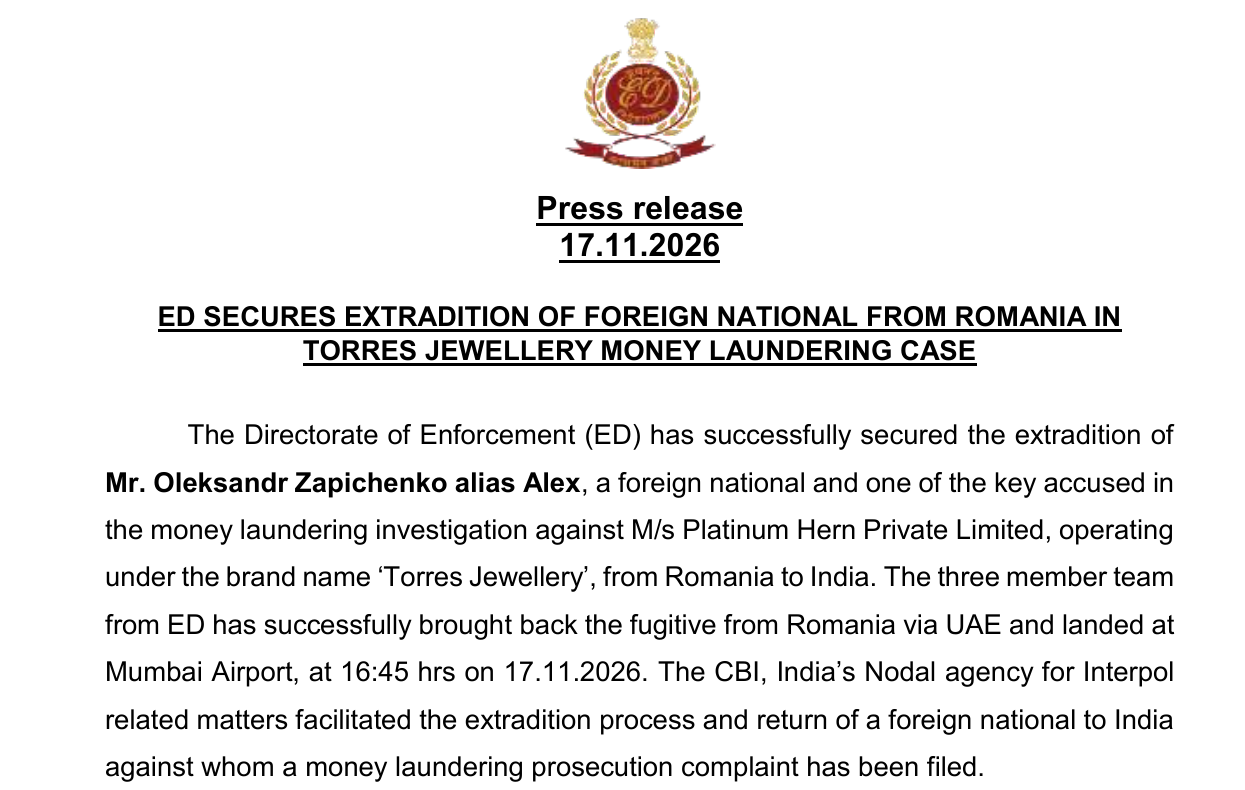
On November 17, 2026, the ED announced the extradition of Oleksandr Zapichenko, also known as Alex, from Romania to India. He is an accused person in the investigation.
The announcement follows a prosecution complaint filed in May 2025. Extradition brings an accused person before the legal process; it is not a conviction or confirmation of compensation.
- The official case concerns Torres Jewellery as operated by Platinum Hern, not every jeweler with a similar name.
- The ED’s releases describe a sales-and-investment pitch, not a normal promotion on the price of a necklace.
- Anyone claiming that extradition automatically releases money to investors is making a promise the announcement does not make.
How the Torres Jewellery Investment Pitch Worked
Step 1: The conversation starts in a showroom
A store gives you something you can see and touch. Staff can show a product, answer questions about its appearance and hand you an invoice.
That setting makes it easy to carry trust from a straightforward sale into a second promise. You may feel that an investment must be real because the shop exists.
The ED’s January 2025 release says a police complaint described promised weekly returns of 2% to 9% on investments tied to jewelry and gemstones.
That release also describes synthetic moissanite being marketed as a high-value investment comparable to diamonds. The concern was the price and promise, not the stone itself.
Ask to see the investment obligation on its own. If the only piece of paper is a receipt for jewelry, it cannot answer who owes the later payments.
Step 2: The weekly return makes the price sound reasonable
A person may be willing to pay much more for an item if they expect part of the cost back every week. The purchase starts to feel temporary.
Investigators allege the jewelry was priced far above its underlying value. That gap matters if the promised payments stop and the item is all you have left.
A weekly payout is easy to picture. It is much harder to explain how a seller could earn enough from real operations to maintain unusually high returns over time.
A discounted future price, a store credit and a cash payment are three different things. Know which one someone is promising, how often, and under what written conditions.
Step 3: A referral gives friends and relatives a reason to join
The ED says the offer included bonuses for referrals. That changes how the pitch spreads, because a potential buyer may hear about it from someone they already trust.
When a relative recommends a showroom, you can reasonably take that as their impression of the shop. It does not establish the source of the promised return.
A payout someone received can be genuine money without establishing that the business earned it through legitimate sales. An individual payment is not an audit of everyone’s deposits.
If you joined on someone’s recommendation, put their message alongside the invoices and payments. Do not assume the person who invited you knew what happened behind the counter.
Step 4: Buyers are left with different records of what happened
One person may have a jewelry receipt, another a bank reference, and another only messages about who collected cash. Each tells part of the story.
The investigation alleges funds were diverted and converted to USDT. It does not follow that every participant held crypto, had a wallet or personally sent a blockchain payment.
Record how you paid and who received it. If your transfer was in rupees, use the bank or payment record rather than guessing about what happened later.
People sometimes put the promised return down as their loss. Write down actual money sent and cash actually received separately, and preserve paperwork about promised amounts as a separate record.
Company and Showroom Checks
Match the brand with the entity on your receipt
Look for Platinum Hern Private Limited or another legal name on the actual documents from your transaction. Save a copy before an email thread or customer portal disappears.
If the transaction involved a different payee, keep its details exactly as printed. An investigator will need the discrepancy, not a cleaner version with one name on everything.
Keep the valuation separate from the sales pitch
An invoice establishes the price someone charged you. It should not be treated as an independent appraisal or a guarantee that somebody else will buy the item back.
If the value matters to your complaint, retain any hallmark, certificate, label and packaging. Ask an independent qualified appraiser what can be assessed before altering or reselling the item.
Use your actual showroom and payment record
Two customers can have the same logo on a receipt but different sellers, locations or payment recipients. Note your showroom, date and invoice number when you make an account.
Preserve both sides of a receipt if either contains terms. If someone wrote a weekly payout or a credit on a separate card, photograph and save it too.
Do not treat an address as a regulatory approval
A real sales counter is not a government endorsement of an investment. The same applies to a building with branded signs, staff and a crowd of customers.
Check the investment offer independently of the shopping visit. If the person selling it cannot give you a clear legal entity and verifiable terms, do not hand over money.
What to Do If You Paid Into the Torres Jewellery Offer
-
Stop payments and save the original records. Keep receipts, bank or app confirmations, messages and any investment schedules. Preserve the jewelry and packaging separately from personal paperwork.
If you only have screenshots, take copies of the original conversation where possible. Include the date and sender information, not just the part promising a payment.
-
Write a transaction history while it is fresh. List the dates, amounts, payment details and promised returns. Record actual payouts in a separate column.
Record who accepted cash, where it changed hands and whether a witness was there. If something is an estimate, label it rather than presenting it as a receipt.
-
Tell your bank or payment provider promptly. Use the official app or a phone number you already trust. Be honest about whether you authorized the transfer.
Ask what can still be flagged or disputed. Older transactions may be harder to recover, but a reference supplied by the bank can help document the complaint.
-
Report through official channels in India. Contact local police and ask how to add your records to the relevant complaint. Keep your acknowledgment or case reference.
For financial cyber fraud, India’s official reporting routes include the National Cyber Crime Reporting Portal and the 1930 helpline. Filing a report does not guarantee reimbursement.
-
Verify anyone offering to get your money back. Do not give a caller your payment PIN, an OTP, a wallet recovery phrase or a remote view of your phone.
If a message says a court or the ED has released funds, find the case office independently. Do not use the new phone number or payment details in that message.
-
Keep your evidence private but accessible. Share originals or full statements with the bank, your legal adviser or verified case officers when needed. Avoid group chats requesting identity records.
Give people you referred the official case information and encourage them to keep their own records. You do not have to collect their bank statements to help them.
Keep Four Things Separate When You Read a Case Update
The complaint describes what authorities are alleging
The November notice traces the investigation to police complaints, including one registered in Vashi, Navi Mumbai. The ED says it filed a prosecution complaint in May 2025.
The notice says the court took up the complaint in July 2025 and issued a non-bailable warrant that November. Those procedural steps are not findings of guilt.
The extradition concerns one accused person
The ED says Zapichenko was provisionally arrested in Romania in May 2026. Romanian courts approved his extradition before authorities brought him to India in November.
A report that one defendant has appeared does not tell you the outcome of a case involving other people. Look for the named person and the specific court action.
Assets identified are not cash ready to send
An investigator’s estimate of alleged proceeds answers a different question from what has been recovered. The announcements should not be read as an accounting of available refunds.
Even if a headline mentions property or funds, look for an official notice that actually describes a distribution. A photograph of property does not tell you who gets it.
Your own complaint still needs its own evidence
The case may move internationally while your evidence remains local. The most useful documents for you may still be the invoice and the account statement showing the original payment.
If you received a partial payout, keep that record regardless of how small it was. An investigator can distinguish money you actually got from credit shown in a message.
If you cannot tell whether a notice applies to your purchase, ask the authority handling your complaint. Do not pay an intermediary to interpret a forwarded announcement.
Buying Jewelry Without Taking On an Investment Promise
Start by deciding what you would pay for the piece if there were no weekly return. If it is not worth that amount on its own, leave it.
Compare the material, weight and any independent grading with an ordinary retail offer. A seller’s illustrated valuation card is not the same as a verified appraisal or resale price.
For an investment, make the seller explain who pays you when, where returns come from and what happens when the company cannot pay. Examine written terms away from the counter.
Be careful if you are asked to put the payment in someone else’s name. A different recipient can make it harder to establish what you bought and who took payment.
Keep a record of promotions before they disappear. Save the return promise beside the ordinary retail terms, so you can show later which claim actually persuaded you to spend.
Do not confuse an extra reward for bringing someone with a reason for that person to invest. Let them see the same evidence and decide without a deadline or pressure.
If a promoter says the details only make sense after you pay, walk away. You should be able to understand what is being sold while you still control your money.
Frequently Asked Questions
What did Torres Jewellery promise investors?
Indian investigators describe a pitch involving high weekly returns and referral bonuses linked to jewelry purchases. Their allegation concerns the investment arrangement, not the mere act of selling jewelry.
What does the ₹177.12 crore number mean?
The ED identified that sum as alleged proceeds of crime at the time of its November release. It is not a list of individual losses or confirmed recoveries.
Does extradition mean the accused has been convicted?
No conviction follows automatically from an extradition. The release describes a transfer to India in an ongoing money laundering investigation and should not be read as a verdict.
Can I report if I do not have the jewelry anymore?
Keep the evidence you still have, such as invoices, messages or payment references. Tell the relevant case officer what happened to the item rather than trying to fill gaps yourself.
Do I need crypto records to report a cash purchase?
Start with the transaction you actually made. The ED’s allegation that funds were later converted into crypto does not require a cash buyer to produce a wallet address.
Should I pay a recovery fee to release my refund?
Do not send money to anyone who claims to release recovered funds through an unofficial account. Verify any claimed process through the actual case authorities using independently sourced contact details.
The Bottom Line
Do not put money into an offer that makes expensive jewelry seem affordable by attaching extraordinary weekly payments and referral bonuses. Real merchandise does not make the return promise reliable.
If you paid into the Torres Jewellery offer, keep the records and report through official channels. An update in court is not an instruction to pay a recovery fee.

Join the discussion
0 commentsShare your experience or ask a question about this article.
Community experiences
Did this happen to you?
Your experience could help someone recognize the same scam. Submit a private report for our team to review.
I experienced this tooReports are reviewed before publication. Sharing publicly is always your choice.
Discussion
Start the conversation
Have a question or something useful to share? Add the first comment.