


The store looked convincing when you ordered. Now the delivery date has passed, the replies have stopped, and your bank wants evidence you never expected to need.
That first dispute form can feel surprisingly difficult. A few carefully chosen records can make your explanation much clearer, without turning the process into another full-time job.
Overview
A chargeback starts with the purchase, not the accusation
An online-shopping chargeback asks your card issuer to challenge a payment through the applicable card-network process. It is not a guaranteed refund or a police finding.
Your strongest starting point is usually straightforward: what you bought, what the seller promised, what you paid, and what actually happened afterward.
A missing delivery, a materially different product, an unprocessed refund, and a payment you never authorized are different problems. Describe yours accurately rather than selecting the most alarming category.
The records should tell one understandable story
Think of your evidence folder as an explanation for someone who never saw the advertisement. The useful documents connect the transaction to the broken promise.
- Keep the order confirmation and the payment entry showing the actual amount.
- Preserve the product description, delivery commitment, and relevant refund conditions.
- Save dated messages, tracking information, and photographs when they explain the problem.
- Ask the provider which documents and filing deadline apply to your particular payment.
The deadline matters more than another seller promise
Contact your provider promptly, even while requesting a merchant refund. Repeated assurances that someone will respond tomorrow should not consume the time available to open a dispute.
Different countries, payment methods, and complaint categories have different protections. The guidance below helps organize your case, but your provider must confirm the procedure that covers it.
What Your Bank Needs to Understand
Start by separating suspicion from facts you can demonstrate. A website disappearing is relevant, but your bank still needs to identify the transaction and the promised goods.
Instead of writing that a seller is obviously criminal, explain that you ordered a particular item, paid a stated amount, and received nothing by the agreed date.
If something arrived, describe the difference precisely. A photograph of the wrong model beside the saved listing is more useful than a long complaint about disappointment.
For a refund dispute, include the cancellation acceptance or return acknowledgment. Show when the merchant agreed to repay you and whether the promised processing period has passed.
A bank may request further details after reviewing your submission. An organized initial account makes those questions easier to answer, rather than eliminating the need for them.
How to Prepare an Online-Shopping Chargeback
Step 1: Identify the payment and the correct provider
Open the banking application or statement you normally use. Find the actual payment date, amount, currency, and merchant descriptor rather than relying solely on the shop’s receipt.
The descriptor can differ from the storefront name. Include both names and explain that they refer to the same purchase if your records establish that connection.
A card purchase made through Apple Pay or Google Wallet usually starts with the issuer of the underlying card. The wallet interface is not your only recovery contact.
With PayPal or a marketplace, inspect the provider’s buyer-protection process too. Ask how simultaneous disputes interact before opening overlapping claims that may interfere with each other.
If you paid by bank transfer, cryptocurrency, or gift card, say so immediately. Those payments require different recovery requests, not an ordinary card chargeback form.
Step 2: Preserve the offer before it changes
Save the exact product listing, including its address and the details that influenced your decision. Capture the promised item, quantity, advertised features, and delivery commitment.
Include relevant return conditions if they matter to your complaint. A generic homepage screenshot may show the store existed without explaining why your particular order failed.
Keep original emails and downloaded receipts alongside screenshots. If the shop disappears later, these records can still establish the offer you accepted when paying.
Never rebuild an old page and present it as an original screenshot. If a detail is missing, describe that gap honestly instead of manufacturing stronger-looking evidence.
Step 3: Record your attempt to resolve the problem
Write a concise request through the seller’s published support route. State the order reference, the problem, and the outcome you want, such as delivery information or a refund.
Keep the full conversation, including replies that change the delivery date or introduce new conditions. Separate what the seller actually said from what you understood it to mean.
If an email bounces or a contact form produces an error, save that result. Do not describe silence as proof that the address never existed.
A useful chronology might show the order date, promised shipment date, first refund request, and final reply. It does not need every unrelated message from your inbox.
Step 4: Present the records in a clear order
Put a short explanation first, then attach the records that support each point. Numbering documents can help an investigator connect your account to the relevant evidence.
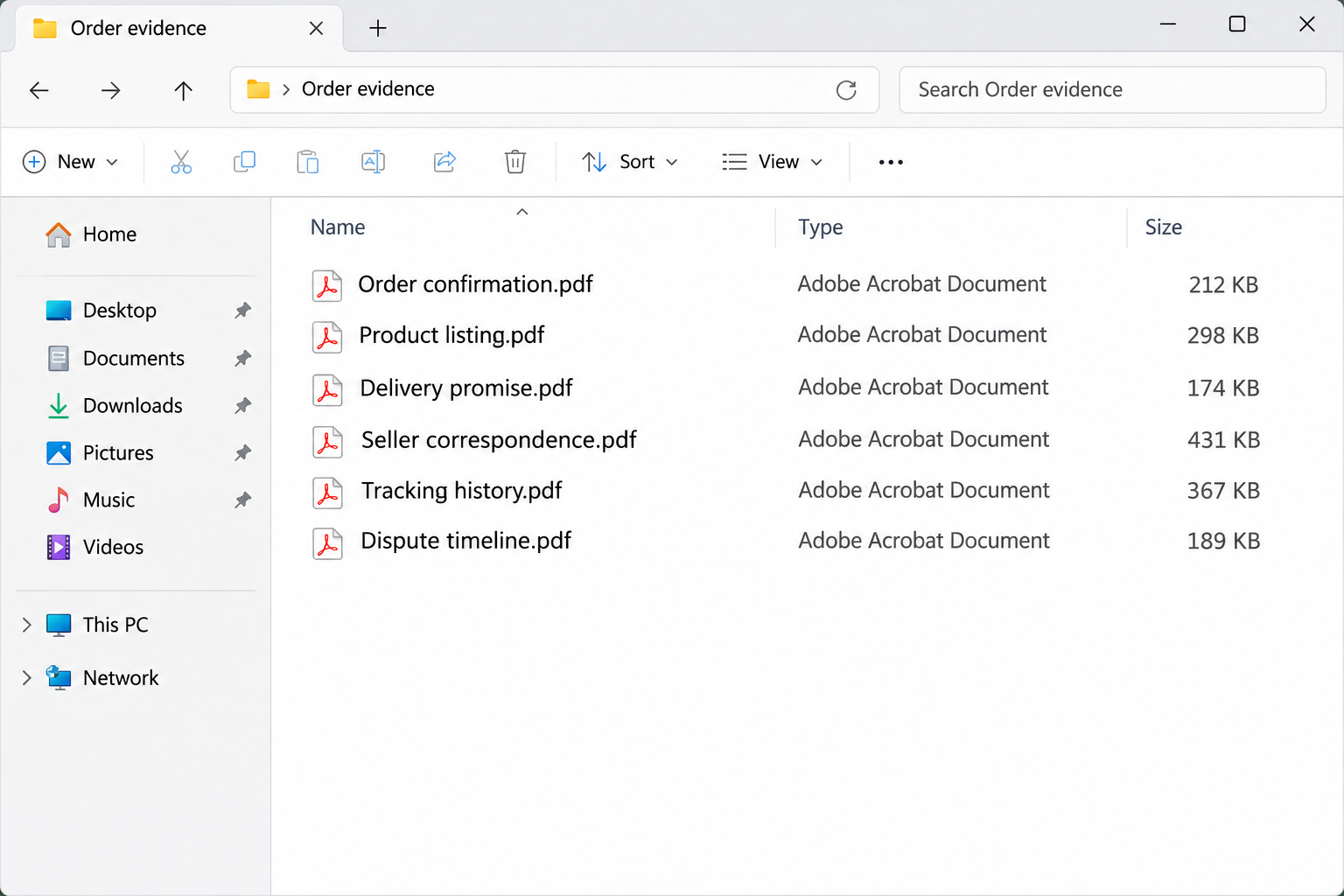
The folder shown above is an illustrative organization example, not a real customer’s dispute. Its filenames simply show how ordinary purchase records can be grouped.
Use your provider’s secure submission route and its accepted file types. Ask about upload limits before sending dozens of images that obscure the important documents.
Keep a copy of exactly what you submit, together with the submission date and case reference. That becomes the starting point for any follow-up questions.
Build the Evidence Around the Actual Problem
When the order never arrives
Connect the receipt to the delivery commitment. Include the expected dispatch or arrival date, any agreed extension, and the tracking history available from the carrier itself.
A tracking number is not automatically proof of delivery to you. If the address or parcel information does not match, ask the carrier what it can confirm.
Request written confirmation where available, without demanding another customer’s private address. Pass the carrier’s actual finding to the bank rather than guessing how the tracking was generated.
If the carrier says delivery occurred but you cannot locate the package, describe that dispute accurately. Lost parcels and deliberately misleading tracking require different factual explanations.
When the item is not what was advertised
Photograph the packaging, identifying labels, and the received item. Then identify the specific difference: model, material, quantity, size, advertised function, or another material feature.
Keep the original listing nearby so the comparison is understandable. A close-up of a defect means little if the reviewer cannot identify the purchased product.
Avoid making technical claims you cannot establish. Describe a device that will not power on as such, rather than claiming its internal components are counterfeit without examination.
Ask the issuer what return evidence is required before shipping goods elsewhere. Keep the seller’s instructions and any postage or tracking records if a return is necessary.
When a promised refund never appears
Preserve the merchant’s refund approval, the amount promised, and its stated processing time. Check the payment account for a reversal or credit under a different descriptor.
Explain whether you returned the item, canceled before dispatch, or accepted another resolution. Those details help distinguish an outstanding refund from an unresolved request.
Do not pay an additional release or verification fee to unlock repayment. Take that demand to your provider and ask how it affects the existing complaint.
Understand the Deadlines Without Guessing
For certain US credit-card billing errors, the Consumer Financial Protection Bureau explains a written-notice deadline of 60 calendar days after the charge appears on the statement.
That rule should not be treated as a universal deadline for every product-quality dispute, debit-card payment, country, or card-network claim. Ask which process applies to your facts.
The FTC’s guidance for goods that never arrived also distinguishes credit-card billing errors from debit-card protections and disagreements about an item’s quality.
In the UK, chargeback and Section 75 are separate routes. The Financial Ombudsman Service explains their different requirements, including the qualifying price range for Section 75.
Do not assume that a quoted 120-day chargeback window applies identically to every situation. Relevant starting dates and scheme rules can depend on the complaint.
If a shipment was promised far into the future, tell the issuer that immediately. Do not assume either that the original deadline has vanished or that recovery is impossible.
What to Do If You Paid a Suspicious Store
-
Contact the payment provider through its official application, statement, or card number. Explain the purchase problem and ask which dispute route and deadline apply.
Use a contact you choose independently, not a phone number sent by someone offering to manage your refund.
-
Send the merchant a factual resolution request and preserve the result. Include the order reference and requested remedy, without disclosing your card security code or account password.
If the seller is unreachable, tell the provider rather than waiting indefinitely for another reply.
-
Submit the smallest complete evidence packet that explains the claim. Keep originals privately and provide copies through the provider’s verified channel.
Redact unrelated transactions where permitted, but leave the disputed payment and required identifying information readable for the institution handling your case.
-
Ask about protecting your card if its details were exposed. Replacing a card and pursuing a purchase dispute solve different problems, so discuss both when necessary.
For an unwanted subscription, request cancellation separately and ask the issuer about preventing further recurring charges.
-
Track the dispute after submitting it, including document requests and response deadlines. Read any explanation carefully if the provider rejects your claim.
A temporary credit may be provisional, so do not treat it as a final decision until the provider confirms the outcome.
-
Use the provider’s complaints process if important evidence was overlooked. Ask for the written reason and the next available review or escalation route.
Keep a complaint reference and avoid opening a new account with a supposed recovery specialist who demands advance payment.
Mistakes That Can Weaken an Otherwise Clear Claim
Do not call an authorized purchase unauthorized merely because the seller failed to deliver. Your complaint can be legitimate without changing the story of how payment occurred.
Avoid flooding the file with reputation scores, copied accusations, or unrelated social posts. These may provide context, but they cannot replace proof of your order.
Keep dates consistent across your timeline and attachments. If you discover an error after submission, correct it openly and explain which record supplies the right date.
Never share the evidence packet publicly with full account details. A useful bank submission can contain information that a forum, social group, or unknown helper should never receive.
Finally, separate merchant contact from bank deadlines. Continuing a conversation with the seller does not necessarily stop the clock on your right to challenge the payment.
If the Seller Responds After You File
A complaint can change while the bank reviews it. A parcel may arrive late, a refund may finally post, or the seller may offer a partial resolution.
Update the investigator when something material changes. Include the new date and supporting record so your file still describes the current situation accurately.
If a package arrives, inspect it before saying the original problem is resolved. Delivery of the wrong item does not necessarily answer a complaint about the purchased product.
On the other hand, do not continue claiming complete non-delivery after receiving the correct goods. Explain the late arrival and ask how the provider wants you to proceed.
When the merchant issues a refund, check whether it actually reaches the original payment account. A screenshot saying a refund was requested is not necessarily a completed credit.
Ask your provider how to handle a merchant refund alongside an existing provisional bank credit. Do not assume that receiving both amounts makes both yours to spend.
Consider a partial refund against the facts of your complaint, without letting a deadline pass during negotiation. Preserve the offer and any conditions attached to accepting it.
If the seller demands that you close the dispute before it will issue repayment, discuss that request with your provider first. Closing a case can affect further review options.
You can remain polite without promising to withdraw a valid complaint immediately. Ask the bank what proof of a completed resolution it needs before making that decision.
Keep any final decision with your original folder. That gives you a reliable record if the same merchant descriptor appears again or a follow-up question arrives later.
Frequently Asked Questions
Can I request a chargeback if I approved the purchase?
Yes, some authorized purchases can qualify for disputes over non-delivery, misdescription, or refunds. Describe the genuine problem and let your issuer identify the applicable process.
Does a chargeback guarantee that I get my money back?
No, the issuer and relevant payment rules determine the outcome. The merchant may respond, further documents may be required, and an initial credit may remain provisional.
What if the fake store has disappeared?
Use the records you already hold, including receipts, saved listings, correspondence, and payment details. Explain when the site became unavailable without inventing missing evidence.
Should I wait for the seller’s final reply?
Ask your provider about its deadline immediately. You can explain that a merchant request remains open, but repeated delays should not prevent you from preserving your dispute rights.
Can a cryptocurrency payment receive a card chargeback?
A direct cryptocurrency transfer does not use the card chargeback process. Contact the platform involved promptly, preserve transaction records, and report suspected fraud through appropriate official channels.
Do I need to buy software to prepare the evidence?
No, ordinary folders, saved messages, photographs, and a simple written timeline are enough to organize the facts. Follow your provider’s document requirements rather than buying a recovery promise.
The Bottom Line
If an online order goes wrong, contact the payment provider promptly and submit a truthful, organized account. The receipt, promise, failure, and timeline matter most.
Save the records now and confirm the deadline directly. Do not surrender more money or private information to anyone promising a guaranteed chargeback or refund.

Join the discussion
0 commentsShare your experience or ask a question about this article.
Community experiences
Did this happen to you?
Your experience could help someone recognize the same scam. Submit a private report for our team to review.
I experienced this tooReports are reviewed before publication. Sharing publicly is always your choice.
Discussion
Start the conversation
Have a question or something useful to share? Add the first comment.