


A Telegram message with a familiar crest offers help with your Singapore nursing registration. The sender claims they can arrange an exam or advance your application for a fee.
That offer targets people who have a real reason to care about a deadline. Before paying or sending a passport, check who actually controls the next step.
Overview
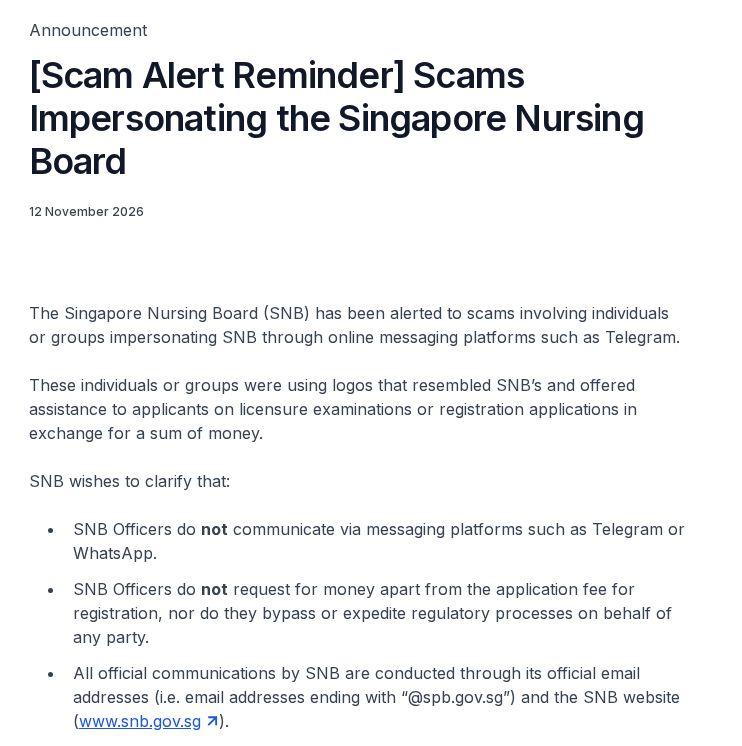
The Singapore Nursing Board warned on November 12, 2026, about impersonators using messaging platforms such as Telegram. They offered paid help with licensure exams or registration applications.
A lookalike logo was part of the impersonation
SNB says the people or groups involved used logos resembling its own. The presence of that logo in an avatar or message does not identify a regulator.
That is especially easy to miss when a sender uses the right vocabulary about your exam. The process is public enough for a stranger to imitate parts of it.
The public alert does not identify a particular Telegram handle, a price list or the number of people who paid. Do not rely on a blacklist of account names.
The Nursing Board does not handle cases on Telegram
According to SNB’s November alert, its officers do not communicate using Telegram or WhatsApp. It also says they do not bypass or expedite regulatory steps for anyone.
A recruiter or colleague may chat with you about a job. That does not make their conversation a Nursing Board channel or authorize them to collect an official fee.
If a sender claims to be SNB and asks for money or documents in chat, stop. Reach the board or your actual employing institution independently.
The legitimate process has its own starting point
For foreign-trained applicants, the board describes an employer-led process that starts with an offer from an eligible healthcare institution. Verify the offer and the HR contact separately.
- A messaging profile is not proof the Nursing Board is handling your application.
- A published application fee is different from a private fee for fast-tracking or exam help.
- Your employer’s verified HR team is the place to check a foreign-trained application and examination arrangements.
- Do not send identity documents, banking details or payment to an unverified chat account.
How the Fake Nursing Board Offer Works
Step 1: The message borrows a real process
Registration and exams are genuine steps in becoming eligible to practise. That is why an impersonator does not need to invent a whole licensing system.
Instead, the sender offers to help with one thing you may already be worried about. It may be the exam, the timing of the application or a missing requirement.
The SNB alert describes offers of exam and application assistance. Treat a claimed booking, faster approval or regulatory connection as something to verify, not a fact about your file.
If someone refers to an institution where you applied, ask that institution whether the person actually works with it. Do not use a number the claimant provides to verify themselves.
Step 2: A familiar-looking logo passes for authority
A messaging profile can show an organization’s name, logo and an official-looking job title without providing any connection to the organization. A group’s membership count cannot establish one either.
Do not treat a conversation screenshot as evidence that an officer approved a step. Confirm who controls the application and whether that step appears in the proper channel.
SNB uses its website and official email addresses ending in @spb.gov.sg. Use the address on the board’s website rather than copying one from chat.
A name on screen can hide the actual address, and a forwarded message can be edited. The most reliable check is a conversation you start using independently sourced details.
Step 3: The sender puts a private fee in front of the next step
SNB’s alert says impersonators offered help in exchange for money. It does not give a common price or say that one group contacted all applicants.
Refuse requests to pay a private account for regulatory access. Do not send a passport scan, identity number, card details or credentials to make an application seem more complete.
Someone offering a real study course should be clear that they cannot alter the board’s decision, reserve special treatment or replace an official application.
If the promise includes a pass or a quicker registration outcome, stop negotiating about the fee. Ask the board or your independently verified employer to check the premise.
How to Check a Real Nursing Registration or Examination
Confirm the healthcare employer and the offer first
The board’s foreign-trained applicant instructions say the eligible institution’s HR team checks its eligibility and, once approved, submits the online registration or enrolment application on your behalf.
Use the institution’s own staff or recruitment directory to verify your point of contact. If you were introduced by an agent, ask the institution to confirm that relationship separately.
The board says it does not work with employment agents directly. Its published instructions direct agents to the healthcare institution’s HR team, not to an officer in a chat.
Do not confuse an offer letter with proof of registration. Ask the employing institution what has been submitted and which steps remain before you make work or travel arrangements.
Check who actually arranges the licensure examination
The official exam guidance describes computer-based testing at designated Pearson VUE test centers. The employing institution’s HR submits the examination application through the stated official process.
Ask HR to confirm that the exam application was submitted before believing a claim about a booking. Do not forward credentials or approve an unfamiliar request.
If a message offers an earlier slot, ask who can verify it and where it appears. Do not assume urgency is proof that something happened in the booking system.
Exam preparation can be helpful, but private tutoring is not exam registration. Keep those decisions separate and do not pay for access that a tutor cannot grant.
Use the published fee and document process
The legitimate process can involve fees, including registration or enrolment application fees and fees due on approval. Read the published instructions for your exact applicant category before paying.
A legitimate fee does not become payable to someone just because they know its name. Ask your verified institution which listed fee applies and what the authorized payment route is.
SNB’s foreign-trained instructions also explain which records go directly from registration authorities or training institutions. A Telegram contact asking to collect all of them is not that verification process.
For an overseas-trained applicant, the board says it communicates the outcome through the employing healthcare institution. If someone promises to release that result privately, check with HR instead.
Take the local graduate route if it applies to you
Local graduates have separate instructions and may have different ways to submit an application. Do not assume that the employer-led foreign-trained process is the only legitimate path for everyone.
Start from SNB’s registration and enrolment pages for your category. If a message claims that your category changed or you need to pay to fix it, verify that independently.
Use the board’s published contact page for general questions. Ask where you can confirm your process without sending unnecessary identity documents in the first inquiry.
Verify a request for a missing document before resending it
A genuine application can need a transcript or a record of an existing registration. That makes a request sound plausible even when it reaches you through the wrong person.
Ask your verified institution which records it needs from you and which the training school or licensing body must send itself. Use the published route for each document.
Check whether you already provided the same document. An uninvited request to send it again to a chat account is not proof the official copy failed.
Keep a checklist of the records you submitted and the dates. Use it to ask specific questions without spreading copies of sensitive documents across several messaging accounts.
What to Do if You Received a Message or Already Paid
- Stop responding to the account and do not follow its links, scan its codes or send documents to keep a claimed booking active.
- Confirm the offer and application stage with the real employing institution using contact details you obtained outside the conversation.
- Save the profile, message, timestamps and any payment reference privately. The record should show what was requested and what you actually sent.
- If you paid or provided bank details, contact your payment provider promptly from an official channel and report the impersonation to police.
- If you provided identity documents or approved account access, tell the relevant issuer or service what was exposed and ask what protective steps apply.
Protect the actual application while you report the scam
Tell verified HR that someone may be impersonating the board, especially if that person used the institution’s name. Ask whether any legitimate step is still outstanding.
Do not withdraw a real application just because someone used it as a pretext. Your employer can help separate steps it authorized from steps a stranger invented.
Keep the details of your application separate from the copy of the chat. When warning colleagues, redact identification documents, admissions details and anything tied to another applicant.
Act on the exposure you had
A screenshot of the fake chat does not show whether money moved. Give the bank your actual transaction details and payment method if you made a transfer.
If you sent a passport or identity card image, note which sides and supporting records you included. Ask the relevant authority what to do about those documents.
If a login or password was disclosed, secure the relevant account from its real sign-in page. Change a reused password elsewhere and report unauthorized access if you see it.
SNB directs recipients to report the matter to police. It also refers people in Singapore to ScamShield at 1799 if they need help checking the message.
Record what the sender called the payment. A charge presented as an exam fee, an application fee or a reservation deposit can be compared with what the official route requires.
If someone claims to be a second officer investigating the first account, contact the board yourself before sharing more evidence. A follow-up in the same group is not independent confirmation.
Confirm the payment reference and the purpose separately
Save a copy of any document the contact treated as an invoice. If your employer says it is unrelated to your application, record that answer with the payment details.
A genuine institution may need time to check a reference. Do not pay to extend a purported deadline while you wait for the people handling the application to respond.
If you were asked to pay in your home currency, keep the amount and conversion shown on the receipt. Your bank needs the amount actually sent.
Once the application is confirmed through HR, use the next official instruction. The fake chat does not change who can schedule your exam or process your registration.
Frequently Asked Questions
Does the Singapore Nursing Board contact applicants on Telegram?
SNB’s November warning says its officers do not communicate on Telegram or WhatsApp. A legitimate-looking logo or officer’s name does not override that statement.
Do not send payment or identity papers to the account. Check the matter with the board or the verified institution handling your application.
Can a private contact get my registration approved faster?
SNB says its officers do not expedite or bypass the regulatory process on behalf of anyone. No private caller can prove special authority by showing an application screenshot.
Ask which genuine stage is taking time. Your verified HR contact can explain the status without selling you a separate service to release it.
Does the scam warning mean legitimate SNB applications are free?
The board does publish legitimate fees for registration-related processes. That is different from paying a stranger for an exam shortcut or help in an unsolicited message.
Check the correct applicant category and payment instructions from the board or the employing institution. Do not pay based on bank details copied into chat.
Who submits a foreign-trained applicant’s registration?
The board says HR at an eligible employing institution submits the application after checking eligibility with SNB. Start by independently verifying the institution and the offer.
If an agent introduced you to the employer, the employer’s own HR team is still the place to check who is submitting your application.
How do I confirm that an exam booking is real?
Use the board’s exam guidance and ask the employer’s verified HR team to check the status. The board describes designated testing centers and a defined application process.
Do not use a chat payment receipt as proof that a place exists. Verify the arrangements with the organization actually responsible for making them.
Should I keep talking to the sender to recover my payment?
Do not send another payment to unlock a refund or keep a booking. Contact the original payment provider independently and save evidence for that provider and police.
Tell your employer separately if your application or identity papers were used. The real application can be checked without trusting the account that asked for money.
The Bottom Line
Do not buy nursing exam access or registration help from someone posing as SNB in chat. Check the real stage with your verified employer or the board.
If you already paid or sent documents, stop communicating with the sender and act on what you actually shared. Keep your legitimate application on its official track.

Join the discussion
0 commentsShare your experience or ask a question about this article.
Community experiences
Did this happen to you?
Your experience could help someone recognize the same scam. Submit a private report for our team to review.
I experienced this tooReports are reviewed before publication. Sharing publicly is always your choice.
Discussion
Start the conversation
Have a question or something useful to share? Add the first comment.