


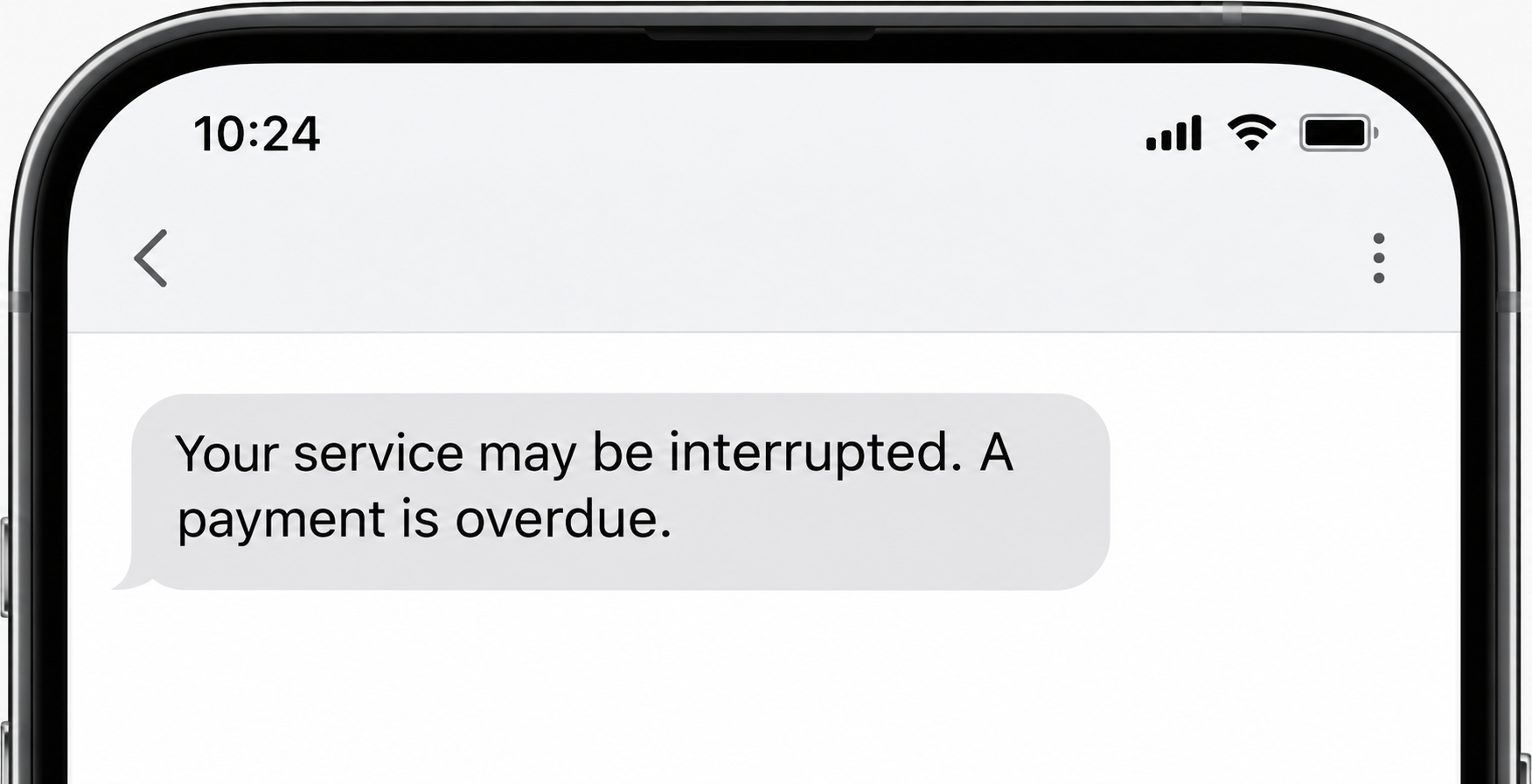
Your internet drops and a text says you missed a Spectrum payment. Before you can check the account, the message offers a quick way to restore service.
The timing makes that offer feel credible. But a text and a disconnected modem do not tell you who is asking for the money.
Overview
A notice is not proof of a past-due balance
A Spectrum past-due text may resemble a real billing notification. Spectrum lets customers choose how they receive billing, appointment, and outage notices.
The independent check is the account itself. Open My Spectrum or visit the provider’s website on your own, then look at the balance and recent payments.
Even if you missed a payment, settle it through a verified channel. A scam message does not become safe because its warning happens to match your circumstances.
A real outage can make a fake request harder to spot
Your service can go down for reasons unrelated to billing. Check for an outage or an account issue before assuming a payment will restore it.
If your internet connection is out, use mobile data if available or call from a verified number printed on a bill you already trust.
You should not have to find the correct answer while someone stays on the line. A legitimate balance will still be there when you open the account yourself.
The payment method can settle the decision early
Spectrum’s fraud guidance says it does not request personal payment information by text and does not accept payment through gift cards, cryptocurrency, or peer-to-peer apps such as Zelle.
- Verify an alleged late payment in your account, not in a text thread.
- Check outage information separately instead of assuming the message explains a connection failure.
- Reject a request to send money to a named person, payment app, or gift card.
This guide covers the past-due or service interruption hook. A prepaid discount call is a related tactic, but it starts with a different reason to hand over money.
How the Fake Spectrum Past-Due Text Works
Step 1: The message supplies a reason to hurry
The text may claim your internet will stop today, or that it is already out because your latest payment failed. It may put the supposed deadline ahead of any explanation.
The demand can arrive when everything is working, too. The point is to make you believe you have less time to act than you do.
An unexpected text is the wrong place to solve that uncertainty. Check for a genuine overdue balance and see what the verified account says about any necessary action.
Do not infer that a sender knows your actual service status just because the timing was good. Timing and a recognizable company name cannot identify who sent a text.
Step 2: The notice tries to choose the payment route for you
One path sends you to a page that collects banking or card details.
Another pushes you to a phone number where someone offers to take payment or help you restore service.
A caller may sound like a normal agent and ask you to confirm details in stages. Hang up rather than trying to decide whether every single question is reasonable.
If the supposed agent asks to take payment through a method Spectrum says it does not take, refuse.
Do not pivot to another version of the same account or payment request.
The difference is where the action happens. A scammer needs you to accept the route in the message; you can check a real account without that route.
Step 3: Payment or account details are diverted
Someone who pays through the false route may still owe their real bill. A receipt from the caller is not proof that money reached Spectrum.
If payment information was entered, the incident may involve more than the amount displayed. Tell the card issuer what details you submitted and whether you saw a real charge.
If you shared your Spectrum password or a sign-in code, the account needs separate attention even if you did not pay. Be clear about which credential or code was shared.
When someone promises a refund after you challenge the first payment, verify that offer independently as well. Do not send a further transfer to try to repair the first one.
Separate Billing From a Service Outage
When service works and the text is the only warning
Open the billing record and look for a statement, due date, balance, and payments you made. Compare the actual dates, not just the total mentioned by the text.
If your account is current, do not pay the message.
If the charge is unclear, use official support to find out whether there is a separate line, service, or account involved.
Do not hand over proof of payment to the person who texted you. Only the verified provider needs your payment date or reference to trace what happened.
Where someone else pays the household bill, check with them before taking action. They can look at the record without seeing or using the message’s instructions.
When the internet is already down
Use mobile service, a different connection you trust, or a verified contact number to check the account. A nonworking home connection does not leave the text as your only option.
Check whether Spectrum shows an outage for your location.
If the bill is current and the provider confirms an area outage, buying a restoration service from the sender will not fix it.
Check at the address where the service is installed. A neighbor’s working connection does not rule out an outage that affects your building or account.
If you see no outage and no account restriction, use the provider’s ordinary troubleshooting or support process. Do not let the unsolicited contact talk you into modifying your equipment.
If both an outage and a past-due balance appear, ask the provider what explains the service status. Paying the verified bill and clearing an outage are separate things.
When you really do owe a balance
Pay only through the official route you opened independently, or ask official support what options are available. If restoration is the issue, ask when to expect it after payment.
If you already paid recently, check whether it is visible in the payment history and whether your bank shows it as pending or posted.
An automatic payment that failed, an account credit, and a different amount due can all change what you see.
Ask the provider to reconcile the entries rather than authorizing another payment in a rush.
Keep your legitimate payment confirmation and note which bill it applied to. If a fraudulent payment also occurred, document that separately so neither provider investigates the wrong transaction.
Check the Account, Not the Sender Label
The message can appear beside earlier texts using a familiar sender label. That appearance is not enough to authenticate the instruction you are about to follow.
Do not try to prove that a specific short code always belongs to one sender.
The most useful record is the bill and activity you can reach without following the message.
The amount in the warning might look realistic. It could match your usual plan price without matching the due date, account, or latest payment.
A payment portal can also display the correct logo and some account details while sending money elsewhere. Begin at the provider’s official site or an app you already use.
If you spot a wrong amount, misspelled address, or strange payment method, you have another reason not to proceed. If you spot nothing wrong, verification is still needed.
When a caller says your account will remain disconnected unless you stay on the line, hang up and call the published support route.
Do not let a transfer from that caller substitute for it.
Sometimes the message offers a discount to make paying now feel like a bargain. A price that appears in an unsolicited message is not the same as an account credit.
If the offer itself is a prepaid discount, see our separate Spectrum discount-call guide. Its explanation of the advance payment does not replace checking a real overdue balance.
The Right Response Depends on What You Shared
If you only received the text, keep what you need to report it and ignore its instructions. There is no need to replace a card solely because the message arrived.
If you opened a link but did not submit information, close it. Check for downloads or permissions you agreed to rather than assuming an account was taken over.
If you entered a password, go back to the verified account from a trusted device and change the affected credential. Review related accounts if you reused that password.
If you handed over a code, describe the text that delivered it to the real provider.
A code for account login or card approval could involve a service other than Spectrum.
If you paid, contact the card issuer, bank, gift-card issuer, or payment service promptly. Tell it what happened and save the exact amount, time, and transaction reference.
If someone also opened an account in your name, Spectrum has a separate identity theft reporting process. That process is for actual account or billing misuse, not every suspicious text.
When the Message Reaches the Wrong Person
Suppose you no longer have Spectrum service but receive a text about an overdue account.
It could be a misdirected reminder, a false payment demand, or a reason to check old records.
If you recently closed an account, find the final bill and any equipment return receipt.
Check the provider’s records using a verified contact instead of assuming the old login is still usable.
If you have never held the account, do not claim it or provide your identity to the sender.
Ask the real provider whether the reference relates to you before opening any dispute.
A new phone number may receive communications intended for the former holder. That possibility does not authorize you to view someone else’s account or make a payment for them.
If the provider confirms a wrongly assigned number, ask how it can be corrected.
If it confirms an account in your name that you never opened, use its identity theft process.
If a household member manages the bill, notify them without forwarding any URL that someone might accidentally tap. They can open their usual account and report what its records show.
What to Do If You Responded to a Fake Spectrum Bill Notice
- Check your real Spectrum account. Verify the statement and service status separately. If you cannot sign in, open the recovery route from the provider’s official site.
- Gather the original evidence. Save the message, any number it asked you to call, and any payment records. Keep confirmation codes and full account details private.
- Call the payment provider if money moved. Explain whether you approved a transfer because of the message or later saw a charge you did not authorize.
- Secure access you actually exposed. Change affected credentials through trusted channels and ask the service named in any shared code to review the activity.
- Confirm what still needs to be paid. Ask Spectrum whether its records show a valid balance. Do not assume paying a scammer cleared the real obligation.
- Keep both case numbers. A Spectrum billing issue and a card dispute may be handled by different teams. Keep the payment evidence attached to the right one.
If the text says a technician must come over to collect payment, do not arrange a visit through it. Verify any existing appointment in the account or through official support.
Frequently Asked Questions
Does Spectrum send genuine billing notifications by text?
Yes, it offers billing notifications as a contact preference. A real notification is not a reason to send personal payment details by text or to use an unexpected payment link.
Is a past-due text real if my internet went down?
The outage does not authenticate the sender. Check the account and service status directly, then use verified support to determine whether they are connected.
Can I pay a Spectrum bill through Zelle or Cash App?
Spectrum’s fraud guidance lists those services among methods it does not accept. Do not pay a person or app account supplied by an unsolicited message.
What if the text shows the amount I actually owe?
Pay through the account you opened independently. A correct amount does not establish that the sender or payment destination is authorized to collect it.
What if I paid the wrong person but still owe Spectrum?
Tell your payment provider about the fraud and contact Spectrum about the actual balance. Treat them as two separate problems, and keep the payment records for both.
Should I reply STOP to a suspicious past-due message?
Spectrum advises against replying to suspicious texts. Preserve the message for a report, then change your notification settings through the actual account if needed.
The Bottom Line
Do not use a past-due text to pay or restore Spectrum service. Open the account directly and check billing and outages before you decide what needs attention.
If you paid or shared access, act on what you actually exposed. Contact the provider handling the payment, and verify that your real Spectrum account is still under your control.

Join the discussion
0 commentsShare your experience or ask a question about this article.
Community experiences
Did this happen to you?
Your experience could help someone recognize the same scam. Submit a private report for our team to review.
I experienced this tooReports are reviewed before publication. Sharing publicly is always your choice.
Discussion
Start the conversation
Have a question or something useful to share? Add the first comment.