


A website name about medical negligence can look like a useful next step after difficult treatment. An official-looking registration number can make that first impression much stronger.
But a real company’s details can be copied into someone else’s pitch. That is the problem behind the FCA warning about medicalnegligenceconsultants.site.
Overview
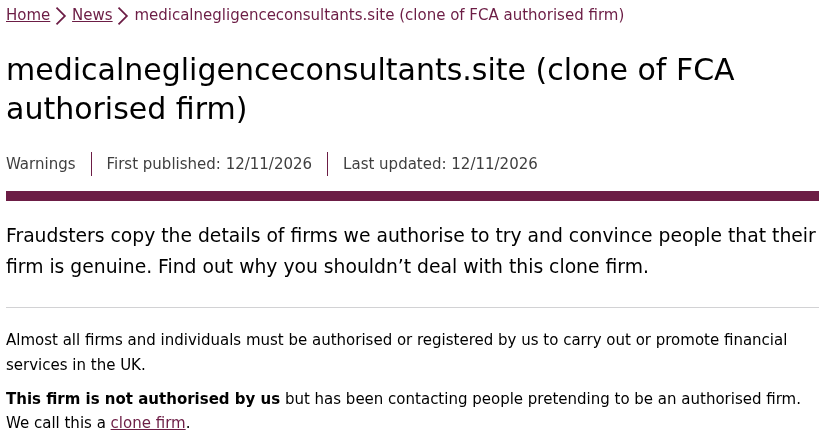
Do not use medicalnegligenceconsultants.site to arrange a claim or supply documents. The Financial Conduct Authority identifies it as a clone impersonating an authorized firm.
The warning concerns impersonation, not a medical verdict
The FCA’s November 12, 2026 notice says the operation contacted people pretending to represent an authorized business. That is the conduct readers need to avoid.
The notice does not assess anyone’s treatment, determine whether compensation is due or establish what happened to a particular claim. An impersonator cannot answer those questions for you.
If you are already concerned about care you received, keep that concern separate. Finding a fake intermediary does not prevent you from getting genuine advice about it.
Flybell Limited is the genuine firm named in the alert
The regulator identifies Flybell Limited under reference number 836324 as the genuine authorized firm. It expressly says that firm has no connection with the clone.
That distinction matters when searching for a company name or checking paperwork. Finding a legitimate record is not enough if the person contacting you copied it.
Check contact details independently against the correct register and verify the service being offered. Do not phone the number on the questionable document to ask whether that document is genuine.
Payment, records and representation are separate risks
A person may have paid, sent records or signed an instruction without doing all three. The response should fit what you actually gave the supposed adviser.
- Do not send payments or patient documents to the operation identified in the warning.
- Check a proposed representative using a register you reached independently.
- Tell your actual adviser if you signed something that may have appointed another representative.
- Contact your payment provider promptly if you already sent money to the clone.
How the Medical Negligence Consultant Clone Scam Works
Step 1: An apparently relevant service opens the conversation
People seeking help after an injury may be uncertain about the difference between a complaint, legal advice and a compensation claim. A service name can seem to answer all three.
The name alone establishes none of those relationships. Ask what the person proposes, which legal entity will do it and which regulator oversees that specific work.
The published warning establishes the clone contact, not its complete sales script. Do not assume a particular hospital leaked your details simply because somebody approached you about healthcare.
If the contact names your treatment, record exactly what they knew. You can ask your provider or current representative about a possible disclosure without giving the caller more information.
Step 2: Copied authorization makes the wrong contact seem credible
The cloning problem is more subtle than an invented company number. A number can belong to a genuine firm while the person displaying it has no relationship with that firm.
Compare the contact channel as well as the company name. If you find an authorized record, start a fresh conversation using the details in that record.
A matching postal address does not solve the problem. Public company addresses are easy to reproduce and do not authenticate the person writing from a different domain.
Similarly, a professional-looking email signature can be copied. Ask the genuine firm whether the proposed service and named adviser belong to it before sending the file.
Step 3: The reader is asked to trust the intermediary
The dangerous decision is to treat the unverified contact as your representative. That can lead to payment or disclosure even before you understand what they have agreed to do.
The FCA notice does not publish a particular invoice or data-collection form. If you received one, preserve it rather than assuming it matches someone else’s experience.
Do not sign a new authority merely to cancel a previous one. First ask an independently verified adviser what the document would authorize and how any existing appointment works.
Check the Representative Before Discussing Your Case
Identify whether you are speaking to a CMC or a lawyer
A claims management company may assess a potential claim, handle paperwork or refer a person to a lawyer. It is not automatically the solicitor who would conduct litigation.
The FCA’s guidance on claims management companies explains that different regulators cover different providers. Check the register appropriate to the actual firm, rather than a logo on its homepage.
If the business claims to be a solicitor, verify the legal firm and its authorized contact details. Ask who would hold your file and who would advise you.
If it is a referral service, ask which organization receives your details and whether you can speak to that organization before anything sensitive is sent.
Check the exact permission, not just a positive search result
A register entry is a starting point, not a guarantee that every offer using the firm’s name is approved. Match the business, contact route and service.
The genuine firm named in this alert has an official website identified by the FCA. A different domain cannot inherit that firm’s authorization by reproducing the same number.
Do not send a small test payment to establish the relationship. Ask the genuine firm directly whether it made the approach and whether the payment instructions are its own.
Save the date and the answer. If the contact later changes a bank account or says an adviser moved, repeat the check through the established channel.
Understand the agreement before authorizing work
Ask what work starts when you sign, how charges are calculated, and what happens if you change your mind. Keep the provider’s complete written answer privately.
Do not assume that a compensation percentage applies to every kind of case. Fee rules and legal arrangements can depend on the service, jurisdiction and contract.
Neither this article nor the clone warning can determine the value or merits of your individual claim. A properly verified professional can explain the relevant options.
If you already have representation, speak to that adviser before entering a second agreement. Overlapping instructions can create problems unrelated to whether the new approach is fraudulent.
Get Genuine Help Without Handing Over Your Medical File
Separate a concern about care from a compensation claim
For an NHS care concern in England, the Patient Advice and Liaison Service can explain support and complaint routes. It is not a private claims sales service.
A complaint and a legal claim can involve different questions and procedures. Ask a qualified adviser about your circumstances instead of assuming one automatically replaces the other.
Do not delay needed treatment while trying to resolve an approach from an intermediary. Contact your clinical team about ongoing care through the usual patient route.
Limit what you send in a first inquiry
Start with a brief description of the kind of assistance you need. A first contact does not usually require broadcasting an entire patient file to several strangers.
Ask which records are necessary, how they will be transferred and who can access them. Confirm the recipient before using any upload link.
If you are acting for a relative, do not assume access to their paperwork authorizes you to appoint someone. Ask the verified provider what authority it needs.
Keep copies of any instruction or consent document you sign. Those records help explain what you intended if the recipient later claims wider permission.
What to Do if You Paid or Shared Documents
- Stop the conversation with the clone and save the original messages, documents, dates and any payment references privately.
- If money left your account, contact the bank or payment provider immediately and describe the actual payment method and recipient details.
- If you supplied medical records or identity documents, list precisely what you sent and contact the relevant genuine organization for tailored advice.
- If you signed an appointment or authority, show it to an independently verified adviser and ask what steps protect your real case.
- Report the impersonation through the FCA’s official route and any relevant police reporting service. Do not use contacts supplied by the suspected clone.
If you sent records but did not pay
No payment does not mean nothing sensitive was disclosed. Distinguish a summary of your concern from a passport image, bank information or a detailed medical history.
Ask your genuine healthcare provider or adviser what action is appropriate if the recipient may claim to act on your behalf. Tell them what authority you signed.
Do not publish your documents online to ask whether they look authentic. Remove identifying information and seek help through a channel suited to the sensitivity of the material.
If someone says another payment will release compensation
Ask the real representative handling your case whether any award exists and how it will be paid. Do not let a caller’s invoice establish that entitlement.
A stranger’s claim number cannot confirm that a court, insurer or healthcare provider approved money. Verify the underlying event through an independent source.
Tell the bank if you paid a claimed release or administration fee. The evidence is the payment you made, not the amount a caller said was waiting.
Keep the legitimate matter moving
If a real deadline may apply, ask a verified adviser promptly. Do not rely on the impersonator’s assurance that they filed something or obtained an extension.
Keep correspondence from your actual representative, the healthcare organization and the suspected clone separate. That helps establish which instructions were genuine.
When reporting the incident, explain whether anyone contacted the hospital or another organization using your name. Include any response you already received, without testing the clone again.
Make a Short Contact and Disclosure Record
Before speaking to a genuine adviser, prepare a short record of who contacted you, what service they offered, and what you were told to sign.
List documents by type rather than forwarding everything immediately. Identify whether the material included treatment records, identification, payment information, or permission to obtain records from another organization.
Keep the original upload address or delivery email privately. A reviewer may need to distinguish the supposed business from a separate file-sharing service used during the exchange.
If a relative helped you reply, ask what they supplied too. Two people may remember different stages, especially when telephone calls and written forms were mixed together.
Write down any real appointment or deadline that needs separate attention. Ask the verified professional which matters are urgent rather than accepting urgency created by the suspect caller.
Our shf-isfca.com clone investigation shows another misuse of real firm details. It illustrates the identity-checking problem, not a proven connection between the two operations.
This preparation makes the next conversation more useful. It lets the genuine provider address actual instructions and disclosures instead of trying to reconstruct an entire incident from memory.
Frequently Asked Questions
Is medicalnegligenceconsultants.site an authorized claims provider?
The FCA identifies that domain as a clone impersonating an authorized firm. Do not use it to appoint a representative or send payment.
If you need help, start a fresh search through the appropriate official register. Verify the contact details before discussing sensitive information.
Is Flybell Limited responsible for the clone?
The FCA explicitly distinguishes Flybell Limited from the impersonator and says the genuine firm has no connection with the clone. Do not treat the warning as a finding against it.
Use the regulator’s current details if you need to verify an approach made in that firm’s name. A copied reference number cannot authenticate a caller.
Can I trust a website that shows an FCA reference number?
Only after checking who actually owns that number and whether the person contacting you belongs to the firm. Public authorization details can be copied.
Contact the genuine business through the register, not through the details being investigated. Confirm the service and any proposed payment instructions separately.
Do I need a paid company to complain about NHS care?
The NHS provides information and support for complaints, including PALS in England. That is separate from obtaining legal advice about a potential compensation claim.
Ask what outcome you want and which process addresses it. Do not accept an unsolicited sales pitch as the only route to being heard.
What if I already signed a claims agreement?
Save the exact agreement and ask an independently verified adviser to check its meaning. Do not sign another document simply because the same sender calls it cancellation.
Tell any existing legitimate representative what happened, especially if the document purported to transfer instructions or authorize access to records.
Should I cancel a genuine claim because of this warning?
The warning concerns impersonation, not the merits of your medical concern. Verify who handles the genuine matter before changing or abandoning it.
If payment or documents were exposed, deal with that incident separately. Keep legitimate deadlines and clinical care under the appropriate professional’s guidance.
The Bottom Line
Do not deal with the clone identified as medicalnegligenceconsultants.site. Verify a claims representative through an independent register, not a registration number printed in the pitch.
If you already paid or sent records, act on that specific exposure. Protect the real healthcare or legal matter without giving the impersonator another fee or document.

Join the discussion
0 commentsShare your experience or ask a question about this article.
Community experiences
Did this happen to you?
Your experience could help someone recognize the same scam. Submit a private report for our team to review.
I experienced this tooReports are reviewed before publication. Sharing publicly is always your choice.
Discussion
Start the conversation
Have a question or something useful to share? Add the first comment.