


An investment document bearing an accounting firm’s name can look like the missing reassurance before you send money. Its presentation can conceal the most important question.
For the purported Baliex audit documents, that question has a direct answer from the firm whose identity appears on them. Check it before relying on any report.
Overview
The specific evidence being rejected
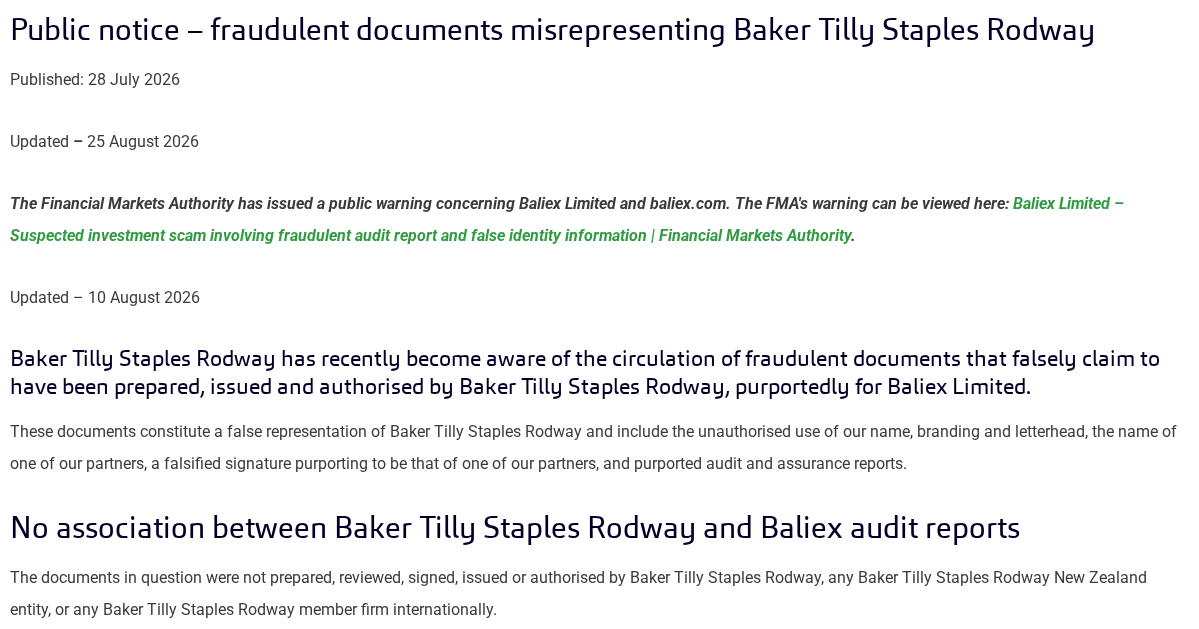
Baker Tilly Staples Rodway says purported Baliex audit and assurance documents misrepresent its identity. They include unauthorized branding, a partner’s name, and a falsified signature.
What the named accounting firm confirms
Its public notice, first published July 28, 2026, states that it did not prepare, review, sign, issue, or authorize these documents.
The notice also rejects the claimed professional relationship. This is an explicit authenticity denial, not a missing accreditation badge or an inconclusive search.
What you should do with a copy
- Do not use the purported report to justify an investment.
- Preserve the file and the message supplying it.
- Verify claimed auditors outside the investment conversation.
- Contact your payment provider promptly after any related transfer.
The Verdict on the Documents Is Clear
The purported Baker Tilly documents are false credentials. An investment pitch cannot turn them into independent assurance by repeating the accounting firm’s name.
Baliex contacted the firm on August 5 and 10, denying that it created, authorized, or distributed them, and saying it was investigating their origin.
Baker Tilly records that response but says it has not independently verified it. The public notice does not establish who created or distributed the falsifications.
That unresolved authorship does not rehabilitate the documents. You can reject false assurance without inventing a finding about who produced it.
The notice’s August 25 update also points to an FMA warning about Baliex. The immediate document check remains independently decisive: the named issuer disowns the reports.
For an investor, the practical consequence is straightforward. Remove the disputed reports from the evidence supporting your decision, rather than treating their appearance as reassurance.
Any remaining investment claims need their own verification. A replacement brochure, a different logo, or another unsigned explanation does not cure the original authenticity problem.
How Borrowed Audit Authority Can Influence a Decision
Step 1: A Recognizable Professional Name Creates Confidence
A recognizable auditor can seem more persuasive than the platform’s own promises. Readers may assume that a separate professional has already checked the difficult questions.
That assumption moves the decision away from the investment itself. Instead of examining the claimed service, you may rely on what appears to be external approval.
This is why issuer verification belongs before financial interpretation. There is no useful audit opinion to analyze if the alleged issuer never produced the document.
Step 2: Formal Document Features Make the Claim Look Independent
Letterhead, a partner’s name, and a signature are identity claims. They can help identify what must be checked, but they cannot complete the check themselves.
A professional layout can be copied into a PDF as easily as ordinary text. Opening that file successfully tells you nothing about who approved its contents.
Do not confuse visual consistency with authenticity. A forged page can look coherent precisely because its designer borrowed the features readers associate with genuine professional work.
Step 3: The Report Is Treated as Broader Protection
Even an authentic report has a defined subject, period, and scope. It should not be silently expanded into a guarantee about every service or future withdrawal.
Read the exact engagement being claimed before drawing conclusions. A statement about one balance or process would not automatically establish legal ownership of all customer assets.
Here, the prior issue is more fundamental: the alleged professional assurance is disowned. Debating its technical wording cannot restore an engagement that the named firm denies.
Step 4: The Reader Is Asked to Act on Unsupported Reassurance
The danger is the decision made after viewing the file. A reader may become willing to deposit, leave money in place, or dismiss another concern.
Those are possible consequences of relying on false assurance, not a claim that every Baliex reader made the same decision or suffered a documented loss.
Use the authenticity finding to interrupt that reliance. Pause the financial action while independently checking whatever evidence remains after the disputed report is removed.
Verify an Audit Without Using the Pitch’s Contact Details
Start With the Claimed Issuer
Identify the exact accounting firm named, including its member firm and jurisdiction. Similar network names do not necessarily identify the same contracting professional entity.
Reach that firm through contact information obtained from its genuine public website. Avoid a phone number, QR code, or reply address embedded only in the disputed PDF.
Ask whether it issued the particular report for the named entity and period. Supply the document through the firm’s preferred channel rather than sending financial account credentials.
A genuine contact can explain what it is able to confirm. Confidentiality may limit a response, but it is not permission to assume the report is authentic.
Check That the Version Is the Same
Keep the original filename, attachment, message, and date received. If you obtained multiple versions, preserve each separately instead of saving the newest over the oldest.
Ask about the exact version in your possession. A valid document concerning another company or reporting period would not authenticate a modified copy supplied to you.
Compare entity names, dates, page references, and the stated engagement. Inconsistencies are reasons to investigate further, not a basis for inventing an explanation.
Do not edit the PDF to highlight concerns before preserving an untouched copy. Annotate a duplicate so the source material remains available for independent examination.
Distinguish a Signature Image From Verified Approval
A handwritten-looking signature displayed on a page can be an ordinary image. Seeing it does not show that the named person signed or approved that document.
If software displays a digital-signature status, understand what identity and file integrity it actually verifies. Do not treat a generic validation icon as investment approval.
For these disputed reports, the issuer’s public denial resolves the central question. There is no reason to trust a signature appearance over that explicit statement.
What an Audit Would Not Automatically Guarantee
Authenticity and usefulness are different questions. A genuine report still needs to address the concern you are trying to resolve, rather than a nearby but narrower subject.
For example, knowing that an entity exists would not establish that your deposit is protected. Knowing a balance at one time would not guarantee access tomorrow.
A technical claim about a blockchain process does not establish legal rights to a customer account. Each question needs its own supporting evidence.
These distinctions help when reviewing any replacement material. Ask what was examined, who performed the work, what limitations apply, and which conclusions the document actually supports.
A platform’s explanation of those questions is not independent verification. Where the stakes are significant, obtain advice from a qualified professional who is separate from the offer.
Do not allow a report to substitute for basic questions about custody, withdrawal terms, contractual identity, and applicable regulation. Each remains relevant even after genuine professional work.
What to Do if the Baliex Documents Influenced Your Decision
- Pause any additional payment while reviewing the information that originally persuaded you, including the exact disputed document.
- Save the original file, its delivery message, relevant account records, and a dated copy of the issuer’s public notice.
- Write a factual timeline connecting receipt of the report with your subsequent financial decisions, without adding motives you cannot establish.
- Contact the payment provider involved if you transferred money, and ask what reporting or intervention options apply to that transaction.
- Submit relevant evidence to the appropriate regulator or police service, keeping copies and report reference numbers for follow-up.
If you remain able to access an account, record its displayed status without making another deposit to test it. A screen balance is not proof of recoverable funds.
Do not send a supposed release fee merely because it is presented alongside a new document. Assess any fresh payment request independently from your earlier spending.
If you request a withdrawal, keep the request and response. Distinguish your own experience from reports you have read, rather than combining them into an unsupported universal claim.
Build a Useful Evidence Packet
Connect the Document to the Person Who Supplied It
A file alone may not show how it reached you. Preserve the surrounding email or conversation so a reviewer can identify the sender and the representation made.
Record whether it arrived directly, through an intermediary, or as a forwarded attachment. That distinction matters when the public record has not established the creator.
Keep any accompanying explanation about what the report supposedly proved. This can be more revealing than the document’s appearance because it records the assurance you were offered.
Separate Your Records From Public Allegations
Organize your own transfers and messages in one section, and official public notices in another. Label third-party comments as comments, not confirmed events in your account.
State what you know directly, what the issuer confirmed, and what remains unknown. A precise account is stronger than a sweeping allegation that cannot be supported.
The FMA’s reporting guidance explains how to submit concerns in New Zealand. A report does not itself provide compensation or recover funds.
Protect Sensitive Information While Reporting
Share originals through an appropriate reporting channel, not a public discussion thread. Redact account numbers and identity documents from any warning you post for other readers.
Do not give wallet recovery phrases or banking passwords to someone offering to investigate the report. Neither secret is necessary to read or authenticate a PDF.
If a private recovery contact approaches you afterward, verify that person separately. The existence of a real warning does not authorize strangers to collect recovery fees.
What the Recorded Denial Does Not Resolve
There are two separate questions: whether the documents are authentic, and who caused them to circulate. The published notice answers the first while leaving authorship unresolved.
That distinction should shape what you repeat to others. Describe the false reports directly, but do not convert an unresolved origin into an established accusation against a person.
At the same time, a denial of authorship does not make the investment evidence sound. The supposed audit remains unusable regardless of who assembled the file.
The appropriate consumer response is neither to ignore the falsification nor invent missing facts. Withhold reliance, preserve the source, and verify the remaining claims independently.
Give an Adviser Questions, Not Just a Stack of PDFs
When seeking independent help, identify the decision the report influenced. Were you deciding whether to deposit, keep funds on a platform, or accept a new condition?
Then explain which passage appeared to answer your concern. A professional can assess that claimed assurance more effectively than a broad statement that the paperwork looked official.
Include what you were told orally or in messages, but label your recollection accurately. A remembered explanation is not the same evidence as a saved written promise.
Ask what evidence would actually resolve the remaining question. This keeps the review focused on legal rights, account access, or another relevant issue rather than document decoration.
If new material arrives, preserve its source and ask whether it changes anything substantive. A revised date or different cover cannot independently repair a missing professional engagement.
Do not repeatedly submit new identity documents to obtain an explanation. A request to authenticate an audit should not quietly become another unverified account-opening exercise.
Our report on borrowed firm identities explains a related verification problem. It concerns a separate operation, with no common ownership inferred here.
The objective is a decision supported by verifiable information. If that information remains unavailable, do not replace it with the same disputed report in a different presentation.
Frequently Asked Questions
Are the Purported Baliex Audit Reports Authentic?
No, the named accounting firm explicitly disowns them. Do not rely on those documents as evidence that it audited or professionally verified the investment.
Does the Public Notice Identify the Forger?
No, it does not establish the creator. It records a denial from Baliex that the accounting firm says it has not independently verified.
Does a Partner’s Signature Prove the Report?
A visible signature is an identity claim, not proof of approval. Check the exact document with its alleged issuer through a separately obtained contact route.
Would a Genuine Audit Guarantee My Withdrawal?
No, its significance would depend on its actual scope and limitations. Professional work must not be expanded into a blanket guarantee about future customer access.
What Should I Save Before Making a Report?
Preserve the original file, delivery conversation, relevant transfers, and a timeline. Keep untouched originals alongside any annotated copies you prepare for explanation.
Should I Pay Someone to Recover My Deposit?
Do not trust an unsolicited recovery guarantee. Contact your actual payment provider first and independently verify any professional before agreeing to a clearly defined service.
The Bottom Line
The purported Baker Tilly assurance is false, and it should carry no weight in your investment decision. A professional-looking document is not an independent financial safeguard.
If it helped persuade you to transfer money, preserve that connection and contact your provider promptly. Reject further payments justified by the same disputed reassurance.

Join the discussion
0 commentsShare your experience or ask a question about this article.
Community experiences
Did this happen to you?
Your experience could help someone recognize the same scam. Submit a private report for our team to review.
I experienced this tooReports are reviewed before publication. Sharing publicly is always your choice.
Discussion
Start the conversation
Have a question or something useful to share? Add the first comment.