


An unexpected message about an E65 payout can look like the answer to a long wait, especially when its sender seems familiar with the program.
Before you follow instructions, separate the money being promised from the money being requested. That distinction determines what you should do next.
Overview
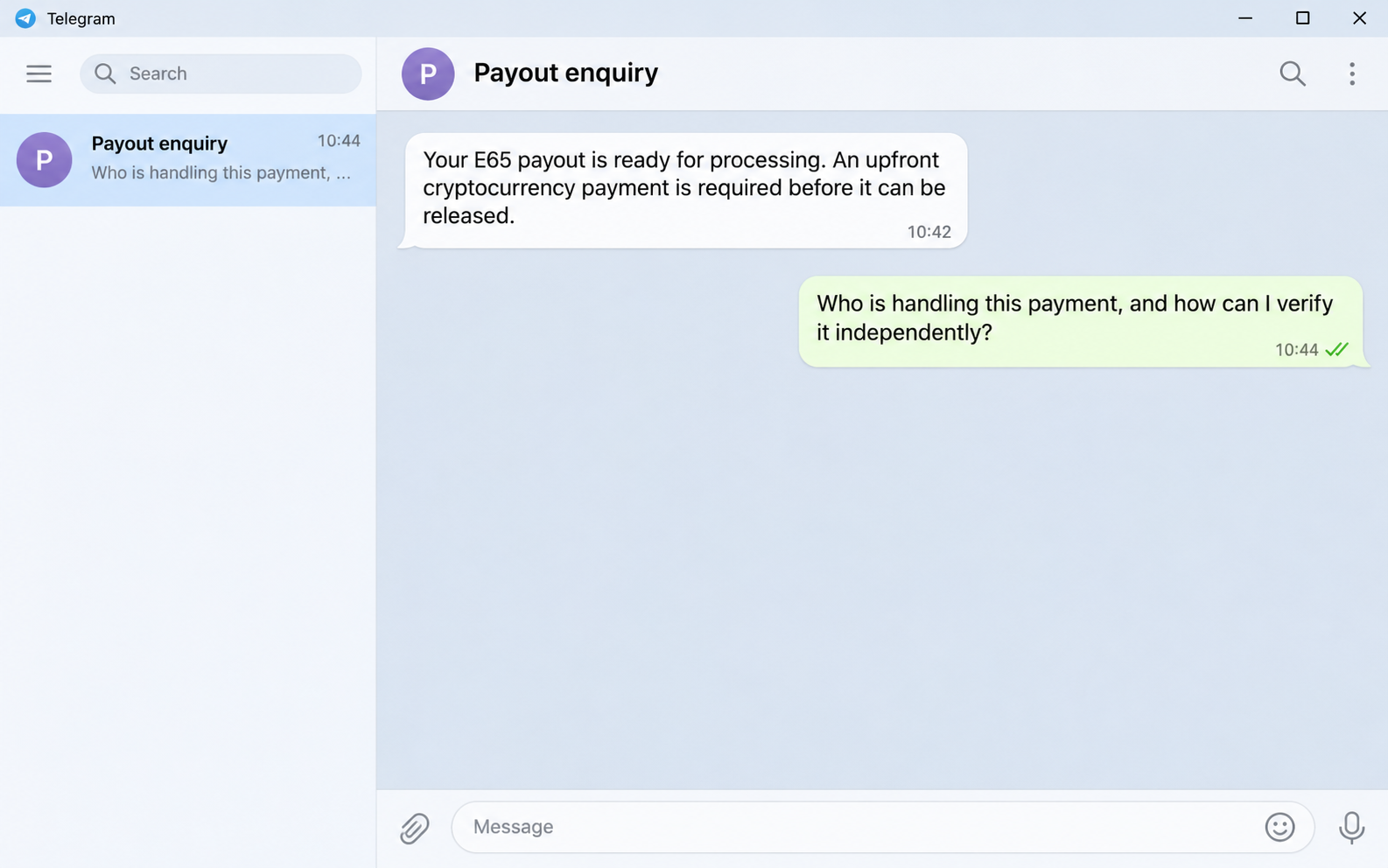
The payout request under investigation
The Endowment 65 payout approach is an advance-fee scam: someone presents a future payment as available, but requires cryptocurrency before supposedly releasing it.
The image above reconstructs that request for explanation. It is not an original conversation, a verified sender account, or evidence of a completed payment.
What the official warning actually establishes
New Zealand’s Financial Markets Authority published its Endowment 65 warning on December 5, 2025.
It reported an individual being approached by someone claiming to facilitate payouts to original E65 participants, with upfront cryptocurrency demanded for processing.
The decision that protects your money
- Do not transfer cryptocurrency to unlock the promised distribution.
- Check any claimed entitlement independently of the contacting party.
- Preserve the request before blocking its sender.
- Contact your payment provider immediately if you already paid.
A Familiar Program Name Is Not Proof of a Payout
A reference to something you previously joined gives the message an advantage over an ordinary unsolicited investment pitch. The story already connects to your memory.
You may recognize the initials, remember a discussion group, or recall waiting for an update. Those connections can make the next instruction feel like unfinished administration.
However, knowing a program name does not establish authority over its funds. A sender still needs an independently verifiable identity and a legitimate reason to contact you.
The regulator’s notice lists www.endowment65.com and Telegram references associated with E65. Those identifiers help recognize the subject; they do not authenticate a new contact.
The warning does not establish that every participant has a valid entitlement, that money is available, or that every listed channel sent the reported demand.
The practical test therefore concerns this new request. Are you being asked to risk additional money because somebody says an earlier payout is almost ready?
Stop the transfer while those questions remain unanswered. An attractive account balance or a familiar group name cannot independently answer who controls the destination wallet.
How the E65 Advance-Fee Approach Works
Step 1: An Earlier Connection Creates the Opening
The approach starts from a claimed connection to the original program. That gives the sender an explanation for contacting people who otherwise might ignore an investment advertisement.
For the recipient, the important question is not whether E65 sounds familiar. It is whether the particular person has demonstrated any authority to arrange payment.
A matching display name is insufficient. Treat forwarded introductions and screenshots as information to check, rather than a substitute for checking the source yourself.
Step 2: A Promised Distribution Becomes Conditional
The offer then places a condition between you and the supposedly available money. Paying first is presented as the action needed to make processing happen.
This reverses the apparent purpose of the interaction. Instead of receiving a payment, you become the person sending value to somebody whose authority remains unresolved.
Ask yourself what independently verifiable event proves that money is actually waiting. A statement supplied by the same contacting party does not answer that question.
Step 3: Cryptocurrency Moves the Risk Onto You
The requested payment method matters because a transfer can leave your control without creating the payout obligation you imagined. A successful transaction is not successful verification.
Even if your wallet reports completion, it confirms movement on the selected network. It does not confirm the recipient’s legal identity or ability to release anything.
Do not send a small test amount to investigate. A test still puts money into the request and cannot establish the existence of the promised distribution.
Step 4: The Claimed Release Must Still Be Proved
After any payment, the original question remains unanswered unless funds genuinely arrive under independently established terms. A new explanation cannot retroactively authenticate the first demand.
If somebody introduces another required charge, pause again rather than treating the earlier transfer as a reason to continue. Previous spending does not validate the next request.
That is a protective decision rule, not a claim that the reported individual experienced every possible follow-up. The published warning describes the upfront-fee approach.
Check the Request Without Staying Inside Its Conversation
Separate Identity From Familiarity
Write down the sender’s exact account identifier, not just the visible name. Then identify what independent organization, if any, supposedly appointed that person.
Use contact information obtained outside the message. Do not let its author supply both the claim and the only channel through which you can verify it.
A referral from another participant can explain where a contact came from. It cannot by itself establish that person’s authority over a distribution.
If the introduction depends entirely on a chain of private assurances, your evidence has not improved. Several people repeating the same assertion are not independent confirmations.
Ask What Your Earlier Records Actually Show
Review your own saved enrollment information, receipts, and correspondence. Look for documented terms describing the original relationship, rather than relying on a newly supplied summary.
Keep three questions separate: what you previously paid, what you were promised, and what a new sender now demands. They may concern different people or arrangements.
Do not rewrite uncertain memories into definite contractual rights. If records are missing, acknowledge that gap when seeking professional advice or making a report.
Equally, do not allow the absence of old paperwork to justify an urgent replacement payment. Missing records make independent verification more important, not less.
Reject Verification That Requires Another Transfer
A wallet address can receive funds without revealing the person behind it. A transaction explorer is useful for recording movements, not certifying a payout agent.
Be cautious if proof is offered only after you pay. That condition asks you to accept the disputed authority before receiving evidence about it.
You do not need to solve the entire history of E65 before refusing the current demand. An unverified advance-fee request is already sufficient reason to withhold payment.
What to Do If You Received an E65 Payout Message
- Stop any planned transfer and preserve the original conversation before blocking the account or leaving the group.
- Record the exact recipient address, requested asset, blockchain network, stated fee, sender identifier, and message dates.
- Check your earlier E65 records separately, without opening new documents or verification links supplied by the contacting party.
- Report the approach through the regulator or police service appropriate to your location, using contact details obtained independently.
- Warn affected family members privately, sharing a redacted explanation rather than forwarding an actionable payment request.
Keep the original evidence even if you also take screenshots. A readable image is useful, but an exported conversation can preserve context missing from a cropped frame.
Do not publish wallet credentials, identity documents, or another participant’s private information while warning others. Evidence can be supplied directly to the relevant reporting service.
If you only read the message, that alone does not establish a compromised wallet or infected device. Your immediate task is to prevent payment and further disclosure.
There is no reason to buy security software simply to reject this demand. Device remediation becomes relevant only if something additional happened, such as installing untrusted software.
Already Paid? Organize the Response Around the Actual Transfer
Contact the Provider That Handled Your Payment
Notify the exchange, wallet service, bank, or payment provider involved. Explain that the transfer followed an advance-fee payout request and ask what intervention remains possible.
Provide the transaction hash, network, amount, recipient address, and time. A concise factual report is more useful than sending an unorganized collection of screenshots.
If you bought cryptocurrency through your bank first, describe both stages accurately. The purchase and the later transfer are different transactions with potentially different options.
Do not assume a provider can reverse an on-chain payment. Ask promptly, preserve its response, and avoid anyone who guarantees recovery before reviewing the transaction.
Preserve a Clear Timeline of What Happened
Start with when the contact arrived, then record each request, each payment, and any subsequent instruction. Distinguish amounts requested from amounts actually sent.
Keep copies of support case numbers and the dates you contacted providers. This helps you avoid repeating information and demonstrates which steps you already took.
New Zealand readers can use the FMA’s scam reporting guidance. Reporting supports investigation, but the regulator does not act as a fund-recovery service.
Readers elsewhere should use their local reporting route as well. Do not wait for a foreign agency to reply before contacting the provider that processed the payment.
Protect Only What Was Actually Exposed
If you disclosed an account password, change it through the genuine service and review active sessions. Use a different password wherever the same one was reused.
If you disclosed a wallet recovery phrase or private key, treat that wallet as compromised. Seek help from the genuine wallet provider without sharing the secret again.
Those actions depend on what you disclosed. Sending cryptocurrency from a wallet does not, by itself, prove that its recovery phrase was stolen.
For identity documents, ask the issuing authority what monitoring or protective measures are appropriate. Avoid replacing every document automatically without advice about your circumstances.
Do Not Turn a Payout Scam Into a Recovery Payment
Once money has gone, the desire to recover it creates another decision point. Be particularly wary of an unsolicited person claiming they can undo the transfer.
A claim that funds have been located still needs independent support. An impressive balance display does not show that a stranger controls recoverable money belonging to you.
The FMA’s cryptocurrency recovery warning is relevant here: paying another purported specialist can create a separate loss.
Keep the original report and the recovery approach in separate folders. That prevents an unknown recovery contact from quietly becoming part of your trusted support network.
Never provide a recovery phrase to somebody claiming to trace funds. Do not install remote-access software because a private chat says it is necessary for reimbursement.
For paid professional assistance, verify the provider and written scope independently. Understand the fee without accepting an assurance that recovery is certain.
How to Discuss the Warning With Another Participant
A person waiting for a payout may hear a warning as criticism of their original decision. Keep the discussion focused on the new demand instead.
Ask whether the recipient has independent evidence of the sender’s identity, the funds’ existence, and the payment condition. These questions address the current risk directly.
Offer to help preserve messages or contact the payment provider. Practical help is usually more useful than arguing over every claim made about the earlier program.
Do not promise that refusing this fee will recover earlier spending. The achievable immediate result is simpler: preventing another unverified transfer while the facts are checked.
Do Not Borrow Money to Meet the Claimed Condition
When a payout is presented as almost available, borrowing the processing fee may seem like a short bridge. That reasoning depends entirely on an unverified promise.
Keep the proposed borrowing decision separate from the amount displayed in a message. A larger promised distribution does not reduce the real cost of money you borrow today.
If someone offers to lend you part of the fee, do not treat that gesture as authentication. Establish the lender’s identity and avoid using another obligation to fund this request.
Tell a trusted person before moving savings or applying for credit. Ask them to examine the actual transfer instruction, not merely the optimistic description of the payout.
We previously examined a separate crypto recovery pitch involving pressure to borrow. That is a comparable financial danger, not evidence of a common operator.
The achievable protective step is to stop additional exposure. You do not have to recover every earlier cost or resolve every uncertainty before making that decision.
Frequently Asked Questions
Is the E65 Payout Fee Legitimate?
The documented approach is an advance-fee scam. Do not pay a supposed processing charge merely because the sender knows about the Endowment 65 program.
Does the Warning Prove My Original Entitlement?
No, it does not establish an entitlement or available funds. Check your original records and any claimed legal rights separately from the new contact.
Can I Verify the Sender Through Telegram?
A familiar group or display name is not independent verification. Establish who the person represents through a contact route you did not receive from them.
Should I Send a Small Test Payment?
No, a test payment cannot authenticate a payout obligation. It only confirms that your transfer reached the address selected by the requesting party.
Can My Exchange Recover Cryptocurrency Already Sent?
Ask the exchange immediately and provide complete transaction details. Available options depend on the transaction and provider; recovery should never be assumed or guaranteed.
Do I Need to Reset My Device?
Not merely because you received a message. Respond to the actual exposure, such as a disclosed password, shared wallet secret, or untrusted software installation.
The Bottom Line
Reject the E65 payout approach that requires cryptocurrency upfront. Familiarity with an earlier program is not authority to collect another payment from you.
If you already sent money, stop further transfers, preserve the evidence, and contact the relevant provider now. Do not pay a second stranger to repair the first loss.

Join the discussion
0 commentsShare your experience or ask a question about this article.
Community experiences
Did this happen to you?
Your experience could help someone recognize the same scam. Submit a private report for our team to review.
I experienced this tooReports are reviewed before publication. Sharing publicly is always your choice.
Discussion
Start the conversation
Have a question or something useful to share? Add the first comment.