


A takeover approach can make an ordinary shareholding appear to have sudden upside. Documents, professional titles, and private meetings can make the opportunity feel unusually concrete.
The Touchstone Exploration case shows why those signals need checking. A convincing transaction story can be deliberately constructed around a real company and an invented buyer.
Overview
The confirmed fraud in this case
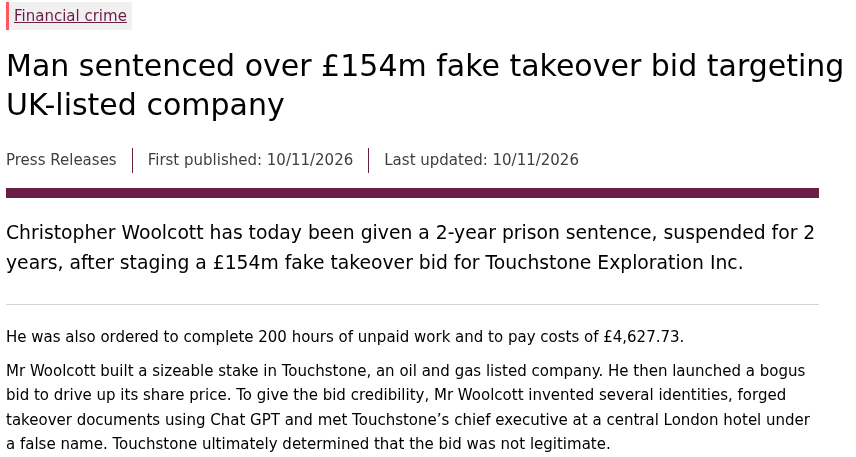
Christopher Woolcott fabricated a £154m takeover approach for Touchstone Exploration, using false identities and forged documents. The target company was real; the proposed transaction was not.
The latest outcome, not an old allegation
The FCA’s November 10, 2026 sentencing announcement records a two-year prison sentence suspended for two years, plus 200 hours of unpaid work.
What shareholders should take from it
- Verify transaction claims through independently obtained official disclosures.
- Do not treat forged papers as evidence of a buyer’s funds.
- Separate a targeted company from the person impersonating counterparties.
- Preserve questionable approaches without promoting them to other investors.
What Happened in the Fake Touchstone Takeover
Woolcott held shares and sought to profit from a price increase. The FCA says he could have gained up to £70,000 if the plan succeeded.
He used ChatGPT for forged takeover documents, invented four identities, and met the chief executive under a false name. Touchstone ultimately determined the approach was illegitimate.
Investigators connected supposed contacts through the same handset, alongside trading records and other evidence. This was not a conclusion drawn merely from suspicious writing.
His September guilty pleas covered fraud by false representation and three false-instrument counts. The earlier plea announcement also explicitly cleared Touchstone of being under investigation in this case.
The £154m figure describes the fabricated bid, not investor losses or money paid to Woolcott. The potential trading gain must not be reported as realized profit.
For readers, the case concerns false transaction authority and manipulated expectations. It does not establish that an ordinary holding in the targeted company is itself fraudulent.
How the Fabricated Transaction Was Made to Look Credible
Step 1: A Shareholder Had a Reason to Create Excitement
A takeover narrative changes the question an investor asks. Instead of assessing the business alone, a reader may focus on what another buyer might pay for it.
That creates an incentive problem whenever the person supplying exciting information could benefit from a price movement. Disclosure of a position does not independently validate the story.
Before acting, ask what evidence exists outside the person promoting the transaction. Separate proof that someone owns shares from proof that a funded counterparty exists.
Step 2: Multiple Professional Roles Suggested Independent Support
A transaction can appear more substantial when several people supposedly support it. Different roles may seem to provide separate confirmations of the same underlying claim.
But introductions inside one conversation are not independent verification. If each supposed participant is known only through another unverified participant, the assurance remains circular.
The useful check is external: identify the organization and professional through a route not controlled by the introducing party, then confirm that person’s actual involvement.
Step 3: Documents Added the Appearance of Preparation
Detailed papers can imply that lawyers, financiers, and decision-makers have already done substantive work. Readers may mistake the amount of text for the quality of verification.
A document can be internally consistent while its central premise is false. Formatting and fluent language do not establish who commissioned it or who approved it.
Before interpreting commercial terms, establish the issuer, authority, and version. Otherwise, you are analyzing a proposed arrangement without knowing whether any authorized party supports it.
Step 4: Direct Contact Made the Story Feel More Real
A face-to-face interaction can make impersonation harder to imagine. Yet meeting someone establishes physical presence, not the truth of the professional identity they claim.
Verify representation independently before sharing sensitive information or accepting commitments. A venue, business card, or confident explanation cannot replace confirmation from the organization supposedly represented.
For individual shareholders, the parallel lesson is to avoid treating a promoter’s access claim as validation. Claimed proximity to executives is not an investment safeguard.
A Takeover Rumor, an Approach, and a Completed Deal Are Different
A share-price rumor is not a transaction agreement. An approach is not proof of a funded offer, and a possible transaction is not a completed acquisition.
These distinctions matter because online discussion often compresses uncertainty. A tentative statement can become a confident headline after several people summarize and forward it.
Locate the original disclosure rather than relying on the strongest interpretation in a discussion thread. Read its date, named parties, conditions, and explicit statements about uncertainty.
If no independent disclosure supports the claim, do not fill the gap with screenshots of private correspondence. Treat that absence of independent confirmation as unresolved.
A real company can receive an illegitimate approach without endorsing it. The existence of correspondence does not show that its contents were accepted or verified.
Likewise, an official statement describing an approach does not automatically support every prediction attached to it. Read what was actually announced, not what a promoter says follows.
How to Check a Takeover Claim Before Acting
Find the Original Public Information
Navigate independently to the company’s genuine investor information and the relevant market’s official disclosure service. Check that the legal entity and traded instrument are the ones you hold.
Search the original announcement text and its publication time. A copied image can omit a qualification, an update, or the fact that the material concerns another period.
Compare later disclosures as well as the first statement. A developing situation cannot be understood from the most optimistic paragraph preserved in an older screenshot.
Do not treat the absence of public details as proof of a secret guaranteed opportunity. Lack of confirmation is a reason to withhold reliance, not increase conviction.
Check the Claimed Counterparty Independently
If someone claims to represent an investment firm, contact that firm using information obtained separately. Ask whether the person and approach are genuinely connected with it.
For a claimed solicitor, use the appropriate professional regulator and the practice’s independently verified contact route. A real practitioner’s name can still be used without permission.
Do not assume a genuine company registration establishes a person’s authority to negotiate. Existence, employment, authorization, and available financing are different questions requiring different evidence.
If you cannot verify a material identity, stop there. You do not need to prove the entire allegation before declining to trade or send documents.
Keep Commercial Claims Separate From Document Appearance
A polished PDF can describe financing that has never been committed. A signature image can name somebody who has never seen the file.
Ask which independently confirmed fact supports each important conclusion. If the answer repeatedly leads back to the same unverified attachment, you have not obtained corroboration.
Do not upload confidential transaction documents to an unknown authenticity-checking website. Verification should not create a second disclosure problem while attempting to resolve the first.
What the ChatGPT Detail Does and Does Not Mean
This case includes a documented use of generative AI in creating false transaction material. It is not necessary to guess from awkward wording or visual artifacts.
However, the wider lesson is not that every fluent document is fraudulent. Legitimate professionals also use drafting tools, and writing style alone cannot establish authorship or authority.
A detector’s score cannot prove a buyer exists, a professional signed, or financing is committed. Those questions need factual verification, not stylistic analysis.
Similarly, passing an automated writing check would not make a fabricated transaction legitimate. A convincing sentence can still communicate an entirely false identity or undertaking.
Focus on independently confirmed relationships and commitments rather than trying to diagnose the software behind a document. That approach remains useful even when no AI was involved.
For organizations handling approaches, establish a verification process that operates regardless of presentation quality. The most professional-looking submission should still pass the same identity checks.
What to Do if Someone Promotes a Supposed Deal to You
- Pause before trading or forwarding the claim, and find the original disclosure through an independently obtained official route.
- Preserve the message, sender identifier, supplied documents, and any claim that the opportunity is private, urgent, or guaranteed.
- Ask your broker through its genuine support channel about the security and the public information available, without relying on the promoter’s contact details.
- Report suspected false market information through the appropriate regulator’s official reporting service, including the original material and a clear timeline.
- If money or account credentials changed hands outside your broker, contact the actual provider immediately and describe that separate exposure accurately.
Do not buy shares merely to test whether the story is real. A trade confirms that an order executed; it does not authenticate the information behind it.
Equally, this article is not a recommendation to buy, sell, or short Touchstone. Its subject is verification of a false approach, not a valuation of the business.
If you already hold shares, separate the fraud report from your wider investment decision. Consider verified disclosures and obtain qualified advice appropriate to your circumstances.
Preserve Evidence Without Becoming Part of the Promotion
A warning can unintentionally spread the same false claim when it repeats the attractive price or supposed buyer without context. Keep your explanation tied to verified facts.
When sending evidence to a broker or regulator, preserve complete originals. When discussing the issue publicly, remove private contact details and clearly identify unsupported promotional material.
Do not present an altered document as the original. If you annotate a copy, retain the untouched file and explain which version contains your notes.
Record when you first received the material and whether it influenced a decision. Distinguish your own transactions from hypothetical gains or losses described by somebody else.
The FCA offers a dedicated route for individuals reporting suspected market abuse. Its reporting process is not a promise of compensation.
A report should identify what you observed, not supply a dramatic explanation for everything you cannot establish. Accurate uncertainty helps an investigator evaluate the evidence.
Watch for a Second Story Built Around the Real Case
A genuine prosecution can itself become material for a misleading pitch. Someone might claim to offer a special shareholder remedy, compensation process, or privileged recovery service.
Do not infer an individual entitlement from a sentencing announcement. Any genuine claim process needs its own independently verified administrator, eligibility requirements, and official instructions.
If somebody requests a fee to release compensation connected with this case, verify that claim outside their message. A real defendant’s name does not authenticate the contact.
Never provide brokerage passwords, one-time codes, or remote access to a purported claims agent. Contact your broker independently if you need help understanding account activity.
Keep any new recovery solicitation separate from the original takeover material. One established fraud does not make every later explanation or proposed remedy trustworthy.
Check Whether a Shareholder Action Is Actually Required
A message may move quickly from a transaction claim to an instruction for shareholders. Do not assume you must register somewhere because a document mentions a takeover.
If action is genuinely required, verify the notice through your broker or independently obtained company information. Check the relevant holding and the stated deadline before submitting anything.
Do not transfer shares to a stranger’s account to secure a proposed premium. Ask your broker to explain any legitimate corporate-action process affecting the holding you actually own.
Read the exact request before sharing information. A request for ordinary contact details differs materially from a demand for a brokerage password or an authorization code.
Our separate clone-firm report demonstrates why a genuine company’s name cannot authenticate an intermediary. It does not establish any connection with this defendant.
These checks remain useful when an offer is genuine. Independent confirmation protects your decision without requiring you to assume that every unfamiliar transaction notice is fraudulent.
Frequently Asked Questions
Was the Touchstone Takeover Approach Genuine?
No, the approach described above was fabricated. Evaluate any new transaction claim independently rather than treating an old document or private assurance as current evidence.
Was Touchstone Accused of Running This Fraud?
No, the company was the target of the false approach. Do not turn a case about impersonated counterparties into an unsupported allegation against the targeted business.
Does the Headline Figure Represent Investor Losses?
No, it identifies the purported transaction value. A bid amount, a potential trading gain, and a person’s actual loss are different figures requiring separate evidence.
Does Professional Writing Prove a Deal Is Authentic?
No, presentation cannot establish identity, authority, or available funds. Verify the underlying parties and original disclosures instead of relying on fluent language or document design.
Should I Trade Based on a Private Takeover Tip?
Do not treat an unverified private claim as a safe trading basis. Seek independently obtained public information and qualified advice rather than following a promoter’s urgency.
Where Should I Send Suspicious Transaction Documents?
Use your broker’s genuine support route and the appropriate regulator’s reporting channel. Preserve untouched originals and avoid circulating private information in public investment groups.
The Bottom Line
The fake Touchstone approach was a constructed transaction story, not an investment opportunity. Names, papers, and personal contact cannot replace independent verification of the underlying deal.
If you received related promotional material, stop forwarding it, preserve the originals, and check with your broker or regulator. Do not pay a stranger for a supposed remedy.

Join the discussion
0 commentsShare your experience or ask a question about this article.
Community experiences
Did this happen to you?
Your experience could help someone recognize the same scam. Submit a private report for our team to review.
I experienced this tooReports are reviewed before publication. Sharing publicly is always your choice.
Discussion
Start the conversation
Have a question or something useful to share? Add the first comment.