


A caller says an iPhone was purchased using your details. You do not recognize the order, but the offer to connect you with investigators sounds reassuring.
Before accepting that transfer, stop and check who initiated the conversation. The person claiming to help may be creating both the problem and its proposed solution.
Overview
The alleged iPhone order opens the conversation
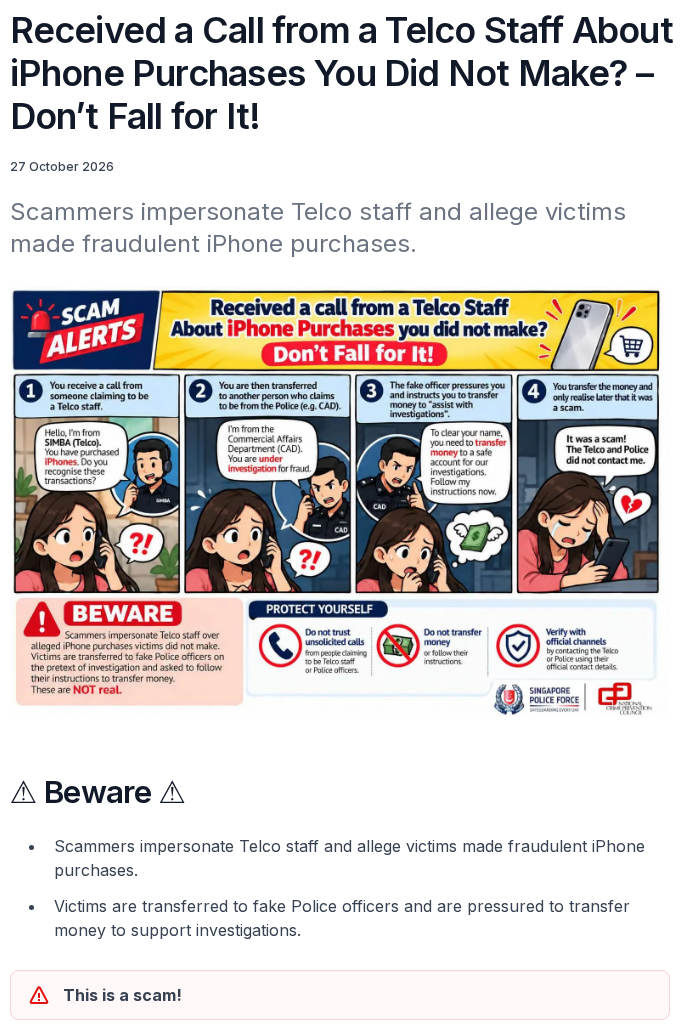
The telco iPhone purchase scam begins with someone pretending to represent a telecommunications provider. They claim fraudulent purchases were made and turn your denial into a reason to continue.
Singapore’s October 27 ScamShield advisory documents this approach: victims are transferred to fake police officers and pressured to move money for an alleged investigation.
The caller’s transfer does not create an independent investigation
A second voice can sound like confirmation, but it arrived through the first unverified contact. Changing titles does not establish that either person represents a genuine organization.
The official illustration shows the money being directed toward a supposed safe account. That instruction is the financial trap, not a way to clear your name.
End the call before trying to resolve the alleged purchase
- Check the order with your provider independently.
- Do not transfer money to support an investigation.
- Do not disclose banking passwords or approval codes.
- Contact the actual bank immediately after any transfer.
Your Denial Is Not a Reason to Accept Their Next Instruction
The opening question invites an entirely reasonable answer: you did not buy the phone. The caller can then use that answer to introduce an apparent identity problem.
What sounds like customer service becomes a discussion of suspected fraud. You may feel that continuing is necessary to avoid being held responsible for something you never did.
But an unsolicited caller cannot establish a debt, criminal allegation, or investigation simply by announcing it. Those claims need checking through channels outside the conversation.
If a real order exists, the genuine provider can help investigate it when you contact them independently. You do not lose that option by ending the unexpected call.
Keep that distinction in mind if the caller says hanging up will make matters worse. Their pressure does not authenticate the situation or remove your ability to verify it.
The immediate safe decision is to stop following instructions. You can address any genuine account issue afterward, without first moving money to an unknown recipient.
How the Telco iPhone Purchase Scam Works
Step 1: A Supposed Provider Introduces an Unrecognized Purchase
The caller borrows the role of somebody who might legitimately know about a phone order or customer account. That makes the question feel relevant before identity is checked.
Do not supply extra information to help them find the account. Ask which provider is claimed, note it privately, and end the call before checking your own records.
A caller naming a real company is making an identity claim. It does not prove that company’s systems were accessed or that an actual iPhone order exists.
Step 2: The Conversation Is Handed to Supposed Police
The transfer changes the emotional setting. What began as an unwanted purchase can now feel like an official matter requiring immediate cooperation.
However, a call transferred by an unverified person is still inside that person’s chosen route. You have not independently reached a police service.
Do not accept an extension, case label, or another person’s professional title as a substitute for starting a fresh contact through an official channel.
Step 3: An Investigation Becomes a Request to Move Money
The false investigation supplies a reason for an unrelated financial action. Money is presented as something that must be moved to help resolve the allegation.
That is the point to refuse, not a stage to complete before asking questions. A stranger’s explanation cannot make their chosen account a safeguard for your savings.
Read your bank’s own payment screen rather than the caller’s description. A transfer instruction remains a transfer instruction when somebody calls it clearance, evidence, or protection.
Step 4: The Transfer Creates a Real Loss From an Unverified Story
There may never have been a fraudulent phone purchase, but the payment you authorize can be real. The alleged problem and the new transaction must be evaluated separately.
If you have already sent money, stop any follow-up transfer and contact the actual bank. Do not keep paying because the caller says the process is incomplete.
A promised return of funds is another claim from the same source. It does not establish that the money is being held by genuine investigators.
Check the Phone Order Without Staying on the Line
Use the Provider You Actually Have a Relationship With
Open your provider’s genuine app or website using your normal route. Check the account, recent orders, bills, and messages relevant to the supposed purchase.
If the claimed company is not your provider, obtain its real contact information independently. Explain the impersonation claim without volunteering sensitive details to an unverified caller.
Do not use a link sent during the call as the starting point. A copied support page can continue the same deception under a more familiar appearance.
Ask About a Specific Account Event
Give genuine support the alleged order details you were supplied and ask whether the event exists. A concrete question is more useful than asking whether all unknown calls are suspicious.
If support finds unexpected activity, follow its verified account-protection procedure. That finding still does not authenticate the person who first called or justify their payment instructions.
Keep any real service case number and the contact route you used. Store the scammer’s claimed reference separately so the two records do not become confused.
Distinguish Account Misuse From a Fabricated Claim
An invented order can be used to frighten someone whose provider account is untouched. Alternatively, genuine unexpected activity may need investigation through the actual service.
Do not decide which happened solely from how much the caller knew. Ask the organization that controls the account to check its own records.
That approach avoids both unnecessary panic and dismissal of a real issue. It lets you reject the payment scam while still addressing any independently confirmed account problem.
Verify Police Contact Without Using the Caller as Your Switchboard
Obtain the appropriate official police contact independently, then explain the claimed handoff and requested transfer. Do not remain inside the connection supplied by the supposed telco agent.
Singapore’s advisory states that government officers will not ask you to transfer money or hand over valuables over a phone call. That directly contradicts the instruction described here.
If a caller invokes a real department, that name still requires verification. A correct title does not show that the speaker works there or has authority over you.
Do not send photographs of bank balances to prove cooperation. An unverified person does not need an inventory of your finances to explain an alleged phone purchase.
If you feel pressured or confused, involve someone you trust after ending the call. Their help should create an independent checking route, not another participant in the same conversation.
What to Do if You Received the Fake iPhone Purchase Call
- End the conversation without accepting further transfers, following new links, or discussing the funds available in your accounts.
- Record the claimed provider, the alleged purchase, the supposed police department, and any payment instruction you already received.
- Check the alleged order through the genuine provider, using its independently obtained app, website, or support contact.
- If money moved or banking information was shared, contact your actual bank immediately and describe each action separately.
- Report the impersonation through the appropriate official service, retaining original messages and transaction records privately.
If you only answered and hung up, do not assume your banking accounts were accessed. The next step is verification of the claim, not an automatic device reset.
If a caller threatens consequences for refusing a payment, preserve the message when safe. Do not continue the conversation merely to collect more dramatic evidence.
The relevant protective outcome is stopping new instructions from becoming real transactions. You do not need to persuade the scammer that you recognize the scheme.
Already Transferred Money? Tell the Bank Exactly What Happened
Identify the Payment Instead of the Caller’s Description
Provide the actual recipient, amount, currency, transfer time, and reference. Explain that the instruction came after a supposed phone purchase and a handoff to fake police.
Tell the bank whether the transfer is still pending and ask what intervention is possible. Do not assume that an authorized payment can automatically be reversed.
If you made several transfers, list them separately. A single total can obscure which provider handled each payment and which transaction may still be interrupted.
List Any Account Information or Approvals You Shared
Distinguish a name or phone number from a banking password, authentication code, or payment approval. Each creates a different question for the bank to assess.
If credentials were exposed, secure the affected account through the real service. Review unfamiliar sessions or changes under its guidance rather than using instructions from the caller.
Do not approve another request that supposedly cancels a previous transfer. Ask the actual bank to explain the controls and next steps appropriate to the account.
Preserve the Communications Alongside the Transactions
Save call times, displayed numbers, messages, and the names used. A number can still be useful evidence even though it does not authenticate the caller.
Retain any instructions about the supposed investigation and the destination account. These records explain why you acted without requiring speculation about the operators’ identities.
Follow the bank’s reporting and dispute instructions promptly. Keep its case reference and any police report details together, without assuming one institution automatically notified the other.
A Real Investigation Does Not Require Following an Unverified Money Trail
Someone may claim that transferring funds is how investigators distinguish legitimate money from criminal money. The description does not establish a genuine procedure or receiving account.
Do not test that explanation with a small transfer. Successful delivery would show that an account received your payment, not that its owner represents police.
Similarly, a balance screenshot or purported receipt cannot prove where the money is being held. Seek confirmation through your own bank and independently reached authorities.
If a caller asks you to conceal the transfer from bank staff, disclose that instruction to the bank. Its staff need the actual context to assess the risk.
Do Not Accept an Unsolicited Recovery Offer Afterward
A second caller may refer to the first incident and offer reimbursement or special help. Knowledge of the alleged phone order does not make that person independent.
Contact the bank or reporting service using the channel you already verified. Ask whether any new approach is connected with your actual case before sharing information.
Do not pay a release fee or supply account access to collect supposed compensation. A promised remedy needs its own verification and cannot be authenticated by the original scam story.
Keep new messages as evidence, but do not turn their author into your adviser. If you need professional help, establish the provider and scope through independent information.
Help Someone Who Thinks They Must Clear Their Name
Start with the action being requested rather than arguing about how convincing the caller sounded. Ask whether money has moved or another transfer is being prepared.
Offer to help contact the genuine provider and bank. That directly addresses the person’s fear without requiring them to keep cooperating with an unverified investigation.
Avoid promising that nothing is wrong with the account before it is checked. The useful reassurance is that genuine organizations can be reached independently.
Keep the person involved in the explanation and reporting. Clear, respectful help makes it easier to disclose payment details that embarrassment might otherwise conceal.
Frequently Asked Questions
Did Someone Really Buy an iPhone Using My Details?
The caller’s assertion cannot establish that. Check your account and the claimed provider independently, without accepting the caller’s police handoff or payment instructions.
Does Being Transferred to Police Make the Call Genuine?
No, the transfer remains part of the unverified approach. Start a separate contact through official channels rather than treating another voice as independent confirmation.
Should I Move Money to a Supposed Safe Account?
No, do not move funds for the investigation described here. A stranger’s label for an account does not change who controls the money after transfer.
What if the Caller Knows Personal Information?
Accurate details do not prove authority. Verify the alleged purchase and institutional identity independently before discussing banking access, balances, or any further personal information.
Do I Need to Reset My Phone?
Not simply because you received this call. Identify any additional exposure, such as installed software or shared credentials, and obtain help appropriate to that action.
What if I Already Approved a Transfer?
Contact the bank immediately with the recipient and transaction details. Ask what intervention remains possible, preserve the communications, and refuse further instructions from the caller.
The Bottom Line
Do not transfer money after a telco caller hands you to supposed police over an iPhone purchase. End the call and verify the alleged order independently.
If you already paid, contact the bank now with the real transaction details. Do not send another payment to complete, cancel, or reverse the supposed investigation.

Join the discussion
0 commentsShare your experience or ask a question about this article.
Community experiences
Did this happen to you?
Your experience could help someone recognize the same scam. Submit a private report for our team to review.
I experienced this tooReports are reviewed before publication. Sharing publicly is always your choice.
Discussion
Start the conversation
Have a question or something useful to share? Add the first comment.