

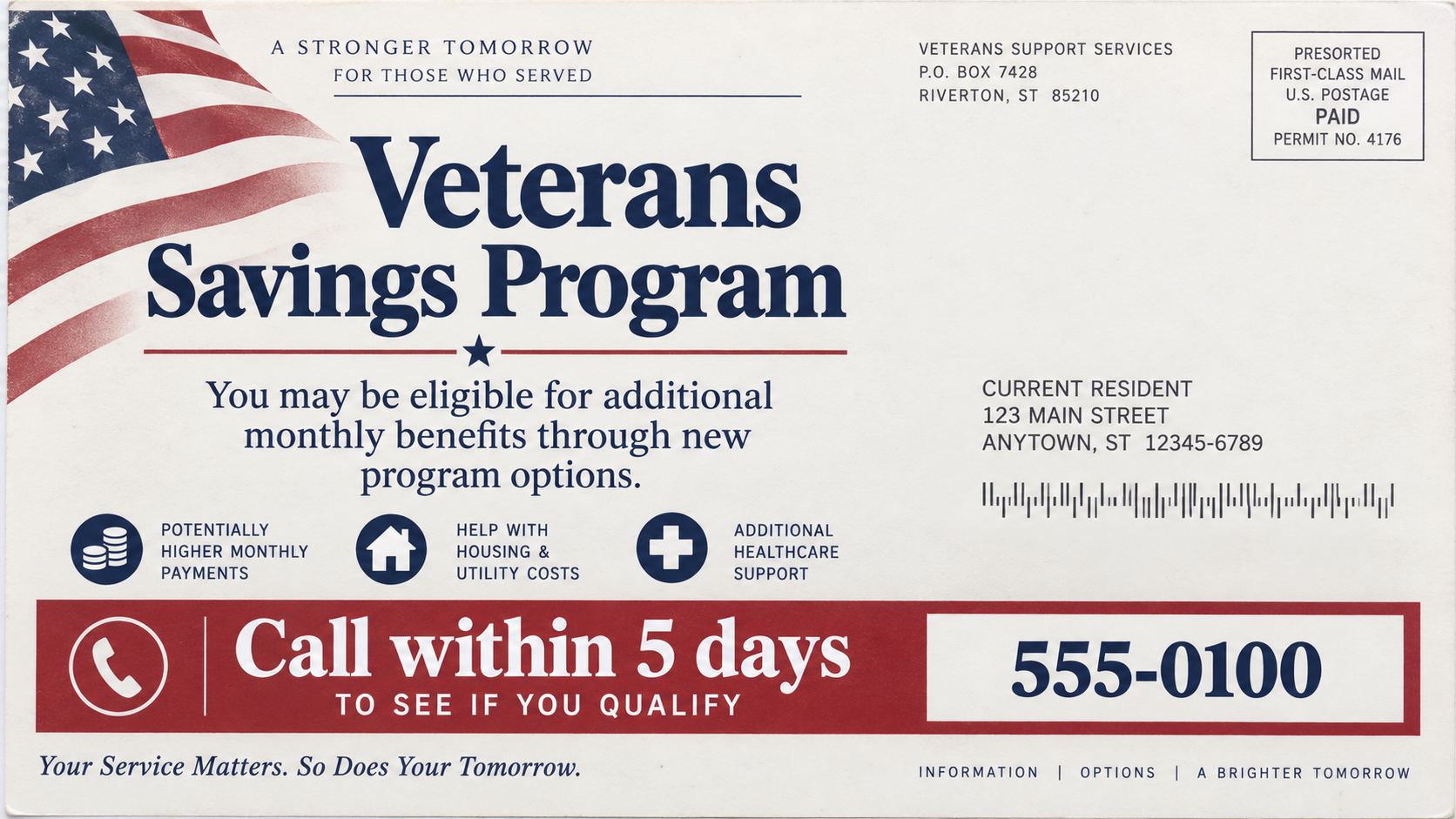
A Veterans Savings Program postcard arrives with a familiar promise: you may qualify for extra benefits. It asks for a quick call, just before the opportunity supposedly disappears.
If you received one, take a breath. The details on that little card matter more than its patriotic colors or the urgency in its headline.
Overview
What the postcard promises
The Veterans Savings Program postcard scam targets veterans and, in some versions, their spouses. It suggests they may be owed additional monthly payments or help with existing benefits.
The mailing can mention the recipient’s state and real benefit names. CHAMPVA and TRICARE For Life are genuine programs, which makes the surrounding invented offer easier to overlook.
A deadline pushes the recipient to call a number printed on the card. The message may imply that waiting five days means losing a benefit that was never identified clearly.
What the VA and FTC actually say
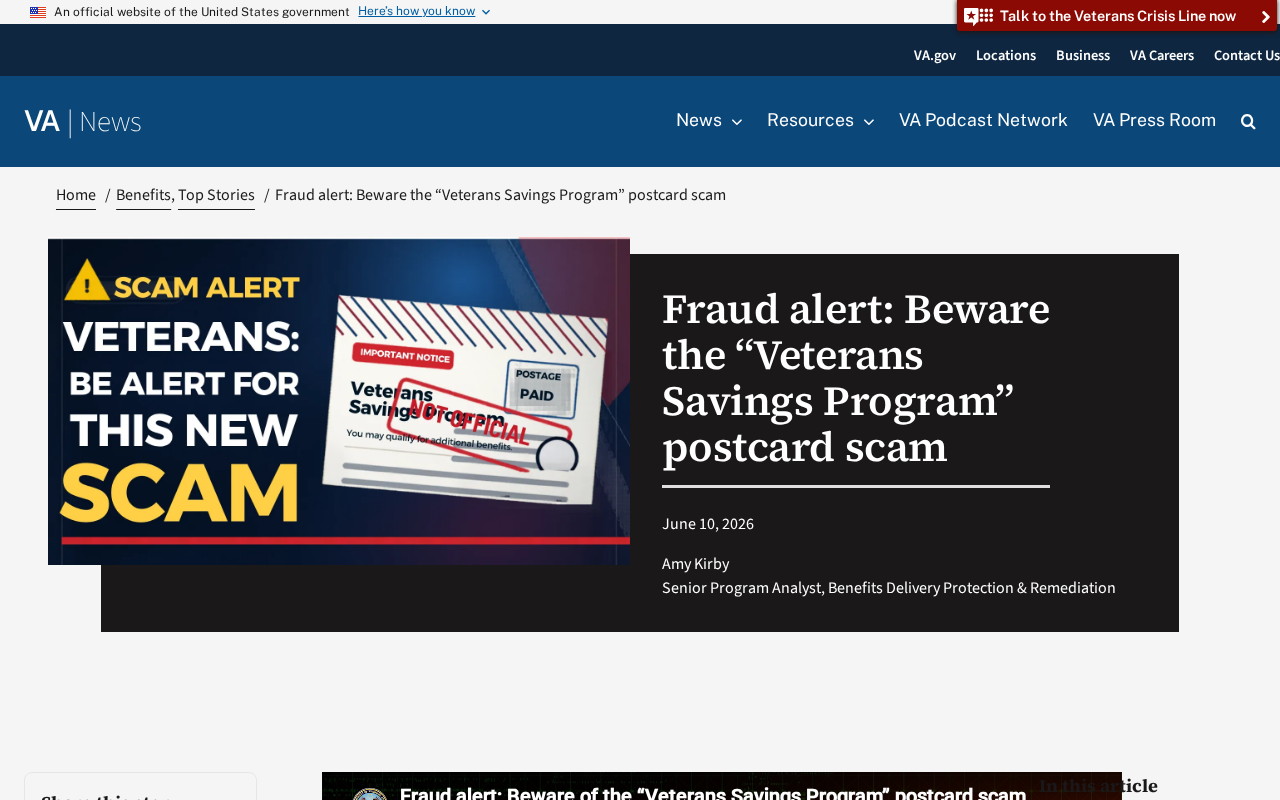
The Department of Veterans Affairs warns that the supposed Veterans Savings Program is not a real VA program.
The Federal Trade Commission describes the same postcard approach: an invitation to call, followed by attempts to collect sensitive information.
That distinction is important. The government does mail genuine notices. The problem is this particular invented program and the pressure to call its unverified number.
Why a small card can feel convincing
A postcard is tangible. It arrives beside bills, insurance notices, and actual VA correspondence. A recipient may give it more weight than an unexpected text message.
Fraudsters exploit that feeling of familiarity with several cues:
- Benefit names that already exist, wrapped around a program name that does not.
- Patriotic design and mail formatting that suggest official status without proving it.
- A state reference that makes a generic mailing feel individually selected.
- A short response deadline that discourages a separate call to the VA.
The card alone cannot change anyone’s benefits. The danger begins when the recipient treats its phone number as the official doorway to an agency.
The Real Benefit Programs Behind the Borrowed Credibility
CHAMPVA is an actual VA health benefits program for certain spouses, dependents, and survivors. TRICARE For Life is also real, with its own eligibility rules.
Neither fact validates a private postcard promising blanket extra payments. A real program name can be placed in a fraudulent sentence without the program authorizing the mailing.
The VA’s warning says callers may hear praise for their service before being asked for a Social Security number, bank details, or other identifying information.
That praise can lower a person’s guard. It also turns a cold call into a conversation that feels like an overdue thank-you from the government.
The person on the phone may know a name, service branch, address, or birth month. Such details can come from lists or public records. Knowledge is not authority.
In August 2026, the VA also announced legitimate Choose VA postcards. That makes independent verification especially important.
A genuine postcard and a fraudulent postcard can arrive in the same season. Do not judge either solely by its format or by whether it mentions the VA.
The safest comparison starts at VA.gov or a number you obtained independently. Ask whether that exact program exists and whether the agency sent the specific notice.
How the Veterans Savings Program Postcard Scam Works
Step 1: A benefits-themed postcard lands in the mailbox
The first contact is ordinary mail, not a login page. The postcard claims a veteran or spouse could receive extra money or related coverage.
Some versions refer to CHAMPVA, TRICARE For Life, or dental benefits. Those words give the piece a government flavor while avoiding a precise, verifiable eligibility determination.
Because postcards are not sealed, the pitch must be brief. That brevity helps the sender skip the details a legitimate benefit explanation would need.
Step 2: The sender creates a false deadline
The card tells the recipient to call quickly, sometimes within five days. It may suggest a limited window to secure money already owed.
A genuine benefit may have application deadlines, but an anonymous postcard cannot prove one applies to you. Pressure is a reason to verify, not to rush.
The five-day device is especially effective against busy families. It asks them to settle uncertainty by calling the convenient number rather than finding an official one.
Step 3: The call begins with rapport
According to the VA, the caller may be complimented for military service. The representative can sound like a patient benefits counselor, not a stereotypical aggressive scammer.
The conversation may begin with harmless questions. Name, branch, or location can make the call feel like routine eligibility screening.
Every answer also gives the operator another detail to use. A person who knows more about you after ten minutes may sound more legitimate after twenty.
Step 4: The caller requests sensitive information
The pivotal request is often a Social Security number, bank information, or both. A claimed need to “confirm” direct deposit can hide an attempt to redirect payments.
Other requests may concern an online VA account, identity document, or a code received by text. The exact script can vary; the common feature is an unverified caller collecting credentials.
Even if the caller never asks for money, identity theft is still a serious outcome. Sensitive information can be used later for account takeover or new applications.
Step 5: The information may be used after the conversation
A victim might not see a loss immediately. Bank details can be tested later, and a fraudster may wait before attempting an account change.
The VA specifically advises veterans to watch for missing benefits payments or changes to direct deposit. A delayed sign does not mean the original call was harmless.
Some operators may contact the person again, pretending to help finish an application or fix a problem. That second call can draw out more information.
Step 6: The recipient is discouraged from independent checks
A convincing caller may claim that another VA employee will not see the pending offer. They may say the postcard number is a special processing line.
That claim protects the scam from the simplest test. A legitimate agency can be reached through its published channels, even when a notice concerns a specific case.
Hang up and use VA.gov or the VA benefits hotline you looked up yourself. A trustworthy opportunity will survive an independent call.
Who Sent the Postcard? Four Checks That Matter
The program name is not an agency identity
“Veterans Savings Program” sounds administrative, but the VA and FTC say it is not a real VA benefit program. The phrase does not identify a lawful sender.
Look for the actual legal entity responsible for the mailing. A logo-like graphic, a marketing name, or a vague “benefits department” is not enough.
Do not assume every envelope bearing a patriotic design is tied to the same operator. Similar scams can be copied by unrelated groups.
A return address does not prove a government office
Bulk mail can carry a postal permit, a processing address, or a mail house. None establishes who owns the pitch or where benefits decisions are made.
If an address is printed, compare it with official VA contact information. A shared building or mailbox can receive replies without being an agency office.
A missing address is also worth noting. Preserve both sides of the postcard so an investigator can assess its routing and printed identifiers.
The phone operator is not your VA counselor
The number on the postcard belongs to the sender’s communication path. Even a polite representative who knows your name has not been authenticated.
Ask the VA through a separate channel whether it recognizes the mailing. The official benefits hotline is 1-800-827-1000.
Never call back using a number supplied by the suspicious representative to “verify” them. That only returns you to the same controlled conversation.
Follow-up websites and forms need tracing
A caller may direct you to a website or text link after the postcard. Check the full domain before typing anything. A government-like design proves nothing.
Real VA online services begin from VA.gov. A link sent by a stranger could lead to a lookalike intake form or an account-login theft page.
Keep screenshots of any follow-up message. A website may vanish, but its URL and the timing of the contact can still help a fraud report.
How to Check a Postcard Without Calling Its Number
First, separate the claim from the presentation. Write down exactly what the postcard promises, which program it names, and what action it demands.
Second, search the program name on VA.gov. The absence of an official program page is a warning, although search results alone are not a final decision.
Third, contact the VA directly through its published hotline. Tell the representative the wording of the postcard, not the caller’s interpretation of it.
Fourth, ask whether any actual benefit application, eligibility update, or account change is pending. This checks your record instead of debating the mailer’s design.
Fifth, compare a genuine VA notice if you have one. Official mail can vary, so use the comparison as a prompt for questions, not as the only test.
Family members can help with verification, especially when the postcard targets an older veteran. They should not make a call to the printed number on the veteran’s behalf.
If a caller says secrecy is required, end the conversation. Benefit administrators do not need to isolate you from your family or your bank.
The Questions a Legitimate Benefits Conversation Should Answer
A real benefits discussion can identify the exact program, the eligibility rule, the agency handling the application, and where the applicant can read those rules.
The representative should be able to explain whether the benefit concerns compensation, health coverage, a survivor, or a dependent. “Extra money” is not a program description.
You should also be told whether an application is needed, what documents it requires, and how to submit them through an official channel.
Consider the difference between eligibility and approval. Even someone who may qualify generally still needs a legitimate determination based on records and program rules.
An unsolicited postcard cannot make that determination simply by knowing your address. It should never be treated as a final benefits decision.
If the sender refuses to give a full legal name or says the details are secret until you disclose your Social Security number, stop there.
Ask whether you can visit a VA office or use VA.gov instead. A caller who insists on a private route is asking you to surrender your independent check.
Spouses and caregivers deserve the same caution. Their names and financial details can be valuable even if the veteran’s benefit account is not directly accessed.
What to Do if You Have Fallen Victim to This Scam
- Stop the conversation and keep the card. Hang up, do not answer follow-up calls, and photograph both sides of the postcard. Save any voicemail or text.
- Call the VA through an independently found number. Explain what information you shared. Ask about benefits, direct-deposit settings, and recent account changes.
- Contact your bank if you disclosed account details. Ask its fraud team about monitoring, replacement account numbers, and reversing unauthorized transfers. Do not wait for a payment to disappear.
- Protect your identity if you shared a Social Security number. Visit IdentityTheft.gov for a recovery plan and consider credit freezes with the major bureaus.
- Change exposed passwords from a clean device. If you entered credentials on a follow-up page, change them directly on the official site and enable strong multifactor authentication.
- Check your device if you opened a file or installed software. Malwarebytes can scan for malicious programs. AdGuard can help block known harmful ads and pages, but neither replaces a bank call.
- Report the attempt. The VA directs suspected benefit fraud to VSAFE.gov or 1-833-38V-SAFE. Report the mailing to ReportFraud.ftc.gov.
- Be wary of recovery offers. Anyone who claims they can retrieve stolen benefits for an upfront fee may be exploiting the same fear again.
There is no shame in having called. The mailing was designed to borrow credibility from real benefits and a familiar government setting.
What matters now is limiting access to your accounts, documenting the contact, and letting the VA and your bank know what happened.
Frequently Asked Questions
Is the Veterans Savings Program a real VA benefit?
No. The VA and FTC identify the Veterans Savings Program postcard as a fraudulent pitch, not a VA-administered benefit.
Can a real VA postcard arrive in the mail?
Yes. The VA mailed legitimate Choose VA postcards in 2026. Verify each notice through VA.gov or a published VA number.
Does mentioning CHAMPVA or TRICARE For Life make the card genuine?
No. Those benefit names are real, but anyone can print them on a postcard. The sender and offer still need independent confirmation.
What if I called but gave no information?
End contact and watch for follow-up calls. If you only spoke briefly and shared nothing sensitive, the immediate risk is lower.
What if I gave my Social Security number or bank details?
Contact your bank and the VA promptly. Use IdentityTheft.gov to plan credit and identity protections, and retain the postcard as evidence.
Should I call the number printed on the postcard to test it?
No. Use the official VA contact page or benefits hotline. A scammer-controlled number cannot reliably verify its own legitimacy.
The Bottom Line
The Veterans Savings Program postcard scam borrows the language of real benefits, then tries to move the conversation to an unverified phone line.
Keep the card, skip its number, and ask the VA directly. A genuine benefit can withstand that simple check; a fake one depends on you not making it.

Join the discussion
0 commentsShare your experience or ask a question about this article.
Discussion
Start the conversation
Have a question or something useful to share? Add the first comment.