


The paperwork names a company borrowing money for equipment. It even shows when the company is supposed to repay the loan and what you’ll receive each month.
Before you rely on that schedule, check whether the borrower actually owes anything under it.
Overview
What Woodhill Capital told investors they were funding
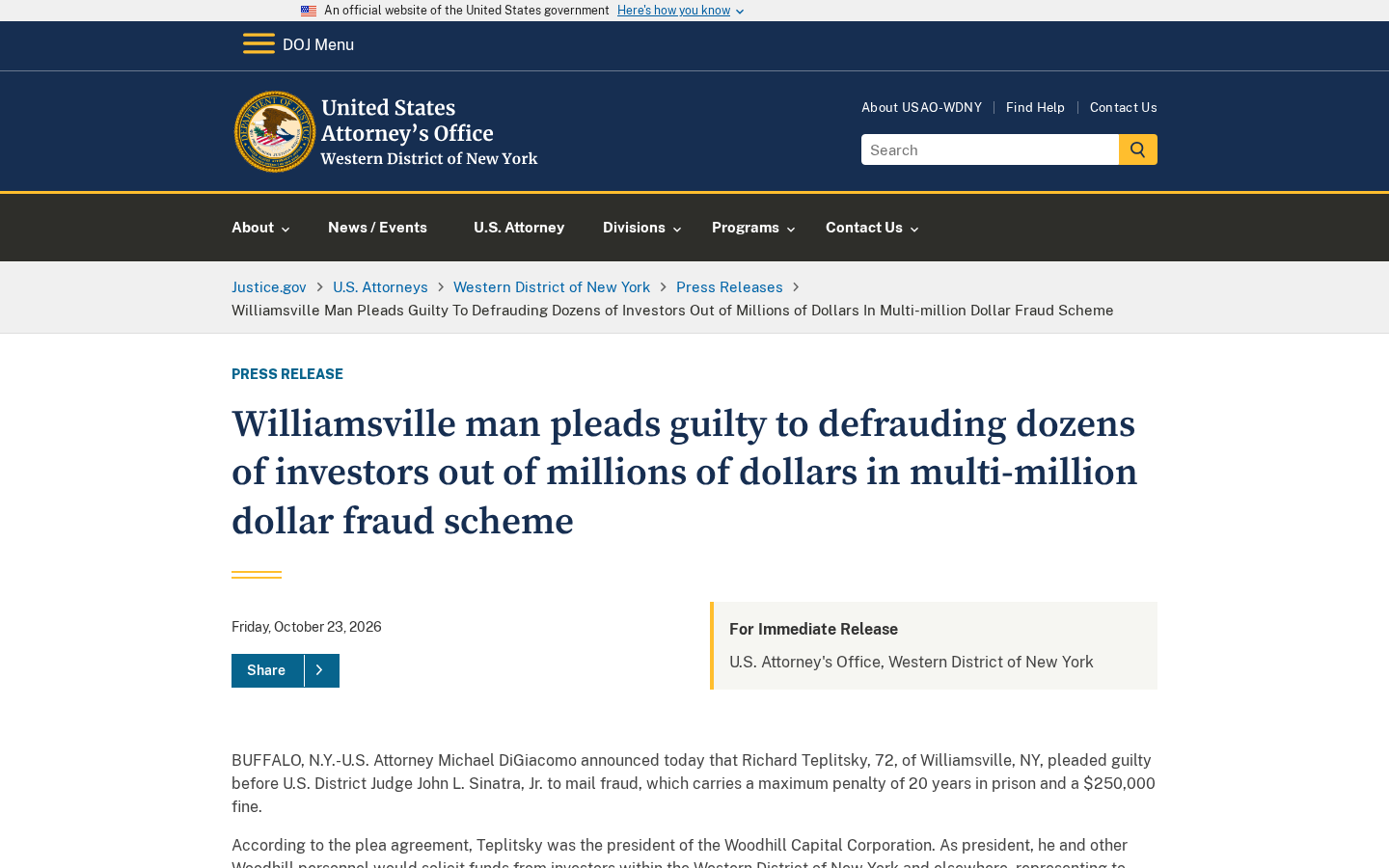
Richard Teplitsky was president of Woodhill Capital Corporation. The Western District of New York’s plea announcement says investors were told their money would finance equipment loans to businesses.
The pitch came with specific documents. Investors could receive financing agreements that purported to identify a borrower and schedules showing when payments were supposed to arrive.
Some investors were told returns could reach 14% or more. The promise was that the returns would be paid as the borrowing businesses repaid their loans.
Over the period described in the case, Woodhill did not use most investor money to fund the loans promised. It used newer money to pay amounts owing to earlier investors.
The counts in the case describe different things
By March 2026, Woodhill owed payments to about 200 investors based on approximately 1,800 outstanding fraudulent loan entries. That number is not a count of real businesses that borrowed.
Prosecutors put the loss at $54,406,742. Teplitsky pleaded guilty to mail fraud on October 23, 2026; the district included the case in its November 24 update.
The original notice said sentencing would be scheduled later. It did not announce repayment to all investors or a public form for anyone to claim money.
A person who has already reported a loss should keep that reference. A new press announcement does not require sending a second set of records to an unverified contact.
What a loan packet can and cannot establish
- A schedule lists expected payments; it cannot prove that the loan exists or that a borrower paid.
- A real business name in an agreement does not show that business signed the document.
- Regular deposits into your account are not proof they came from the borrowers listed in the packet.
- Find out who controls the documents, who holds your money and who can independently verify the arrangement.
A real payment can make a false explanation harder to question. Before you reinvest it, find out how the firm says it was earned and whether that can be checked.
How the Woodhill Capital Equipment Loan Fraud Worked
Step 1: The offer named a specific business purpose
Money for commercial equipment is easy to picture. A machine needs financing, a business uses it, and the business pays back the loan over time.
That was the premise Teplitsky and other personnel presented to investors, according to the plea account. The stated purpose explained why predictable monthly payments might seem plausible.
Ask what rights you would actually receive from an offer like that. Funding a firm is not automatically the same as owning a specific loan or claim against equipment.
Step 2: The paperwork made the promise look measurable
Investors received purported agreements and payment schedules. Prosecutors said Teplitsky created fraudulent records that made it appear the money was funding loans to businesses.
An amortization schedule shows how a balance might fall if payments occur. It does not prove that the listed parties signed a valid agreement or that the loan was funded.
The best check is independent of the person asking for an investment. Ask who can confirm the agreement exists and whether your interest in it is documented.
Step 3: Monthly payments looked consistent with the story
Woodhill commonly paid investors on the tenth or the twenty-fifth of the month, prosecutors said. A deposit arriving on schedule could therefore look like evidence the borrower paid.
According to the plea account, the firm used new investor money to pay amounts owed to earlier participants. The payment timing did not establish the source.
If you already received a payment, save your own bank record and the explanation that arrived with it. Those two documents may describe different parts of the story.
Step 4: The number of paper loans hid the underlying gap
The conduct the government described extended from the mid-1990s through March 2026. The later count of fraudulent entries showed obligations the firm’s paperwork said remained outstanding.
The release does not invite readers to infer that every unrelated equipment lender was involved. The admitted conduct is specific to the Woodhill case and the transactions established there.
When considering an offer now, do not ask only when the first payment arrives. Ask whether anyone outside the promoter can identify the borrower and the claimed loan.
How to Check a Promised Investment in Equipment Loans
Match the offer to the party signing the agreement
Take the name from the proposed agreement rather than a logo. Check the firm’s role and the person signing, and ask where the firm is registered if registration applies.
The SEC’s investment professional lookup guide can help you research someone who claims to be a registered professional. Confirm you found the right person and firm.
A registration check settles only one question. A legitimate firm name does not prove the person using it works there or that a particular transaction is authorized.
Contact the firm through a route you find independently. Give it the offer’s name and ask whether the person who approached you is authorized to make that offer.
Find out what you are buying and how it would be held
Ask whether you would own a share of a particular loan, a claim against the firm, or an interest in a pool. The paperwork should give the same answer.
Ask who services the loan and where the evidence of your interest is kept. A sales representative who only points to a spreadsheet has not answered that question.
Confirm who would receive your payment, whether that matches the contract and how you would get records directly from that party. Don’t accept a last-minute account change without checking.
If the proposed investment depends on particular equipment, ask an independent adviser how the equipment and security interest could be checked. A product photo or invoice is not sufficient.
Understand the difference between a scheduled payment and an exit
Read how and when you can get principal back. A monthly return may be described separately from any right to redeem or transfer the investment.
Ask what happens if a borrower misses a payment or the servicer fails. Those answers should come from the agreement, not an assurance that none of the loans has defaulted.
Keep the terms governing renewals before agreeing to roll anything over. A new document that calls your prior balance an investment may change what you can do with it.
How to Read a Loan Schedule Beside Your Own Records
Follow the money from the agreement to the account
Write down which company owes the money under the agreement. Then check whether that entity is the borrower, a servicer or the investment company issuing a separate obligation.
If the schedule names a borrower but the agreement names only the promoter, ask what connects them. That difference may determine what rights you could enforce.
Note whether you can obtain account statements from the actual entity holding the investment. Ask how its records would document a new investment, payment or adjustment.
Use your bank record to identify who actually sent a distribution. If the money came from an intermediary, ask for the approved statement showing which obligation the payment satisfied.
A deposit may combine several underlying payments. A reliable servicer should be able to explain how it calculated the total without making you rely on a salesperson’s memory.
Ask what happens to a loan when somebody stops paying
Find the part of the agreement that explains missed payments. Check who contacts investors, who handles collection and how losses may affect the amount due to you.
Ask how delinquencies are reported and where you would see one. A snapshot that shows every loan as current is a claim, not an independent quality check.
If an offer relies on insurance or collateral, ask an independent adviser to check the actual terms. The word secured does not guarantee that every investor recovers the full principal.
Ask who can identify the pledged asset if the promoter stops answering. That question often matters most when a loan is already in trouble and records are hard to get.
Compare any new document with what you first received. If the borrower, dates or account holder changed, get an explanation in writing before drawing a conclusion or renewing.
Keep a clear record if the investment is already in dispute
Make a row for each date you sent or received money. Set the sums promised by a schedule aside until you can connect them to actual payments.
If you accepted a rollover, identify what was carried forward rather than counting that balance as a new cash deposit. Keep both agreements and the correspondence approving it.
If the firm pays you after you raise a concern, record the amount and keep the rest of the issue open. One payment does not reconcile all outstanding balances.
When an adviser asks what remains at risk, bring the payment history and agreements, not only a balance from the promoter. Have them separate verified information from estimates.
Keep the name of the person who supplied each document. It is useful to know whether the agreement came from a borrower, a servicer or just the sales contact.
Bring the most recent records when you ask about reporting. A prospectus alone will not tell an investigator how much you transferred or which payments you got back.
What to Do If You Paid for a Loan That May Not Exist
-
Pause any new investment or automatic rollover. Use your own bank or account controls to identify payments that can still be stopped, then contact the provider through a confirmed number.
If a firm claims a new transfer is necessary to keep past payments coming, don’t pay it while the underlying investment remains unverified.
-
Preserve the file for each purported loan. Save the agreement, schedule, sales communication and transfer record, including which account received the money and when it was sent.
Separate your original contribution from subsequent deposits. Mark each claimed loan by its reference so another person can connect it to the documents you received.
If some documents used different borrower names for the same payment, preserve both versions. Do not “correct” them by overwriting information you saw.
-
Ask for independent verification of the underlying asset. Contact a verified firm or custodian about the account. If you need outside help, choose someone who did not sell the investment.
Where a business is named as a borrower, avoid posting its name as proof of wrongdoing. A real name can be used in a document without that party’s involvement.
Ask what portion of your balance you can verify with source records, not what the promoter says it should be worth.
-
Report a suspected investment fraud with payment records. Use the SEC’s tip and complaint page for relevant investment misconduct and give investigators actual transaction details.
If you think your records relate to the Woodhill case, use the district’s official website to contact its office. Ask which records it wants and how to provide them securely.
Save the confirmation and any follow-up dates. Avoid sending investment records to a purported investigator whose contact you have not verified.
-
Verify any claim about repayment before responding. A press release reporting a loss does not establish the amount each investor will get or when.
Ignore pitches asking for an upfront release charge. Ask the actual office whether it sent the notice and if an official process applies to your situation.
Frequently Asked Questions
What did Richard Teplitsky plead guilty to?
Teplitsky pleaded guilty to mail fraud in October 2026. Prosecutors said he generated false equipment loan documents and used newer investor money to pay amounts owed earlier.
Does receiving monthly payments prove my loan exists?
Payments prove that money arrived, but they do not establish where it came from. Check the stated investment with someone who can verify its underlying records independently.
Are the 1,800 loans evidence that 1,800 companies borrowed?
The DOJ reported approximately 1,800 outstanding fraudulent loan entries as of March 2026. It did not describe that as a borrower count.
Is the 14% figure an actual payment rate for everyone?
Prosecutors described returns as high as 14% or more being offered. That is a description of the pitch, not an audited record of what every investor earned.
Can I verify an investment just by finding a registered firm?
Use the registration record to check identity, then verify the specific person, deal and payment instructions. Do not infer a particular investment is valid from a name match.
Does the reported loss equal what will be recovered?
The loss figure describes the admitted conduct. It does not establish how much money will be recovered or whether any particular investor has already been paid.
The Bottom Line
Do not fund an equipment loan investment based only on a promoter’s documents or streak of monthly payments. Verify the actual asset and payment destination before you commit.
If your money is already involved, pause reinvestment and preserve each agreement and transfer. Check the assets independently and verify any recovery instructions with the responsible office.

Join the discussion
0 commentsShare your experience or ask a question about this article.
Community experiences
Did this happen to you?
Your experience could help someone recognize the same scam. Submit a private report for our team to review.
I experienced this tooReports are reviewed before publication. Sharing publicly is always your choice.
Discussion
Start the conversation
Have a question or something useful to share? Add the first comment.